Posted on: August 24th, 2026 by Cornerstone
Did you know that 93% of UK businesses have already faced a business-critical cyber incident this year? It’s a sobering reality that shows digital threats aren’t just a possibility; they’re an inevitability for almost every organisation. When you’re responsible for a company’s future, the fear of ransomware or a sudden data breach can keep you up at night. You want to focus on growth, but the complexity of modern compliance and the lack of internal expertise often feel like a massive weight, especially when trying to manage your cyber security requirements alone.
We understand that you need more than just a reactive fix; you need a partner who prevents issues before they disrupt your day. This guide explains how to achieve total peace of mind through a proactive, award-winning approach to business resilience. You’ll learn how to navigate the latest UK national security standards and the 2026 Cyber Security and Resilience Bill with confidence. We’ll show you how a proactive, strategic approach turns unpredictable security risks into stable, predictable monthly costs, ensuring your business remains resilient in an evolving digital world.
Key Takeaways
- Understand why transitioning to AI-driven threat detection is essential for maintaining business stability and resilience in 2026.
- Discover how Zero Trust policies and 24/7 Managed Detection and Response provide a level of protection that internal teams often struggle to match.
- Evaluate the financial benefits of managed security, including predictable monthly costs and a significantly higher ROI compared to internal hiring.
- Learn the critical benchmarks for choosing a partner for cyber security Teesside, focusing on strategic global partnerships and award-winning expertise.
- See how integrating disaster recovery with your digital infrastructure creates a reliable, secure foundation for long-term commercial growth.
The Shifting Landscape of Cyber Security for UK Businesses in 2026
The days of installing a simple antivirus and forgetting about it are gone. In 2026, the digital environment moves far too fast for manual checks or basic software to keep up. For organisations seeking reliable cyber security Teesside, the focus has shifted from simple protection to total business resilience. AI-driven threat detection now sits at the heart of modern defence. These systems identify anomalies in milliseconds, catching subtle patterns that a human eye would likely miss. It’s a proactive world now. If you aren’t using automated intelligence to watch your network, you’re already behind the curve.
Waiting for something to break before fixing it is a gamble that most businesses can no longer afford to take. A “break-fix” approach in 2026 often leads to catastrophic data loss or weeks of operational downtime. Proactive monitoring is a foundational element of business stability. It ensures your systems aren’t just surviving, but are robust enough to withstand constant pressure. With hybrid work now a permanent fixture for UK firms, your corporate perimeter no longer ends at the office door. Every home office and mobile device is a potential entry point. This expansion requires a fresh look at the core principles of computer security, moving protection away from the central server and directly to the user.
The Rise of Sophisticated Ransomware
Ransomware has become significantly more intelligent. Criminals now use generative AI to craft highly personalised phishing attacks that bypass traditional email filters. Once a single user clicks a link, the threat attempts “lateral movement,” jumping between devices to locate your most sensitive data. A multi-layered defence is the only effective way to stop this. By implementing proactive monitoring, we can identify these internal movements early. We isolate the threat before it has the chance to encrypt your files or leak sensitive client information.
Strategic Security Partnerships
You don’t just need a software vendor; you need a dedicated long-term partner who understands your specific growth goals. Navigating modern UK regulations, such as the 2026 Cyber Security and Resilience Bill, requires expert guidance. Our it company solutions align your security roadmap with national standards and regional business needs. This collaborative approach ensures you aren’t just ticking compliance boxes. Instead, you’re building a robust shield that supports your commercial success. Managing cyber security Teesside effectively means having a local team of experts who treat your business safety as their own priority.
Core Pillars of Professional Cyber Security Services
Building a resilient business isn’t about luck. It’s about structure. For effective cyber security Teesside, we focus on four core pillars that transform your digital defence from a simple barrier into a proactive shield. This structure aligns with the UK government’s approach to cybersecurity, which emphasises the need for robust, multi-layered protection across all sectors. By viewing security as a foundational element of stability, you can focus on growth while we handle the technical complexities.
Zero Trust Architecture is the first pillar. It operates on a simple premise: never trust, always verify. Every user and device, whether inside or outside your network, must be authenticated before gaining access. This prevents a single compromised account from bringing down your whole system. We pair this with Managed Detection and Response (MDR). This isn’t just software; it’s active, 24/7 threat hunting. Our team monitors your environment around the clock to stop attackers before they can settle in, providing a level of vigilance that internal teams often can’t maintain alone.
Your laptops, mobiles, and cloud spaces are your modern endpoints. Securing these is vital because they’re the most common entry points for threats. We include regular security audits and vulnerability assessments as standard. These aren’t one-off events. They’re part of a continuous cycle that keeps your defences sharp and ready for whatever comes next. This proactive monitoring is reassuring and ensures your business continuity is never left to chance.
Cloud Security and Microsoft 365
Moving to the cloud offers great flexibility, but it requires a specific strategy. If you’re planning a Microsoft 365 migration for business UK, security must be baked in from day one. We implement advanced Multi-Factor Authentication (MFA) and conditional access policies. This ensures remote workers can only access sensitive data from approved devices and locations. Adding cloud-to-cloud backup provides an extra layer of data resilience, protecting you against accidental loss or malicious deletion.
Infrastructure Resilience with Global Brands
We don’t believe in cutting corners with your hardware. By leveraging technology from global leaders like Cisco and IBM, we ensure your network infrastructure is built on a foundation of strength. Professional deployment means every switch and router is configured correctly, leaving no “open doors” for intruders. We also manage the hardware lifecycle for you. Old devices are often security gaps waiting to happen, so we proactively replace them before they become a liability. If you’re ready to strengthen your perimeter, you might want to chat with our local team about a bespoke cyber security Teesside plan.
Managed Security vs. Internal IT Teams: An ROI Evaluation
Deciding between building an internal team and partnering with an expert is a pivotal moment for any growing business. While having a person in the office feels reassuring, the financial reality of hiring dedicated security specialists in the UK often doesn’t stack up for SMEs. You aren’t just paying a salary. You’re covering National Insurance, pension contributions, and the constant cost of high-level training to keep their skills current. When you choose managed cyber security Teesside, you gain an entire department of experts for a fraction of the cost of a single senior hire.
While managed services solve technical overheads, businesses expanding into European markets also face unique administrative challenges; for instance, those working with independent specialists in Germany often seek expert guidance to Scheinselbstständigkeit vermeiden and ensure their engagement models remain legally sound.
Coverage is another critical factor. A small internal team works 9-5, but digital threats are active 24/7. Cybercriminals don’t wait for Monday morning to launch an attack. By using managed IT services Teesside, you benefit from round-the-clock threat hunting and response. This ensures your systems are protected while you sleep, providing a level of emotional security that a standard office-hours team simply can’t match. As your business grows, this support scales with you, adding resources the moment you need them without the delay of a recruitment drive.
The True Financial Impact of Downtime
Financial planning becomes much simpler when you move away from unpredictable capital expenditure. Instead of facing sudden, large bills for emergency hardware or software licenses, you switch to a stable, monthly operational cost. This fixed-fee model eliminates hidden expenses and allows you to forecast your IT spend with total accuracy. Fixed-term contracts provide the stability you need for long-term growth, turning your cyber security Teesside strategy into a manageable, value-driven asset rather than a scary, unpredictable overhead. It’s about moving from a reactive mindset to a proactive, partnership-based approach.
Critical Criteria for Selecting a Cyber Security Partner
Selecting a partner for cyber security Teesside requires more than a quick look at a price list. It’s about vetting their technical pedigree and ensuring they have the weight of global leaders behind them. You should verify that any potential partner holds strategic relationships with brands like Microsoft, IBM, and Cisco. These partnerships aren’t just badges; they provide direct access to the latest security protocols and hardware innovations before they hit the general market. A multi-award-winning provider offers a proven track record, showing that their peers and clients alike recognise their commitment to excellence and reliability.
It’s essential to find a partner who treats cyber security services as a core offering rather than a secondary add-on. When security is the foundation of their business, it becomes the foundation of yours too. This focus ensures that their team is always up to date with the latest UK national security standards and evolving digital threats. We believe that a dedicated partner should feel like an extension of your own team, offering regional warmth and accessibility that a faceless national call centre simply can’t match.
SLAs and Response Time Guarantees
Service Level Agreements (SLAs) are the backbone of a reliable partnership. However, you must look beyond simple response times. A “response” can be an automated ticket acknowledgement, which does nothing to secure your network. Focus on resolution times and, more importantly, the commitment to proactive monitoring. If your partner identifies a threat before it impacts your operations, the response time becomes secondary to the fact that you never suffered an outage. Your contract should clearly outline security uptime and how the team handles critical incidents to ensure total peace of mind.
Cultural Fit and Transparency
Technology is only half the battle; the people behind it matter just as much. You need an approachable expert team that speaks your language, not a faceless call centre that relies on scripts. Transparency in reporting is a non-negotiable requirement. Your partner should provide regular, clear roadmaps that show exactly how your security posture is improving over time. A provider who understands the national business landscape brings a unique perspective to your resilience, combining global standards with a humble, community-focused approach. If you want to see how a dedicated partner can transform your protection, contact our expert team today for an informal conversation about your specific needs.
Award-Winning Technology Solutions for Business Continuity
Commercial growth shouldn’t be stalled by the fear of digital disruption. When you build your organisation on a foundation of award-winning it company solutions, you’re doing more than just buying software. You’re creating a stable environment where your team can thrive without the constant threat of downtime. Our approach to cyber security Teesside focuses on this long-term stability. We combine global technical authority with the approachable, regional warmth you expect from a local partner. It’s about moving beyond basic protection to achieve true business resilience.
Bespoke Infrastructure for Modern Workforces
Your team is likely more mobile than ever before. This flexibility is a huge advantage, but it also creates new risks that a standard office firewall can’t handle. We design bespoke networks that provide seamless security for both office-based and remote workers. By integrating Business Mobile and Business VoIP into a unified security strategy, we ensure that every communication channel is encrypted and monitored. We don’t just ship boxes of IT Hardware and hope for the best. Every device we deploy is hardened against threats before it ever reaches your staff. This holistic view of your infrastructure ensures there are no weak links in your chain, allowing your digital tools to support your success rather than hinder it.
The Cornerstone Peace of Mind Guarantee
Securing Your Digital Future in 2026
Achieving true business resilience requires a fundamental shift from reactive fixes to proactive, AI-driven strategies. We’ve explored how a dedicated partner delivers far greater ROI than an internal team alone, providing 24/7 vigilance that protects your operations while you sleep. By integrating bespoke technology solutions with the power of global leaders like Microsoft, IBM, and Cisco, you build a foundation that isn’t just secure but is ready for rapid commercial growth. Managing cyber security Teesside effectively means having a local team that treats your stability as their own priority.
As a multi-award-winning IT services provider, we’re here to simplify the complex and ensure your organisation remains compliant with evolving UK standards. You don’t have to face the digital landscape alone. We invite you to book a consultation with our award-winning cyber security experts today to start building your 2026 technology roadmap. Let’s turn your security into a competitive advantage that gives you total peace of mind. Your business deserves a partner that stays one step ahead, so you can focus on what you do best.
Frequently Asked Questions
What is included in a professional cyber security service?
A professional service provides a comprehensive shield for your digital infrastructure through Managed Detection and Response (MDR), Zero Trust policies, and endpoint protection. It includes regular vulnerability assessments and proactive monitoring to identify threats before they disrupt your day. We also implement cloud-to-cloud backups and advanced multi-factor authentication (MFA). This holistic approach ensures every part of your network, from mobile devices to servers, remains hardened against evolving digital threats.
How much does managed cyber security cost for a UK business?
The cost of managed security in the UK varies depending on your organisation’s size and the complexity of your network. Instead of unpredictable capital expenditure, businesses typically pay a stable, monthly operational fee. This predictable budgeting model covers 24/7 monitoring, software licenses, and expert support. While we don’t provide a flat rate here, switching to this model often results in significant long-term savings compared to the emergency recovery costs of a breach.
What is the difference between reactive and proactive security?
Reactive security waits for an incident to happen before fixing it, whereas proactive security identifies and stops threats before they cause damage. Proactive monitoring is a foundational element of business stability in 2026. It uses AI-driven tools to hunt for anomalies and lateral movement within your network. This reassuring approach prevents the catastrophic downtime and reputational damage that often follow a “break-fix” response to cyber incidents.
Do small businesses really need advanced cyber security?
A dedicated partner offers 24/7 monitoring, ensuring that response begins the moment an anomaly is detected. It’s important to distinguish between “response” and “resolution.” While automated systems can flag threats instantly, our expert team prioritises active threat hunting to isolate issues before they escalate. This constant vigilance provides a much faster and more effective shield than an internal team working standard office hours could ever provide for your organisation.
Can managed IT services help with GDPR and NIS2 compliance?
Managed IT services are essential for navigating complex UK regulations like GDPR and the 2026 Cyber Security and Resilience Bill. We provide clear, transparent reporting and roadmaps that demonstrate your commitment to data protection. This expert guidance ensures your organisation meets national security standards, protecting you from potential regulatory fines. By treating security as a foundational element of your business, we make compliance a natural and manageable part of your daily operations.
What are the benefits of outsourcing security vs. hiring a manager?
We manage the transition through a phased approach that ensures your systems remain active and protected throughout the move. Our team conducts a thorough audit of your existing infrastructure before migrating services, preventing any security gaps. By handling the technical complexities behind the scenes, we make the switch feel seamless for your staff. You’ll move to a more robust, award-winning platform without interrupting your daily operations or causing unnecessary stress for your team.
Posted on: June 5th, 2026 by Cornerstone
Did you know that over 612,000 UK businesses faced a cyber breach in the last year alone? With 5.19 million cybercrimes recorded against British firms recently, the old belief that small companies are “too small to target” is officially dead. You’re likely feeling the squeeze from cyber insurance providers demanding security information and event management (SIEM) for SMEs, all while your team struggles to make sense of a never-ending stream of security alerts. It’s a heavy burden when you’re trying to focus on growth rather than just surviving the next attack.
We know that advanced monitoring often feels like an expensive, enterprise-only luxury. This 2026 guide changes that narrative. We’ll show you how modern, cloud-native solutions provide a “digital flight recorder” for your business without the “big tech” price tag. You’ll get a clear roadmap to meet the June 19, 2026, data protection deadlines and build a resilient defense that fits your budget. We’re here to help you turn complex technical data into genuine peace of mind for your local business.
Key Takeaways
- Learn why SIEM acts as your business’s “digital flight recorder,” providing the essential visibility required for cyber insurance and rapid recovery.
- Discover how modern security information and event management (SIEM) for SMEs filters through network noise to highlight real threats before they impact your operations.
- Understand the differences between EDR and SIEM to build a comprehensive defense that leaves no room for sophisticated attackers to hide.
- Follow our five-step roadmap to audit your data sources and meet the 2026 UK data protection compliance deadlines with total confidence.
- Explore how a managed partnership provides the proactive monitoring your business needs to stay secure without the overhead of a full-time internal team.
Understanding SIEM: The Digital Flight Recorder for Your Business
Think of your business network like a busy regional airport. You have security guards at the gates and cameras in the lobby, but what happens if something goes wrong mid-flight? You need the black box. This is exactly what What is Security Information and Event Management (SIEM) does for your digital world. It’s a central brain that collects and analyses security data from every corner of your network, from your office server to a remote worker’s laptop.
The “flight recorder” analogy isn’t just for show. In 2026, cyber insurance providers increasingly demand a clear record of network events before they’ll even consider a payout. If a breach occurs, you can’t afford to spend weeks guessing what happened. SIEM gives you the forensic evidence needed for a fast recovery. It bridges the gap between simply detecting a problem and stopping a total disaster.
Standard antivirus and firewalls are no longer enough on their own. Modern threats are quiet. They don’t always trigger a traditional alarm. Instead, they mimic normal user behaviour to slip past your perimeter. By the time a basic firewall notices something is wrong, it’s often too late. You need a system that connects the dots across your entire infrastructure to spot these subtle patterns early.
The Evolution of SIEM for the Modern SME
SIEM used to be a luxury reserved for massive banks with seven-figure budgets. That’s changed. The rise of cloud-native platforms has removed the high entry costs and complex hardware requirements of the past. Today, security information and event management (SIEM) for SMEs uses AI-driven intelligence to automate the heavy lifting. This shift allows smaller firms to move away from reactive “clean-up” jobs. Instead, you can focus on proactive threat hunting, finding vulnerabilities before a hacker does.
Why UK SMEs are Now the Primary Targets
Hackers often target UK small businesses as a “back door” into larger supply chains. They know that attacking a smaller partner is often easier than hitting a multinational corporation directly. Beyond the risk of downtime, there’s also the weight of regulation. With the Data (Use and Access) Act 2025 now in effect, UK organisations face a critical June 19, 2026, deadline to have formal internal processes for handling data protection. SIEM provides the automated logging and reporting required to stay compliant with GDPR and Cyber Essentials Plus without drowning in paperwork. In 2026, security information and event management (SIEM) for SMEs is the essential foundation of business continuity and digital trust.
How SIEM Works: Turning Noise into Actionable Intelligence
Every digital action leaves a trail. From the moment your first employee logs in over breakfast to the last automated backup running at midnight, your network is constantly generating data. On their own, these logs are just background noise. Security information and event management (SIEM) for SMEs acts as a filter, gathering every scrap of information from your laptops, servers, and cloud apps into one central location. This process, known as data aggregation, ensures nothing slips through the cracks.
Once gathered, the system performs “normalization.” This simply means it translates different technical logs into a single, readable language. A security event from your firewall looks very different from a login event on a tablet. By standardising this data, the SIEM can compare them side by side. This follows official guidelines on SIEM systems which highlight that unified visibility is the only way to catch sophisticated intruders. It turns a mountain of confusing code into a clear, chronological story of your network’s health.
The real power lies in correlation. A single failed login isn’t a threat; it’s usually just a forgotten password. However, if that same user account then attempts to access a sensitive database from an unusual IP address, the SIEM connects those dots instantly. It flags the “quiet” events that traditional antivirus would ignore. This leads to smart alerting, which is the ultimate cure for the notification fatigue many business owners face. You only get a call when there’s a genuine reason to act.
The Role of AI and Machine Learning in 2026
In 2026, AI has transformed how we manage security. Modern systems use behavioural analytics to learn what “normal” looks like for your specific team. If an employee who typically works 9-5 from their usual location suddenly starts downloading large files from a server in a different country at 2 AM, the system notices the deviation immediately. AI helps eliminate false positives, meaning your security resources aren’t wasted chasing shadows. Some advanced setups even allow for automated response, where the system can isolate a compromised device the second a threat is confirmed.
Integrating SIEM with Your Existing UK Infrastructure
Most British businesses now operate in a hybrid world. Your security needs to cover the office, the home, and the cloud simultaneously. We frequently assist businesses across the UK with their Microsoft 365 migration for business UK, and it’s vital that your SIEM integrates directly with these environments. This ensures that your remote workers stay just as protected as those sitting in your main office. If you’re concerned about how your current setup handles these hidden risks, it might be time to chat with a security expert who understands the diverse operational landscape facing businesses today.
SIEM vs. The Alternatives: Choosing the Right Level of Protection
Choosing the right level of protection often feels like a balancing act between security and budget. Many business owners ask if they can just stick with Endpoint Detection and Response (EDR). While EDR is excellent for protecting individual devices like laptops or servers, it doesn’t see the whole picture. You need security information and event management (SIEM) for SMEs to connect those isolated dots. Without SIEM, an attacker could move from your email to your cloud storage without ever being detected by your antivirus. It’s the difference between having a lock on every door and having a central security hub that monitors the entire building.
The shift toward managed detection models is accelerating across the UK. Our cyber security services now focus heavily on this integrated approach because threats have become too complex for single-point tools. A DIY SIEM might look cheaper on paper, but the hidden costs often bite. You have to account for significant data storage fees, software licensing, and most importantly, the time of a skilled analyst. In the UK, the current skills shortage means hiring an in-house security expert is both difficult and expensive for a growing company.
The Myth of the “Set and Forget” Security Tool
Installing a SIEM and walking away is a recipe for disaster. Without a human analyst to interpret the data, you’re essentially building a very expensive log pile. Real threats require real-time eyes to distinguish between a harmless technical glitch and a sophisticated breach. Most UK businesses don’t have the internal resources to monitor alerts at 3 AM on a Sunday. This is why many are looking toward cybersecurity solutions for SMEs that offer enterprise-grade monitoring at a price that makes sense for a regional firm. It’s about having a proactive partner who watches your back while you sleep.
Cost-Benefit Analysis for SME Leaders
The Cyber Security Breaches Survey 2025/2026 found that 43% of UK businesses experienced a breach last year. That’s approximately 612,000 firms facing potential disruption. When you compare the cost of a managed SIEM subscription to the average financial impact of a breach, the decision becomes much clearer. Beyond just stopping attacks, there’s a significant insurance incentive. Many providers now offer lower cyber insurance premiums for firms that can prove they have active, logged monitoring in place. Ultimately, SIEM is an investment in business stability, not just an IT expense.
Building Your SIEM Strategy: A 5-Step Roadmap for UK Businesses
Implementing a robust security strategy doesn’t have to be an overwhelming technical hurdle. For many UK business owners, the challenge lies in knowing where to start without wasting budget on unnecessary features. A successful rollout of security information and event management (SIEM) for SMEs follows a logical path that prioritises your most valuable assets while ensuring you stay on the right side of the law. Here is your chronological roadmap for 2026.
- Step 1: Audit your data sources. Identify exactly what needs to be watched. This includes your servers, cloud applications, and every endpoint used by your team.
- Step 2: Define your compliance goals. Whether you’re aiming for Cyber Essentials Plus or need to meet the June 19, 2026, deadline for the Data (Use and Access) Act 2025, your SIEM must be configured to generate the right reports.
- Step 3: Choose your deployment model. Decide between a cloud-native setup, an on-premise installation, or a fully managed service. Most SMEs find the managed model offers the best balance of cost and expertise.
- Step 4: Establish an Incident Response Plan. Currently, only 25% of UK businesses have a formal plan for when things go wrong. Your SIEM provides the data, but you need a pre-defined process to act on it.
- Step 5: Continuous Tuning. Your business will grow, and your security must grow with it. Regular reviews ensure your system isn’t flagging harmless activities as threats.
Prioritising Your Critical Assets
Not all data is created equal. Your strategy should focus heavily on protecting customer records, financial systems, and intellectual property. We often see firms trying to monitor everything at once, which leads to high costs and confusion. Our team providing managed IT services Teesside helps local leaders identify these high-risk gaps first. By mapping your SIEM strategy to your specific business risks, you ensure that your strongest defences are wrapped around your most vital information.
Selecting a SIEM Vendor That Scales
When evaluating vendors, look beyond the technical specs. For UK firms, data residency is a major factor; you need to know your security logs are stored in compliance with local regulations. Predictable pricing is equally important. Many “big tech” solutions have hidden costs based on data volume that can spiral out of control. Ensure your chosen tool integrates seamlessly with the cloud solutions you already use, such as Microsoft 365 or AWS. If you’re unsure which platform fits your 2026 growth plans, contact our expert team for a friendly chat about your options.
Future-Proofing Your Business with Managed SIEM
At Cornerstone Business Solutions, we don’t just sell you a license and wish you luck. We provide the “Expert Eyes” that your network deserves. As a multi-award-winning team, we take pride in our regional roots and our ability to simplify complex cyber security concepts for busy business owners. We act as an extension of your own team, watching your systems so you can focus on growth. This collaborative approach turns a technical necessity into a foundational element of your business stability.
The Cornerstone Approach to Managed Security
We believe in proactive monitoring that stops threats before they become headlines. Our approach is built on constant vigilance that identifies anomalies in real-time. We don’t believe in one-size-fits-all packages. Instead, we provide bespoke technology solutions tailored to your industry’s specific risks. You get direct access to a local team that understands the UK business landscape and speaks your language, not just “tech-speak.” It’s about building a relationship based on trust and reliability.
Next Steps: Securing Your 2026 Growth
If you’re ready to move beyond basic protection and want to explore how a managed partnership can safeguard your business, we’re here to help. We’d love to invite you for a no-obligation conversation about your security roadmap. Let’s talk about how we can work together to keep your business resilient and ready for whatever 2026 brings. Reach out to our approachable team of experts today to get started.
Take Control of Your Digital Future Today
The 2026 threat landscape doesn’t give small businesses a pass. As we’ve discussed, having a “digital flight recorder” is now a necessity for both cyber insurance and regulatory compliance. You’ve seen how security information and event management (SIEM) for SMEs turns overwhelming network noise into clear, actionable intelligence that stops disasters before they start. By following a clear roadmap and choosing a managed model, you can secure enterprise-grade protection without the massive overhead of a dedicated internal team.
We’re proud to be a multi-award-winning IT provider and strategic partners with industry leaders like Microsoft, IBM, and Cisco. Our proactive, expert team provides national UK coverage, ensuring your business stays resilient no matter where your team is based. It’s time to move beyond basic IT support and embrace a partnership that prioritises your emotional and financial security. Secure your business with a Managed SIEM solution from Cornerstone and let’s start a conversation about your roadmap. You’ve built a great business; we’re here to help you protect it.
Frequently Asked Questions
Does an SME really need a SIEM if we have a firewall?
Yes, because a firewall only guards the perimeter, while a SIEM monitors what happens inside your network. Firewalls are excellent at blocking known threats at the door, but they can’t see lateral movement if an attacker slips through using stolen credentials. Think of a firewall as a sturdy front door lock and a SIEM as a motion-sensor alarm system that covers every room in the house.
How much does a SIEM solution typically cost for a small business?
The cost depends on several factors, including the volume of data logs being processed and the number of devices you need to monitor. While enterprise tools were once very expensive, modern cloud-based options offer flexible monthly subscriptions that scale with your business. We suggest a security audit to determine your specific requirements, as this ensures you only pay for the protection your organisation actually needs.
Will a SIEM slow down our office network or internet speed?
No, modern SIEM solutions are designed to have a negligible impact on your network performance. These systems typically collect metadata or small log files rather than monitoring every piece of raw data traffic, which keeps bandwidth usage very low. Since the heavy data processing happens in the cloud, your local servers and office internet speeds remain fast and responsive for your team.
What is the difference between SIEM and a Managed SOC?
SIEM is the software tool that collects and analyses data, while a Managed SOC is the team of experts who monitor that tool. Think of the software as a high-tech CCTV system and the SOC as the professional guards watching the monitors. security information and event management (SIEM) for SMEs is most effective when paired with expert human oversight to catch subtle threats.
Can SIEM help us comply with UK GDPR requirements?
Yes, SIEM provides the automated logging and reporting necessary to prove compliance with UK GDPR and the Data (Use and Access) Act 2025. It helps your business identify data breaches quickly, which is vital for meeting the 72-hour reporting window required by the ICO. Having a clear, searchable record of network events ensures you can answer regulatory queries with total confidence.
How long does it take to implement a SIEM for a mid-sized company?
A typical implementation usually takes between a few weeks and a couple of months, depending on the complexity of your current infrastructure. The process involves connecting your various data sources, such as Microsoft 365 and local servers, to the central hub. After the initial technical setup, there is a short “tuning” period where the system learns your normal business patterns to reduce false alarms.
Do we need to hire a security expert to run the SIEM software?
No, you don’t need an internal hire if you opt for a managed partnership. Managing security information and event management (SIEM) for SMEs requires specific technical expertise that can be difficult and expensive to source in the current UK job market. A managed provider gives you instant access to a team of analysts who watch your network around the clock, saving you the cost of recruitment.
Is SIEM required for Cyber Essentials Plus certification?
While SIEM isn’t a strict requirement for the basic Cyber Essentials, it’s a powerful tool for meeting the monitoring and logging standards of Cyber Essentials Plus. It provides the documented evidence that your security controls are working in real-time. Many UK businesses find that having a SIEM in place makes the entire certification process much smoother and provides a higher level of long-term resilience.
Posted on: June 4th, 2026 by Cornerstone
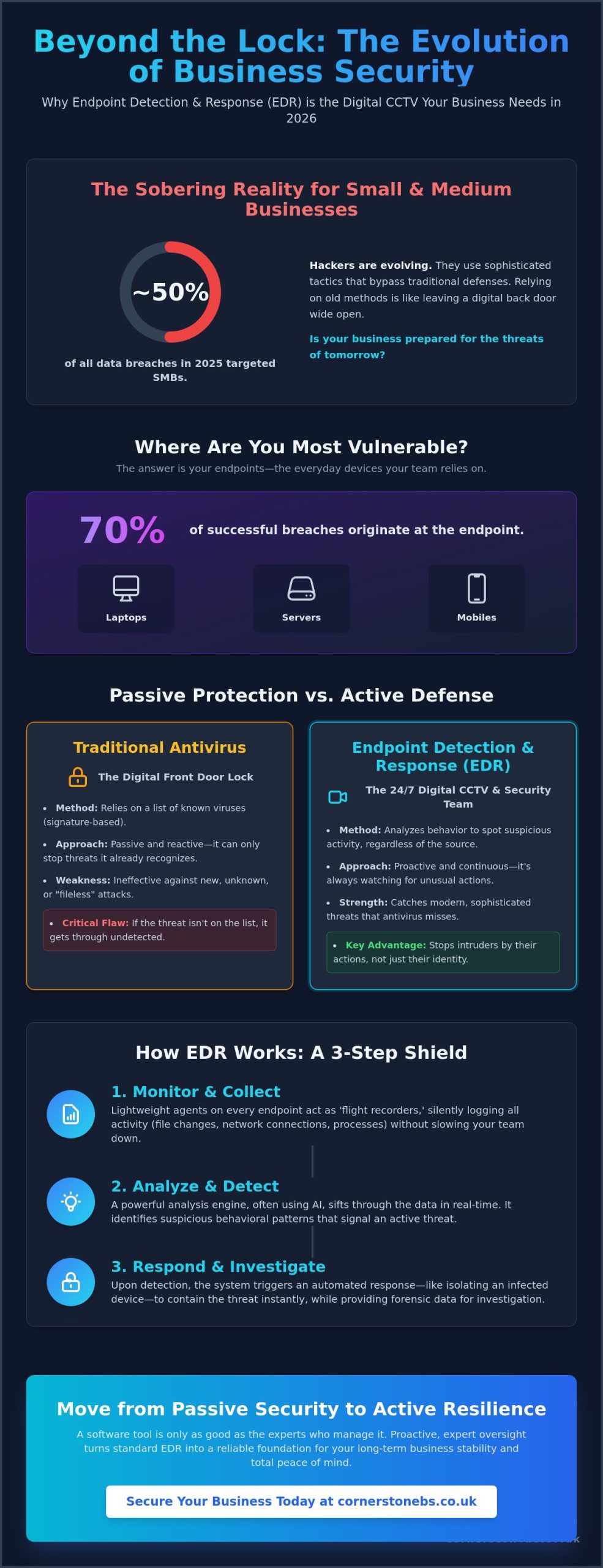
Did you know that in 2025, small and medium sized businesses accounted for nearly half of all data breaches? It is a sobering reality that traditional antivirus often misses the sophisticated tactics used by modern hackers. This is why implementing endpoint detection and response (EDR) for business has become a foundational element of stability rather than just a technical luxury. You likely feel overwhelmed by the constant stream of cybersecurity jargon and the persistent anxiety of a potential ransomware attack. It is exhausting for a small IT team to monitor every device around the clock while trying to run a successful local company.
We are here to simplify the complex and help you secure your digital infrastructure with confidence. Discover exactly how EDR acts as the digital CCTV your business needs to stop threats that traditional tools miss. We provide a clear framework for choosing the right level of protection and a step by step 2026 strategy to ensure your endpoints are monitored every single hour of the day. Let’s move from passive security to active business resilience together.
Key Takeaways
- Understand why laptops and servers are the primary targets for modern attacks and how to secure them effectively.
- Learn how endpoint detection and response (EDR) for business identifies strange behavior to catch threats that traditional antivirus tools often miss.
- Discover the difference between passive protection and active monitoring to ensure your security strategy matches the risks of 2026.
- Follow a practical framework for auditing your devices and choosing a platform that balances high level security with smooth system performance.
- Explore how proactive, expert oversight turns a standard software tool into a reliable foundation for your long term business stability.
What is Endpoint Detection and Response (EDR) for Business?
Think of your business network as a secure office building. While your traditional antivirus acts like a sturdy lock on the front door, endpoint detection and response (EDR) for business is the sophisticated CCTV system and internal security team that monitors every hallway. It is a security solution specifically designed to monitor end-user devices, such as laptops, mobiles, and servers, to detect and respond to cyber threats that have already managed to bypass initial defenses.
The reason we focus so heavily on these devices is simple: endpoints are the primary target for approximately 70% of successful breaches. Hackers know that your team members are busy and might occasionally click a suspicious link or use an unsecured network. In the 2026 threat landscape, relying solely on passive prevention is no longer enough. You need a system that acts like a flight data recorder, capturing every file change, process start, and network connection across your entire local infrastructure. This visibility allows us to see exactly what happened during an incident, providing the clarity you need to maintain business continuity.
The Evolution of Endpoint Security
Security has moved far beyond the days of simple blacklisting. In the past, antivirus software worked by recognizing a list of known “bad” files. If a virus wasn’t on that list, it got through. Modern cyber security services now prioritize behavioral analysis. Instead of looking for a specific file name, EDR looks for suspicious actions, like a spreadsheet suddenly trying to encrypt your entire hard drive.
Traditional antivirus is no longer a set and forget solution. As your dedicated regional partner, we understand that hackers evolve their tactics daily. Endpoint detection and response (EDR) represents a shift toward active detection, where the goal is to catch an intruder the moment they step foot inside your network, rather than waiting for them to trip a static alarm.
Key Components of an EDR System
To provide this level of protection, EDR relies on three foundational elements that work together seamlessly to keep your business safe:
- Data collection agents: These are the eyes and ears installed on every device. They record activity in real time without slowing down your team’s workflow.
- Analysis engine: This is the brain of the operation. It identifies patterns and anomalies that signal a breach might be in progress, often using AI to stay ahead of new threats.
- Forensic capabilities: If a threat is detected, these tools allow us to see the how and why. We can trace the path of an attack back to its source, ensuring we close the gap for good.
How EDR Works: From Silent Monitoring to Rapid Response
Your business needs a security system that never blinks. While standard tools wait for a match in a database, endpoint detection and response (EDR) for business works by maintaining a constant, silent watch over every digital interaction. It records everything. Every file change, process execution, and network connection is logged. This continuous monitoring creates a rich history of activity, which is vital for spotting the subtle breadcrumbs an intruder leaves behind.
This approach moves beyond simple virus signatures. It focuses on behavioral detection. By spotting “strange” activity, the system can flag a threat even if it has never been seen before. If a user’s workstation suddenly starts scanning your internal network for open ports, the EDR system recognizes this as a deviation from normal business operations. It acts as an automated first responder, often isolating an infected device before a human technician even sees the alert. This speed is critical for stopping a minor incident from becoming a full scale disaster.
Proactive threat hunting is another core feature of a modern setup. Instead of just waiting for an alarm, we can use the EDR data to look for vulnerabilities or hidden indicators of compromise that haven’t been triggered yet. It’s about staying one step ahead of the adversary to protect your local company’s reputation and data.
The Detection Phase: Spotting the Invisible
Cyber criminals often use lateral movement to navigate your network. They might compromise a single low-level laptop and then attempt to jump to your more sensitive servers. EDR identifies these suspicious leaps instantly. It also excels at catching fileless malware. These are sophisticated attacks that hide in a computer’s memory rather than on the hard drive, making them invisible to traditional scanners. Behavioral analysis is the study of software actions over time. By focusing on what a program does rather than what it is, we can protect your Cyber Security infrastructure from the most elusive threats.
The Response Phase: Neutralising the Threat
Detection is only half the battle; the real value lies in the rapid response. When a compromise is confirmed, the system can trigger network isolation. This instantly cuts off a compromised laptop from the rest of your network and the internet, preventing the spread of ransomware. Many modern EDR platforms also feature rollback capabilities. This allows us to revert a device to its healthy state before a ransomware infection took hold, saving hours of manual recovery time. Finally, the remediation process ensures every trace of the intruder is wiped clean, restoring total stability to your local operations.
EDR vs Antivirus vs MDR: Clearing the Confusion
Choosing between security layers shouldn’t feel like a guessing game. To understand the value of endpoint detection and response (EDR) for business, it helps to look at your office security as a series of levels. Antivirus is your front door lock. It keeps out anyone without a key. EDR is the security guard patrolling the hallways. Even if someone slips through the door, the guard spots the suspicious behavior. Managed Detection and Response (MDR) is the remote monitoring station where experts watch your cameras. Finally, Extended Detection and Response (XDR) connects the cameras in your office to your cloud storage and email, giving you a single, unified view of your entire network.
Each level serves a distinct purpose in protecting your business continuity. While antivirus stops the known threats we’ve seen before, EDR focuses on the unknown. It looks for patterns that don’t fit your normal daily operations. This proactive stance is what separates a modern, resilient company from one that is constantly reacting to crises. We want to help you build a foundation that feels stable and secure, no matter how the threat landscape changes.
Why Antivirus Alone is a High-Risk Strategy
Relying on antivirus alone is a high-risk strategy in 2026. Attackers now use zero-day exploits that bypass traditional filters because the software hasn’t learned to recognize them yet. They also use “living off the land” techniques, which involve using legitimate business tools to carry out malicious tasks. This makes the attack look like normal work to a basic scanner. Our it company solutions help you see how security fits into your wider digital infrastructure, ensuring no gaps are left open for intruders to exploit.
Choosing the Right Level for Your Business
Every local company has a unique risk profile. If you handle sensitive client data or financial records, a basic lock on the door isn’t enough. SMEs are now the primary target for automated cyber attacks. In 2025, small and medium sized businesses accounted for nearly half of all data breaches. You must decide between a “DIY” approach, where your own team manages the alerts, or a managed service. For most, the peace of mind that comes from expert oversight far outweighs the cost of trying to handle complex security in-house. We are here to help you find that perfect balance of protection and performance.
Implementing EDR: A Practical Guide for UK Businesses
Moving from understanding the theory to putting it into practice is where many local business owners feel the most pressure. We’ve designed this guide to ensure your implementation of endpoint detection and response (EDR) for business is smooth and effective. Success starts with a comprehensive audit. You cannot protect what you cannot see. This means cataloging every laptop, server, and mobile phone that touches your corporate data, whether it’s in the office or used remotely.
Once you have a clear map of your endpoints, select a platform that balances high level protection with your specific hardware capabilities. After selection, you must configure your policies to set clear rules of engagement. For instance, you might decide that any device showing signs of ransomware should be isolated automatically at any time of day. Don’t forget to train your team. When staff understand that a blocked action is a sign of the system working to keep them safe, they feel more secure rather than frustrated. Integrating these insights into your wider managed IT services strategy ensures your defenses evolve as fast as the threats do.
Overcoming Common Implementation Hurdles
Implementation often brings up two main worries: false positives and system slowdowns. We understand that you can’t have security getting in the way of your daily operations. A well configured system minimizes these interruptions by learning what “normal” looks like for your specific business over time. Regarding performance, you can rest easy knowing that modern EDR agents are designed to be incredibly lightweight. Most reputable solutions use less than 1% of a device’s CPU power. This means even your older office hardware can stay protected without a noticeable drop in speed.
Compliance and Regulatory Benefits
For UK businesses, the regulatory landscape is shifting toward demonstrable resilience. Implementing endpoint detection and response (EDR) for business is a significant step toward meeting the latest Cyber Essentials and Cyber Essentials Plus requirements. These tools provide the granular visibility needed to satisfy GDPR obligations, especially regarding the mandatory reporting of significant cyber events. Beyond legal requirements, having detailed endpoint logs is a huge advantage during professional insurance audits. It proves to underwriters that you are a low risk, proactive organization, which can help keep your premiums manageable. Talk to our friendly team to see how we can streamline your security transition and provide the peace of mind you deserve.
The Cornerstone Approach: Managed EDR for Total Peace of Mind
Even the most advanced software is only as effective as the person monitoring it. While endpoint detection and response (EDR) for business provides the raw data, it’s the expert analysis that truly protects your livelihood. A software alert at 3 AM is useless if there’s no one there to interpret it. At Cornerstone Business Solutions, we combine industry leading technology with award winning support to ensure that every warning is met with a swift, professional response. We act as your dedicated internal security team, catching threats while you sleep so you can wake up to a business that’s ready to grow.
Our approach is built on seamless integration. If you already use Microsoft 365, our EDR solutions fit perfectly into your existing environment. This reduces friction and ensures that your security doesn’t come at the cost of productivity. We are proud of our national reach, but we never forget our community focused roots. You get the professional authority of a top tier provider delivered with the friendly, approachable face of a local partner who genuinely cares about your success.
Your Long-Term Cyber Security Partner
We believe in a collaborative partnership rather than a transactional service. Our goal is to simplify the complex technical world of endpoint detection and response (EDR) for business so you can focus on what you do best: running your company. Cornerstone Business Solutions doesn’t just sell you a license; we provide a foundational element of your business stability. By moving from reactive support to proactive monitoring, we help you build emotional security alongside digital safety. It’s about knowing your systems are reliable and your data is protected by people who know your name.
Ready to Secure Your Business Future?
The journey to total resilience begins with a clear understanding of your current status. We recommend a comprehensive security audit of your endpoints as the first step toward modernizing your defense. This audit identifies where you’re strong and where you’re vulnerable, allowing us to tailor a strategy specifically for your needs. Whether you are currently planning a Microsoft 365 migration or simply want to upgrade your existing protection, we are here to help. Let’s have a friendly chat about your security needs today.
Securing Your Business Growth with Confidence
As a multi-award-winning IT provider and proud partner of Microsoft, IBM, and Cisco, we bring global expertise to our local community. Our UK-based proactive support team is ready to help you navigate these technical shifts with clarity and ease. We believe that security should feel like a partnership, not just a service. If you are ready to take the next step toward total peace of mind, book a free cybersecurity health check with our expert team today. Let’s work together to make your business more resilient and secure for the future.
Frequently Asked Questions
What is the difference between EDR and traditional antivirus?
Traditional antivirus relies on a database of known threats to stop attacks, whereas EDR monitors the behavior of your devices in real time. It doesn’t just look for “bad” files; it looks for “bad” actions. This allows it to catch sophisticated, unknown threats that haven’t been recorded in a standard antivirus database yet. It’s the difference between a simple lock on your door and a security guard watching your hallways.
Will EDR slow down my employees’ computers or laptops?
You won’t notice a drop in performance because modern EDR agents are designed to be incredibly lightweight. They typically use less than 1% of a computer’s processing power. This ensures your team stays productive and focused on their daily tasks while the security software works silently in the background to keep your local company safe from digital intruders.
Does my small business really need EDR, or is it just for big corporations?
Small businesses are actually the primary target for many automated attacks because hackers assume their defenses are weaker. Implementing endpoint detection and response (EDR) for business is now a foundational requirement for any local organization handling sensitive data. It provides the high level of protection once reserved for global enterprises at a scale that fits your specific business needs.
Can EDR protect my staff while they are working remotely or from home?
Yes, EDR is perfectly suited for the modern hybrid workforce. Since the protection is installed directly on the laptop or mobile device, it stays active no matter where your staff connects to the internet. Whether your team is in the office or working from home, they receive the same proactive monitoring and rapid response capabilities to keep your corporate data secure.
How much does EDR cost for a typical UK business?
The investment for EDR depends on the number of endpoints you need to secure and whether you choose a self managed or fully managed service. Most local business owners find that the cost is a small price to pay for the emotional security and business continuity it provides. It’s a strategic investment that helps you avoid the massive financial and reputational costs associated with a data breach.
Is EDR a requirement for Cyber Essentials certification?
While EDR isn’t strictly mandatory for the basic Cyber Essentials certificate, it is a powerful tool for meeting the stricter requirements of Cyber Essentials Plus. It helps you demonstrate the active monitoring and incident response capabilities that the scheme expects. Having these logs available also makes the audit process much smoother for your team and provides evidence of your commitment to resilience.
What happens if EDR detects a threat on one of our devices?
The system acts instantly by following pre-set rules, which often includes isolating the compromised device from the rest of your network. This stops a threat like ransomware from spreading to other computers or your main server. At the same time, an alert is sent to our experts so we can investigate the root cause and clean up any traces left behind by the intruder.
Do I need a dedicated IT team to manage an EDR system?
You don’t need to hire your own cybersecurity experts if you choose a managed approach. We handle all the complex monitoring, alert filtering, and threat hunting for you. This allows you to focus on running your business with total peace of mind, knowing that your digital infrastructure is being watched over by a team of friendly, local specialists.
Posted on: June 3rd, 2026 by Cornerstone
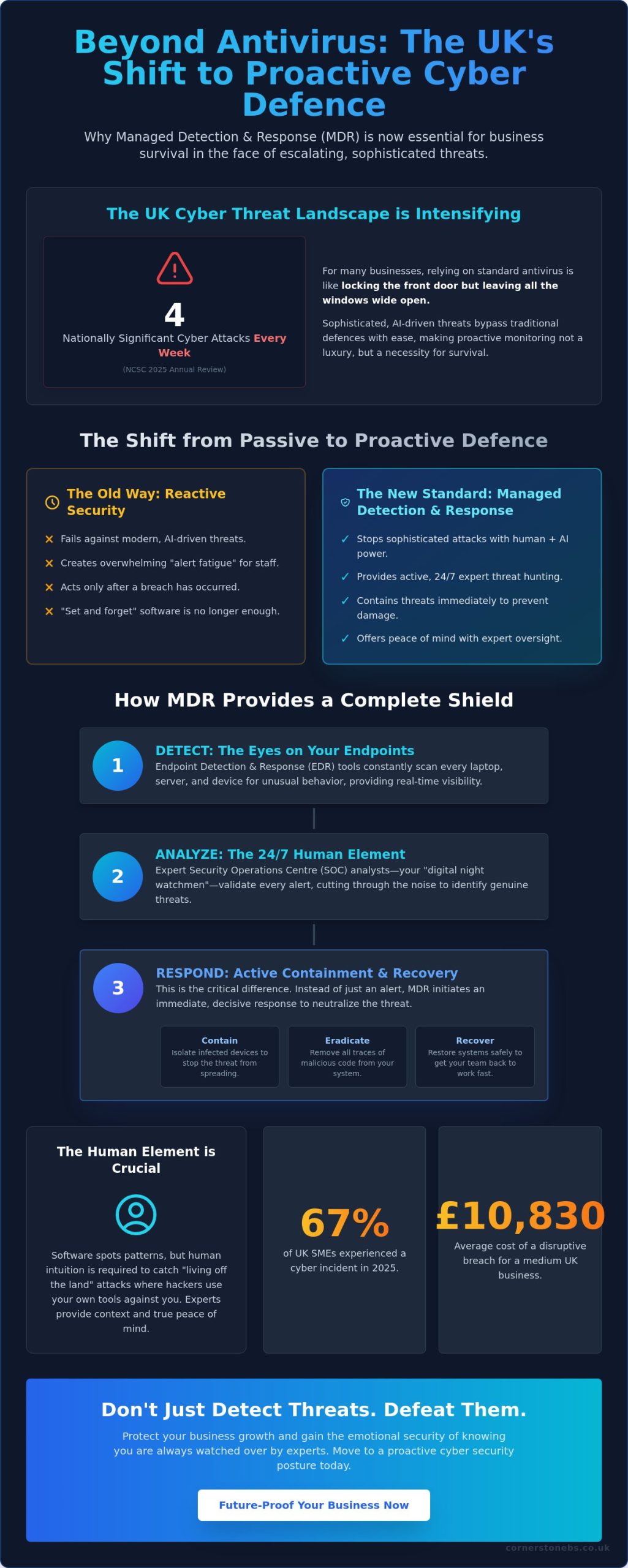
Did you know the National Cyber Security Centre confirmed in its 2025 Annual Review that the UK now faces four nationally significant cyber attacks every week? For many local business leaders, this startling reality makes standard antivirus feel like a locked front door with the windows left wide open. It’s exactly why more organizations are shifting their focus toward managed detection and response (MDR) services UK to bridge the gap between simple detection and actual survival.
We understand the pressure you’re under. You’re likely tired of the overwhelming volume of security alerts and the constant fear that a ransomware attack might go undetected until it’s too late. You want to know your data is safe without needing to build a massive in-house team from scratch. This guide will show you how to achieve 24/7 peace of mind through proactive monitoring and expert-led response. We’ll break down the 2026 regulatory environment, including the new Cyber Security and Resilience Bill and the latest Cyber Essentials updates, so you can focus on running your business while we keep the threats at bay.
Key Takeaways
- Move beyond static defenses by pairing advanced technology with human oversight to stop sophisticated, AI-driven threats before they take hold.
- See how managed detection and response (MDR) services UK provide active containment and recovery rather than just sending overwhelming security alerts.
- Identify the critical benchmarks for choosing a UK security partner, including the necessity of local expertise and vendor-agnostic support.
- Learn why behavioral analysis is the new gold standard for spotting breaches that traditional signature-based security often misses.
- Discover how a proactive security partnership protects your growth and provides the emotional security of knowing your business is always watched.
Why Managed Detection and Response (MDR) is Essential for UK Businesses in 2026
In 2026, the digital perimeter of your business isn’t a static wall; it’s a moving target. Cyber criminals now use automated social engineering and AI-driven ransomware to find gaps in your security in seconds. This is why Managed detection and response (MDR) has become the baseline for modern protection. It isn’t just a piece of software you install and ignore. Instead, it’s a sophisticated blend of high-speed technology and 24/7 human expertise. For local firms, choosing managed detection and response (MDR) services UK means moving past simple alerts and toward active, real-time protection that actually stops an intruder in their tracks.
We know that the upcoming Cyber Security and Resilience Bill is weighing on the minds of many directors. You aren’t just worried about losing data; you’re worried about the legal fallout and the hit to your hard-earned reputation. Noticing a threat is no longer enough to stay compliant or safe. If your system flags a breach at 2 AM on a Sunday, but no one is there to kill the process, the damage is already done. True MDR bridges that gap by providing a response that is immediate and decisive.
The Shift from Passive to Proactive Defence
Traditional “set and forget” security models failed many in 2025. Statistics show that 67% of UK SMEs experienced a cyber incident that year, proving that basic firewalls are no longer a total solution. We focus heavily on Mean Time to Detect (MTTD). In the UK SME sector, reducing the time an intruder spends in your network is vital for survival. Active threat hunting is now a standard requirement for business continuity. It involves searching your network for signs of a “silent” intruder before they ever trigger a standard alarm. This proactive stance ensures that your Managed IT Support isn’t just fixing what’s broken, but actively preventing the break from happening.
The Human Element: Why Software Alone is Not Enough
Software creates noise. Your staff are likely already buried under a mountain of digital notifications. This “alert fatigue” is dangerous because it leads to critical warnings being ignored or buried. Our Security Operations Centre (SOC) analysts act as your digital night watchmen, providing the backbone for effective managed detection and response (MDR) services UK. They validate every alert so you don’t have to. While AI is great at spotting patterns, human intuition is required to catch “living off the land” attacks. These are breaches where hackers use your own legitimate admin tools against you. No algorithm can match the gut feeling of an expert who knows when a routine task looks suspicious. It’s about providing the emotional security that comes from knowing a real person is watching over your business.
The Core Components: How MDR Services Protect Your Digital Infrastructure
MDR isn’t just a dashboard; it’s a comprehensive shield for your digital assets. Think of Endpoint Detection and Response (EDR) as the “eyes” of the system. These tools constantly scan every laptop, server, and mobile device for unusual behavior. This real-time data feeds into a broader strategy where 24/7 monitoring acts as a digital night watchman. According to the UK Government Cyber Security Breaches Survey, the average cost of a disruptive breach for medium UK businesses reached £10,830 in 2024. That’s a financial and operational hit no leader wants to face.
The “Response” in managed detection and response (MDR) services UK is where the real value lies for a busy professional. It isn’t just about sounding an alarm. It’s about active containment, where we isolate infected devices to stop a threat from spreading. Then comes eradication, removing the malicious code entirely, followed by recovery to get your team back to work. This seamless flow is especially vital when protecting cloud solutions like Microsoft 365, where a single compromised account could expose your entire organization in minutes.
24/7/365 Security Operations Centre (SOC)
Cybercriminals don’t clock off at 5 PM on a Friday. Your security shouldn’t either. A SOC is a dedicated hub of security professionals who monitor your systems around the clock. Their primary job is triage. They expertly separate the “noise” of harmless system updates from genuine, malicious attacks. This ensures that when we reach out to you, it’s because there’s a real issue that needs attention, not a false alarm. It’s about providing the clarity you need to make informed decisions without the technical jargon.
Advanced Threat Hunting and Intelligence
We use global threat intelligence to protect our local partners. By analyzing data from attacks happening across the world, we can spot “indicators of compromise” before they even trigger a standard alert. This proactive hunting creates a solid foundation for growth. It ensures your operations remain stable while you focus on scaling your business. If you’re concerned about your current vulnerabilities, exploring our Cyber Security options is a great place to start a conversation about your long-term stability.
MDR vs. Traditional Security: Why Standard Antivirus is No Longer Enough
“We have a firewall and antivirus, so we’re fine.” It’s a phrase we hear often from busy business owners. While these tools were once enough, the 2026 threat landscape has moved on. A firewall is like a sturdy fence around your property. It’s great for keeping out casual intruders, but it won’t stop a professional who knows how to climb over or walk through with a stolen key. This is where managed detection and response (MDR) services UK provide the active oversight that basic software simply can’t match.
Traditional antivirus relies on signature-based detection. It’s essentially looking for a “mugshot” of a known virus. If the threat is new or has changed its appearance, the antivirus won’t recognize it. As Gartner defines MDR, the service focuses on detecting and responding to threats that have already bypassed these initial defenses. We use behavioral analysis to watch what a program *does* rather than what it looks like. If an application suddenly starts encrypting files or communicating with an unknown server in the middle of the night, we stop it immediately.
Another critical factor is the “Detection Gap.” This is the time a hacker spends inside your system before being noticed. Without proactive monitoring, an intruder can spend weeks quietly stealing data or preparing a ransomware attack. MDR shrinks this gap to minutes. By the time a traditional system might have flagged an error, an MDR team has already contained the threat and started the remediation process.
Antivirus vs. EDR vs. MDR
It’s helpful to clear up the jargon. Antivirus is a tool, and EDR (Endpoint Detection and Response) is the data that tool generates. However, data is useless if no one is looking at it. MDR is the service that provides the “brain” to act on the information EDR collects. Antivirus stops known threats, while MDR finds the unknown ones hiding in the shadows. It’s the difference between having a smoke alarm and having a fire crew already on-site when the first spark flies.
The Real Cost of a Cyber Breach in 2026
The financial impact of a breach goes far beyond a single ransom payment. You have to consider the fines from regulatory bodies, the total loss of productivity while systems are down, and the long-term reputational damage. In fact, many UK insurance providers now mandate MDR-level security before they’ll even consider offering cyber coverage. It’s no longer a luxury; it’s a requirement for staying insured and operational. For more on building a resilient business, take a look at our guide on cyber security services. Investing in prevention is always more cost-effective than paying for a cure that might come too late.
Evaluating MDR Providers: A Framework for UK Business Leaders
Selecting a partner for managed detection and response (MDR) services UK is a significant step toward securing your business’s future. It’s a choice that moves you from a transactional relationship to a long-term partnership. You need a team that doesn’t just sit behind a screen in a different time zone. Instead, look for UK-based support that understands the specific regulatory and economic pressures your organization faces. A local presence ensures that communication is clear and that your partner is truly invested in your regional success.
One of the first things to clarify is whether a provider is vendor-agnostic or vendor-specific. Vendor-specific providers often require you to use their preferred software stack. This can lead to hidden costs if you’re forced to replace systems that already work for you. Vendor-agnostic partners are more flexible. They integrate with your existing setup, providing oversight without demanding a total infrastructure overhaul. You should also ensure they offer full incident response. Some providers only “detect” and notify you of a breach, leaving the hard work of fixing it to your busy staff. A true partner contains the threat and handles the eradication themselves.
Key Questions to Ask Your Potential Partner
Don’t be afraid to dig into the details during your evaluation. Start with these three critical questions to separate the experts from the pretenders:
- “What is your guaranteed response time for a critical incident?”
- “How do you handle false positives to avoid disrupting my staff’s daily work?”
- “Can you demonstrate clear compliance with NIS2 or Cyber Essentials Plus requirements?”
Understanding Service Level Agreements (SLAs)
Not all SLAs are created equal. You must distinguish between “notification SLAs” and “remediation SLAs.” A notification SLA only guarantees that they will tell you about an attack within a certain timeframe. A remediation SLA is far more valuable; it outlines how quickly they will actually start stopping the threat. Transparency is the bedrock of this relationship. You should expect regular security posture reporting and executive briefings that translate technical data into business logic. This collaborative approach ensures you always know exactly how your investment is protecting your growth. If you’re ready to strengthen your defenses with a team that speaks your language, reach out to us to discuss our Cyber Security solutions.
Future-Proofing Your Business with Cornerstone Business Solutions’ Managed Cyber Security
At Cornerstone Business Solutions, we don’t believe in one-size-fits-all security. As a multi-award-winning provider, we’ve built our reputation on understanding the unique pulse of UK SMEs. We know that for you, managed detection and response (MDR) services UK isn’t just about code; it’s about protecting the livelihood of your team and the trust of your clients. By integrating our advanced security measures directly into your Managed IT Support, we create a unified defense that works silently in the background. This ensures your business continuity is never a matter of luck.
We focus on the emotional security of business owners just as much as the technical data. You deserve to sleep soundly knowing that a dedicated, local partner is watching over your systems. We move away from transactional relationships. Instead, we act as a long-term ally that grows alongside you. Our proactive stance means we’re constantly looking for ways to strengthen your posture before a threat even appears on the horizon. It’s about providing a foundation of stability that allows you to focus on your next big move.
A Seamless Extension of Your Team
Our approach is simple: we find the problems so you don’t have to. Cornerstone Business Solutions acts as a seamless extension of your existing staff, removing the burden of security management from your shoulders. To do this, we leverage powerful partnerships with global leaders like Microsoft, IBM, and Cisco. We take this high-level technology and make it simple, reliable, and relevant to your specific needs. You don’t need to understand the complex mechanics behind every alert because our experts are already handling it. We translate the technical jargon into clear, benefit-driven insights that help you lead with confidence.
Your Next Steps to Total Security
Getting started shouldn’t feel like a mountain to climb. Our onboarding process is designed to be efficient and transparent. It begins with a comprehensive audit of your current digital infrastructure to identify any immediate gaps. From there, we move into implementation, tailored to your specific operational flow. Once the systems are live, our 24/7 watch begins. It’s vital to remember that security is a journey, not a destination. As threats evolve, our strategies adapt to keep you ahead of the curve. We invite you to a low-pressure, informal chat about your current security roadmap and how we can help you secure your future. Book a conversation with our security experts today and let’s start building a more resilient business together.
Secure Your Business Growth with Expert Oversight
The 2026 threat landscape demands more than just a locked door; it requires a watchful eye that never blinks. We’ve explored how moving from passive tools to active threat hunting dramatically reduces the time an intruder can spend in your network. By choosing managed detection and response (MDR) services UK, you ensure that your organization isn’t just noticing problems, but actively stopping them in real-time. This level of professional protection provides the emotional security you need to lead your business with confidence while staying compliant with the latest UK regulations.
As a multi-award-winning IT provider, we combine our regional roots with global technical strength through partnerships with leaders like Microsoft, IBM, and Cisco. Our 24/7/365 proactive monitoring ensures your digital infrastructure remains a foundation for growth rather than a source of stress. We’re here to be your long-term partner in resilience, simplifying complex security into reliable results. Let’s have an informal conversation about securing your business and building a roadmap that keeps you safe. We’re ready to help you protect what you’ve worked so hard to build.
Frequently Asked Questions
What is the difference between MDR and an MSSP?
An MSSP typically manages your security infrastructure, such as firewalls, and sends alerts when something looks wrong. MDR goes a step further by focusing on active threat hunting and immediate response. While an MSSP tells you there’s a problem, an MDR service takes the lead in fixing it. This proactive approach ensures that threats are neutralized before they can cause lasting damage to your operations.
Does my small business really need MDR services?
How does MDR help with UK GDPR and NIS2 compliance?
MDR provides the continuous monitoring and rapid incident response required to meet “state of the art” security standards under UK GDPR. For organizations navigating the new NIS2 requirements or the UK’s Cyber Security and Resilience Bill, MDR offers the documented evidence of security controls you need. It demonstrates that you’re taking proactive steps to protect sensitive data and maintain essential services.
What happens if the MDR service detects a ransomware attack at 3 AM?
The system automatically isolates the affected device the moment a threat is detected to prevent ransomware from spreading through your network. Our analysts then step in to validate the alert and begin the eradication process immediately. You won’t wake up to a locked network and a ransom demand. Instead, you’ll receive a report explaining how the threat was neutralized while you slept.
Can MDR replace my existing internal IT team?
MDR doesn’t replace your internal IT staff; it empowers them to focus on what they do best. Most internal teams are busy with daily operations and strategic projects rather than 24/7 security monitoring. We handle the specialized threat hunting and the constant stream of alerts. This partnership allows your team to focus on the core activities that drive your business success.
How long does it take to implement an MDR service?
Most businesses can be fully protected within a few weeks. The process starts with a thorough audit of your digital infrastructure and the deployment of lightweight sensors across your network. Once we establish an initial baseline of your normal operations, our 24/7 monitoring begins. We work closely with you to ensure the rollout is smooth and doesn’t disrupt your daily business activities.
What is the typical cost structure for MDR services in the UK?
The cost structure for managed detection and response (MDR) services UK is typically based on a predictable monthly subscription. This is usually calculated per endpoint or per user, making it a manageable operational expense rather than a large capital investment. This model allows you to scale your security protection up or down as your business needs change over time.
Will MDR slow down my employees’ computers or network?
Modern MDR agents are designed to be extremely lightweight and have a negligible impact on system performance. They operate quietly in the background, using minimal memory and processing power. Your employees can continue their work without noticing any slowdowns in their computer speed or network connectivity. We prioritize both your security and your team’s productivity.