The most useful benefits of IT automation for small business may come from fixing one everyday bottleneck, not adding more technology. Staff can lose time copying information, repeating routine checks and following manual steps. Automating a suitable task can free them to focus on work that needs their judgement and help routine operations run more consistently.
It’s sensible to be cautious. Automation can cause problems if it’s applied to a broken process or introduced without clear safeguards. Errors, security risks and disruption all matter, so the goal isn’t to automate everything. Look for a repetitive, rule-based task where the likely benefit justifies the effort, and keep people accountable for the outcome.
This guide covers practical tasks to consider, the benefits and limitations of automation, and safeguards for reliable operations. It also explains how to choose a manageable starting point and assess the results. Understanding your existing IT environment, alongside reliable managed IT support, can help you plan changes with confidence.
Key Takeaways
- Explore the benefits of IT automation for small business, including how standardised tasks can free staff time and reduce avoidable inconsistencies.
- Assess opportunities by how often a task occurs, how much time it takes, how consistent the process is and what could happen if it fails.
- Start with a stable, well-understood workflow rather than a critical process full of exceptions.
- Use a structured rollout: map the process, set a baseline, plan safeguards, pilot the change, then review and refine it.
- Understand existing systems and workflows, including through a site survey, before planning technology changes.
What IT Automation Means for a Small Business
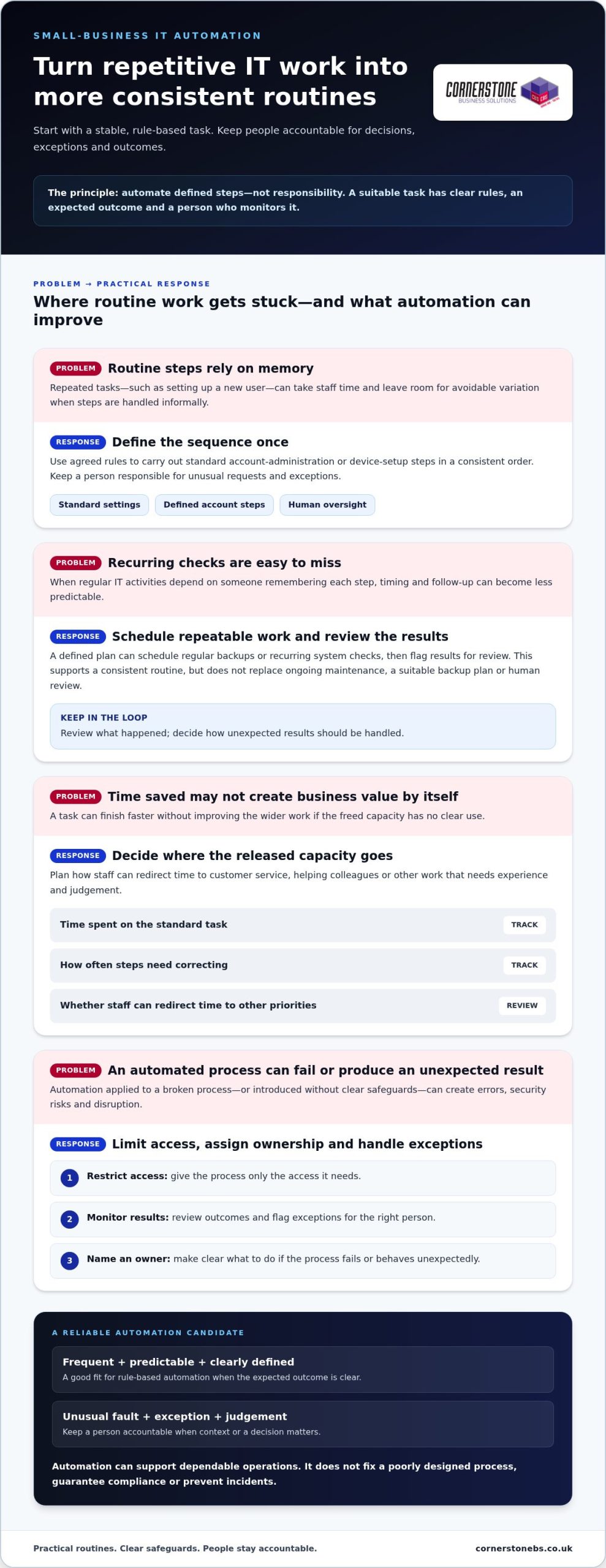
In a small business, the same IT tasks can arise every day: setting up access, checking systems or arranging routine maintenance. Each may seem quick, but together they take time away from customer service and other priorities. The benefits of IT automation for small business begin with a practical question: can a repeatable task be handled more consistently while staff remain responsible for work that needs their judgement?
IT automation uses software to carry out repeatable tasks according to agreed rules. A defined trigger starts a set of steps, and the process produces an expected outcome. For example, a routine request could start a standard sequence of account-administration steps. The key is to specify the process in advance, rather than improvise it each time.
This differs from broader business process automation (BPA). BPA can cover workflows across an organisation, such as handling an invoice or coordinating a customer follow-up. IT automation focuses on technology operations and support tasks. The two can overlap, but they aren’t interchangeable. What is Business Process Automation? offers a wider introduction to how BPA applies across business activities.
Which IT tasks can automation handle?
Good candidates are frequent, predictable tasks with clear steps and outcomes. Common possibilities in small-business IT environments include:
- Applying standard settings during routine device setup.
- Completing defined steps in account administration.
- Scheduling regular backups according to an agreed plan.
- Running recurring system checks and flagging results for review.
By contrast, investigating an unusual fault or deciding whether to grant an exception calls for context and judgement. Automation can handle routine steps around a task, but a person should remain accountable when decisions or exceptions matter.
How does IT automation differ from AI?
In either case, technology handles defined activities, not responsibility. People set the rules, monitor outcomes, manage exceptions and decide whether a process is working as intended. Keeping that distinction clear helps automation support dependable operations without replacing informed decisions.
The Main Benefits of IT Automation for Small Business
The value of automation isn’t simply that a task finishes faster. It can make routine IT work more consistent, free staff to focus on customers and make recurring processes easier to track. These benefits of IT automation for small business depend on choosing a suitable task and keeping people involved in oversight. Automation can support good operations, but it won’t fix a poorly designed process on its own.
Productivity, consistency and staff capacity
Consider repeatable user setup. If each new starter requires the same agreed steps, a defined process can help staff complete them in a consistent order instead of relying on memory or an informal checklist. This may reduce time spent repeating routine actions and lower the chance of avoidable variation. It doesn’t mean every setup will take the same time or that every exception can be handled automatically.
Freed capacity creates value when the team can put it to use. Staff might spend more time helping colleagues, responding to customers or handling work that requires experience. Before introducing automation, decide who will benefit from the time released and how. Otherwise, the task may be quicker without making a meaningful difference to the business.
“The value of automation is measured by what it improves in the task, not by a promised saving.” For user setup, track how long the standard process takes, how often steps need correcting and whether staff can redirect time to other priorities. These measures give you a more useful view than a general claim about productivity.
Reliability, security and business continuity
Regular IT activities are easier to plan when their steps and timing are clear. A scheduled check, for instance, can establish a consistent routine and make it easier to review what happened. Standardisation may also reduce reliance on individual memory, particularly when responsibilities are shared. This can support operational continuity, but it doesn’t replace a suitable backup plan, ongoing maintenance or human review.
Safeguards matter. Give an automated process access only to what it needs, monitor its results and decide how exceptions should be flagged or handled. Assign an owner and make clear what action to take if the process fails or produces an unexpected result. Automation can support security procedures, but it doesn’t guarantee compliance or prevent incidents.
For a small business, useful gains are often practical: clearer routines, less repetitive effort and more predictable handling of defined tasks. Results depend on the process, the oversight it receives and whether the team can use any capacity released. If you’re reviewing how your IT arrangements support those goals, managed IT support can help provide a foundation for maintaining business technology.
What Should a Small Business Automate First?
The best first candidate usually isn’t the most impressive technology project. It’s a recurring task that takes noticeable effort, follows stable steps and has a manageable impact if something goes wrong. This gives a small business a practical way to explore the benefits of IT automation for small business without starting with a complex, business-critical process.
A practical way to rank automation opportunities
Compare potential tasks using four questions: How often does the work happen? How much staff time does it take? Does it follow consistent rules? What could happen if it failed or handled an exception incorrectly? Give each task a simple low, medium or high rating for these factors, then discuss the strongest candidates with the people who do the work.
Check that the process has a clear owner and documented steps. Sensitive information, complex exceptions or serious operational consequences are reasons to pause for closer review, not necessarily reasons to rule a task out. Start with a stable, well-understood workflow. Avoid automating a process that is still changing or depends on frequent judgement calls.
| Task |
Potential benefit |
Oversight required |
Suitable first step |
| Routing routine IT support requests |
More consistent initial sorting |
Review misrouted or unusual requests |
Agree categories and an escalation route |
| Reporting backup completion status |
A regular view of completed or flagged runs |
Investigate failures and exceptions |
Document who reviews the report and what action follows |
| Removing access when a staff member leaves |
A repeatable offboarding sequence |
Confirm approvals and check access changes |
Map the current process before considering automation |
These examples are prompts for evaluation, not a recommendation to automate every task shown. The right choice depends on your systems, process and tolerance for risk. A lower-impact activity with clear rules may be a better starting point than a task that appears to save more effort but could interrupt essential operations.
Where human oversight still matters
Keep people accountable for approvals, unusual requests and security-sensitive decisions. Define who receives exceptions, how quickly they should review them and when the process must stop for intervention. Automation can assist a team, but it can’t take responsibility for business outcomes or replace the expertise needed to assess unfamiliar situations.
Reviewing existing workflows can help make these choices more grounded. Managed IT support can help businesses understand and maintain their technology as they assess potential changes.
How to Introduce IT Automation Without Unnecessary Disruption
A measured rollout helps you find out whether automation is useful before it becomes part of everyday operations. Start with a defined workflow, document how it works now and keep a person accountable throughout the test. This makes it easier to spot unintended effects early and adjust the plan before extending it.
Plan and test a small automation pilot
Before testing, record who owns the process, which permissions it needs, what outcome is expected and how exceptions will be handled. Then work through these steps in order:
- Map the process. Write down the existing steps, decision points, people involved and common exceptions. Clarify where the process starts and what counts as successful completion.
- Set a baseline. Record how long the task takes, how much staff effort it requires and how often errors or rework occur. Use a representative period to make the comparison fair.
- Plan safeguards. Limit permissions to what the task needs, decide who can review outcomes and set out how staff should escalate exceptions. Identify a manual alternative in case the pilot needs to stop.
- Run a pilot. Test one suitable workflow with a limited scope. Tell the staff involved what will change, what to look out for and who to contact if the process behaves unexpectedly.
- Review and refine. Compare results with the baseline and discuss them with the process owner. Resolve issues and adjust the rules before deciding whether to extend the approach.
Measure outcomes and manage the risks
Choose measures that reflect the task’s purpose. Completion time, staff effort, error frequency and rework can show whether the process has improved. A faster result isn’t automatically better if it creates more corrections or makes exceptions harder to handle. Consider feedback from the people doing the work alongside the recorded results.
Keep permissions, data handling, process ownership and available logs under review as the workflow changes. Make sure staff know what requires intervention, such as an unexpected result, a failed step or a request outside the agreed rules. A documented rollback or manual alternative can help the business continue the task while an issue is investigated.
Ongoing IT oversight helps keep a workflow aligned with the systems and processes around it. A managed IT services guide can help explain how wider support fits into business technology planning. For a practical conversation about your IT environment and possible next steps, speak with Cornerstone Business Solutions.
How the Right IT Support Can Help Automation Deliver Value
Automation depends on the systems, access and workflows already in place. Before deciding what to automate, a business needs a clear picture of how its technology fits together and where routine work happens. Managed IT support can help provide that foundation through support for planning, maintaining and reviewing business technology. It doesn’t mean every task needs automation. It helps make the decision more informed.
Start with the systems and processes you already have
Begin by recording recurring IT tasks, the systems involved, who owns each process and where information or approvals pass between people. This can reveal dependencies that aren’t obvious from a task list alone. For example, a routine process may rely on a particular workstation, server or network connection. Understanding those relationships helps teams consider potential disruption before making a change.
Cornerstone Business Solutions’ experienced sales engineers conduct site surveys assessing network cabling, workstations, servers, switches and internet devices. Reviewing these elements can help build a picture of the existing infrastructure, including interdependencies and equipment redundancy. That context can inform technology planning, but the process itself still needs to be assessed before choosing what to automate.
If a potential workflow depends on hosted systems or storage, understanding the wider environment matters too. The business cloud solutions guide provides related context on cloud technology, while the IT company solutions guide explores broader business IT considerations.
Make the next step practical and collaborative
Bring one recurring task to an initial discussion. Describe what starts it, the steps staff take, where delays or confusion occur and what can go wrong. Include the systems involved and the person responsible for the outcome. A specific example gives everyone a shared starting point for considering whether the process is stable, suitable and worth reviewing.
Cornerstone partners with Microsoft, IBM and Cisco and provides managed IT support to organisations across the UK. Its IT support and service is award-winning. Managed IT support can help organisations plan and maintain business technology as they assess how routine work is handled.
The benefits of IT automation for small business matter most when they fit the organisation’s systems and working practices. Discussing one task with an IT partner can help you consider its dependencies, safeguards and next steps together. Talk with Cornerstone Business Solutions about your business IT needs.
Make Your Next IT Improvement Count
Automation works best as part of an ongoing approach to improving how your organisation operates. As systems, responsibilities and priorities change, review whether automated processes still reflect how your team works. A useful workflow today may need different rules later. Regular review helps prevent a once-helpful process from becoming an overlooked source of friction.
The benefits of IT automation for small business aren’t measured by how much technology is introduced. They come from choosing changes that support your people and fit your operational needs. Give your team room to learn from each improvement and build on what works at a manageable pace.
Cornerstone Business Solutions takes a collaborative approach to business technology, helping organisations consider their IT needs in the context of wider operations. If you’re ready to explore a practical next step, discuss your business IT needs with Cornerstone. A considered conversation can help you move forward with clarity and confidence.
Frequently Asked Questions
What are the main benefits of IT automation for a small business?
The main benefits of IT automation for small business can include less time spent on repetitive tasks, more consistent handling of routine work and greater staff capacity for other responsibilities. For example, a clear process can make recurring tasks easier to track and hand over between colleagues. The results depend on the task and how well it’s managed. Compare effort and outcomes before and after a change rather than assuming it has saved time.
Which IT tasks can a small business automate?
Suitable candidates can include repeatable device setup, account administration, scheduled backups and routine system checks. A useful test is whether different staff members can follow the same steps and reach a predictable result. For instance, a standard device setup may be easier to assess than an unusual access request involving sensitive information. Consider the systems involved, who owns the task and how staff will handle cases that don’t follow the usual pattern.
Is IT automation suitable for a small business?
Yes, a small business can explore automation by focusing on one limited task rather than launching a large programme. Choose work that occurs regularly, is understood by the people doing it and has manageable exceptions. A small pilot lets the team learn how the change fits its normal working practices. Set the scope according to the organisation’s ability to supervise the process, respond to problems and maintain it as business needs change.
Can IT automation improve cyber security?
Automation may help staff carry out routine security-related steps consistently, but it can’t guarantee stronger security, compliance or protection from incidents. For example, a process that changes account access needs carefully controlled permissions and a clear approval route. Assign an owner to review activity and handle unexpected cases. Keep security-sensitive decisions accountable to people who understand the context, and review the process if systems, access needs or working practices change.
How should a small business get started with IT automation?
Start by selecting one recurring task and describing how staff complete it today. Note who owns the process, where delays or rework occur and what a successful result looks like. Before testing a change, decide who can access the systems involved and what staff should do if the process reaches an unusual case. After the pilot, discuss the result with the people involved and decide whether to adjust, continue or stop it.
Does IT automation replace employees?
No. IT automation handles defined steps; people remain responsible for priorities, approvals and outcomes. If a routine process flags an unusual request, a staff member can assess the context and decide what happens next. The time or capacity created doesn’t have to lead to a fixed staffing change. The business can decide how to use it, such as improving responses to internal requests or focusing on work that needs experience and judgement.
What are the risks of automating IT processes?
Risks include applying outdated rules, granting broader access than a task needs or failing to account for exceptions. A process that worked before a system or workflow changed may no longer produce the intended result. Reduce exposure by assigning an owner, testing realistic scenarios and keeping a manual way to complete the task if automation has to pause. Review permissions and results periodically, and after relevant changes to systems or responsibilities.
How can a business tell whether IT automation is working?
Compare the pilot with a baseline recorded before the change. Depending on the task, track completion time, staff effort, errors, rework or how often someone needs to intervene. Ask the staff using the process whether it has made their work clearer or created new steps. A positive result should improve the chosen task without adding unacceptable effort or risk. If the measures worsen or exceptions become harder to resolve, refine or reconsider the process.
If your team is still spending Monday mornings manually syncing spreadsheets, you aren’t just losing time; you’re paying a “hidden tax” on your business growth. With the global business process automation market projected to reach $22.3 billion in 2026, the competitive gap is widening between efficient firms and those bogged down by administrative tasks. Leveraging Power Automate for business process automation allows you to turn those wasted hours into a strategic advantage by using the tools you already own.
We understand the frustration of seeing talented staff stuck in a loop of manual data entry and approval delays. It’s a common hurdle that drains morale and invites human error into your systems. This strategy guide reveals how to eliminate those repetitive tasks and scale your operations using the Microsoft 365 ecosystem you already trust. As your local partner in IT stability, we’ll walk you through the 2026 roadmap for creating a “hands-off” workflow. You’ll discover how the latest AI agent authoring and self-healing flows can reduce your operational costs while giving you total visibility over your data.
- Learn how to unify your Microsoft 365 apps and third-party tools into a single, cohesive engine for maximum efficiency.
- Understand the difference between API-driven Digital Process Automation and bot-led Robotic Process Automation to choose the right fit for your specific workflows.
- Identify high-impact opportunities for automation, such as instant approval chains and seamless employee onboarding, that immediately reduce manual workloads.
- Master the audit and governance steps required to build a secure roadmap that prevents unmanaged flows and protects your business data.
- Discover why professional monitoring is the secret to scaling Power Automate for business process automation across your entire digital infrastructure.
Power Automate is the digital heartbeat of a modern, efficient office. It’s a low-code platform sitting within the Microsoft Power Platform ecosystem, designed to bridge the gap between your favorite applications. Think of it as the connective tissue that allows Outlook, SharePoint, Excel, and even third-party tools like Slack or Trello to talk to one another. By using Microsoft Power Automate, you can move data across these systems without manual intervention, effectively ending the era of “digital drudgery.”
For many of the local businesses we partner with, the most reassuring fact is that this technology is likely already sitting in your toolkit. Power Automate is included with most Microsoft 365 business licenses, including Business Basic, Business Standard, and Enterprise E3 or E5 plans. You don’t need a massive new investment to start. You just need a strategy to unlock the power you’re already paying for. By shifting from manual entry to proactive, automated workflows, your team can finally focus on the high-value work that actually drives growth.
The Three Pillars: Cloud Flows, Desktop Flows, and Business Process Flows
To master Power Automate for business process automation, you need to understand the three ways it moves your data. Each pillar serves a distinct purpose in your digital infrastructure:
- Cloud Flows: These are the most common automations. They trigger based on specific events in the cloud, such as a new email arriving or a file being updated in SharePoint.
- Desktop Flows: This is where Robotic Process Automation (RPA) comes into play. It’s perfect for older, legacy software that doesn’t have modern connection points. It records and mimics human clicks to handle repetitive tasks on your PC.
- Business Process Flows: These act as a guided roadmap for your staff. They ensure every team member follows the exact same steps in a sequence, like a standardized checklist for a new client intake.
Why 2026 is the Year of the “Automated SME”
The landscape of 2026 has made automation a survival requirement rather than a luxury. The global business process automation market is projected to reach $22.3 billion this year, driven largely by the accessibility of AI. With the integration of Microsoft Copilot and new AI agent authoring tools, building a complex workflow no longer requires a computer science degree. You can now describe the process you want, and the system helps build it for you.
In the UK, rising operational costs and the need for rapid service delivery have made manual processes a liability. Small and medium-sized enterprises are using automation to maintain their competitive edge. It’s about speed and reliability. When you automate a process, it runs the same way every time, 24 hours a day, without the risk of human error. This stability is the foundation of a scalable business.
When you begin your journey with Business Process Automation (BPA), you’ll quickly encounter two distinct paths: DPA and RPA. Understanding the difference is vital for your long term stability. One is a direct conversation between modern cloud systems; the other is a digital bot mimicking human actions on a screen. Most of our local partners find that choosing the right tool for the specific task prevents technical debt and keeps their operations running smoothly.
Using Power Automate for business process automation allows you to mix these two methods. However, we typically recommend a “cloud-first” strategy. By prioritizing modern connections, you build a foundation that is faster, more secure, and significantly easier to maintain as your business grows. If you aren’t sure where your current systems sit, seeking expert IT guidance can help you map out the most cost effective starting point.
When to Use Digital Process Automation (DPA)
Digital Process Automation is the gold standard for modern offices. It relies on APIs to share data behind the scenes. This is the “modern” way to work. It’s the best choice for any task involving Microsoft 365 native apps like Teams, SharePoint, or Excel. DPA is incredibly reliable because it doesn’t rely on what the software looks like on your monitor. If a software provider updates their interface and moves a button, your DPA flow won’t break. It continues to talk to the database directly, ensuring your workflows remain uninterrupted and your maintenance costs stay low.
When Robotic Process Automation (RPA) is Essential
There are times when the modern approach isn’t an option. Robotic Process Automation is your “legacy” bridge. It’s essential for older accounting software, bespoke industry applications, or local government portals that simply don’t have modern connection points. In these cases, Power Automate for business process automation uses “Desktop Flows” to record human actions. The bot will open the app, click the specific fields, and type in the data just like a staff member would.
RPA is particularly useful in two scenarios:
- High-volume data entry: When you have thousands of records to move into an old system that hasn’t changed in a decade.
- Transition periods: RPA acts as a perfect temporary fix during a Microsoft 365 migration. It allows you to keep your old on-premises software functional while you build out your new cloud infrastructure.
By using a hybrid approach, you get the best of both worlds. You can use the reliability of DPA for your daily communications while letting RPA handle the heavy lifting in your older, specialized software. This ensures no part of your business is left behind as you modernize.
Moving from theory to practice is where the real excitement begins. We often see local business owners light up when they realise how much “busy work” can simply vanish. Implementing Power Automate for business process automation isn’t just about high-level tech; it is about fixing the small, daily frictions that slow your team down. By connecting the apps you use every day, you create a seamless flow of information that requires zero manual intervention.
Here are five ways we see businesses transforming their daily operations right now:
- Automated Approval Workflows: Stop chasing managers for signatures. You can set up a flow that automatically pings a supervisor via Teams or email when an expense claim or contract is uploaded. They click “Approve,” and the system moves the file to the next stage instantly.
- Seamless Employee Onboarding: When you hire someone new, a single entry in a SharePoint list can trigger the creation of their user account, order their IT hardware, and send a welcome pack to their inbox.
- Real-Time Data Synchronisation: Forget manual CSV exports. You can keep your contact lists perfectly synced across Outlook, Excel, and your marketing tools so your data is always accurate and ready to use.
- Proactive Status Alerts: Stay ahead of deadlines. Set up a flow to notify your team in a specific Teams channel whenever a high-priority file is modified or a project milestone is approaching.
Streamlining Finance and Invoicing
The finance department often carries the heaviest burden of manual data entry. Power Automate changes this by using intelligent tools to read and process documents. You can set up a system that extracts data from PDF invoices and pushes it directly into your accounting software. AI Builder is an add-on that turns images into structured data. This technology significantly reduces “month-end” stress by automating bank reconciliation alerts and ensuring every penny is accounted for without a staff member needing to type a single number.
Enhancing Team Collaboration
Modern teamwork relies on information being in the right place at the right time. By integrating various cloud solutions into your daily communication, you remove the silos that cause confusion. You can automate “Daily Stand-up” prompts in Microsoft Teams to keep projects on track without hosting another meeting. More importantly, you can ensure all project documents are filed correctly in SharePoint. This happens automatically behind the scenes, so your digital workspace stays organised without any human effort. It makes your business more agile and much easier to manage.
Success with Power Automate for business process automation isn’t about how many flows you can build in a week. It’s about building the right ones securely. We always advise our local partners to start with a thorough audit phase. Look for the “low-hanging fruit.” These are the repetitive, rule-based tasks that consume the most staff hours. By identifying these high-volume bottlenecks first, you ensure your initial automation efforts deliver the fastest return on investment.
Security must be your foundation. You wouldn’t leave your office unlocked, and your digital workflows should be no different. A common mistake is allowing automation to bypass Multi-Factor Authentication (MFA) or existing data permissions. Your automated systems should respect the same security boundaries as your human staff. Once a flow is live, don’t just “set and forget” it. Regular testing and iteration ensure your processes remain efficient as your business evolves.
The Risk of Unmanaged Automation
While the “low-code” nature of Microsoft tools is a massive benefit, it also creates the risk of “Shadow IT.” This happens when employees create their own unmanaged flows without any professional oversight. A poorly designed automation could accidentally share sensitive client data with an external email address or a public folder. To prevent this, you need robust Data Loss Prevention (DLP) policies within your environment. These policies act as digital guardrails, stopping sensitive information from leaving your secure perimeter. Maintaining these high standards is a core part of our cyber security services, ensuring your innovation never compromises your safety.
Creating a “Center of Excellence”
Scaling your automation requires a structured approach. A Center of Excellence is a framework for governing low-code development across your entire organization. It establishes clear rules for who can create, trigger, and modify business-critical flows. This isn’t about slowing things down; it’s about providing a safe environment where your team can innovate. Proper documentation is a vital part of this framework. It ensures that the technical knowledge behind your workflows stays within the company, even if a key staff member moves on. If you’re ready to build a more resilient office, we invite you to start your automation audit with our team of experts today.
Building a workflow is just the start of the journey. To truly scale, you need a system that adapts as your business grows. As your it company solutions change and your team expands, your automated flows must keep pace. Managed IT support provides the continuous monitoring required to catch errors before they impact your customers. When you use Power Automate for business process automation, having an expert eye on your dashboard ensures that every trigger and action remains aligned with your live data.
Scaling means more than just adding more flows. It means ensuring those flows are resilient. We integrate automation into your broader business continuity and disaster recovery strategy. If a cloud service experiences downtime, your managed partner ensures your business processes have a failover or a manual backup ready to go. This proactive approach transforms technical support from a necessity into a strategic advantage. We identify new opportunities for efficiency that you might miss while focusing on your day-to-day operations.
Cornerstone: Your Partner in Proactive Technology
Our team brings multi-award-winning expertise to your Microsoft 365 environment. We’ve moved beyond the traditional “break-fix” model. Instead, we focus on strategic business process optimisation that aligns with your specific goals. By ensuring your automation is backed by robust network infrastructure and expert support, we provide the peace of mind you need to innovate. We pride ourselves on being a local partner that understands the unique challenges of UK businesses. Our goal is to make complex technology feel simple, reliable, and deeply connected to your success.
Getting Started with a Process Audit
The journey toward a “hands-off” workflow begins with a simple, honest conversation. We help businesses across the region identify the manual bottlenecks that are currently draining their resources and morale. Transitioning to an automated future doesn’t have to be overwhelming when you have a trusted expert by your side. We provide the clarity and technical strength needed to modernise your operations without the stress of doing it alone.
We invite you to contact our expert team today for a bespoke technology review. Let’s explore how Power Automate for business process automation can give your team the time they need to focus on what they do best. We are ready to help you build a more efficient, secure, and scalable future for your business.
The shift toward a more efficient office isn’t just about software; it’s about giving your team the freedom to do their best work. You’ve seen how choosing between DPA and RPA can bridge the gap between your legacy systems and the modern cloud. By establishing a secure roadmap with proper data governance, you protect your business while you innovate. Leveraging Power Automate for business process automation allows you to turn these technical tools into a reliable engine for growth.
As a multi-award-winning IT provider and Microsoft Certified Partner, we don’t just set up your flows and walk away. Our managed plans include 24/7 proactive monitoring to ensure your systems remain stable and secure around the clock. We are here to be your long-term partner in technology, helping you navigate the complexities of 2026 with confidence and clarity.
Book a free business process audit with our award-winning team to identify your manual bottlenecks. We’ll help you build a tailored strategy that fits your unique local roots and ambitious growth plans. Let’s start a conversation about making your business more efficient today.
Is Power Automate included in my Microsoft 365 business subscription?
Yes, most Microsoft 365 business subscriptions include a version of Power Automate. Plans like Business Standard or Enterprise E3 allow you to create standard cloud flows within the Microsoft ecosystem. However, advanced features like Robotic Process Automation (RPA) or connecting to certain premium third-party apps usually require a separate Premium or Process license. We can check your current licensing to see exactly what is available to you right now.
Do I need to be a coder to use Power Automate for business process automation?
You don’t need to be a developer to build effective workflows. Power Automate for business process automation uses a “low-code” interface with a visual, drag and drop designer. While complex logic might benefit from professional setup, most business owners can use pre-built templates to handle simple tasks like email notifications or file syncing. It’s designed to empower your team to solve their own daily bottlenecks without writing a single line of code.
Can Power Automate connect to non-Microsoft apps like Salesforce or Slack?
Power Automate connects to over 1,000 different applications, including popular non-Microsoft tools like Salesforce, Slack, and Trello. These connections happen through “connectors” that allow data to flow securely between disparate systems. While many of these are “Premium” and require additional licensing, they are essential for creating a truly unified digital workspace where your CRM and communication tools talk to each other automatically.
How secure is Power Automate for handling sensitive financial data?
Power Automate is built on the enterprise-grade security of the Microsoft Cloud. It inherits the same identity and access management protections you already use, such as Multi-Factor Authentication (MFA). To protect sensitive financial data, we implement Data Loss Prevention (DLP) policies. These guardrails prevent your staff from accidentally sharing internal data with external parties, ensuring your automation remains both efficient and compliant with UK data regulations.
What happens to my automated flows if the person who created them leaves the company?
Flows can stop working if they are tied to a specific individual’s user account who then leaves the company. This is a common pitfall that can disrupt your operations. This is why we recommend using “Service Accounts” or shared environments for business-critical workflows. By setting up your automation under a central company identity rather than a personal one, you ensure that your processes remain stable and accessible regardless of staff changes.
Is there a limit to how many flows I can run in a month?
Microsoft sets limits on the number of “requests” or runs allowed per user, but these are typically high enough for most small and medium-sized businesses. For example, a standard license might allow thousands of actions per day. If you find your business outgrowing these limits, we can help you move to a per-process license. This provides much higher capacity for the complex, high-volume operations that larger organisations require.
Can Power Automate work with my old on-premise servers?
You can absolutely connect Power Automate to your on-premises servers using an “On-premises Data Gateway.” This acts as a secure bridge between your local databases and the cloud. It allows you to automate tasks involving local SQL servers or file shares without moving all your data to the cloud at once. This is a perfect solution for businesses maintaining a hybrid IT environment while they modernise their infrastructure.
How long does it typically take to implement a basic approval workflow?
A basic approval workflow can often be designed and tested within a few hours. Simple tasks, like approving a holiday request or a small expense, use standard templates that require minimal customisation. More complex processes involving multiple departments or legacy software might take a few days of planning and testing. Our goal is always to get you up and running as quickly as possible while ensuring the system is robust and reliable.