

Treating enterprise infrastructure as a run-to-failure asset isn’t saving your business money; it’s quietly exposing your organisation to disruptive emergency outages and steep post-warranty support fees. Implementing a structured server lifecycle management strategy fundamentally changes that dynamic. It transforms critical hardware from an unpredictable downtime liability into a dependable, strategic driver of operational stability.
You already understand the frustration of balancing aging on-premises servers with hybrid cloud demands, relentless firmware updates, and spiralling manufacturer renewal contracts. When physical systems age without a plan, internal teams spend their energy firefighting unexpected failures instead of supporting business growth. It doesn’t have to be this way. Master every stage of server lifecycle management to eliminate unplanned downtime, cut operational overheads, and build a resilient IT infrastructure that supports your company for the long term.
In this guide, we outline a practical, phased roadmap spanning strategic procurement, proactive maintenance, and certified disposal, giving you the clarity needed to protect your uptime and secure predictable hardware refresh cycles.
Key Takeaways
- Discover how a structured server lifecycle management framework transforms aging infrastructure from an emergency downtime risk into a predictable strategic asset.
- Explore clear criteria to evaluate post-warranty OEM contracts against fresh hardware investments, helping you pinpoint the ideal time to refresh.
- Safeguard your organisation against regulatory penalties by aligning legacy decommissioning with UK GDPR, updated WEEE rules, and strict data sanitisation standards.
- Learn how partnering with dedicated Managed IT Support removes the daily burden of firmware updates and round-the-clock monitoring, keeping your business resilient.
What Is Server Lifecycle Management and Why Does It Matter?
At its core, server lifecycle management is the end-to-end framework governing physical hardware from initial procurement and provisioning right through to maintenance, retirement, and compliant disposal. While hyperscale tech giants maintain dedicated divisions for this, commercial organisations often treat on-premises racks as background equipment until a critical system faults. That reactive habit proves expensive. Unplanned downtime costs UK businesses thousands of pounds per hour in lost productivity, stranded transactions, and emergency recovery fees.
Proactive oversight changes the equation entirely. Instead of scrambling to replace blown power supplies or obsolete motherboards during a busy working week, you address hardware health systematically. Industry frameworks like Wikimedia’s Server Lifecycle Process demonstrate how treating physical infrastructure as a continuous, structured pipeline ensures dependable service continuity. Adopting a unified lifecycle plan keeps day-to-day operations smooth while turning erratic emergency repairs into predictable capital and operational expenditure.
The True Cost of Neglecting Legacy Server Hardware
Running server hardware past its reliable operating lifespan introduces compounding business liabilities that reach well beyond sluggish response times:
- Elevated Cyber Vulnerability: Aging server architecture often lacks modern silicon-level protections, while outdated baseboard management controllers and neglected firmware create unmonitored entry points for network intrusion.
- Costly Emergency Procurement: Sourcing obsolete replacement drives, memory modules, or legacy components during an active hardware failure triggers extortionate rush shipping charges and premium supplier surcharges.
- Hidden Productivity Drains: Bottlenecks in input/output operations force staff to endure slow-loading internal databases and frozen remote desktops, steadily eroding daily operational output.
Strategic Business Benefits of Structured Lifecycle Governance
Deliberate lifecycle governance delivers complete clarity over your IT estate. By mapping replacement schedules years in advance, leadership teams establish predictable IT budgeting rather than facing sudden, unbudgeted hardware capital outlays. This forward planning also ensures processing capacity, memory allocations, and storage tiers scale proactively with workload spikes and business growth.
Most importantly, continuous telemetry and scheduled health checks solidify operational resilience. Your critical business applications remain available, secure, and fully compliant without unexpected hardware surprises disrupting company momentum.
The 5 Critical Stages of the Server Management Lifecycle
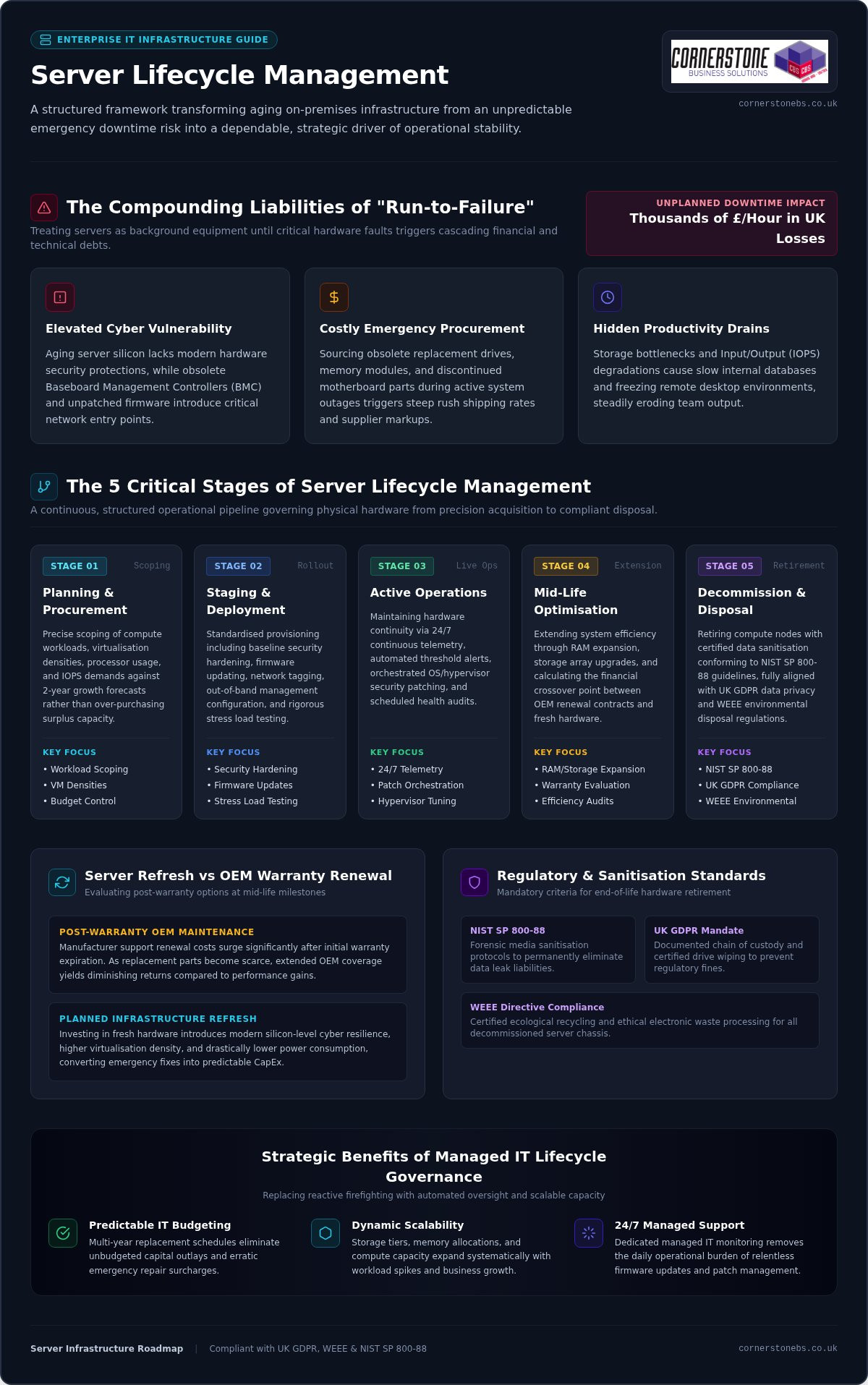
Successful infrastructure governance requires a repeatable framework that covers physical equipment from its initial arrival to its eventual retirement. When you manage servers methodically across five defined phases, you remove guesswork, stabilize performance, and protect your bottom line. Robust server lifecycle management relies on treating these stages as an interconnected operational pipeline:
- Stage 1: Planning and Procurement: Scoping exact compute workloads, virtualisation densities, and projected data growth rather than over-purchasing surplus capacity.
- Stage 2: Staging and Deployment: Conducting baseline security hardening, firmware updating, network tagging, and load testing prior to production handover.
- Stage 3: Active Operations: Maintaining ongoing telemetry, rapid alert dispatch, security patch orchestration, and hypervisor tuning.
- Stage 4: Mid-Life Optimisation: Expanding internal RAM and storage arrays while assessing warranty renewals against operating efficiency.
- Stage 5: Decommissioning and Disposal: Retiring compute nodes with forensic sanitisation that follows established NIST Guidelines for Media Sanitization to eliminate data leak risks.
Phase 1 to 2: Precision Procurement and Secure Provisioning
Before purchasing hardware, evaluate real processor usage, memory demands, and storage input/output per second (IOPS). Modern procurement must align directly with immediate application requirements and realistic two-year growth targets. Once equipment arrives, rigorous staging ensures reliable deployment. Engineers establish out-of-band management protocols, apply driver updates, and lock down physical ports. Integrating these initial configurations with comprehensive cyber security services guarantees your fresh hardware enters service fully defended against baseline exploits.
Phase 3 to 4: Active Maintenance and Mid-Life Optimization
Operating a production server demands proactive vigilance. Real-time telemetry continuously tracks thermal levels, fan speeds, drive parity, and memory single-bit error rates, catching failing components before they halt business operations. Staggered hypervisor and operating system updates close critical vulnerabilities without introducing operational disruption. Around year three or four, adding affordable solid-state arrays or expanding server memory can often extend reliable equipment life without requiring complete rack replacements.
Managing these interlocking stages takes dedicated engineering time and specialized tooling. If your internal team spends too much time chasing hardware alerts instead of driving core projects, it might be time to partner with an experienced IT specialist to handle your ongoing infrastructure oversight.
Server Refresh vs Third-Party Maintenance: How to Decide
Reaching the end of a manufacturer’s standard warranty creates an operational fork in the road. Original equipment manufacturers often push steep renewal fees or insist on total replacements, even when physical components remain in sound working order. Deciding whether to invest in fresh hardware, transition to a third-party maintenance (TPM) agreement, or shift suitable workloads into scalable cloud solutions requires a calculated business assessment. Effective server lifecycle management isn’t about replacing systems on an arbitrary calendar schedule; it’s about matching business risk against performance requirements and budgetary control.
Every server estate eventually develops natural dividing lines between legacy continuity and modernization:
When to Extend Server Life with Third-Party Support
Maintaining existing compute hardware past initial warranties makes sense under specific conditions:
- Secondary Workloads: Backup targets, local print servers, and internal test environments rarely demand bleeding-edge processing capabilities.
- Proprietary Legacy Systems: Older operational software or bespoke industrial tooling may rely on particular chipset configurations or legacy OS architectures that break on modern hypervisors.
- Direct Cost Control: Third-party maintenance contracts provide guaranteed parts replacement and response SLAs, shielding you from inflated post-warranty OEM service fees while preserving capital for other strategic projects.
Clear Indicators It Is Time for a Hardware Refresh
Extending physical assets has clear physical limits. If recurring diagnostic alerts log disk controller time-outs, intermittent power spikes, or motherboard memory parity faults, failure is no longer speculative. Continuing to run production systems on failing chassis puts business continuity in immediate danger.
Performance ceilings also dictate upgrades. Legacy architectures choke under modern multi-threaded applications, dense virtualization clusters, and high-throughput data tasks. Upgrading delivers denser compute cores, faster PCIe bus speeds, and significant electrical efficiency gains. Refreshing your hardware estate also becomes non-negotiable when hypervisor vendors and operating systems reach official end-of-support deadlines, cutting off essential security fixes and leaving your local network exposed.
Secure Decommissioning: UK Compliance, WEEE, and Data Sanitisation
Pulling an obsolete server from a rack isn’t the finish line of server lifecycle management. In many respects, it’s where your greatest legal and regulatory exposures begin. Decommissioning legacy hardware in the United Kingdom requires rigid adherence to UK GDPR and statutory environmental frameworks. Simply dragging a volume into the recycle bin or running a quick disk reformat leaves gigabytes of confidential customer information, commercial contracts, and internal credentials recoverable via entry-level forensic software.
Failing to document every stage of physical retirement invites devastating consequences. The Information Commissioner’s Office (ICO) levies severe financial penalties for unverified data leaks originating from discarded storage drives. An unbroken audit trail proves you exercised absolute due diligence.
Data Sanitisation Standards and Chain of Custody Protocols
Meeting regulatory requirements demands precise technical sanitisation matched to the media type:
- Cryptographic Erasure and Multi-Pass Overwrites: Useful for working solid-state and magnetic media intended for redeployment, zeroing storage blocks according to recognised sanitisation guidelines.
- Physical Degaussing and Mechanical Shredding: For magnetic platters reaching final retirement, industrial degaussing disrupts the magnetic domains entirely, followed by cross-cut physical shredding that reduces platters to scrap fragments.
- Tamper-Evident Certification: Your asset disposal partner must generate certificates of destruction detailing specific drive serial numbers, timestamps, and technician signatures.
Environmental Responsibility and Circular IT Economy
Proper retirement protects the planet as much as your liability profile. Enterprise server chassis contain toxic elements like lead, mercury, and flame retardants alongside recoverable rare-earth metals. Compliance with the UK Waste Electrical and Electronic Equipment (WEEE) regulations is legally mandated, making it an offence to discard server equipment into general landfill streams.
Adopting responsible circular IT practices allows businesses to recover latent asset value through ethical component harvesting and certified secondary-market remarketing. This structured approach directly supports your corporate environmental, social, and governance (ESG) targets while ensuring full regulatory compliance.
Navigating the legal intricacies of asset disposal shouldn’t drain your internal engineering time. If you want seamless, fully audited hardware disposal that protects your brand, contact our team of infrastructure specialists to manage your complete lifecycle transition safely.
How Managed IT Support Simplifies Server Lifecycle Management
Maintaining complex infrastructure in-house often pulls internal technical teams away from strategic business initiatives. Engineers find their days consumed by routine diagnostic alerts, emergency drive swaps, and complex firmware compatibility matrices. Partnering with a dedicated external provider fundamentally changes this balance. Professional Managed IT Support lifts the day-to-day administrative burden, giving your business access to veteran infrastructure specialists and advanced telemetry platforms without expanding your internal payroll.
A strategic partner designs tailored infrastructure roadmaps that seamlessly blend routine physical refreshes with broader modernisation plans. Exploring tailored IT company solutions ensures your servers maintain optimal performance, backed by clear engineering accountability at every stage of the hardware journey.
Proactive Monitoring, Patching, and Disaster Recovery
Modern server oversight relies on catching physical anomalies before they impact production workloads:
- Automated Telemetry: Enterprise diagnostics detect subtle voltage spikes, cooling inefficiencies, and memory threshold errors before components suffer catastrophic failure.
- Orchestrated Maintenance Windows: Hypervisors and virtual operating environments receive validated patches outside core operational hours, preventing costly disruption to customer-facing services.
- Integrated Business Protection: Server baseline states, network snapshots, and offsite replications link directly into robust Disaster Recovery plans, ensuring swift failover if physical hardware encounters an unrecoverable fault.
Choosing an Experienced Partner for Your Infrastructure Journey
Selecting the right technology provider requires looking closely at real-world capability. Focus on providers holding proven partnerships with industry leaders like Microsoft, IBM, and Cisco. These relationships confirm that support engineers possess direct access to proprietary diagnostic tools, authentic replacement parts, and advanced vendor escalation paths.
Demand transparent Service Level Agreements (SLAs) with clear incident response times and rapid dispatch protocols. An experienced managed provider treats server lifecycle management not as an isolated administrative chore, but as an essential pillar of your organisation’s long-term commercial resilience and peace of mind.
Transform Your Infrastructure into a Resilient Strategic Asset
Modernising your hardware strategy doesn’t mean facing unexpected capital spikes or endless fire drills. Taking full control of server lifecycle management turns unpredictable hardware failure into an orderly, transparent roadmap that protects your bottom line. By establishing clear refresh criteria, maintaining tight patch governance, and insisting on certified UK data sanitisation, your business achieves complete operational stability.
You don’t have to navigate complex hardware transitions alone. As a multi-award-winning IT service provider trusted across the UK, Cornerstone Business Solutions delivers proactive infrastructure monitoring that stops downtime before it starts. Backed by tier-one partnerships with industry titans Microsoft, IBM, and Cisco, our dedicated team handles every stage of your hardware estate so your internal staff can stay focused on core commercial goals.
Ready to build an agile, bulletproof server foundation? Speak with our server infrastructure team today to review your current estate and map out a dependable, cost-effective path forward.
Frequently Asked Questions
What is the typical lifespan of an enterprise server in a modern business environment?
Most enterprise servers operate reliably for four to six years in active production environments. While the physical chassis and fans might spin for up to a decade, declining component efficiency, thermal stress on silicon, and expiring manufacturer warranties make running them past six years a significant business continuity risk.
How does server lifecycle management differ from basic routine IT maintenance?
Routine IT maintenance focuses strictly on reactive tasks like clearing error logs, running virus scans, and swapping blown hard drives. Structured server lifecycle management is a broader strategic discipline. It governs every stage of hardware ownership, aligning long-term procurement, security baselining, telemetry-driven health tracking, and certified disposal directly with commercial growth targets.
Can server lifecycle management help our business achieve regulatory compliance?
Yes, robust lifecycle governance is essential for satisfying strict UK regulatory mandates like UK GDPR and the Data Protection Act. By establishing automated patching schedules, enforcing firmware integrity, and generating verifiable certificates of data destruction during decommissioning, your business maintains the auditable operational proof required by statutory bodies.
What happens when an enterprise server reaches its official End-of-Life (EOL) date?
When an OEM designates a server as End-of-Life, they discontinue critical firmware security updates, baseboard management patches, and guaranteed replacement parts availability. Operating past this milestone leaves your local network vulnerable to unpatched silicon-level exploits and exposes your business to extended downtime while engineers hunt for scarce secondary-market spare components.
Is it better to replace aging physical servers or migrate workloads to the cloud?
The right choice depends on your specific performance requirements, data sovereignty mandates, and capital budget. Many UK businesses adopt a hybrid model. Low-latency databases and legacy industrial applications often stay on modernised on-premises hardware, while standard office tooling, email, and mobile collaboration platforms migrate smoothly into hosted cloud environments.
How do businesses securely destroy sensitive company data during server decommissioning?
Secure data destruction requires strict adherence to recognised sanitisation standards like NIST 800-88 rather than simple drive formatting. IT teams use cryptographic wiping or multi-pass disk overwrites for drives intended for reuse. For final retirement, physical degaussing combined with cross-cut mechanical shredding ensures sensitive commercial records cannot be reconstructed.
What is dynamic capacity planning and how does it prevent unexpected IT bottlenecks?
Dynamic capacity planning uses live performance telemetry to model future processor usage, memory consumption, and disk storage trends based on historical workload patterns. By projecting these demands months in advance, leadership teams can scale compute resources or upgrade storage arrays proactively before system slowdowns disrupt customer services or staff workflows.
Tags: Decommissioning, Enterprise IT, hardware refresh, IT Asset Management, IT infrastructure, Server Lifecycle Management, Server Maintenance