

The fastest connection on paper may be the wrong choice for your business. To understand 5G for business UK benefits, look beyond headline speeds and ask whether it solves a specific connectivity problem at your locations. 5G could help mobile teams, connected equipment or sites where fixed broadband is unreliable, but coverage and performance vary.
Check whether the service will be available and dependable where your people work, and whether your devices and systems can use it. Ofcom’s May 2026 figures show overall 5G coverage outside premises ranging from 76% to 94% across individual UK mobile network operators. That national picture can’t confirm the signal inside your building or at a particular site, so local checks matter.
This guide explains where 5G can make a measurable difference, where Wi-Fi or a leased line may be a better fit, and what to check before testing or deploying it. It covers practical use cases, coverage, compatible devices and integration with your existing network, helping you compare options and decide whether 5G belongs in your wider business connectivity plan.
Key Takeaways
- 5G for business UK benefits depend on matching its capabilities to a real need, such as mobile working, temporary sites or backup connectivity.
- Compare 5G with 4G, business Wi-Fi and fixed broadband by considering where and how your teams need to connect.
- Check your locations, users, applications and devices before planning a trial.
- Measure performance against business requirements, not headline speeds, and review security and integration needs before rollout.
- Coordinate mobile connectivity with your network infrastructure and managed IT to support a more resilient technology environment.
What 5G for UK businesses means, and where its benefits begin
5G is the fifth generation of mobile network technology, designed to carry data between compatible devices and mobile networks. It can offer more capacity, responsive connections and flexible access than earlier mobile technology, but it doesn’t guarantee a particular speed or signal. The 5th generation of cellular network technology covers a range of capabilities. What a business experiences depends on its location, provider, device and network conditions.
That distinction matters. Ofcom’s May 2026 figures put overall 5G coverage outside premises between 76% and 94% across individual UK mobile network operators. Those figures don’t confirm the signal inside a particular office, warehouse or site. Building materials, local demand and distance from network infrastructure can all affect performance. The practical 5G for business UK benefits therefore start with a specific need, not a speed claim.
How 5G differs from 4G for business connectivity
5G NR, short for New Radio, is the radio technology used to connect 5G devices to the network. 4G LTE is its predecessor. Depending on coverage and network capacity, 5G may handle more simultaneous traffic or reduce delays in data transmission, which could help applications that need a responsive connection. Neither improvement is automatic. Your business needs 5G coverage where it operates and devices that support the relevant network technology.
Which UK business needs could benefit from 5G?
These are possibilities to assess, not guaranteed results. A temporary site may have a strong outdoor signal but weaker indoor reception. A device may support 5G yet still perform poorly if the local network is busy. Test the connection where it will be used, with the actual devices and applications your team relies on. This gives you a clearer basis for deciding whether 5G solves a genuine business problem or another connection is a better fit.
The main 5G business benefits: speed, flexibility and continuity
For a business, the value of 5G isn’t simply a faster download. A suitable connection may help staff access business systems away from a fixed office, give a temporary operation another way to get online, or support more devices sharing a network. These are potential 5G for business UK benefits, not guaranteed outcomes. Coverage, network demand and the way each application uses data all matter.
Speed and latency are different measures. Speed affects how quickly data can be downloaded or uploaded. Latency is the delay before data starts moving between a device and a service. Lower latency may help applications that need a quick response, while large file transfers are more directly affected by available bandwidth. Neither metric alone tells you whether a connection will improve a particular workflow. The UK government’s Realising the benefits of 5G report explores how applications and business needs shape the potential value.
Can 5G improve mobile working and customer operations?
Consider a field engineer who needs to check inventory, update a job record and contact colleagues while moving between customer locations. A reliable mobile connection could make those tasks easier without relying on office Wi-Fi. But 5G can’t fix slow software, an older device or a delay in the service hosting the application. Test the whole workflow, not just a speed-test result, and keep fixed connections where they remain the better fit.
Can 5G support business continuity and connected devices?
A mobile connection can provide another route online if a fixed service becomes unavailable, or help a business connect a site before fixed infrastructure is ready. To strengthen continuity, the equipment must be set up to switch connections appropriately, and the failover process needs testing. A backup that hasn’t been tried may not work as expected when staff need it.
Bringing connectivity together with business mobile and network infrastructure can help clarify how a mobile connection fits your wider technology environment. If you’re weighing up options, you can discuss your business connectivity needs with a team that supports organisations across the UK.
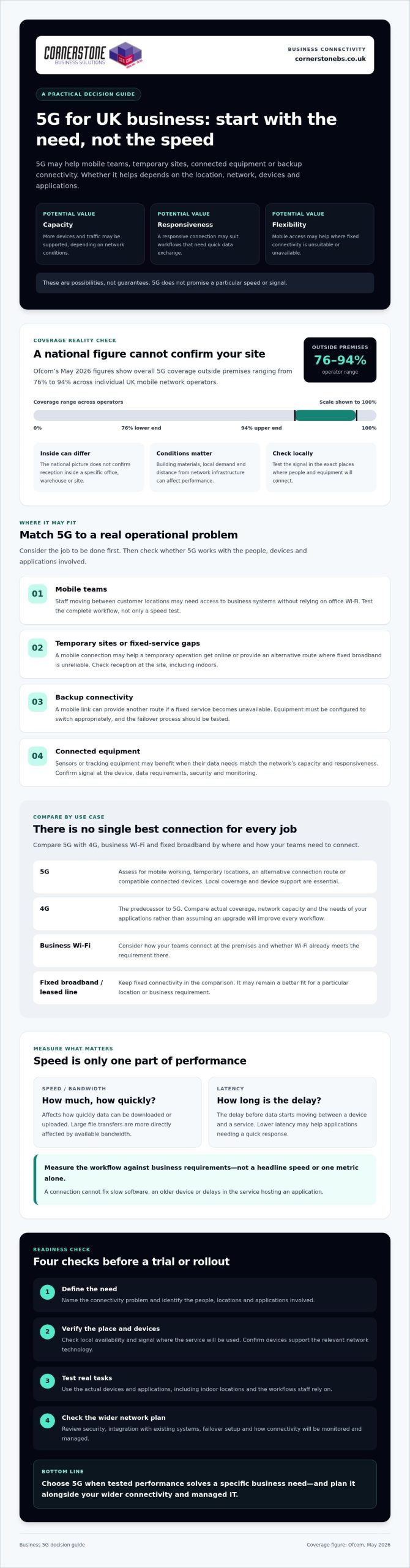
5G vs Wi-Fi, 4G and broadband: choose by business use case
The right connection depends on where your teams work, what they need to access and how much disruption your organisation can tolerate. 5G and 4G connect devices to mobile networks. Fixed broadband connects a premises to the internet, while business Wi-Fi shares that connection locally with devices around the workplace. In practice, Wi-Fi and a mobile or fixed internet connection often work together rather than compete.
Use this comparison to weigh the 5G for business UK benefits against the strengths of existing options:
| Option | Coverage and mobility | Setup and resilience role | Could suit |
|---|---|---|---|
| 5G | Mobile network coverage supports use beyond one premises, subject to signal. | Needs compatible equipment and usable local coverage. Could provide a primary or backup connection. | Mobile teams, temporary sites or locations where fixed broadband is unsuitable. |
| 4G | Mobile network access, with coverage and performance varying by location. | May work with existing compatible devices and equipment. Can be another connection option. | Mobile tasks that current 4G service already handles effectively. |
| Business Wi-Fi | Provides local wireless access within a configured premises. It doesn’t itself provide the external internet connection. | Requires suitable network equipment and coverage across the workplace. Can distribute a fixed or mobile connection. | Staff and devices connecting around an office or other site. |
| Fixed broadband | Connects a specific premises and isn’t designed for mobile use. | Requires a service and equipment at the location. May be the main connection, depending on availability and requirements. | Businesses needing internet access at a permanent site. |
These are general distinctions, not performance guarantees. The 5G business use cases resource outlines sector examples, but the best fit for your organisation still depends on its applications and locations.
When is 5G a better fit than fixed broadband or Wi-Fi?
5G may be worth testing for a team that works across sites, a temporary operation, or as a potential backup link. But mobile signal can weaken indoors, and walls, layout and equipment placement can affect reception. Compare measured performance at the actual site with what your systems need, including reliability and upload performance as well as download performance.
When are 4G or existing connections still the sensible choice?
If your current connection supports essential tasks reliably, switching may add complexity without solving a real problem. Check device compatibility, application requirements and the operational impact of changing connections before making a decision. For broader planning around hosted systems and business technology, explore this UK business cloud solutions guide.
How to assess 5G readiness across your UK business
Start with a business task, not a network upgrade. These steps can help you determine whether 5G meets a real need and how to judge the result.
- Define the need. Ask teams to record the locations, users, applications and devices that need connectivity. Identify what isn’t working today, such as unreliable access at a worksite or a lack of connectivity for mobile staff.
- Check coverage. Review current coverage information from relevant UK mobile providers for each location. Treat maps as a starting point, not proof of indoor service. Buildings, equipment and the exact position of users can affect reception.
- Test on site. Use the devices and applications staff would use in normal work. Check the connection in the rooms, work areas or outdoor locations where it needs to perform.
- Assess security and integration. Confirm how devices will be managed and how a mobile connection will fit your existing network and security controls.
- Review the evidence. Compare results with agreed business requirements. Decide whether 5G improves the task enough to justify a change, or whether your current connection remains the better fit.
This process turns the 5G for business UK benefits into a decision based on your sites and workloads, rather than assumptions about a network label.
What should a 5G business trial measure?
Choose measures that reflect the job: connection availability, response time, application performance or successful completion of a critical workflow. Test at representative locations and working times, then record user experience, connection failures and any disruption. A strong speed-test result alone may not show whether staff can reliably complete the tasks that matter.
How should businesses address security and integration?
Include device management, access controls, encryption and monitoring in the trial, following your existing security policies. Check how traffic will move between mobile connections, Wi-Fi, firewalls and business applications, and confirm who will review alerts or connection issues. For more on wider security planning, see the business cyber security services guide.
Once you have test results and a clear view of integration needs, discuss your business connectivity requirements with Cornerstone Business Solutions. Its business mobile, network infrastructure, cyber security and managed IT support can be considered as part of a joined-up technology plan.
Make 5G part of a managed business connectivity plan
5G is worth adopting when tests show it solves a defined business need, whether that means connecting a location, supporting mobile workers or adding another connection option. If trial results don’t meet your requirements, there’s no reason to switch simply because the technology is newer. A measured decision helps protect day-to-day operations and keeps connectivity aligned with how your organisation works.
Plan the connection alongside the rest of your technology. Consider how mobile connectivity will work with your fixed services, Wi-Fi, network infrastructure, devices and business-critical applications. Cornerstone Business Solutions provides business mobile, network infrastructure and managed IT support to organisations across the UK. Confirm specific 5G plan availability as part of any provider discussion.
What support can a business connectivity review provide?
A structured review can map existing connections, key applications, users and locations, then highlight where performance or continuity may need attention. Assess mobile, fixed and Wi-Fi options together to see how each connection supports the wider environment. For a broader look at ongoing operational support, read the managed IT services guide.
What are the next steps before adopting business 5G?
Write down the use case and success measures before speaking with a provider or technical adviser. Decide what acceptable performance means for the relevant applications and users. If coverage, device compatibility or real-world performance is uncertain, run a representative trial at the locations and times the connection will be needed. Record the results, including any effect on important workflows, then compare them with your existing options.
That evidence makes it easier to judge whether the 5G for business UK benefits are relevant to your organisation and how mobile connectivity should fit with network infrastructure and managed IT. To discuss your requirements with Cornerstone, talk with the team about your business connectivity needs.
Make your next connectivity decision with confidence
The 5G for business UK benefits come down to fit, not hype. A mobile connection may support workers across locations, temporary operations or a backup plan, but its value depends on tested performance where your teams actually need it. Coverage, compatible devices, security and integration all belong in the decision.
Compare 5G with 4G, Wi-Fi and fixed broadband against your business requirements. If your existing setup already supports essential work, there may be no need to change. If a trial shows that 5G solves a clear problem, plan how it will work alongside your network infrastructure and wider IT environment.
Cornerstone Business Solutions supports organisations across the UK with business mobile and network infrastructure, alongside managed IT support. Its relationships with technology partners including Microsoft, IBM and Cisco can inform a broader conversation about how connectivity fits your systems. To discuss your requirements and next steps, speak with Cornerstone about your business connectivity needs. A clear, measured plan can help your organisation choose the connection that works for it.
Frequently Asked Questions
What are the main benefits of 5G for UK businesses?
5G can offer mobile connectivity with potential advantages in capacity, responsiveness and flexibility. It may help staff connect while working across locations, support temporary sites or provide an alternative connection where fixed broadband is unsuitable. Connected devices may also benefit if their needs match local network performance. The 5G for business UK benefits depend on coverage, network demand, compatible equipment and the applications being used, so test against a specific business need.
Is 5G available everywhere in the UK?
No, 5G coverage isn’t available everywhere, and signal strength varies by provider and location. Ofcom’s May 2026 figures show overall 5G coverage outside premises ranging from 76% to 94% across individual UK mobile network operators. These national figures don’t confirm indoor reception at a particular workplace. Check provider coverage information for each site, then test the connection where employees and devices will actually use it.
Can 5G replace broadband for a business?
Sometimes, but 5G isn’t a universal replacement for fixed broadband. It may suit a temporary site, a location without a suitable fixed connection or a business whose tested mobile service meets its needs. Fixed broadband may be preferable for a permanent workplace with specific reliability or service requirements. Compare real performance, resilience needs, device compatibility and how many users and applications depend on the connection before deciding.
Is 5G faster than 4G for business use?
5G can deliver faster data transfer than 4G in suitable conditions, but it isn’t guaranteed to be faster at every site or at all times. Performance depends on coverage, network demand, device capability and the connection being used. A 5G connection may also offer lower latency, which means less delay in data response, but that’s different from download speed. Test the applications your staff rely on rather than judging by headline speeds alone.
Is 5G secure enough for business use?
5G can be used for business, but the connection alone doesn’t secure devices, accounts or data. Apply your organisation’s security policies, including device management, access controls, encryption and monitoring. Consider how mobile traffic connects to business applications and the wider network, and ensure staff understand how to use devices safely. A security review can help identify whether your existing protections cover the equipment and workflows involved in a 5G deployment.
Does a business need new devices to use 5G?
Yes, the devices connecting to the mobile network need to support 5G. This may include phones, routers or other equipment, depending on how the business plans to use the connection. Check device specifications and confirm that the provider’s service and SIM arrangements are compatible. Older 4G devices can continue to use 4G where it’s available, but they won’t access 5G simply because a site has coverage.
How can a business check whether 5G will work at its premises?
Start by checking coverage information from relevant mobile providers for the exact business address. Treat coverage maps as a guide, not a guarantee of indoor service. Test using the intended 5G device and business applications in the areas where staff will work, including at representative times. Record connection availability, application performance and any dropouts, then compare the results with your operational requirements before making a change.