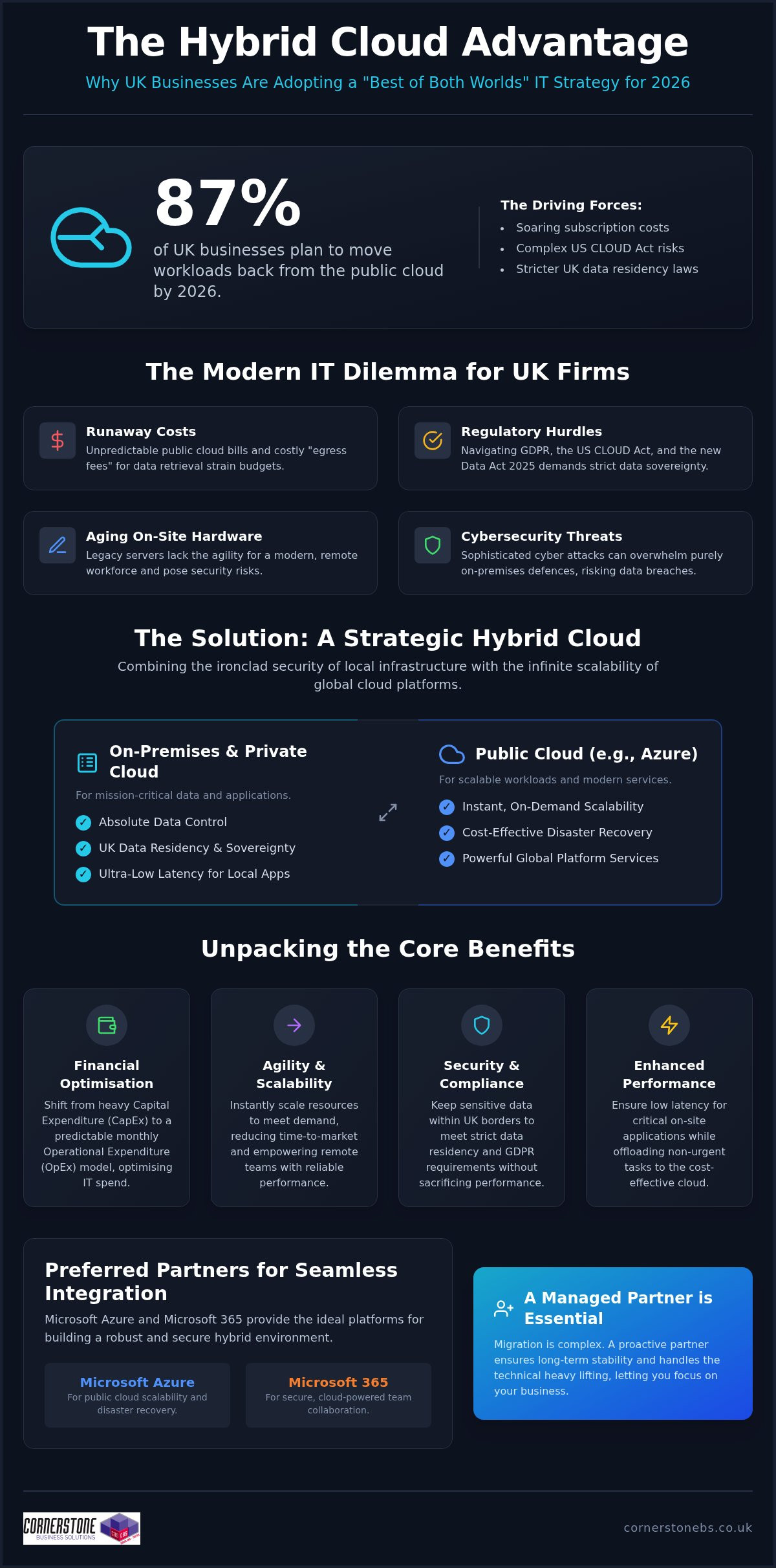
Did you know that 87% of UK businesses are planning to move at least some of their workloads back from the public cloud by the end of 2026? While the “all-in” cloud promise once seemed like the only way forward, many local firms now face soaring subscription costs and the complex jurisdictional risks of the US CLOUD Act. Understanding the hybrid cloud benefits for UK business is no longer just a technical choice. It’s a vital strategy to ensure your infrastructure remains agile and compliant in a rapidly shifting regulatory landscape.
We know how stressful it is to manage aging on-site hardware while trying to navigate the new Data (Use and Access) Act 2025. You need a system that supports your remote team without leaving your sensitive data exposed. This guide reveals how a bespoke hybrid model provides the emotional security of knowing your data is residency-compliant while slashing your capital expenditure. We’ll show you how to balance security, cost, and performance to create a scalable, bulletproof IT environment that’s ready for whatever 2026 throws your way.
Key Takeaways
Learn how a strategic mix of on-premises and private cloud systems provides the foundation for a modern, agile UK business infrastructure.
Discover the core hybrid cloud benefits for UK business, including the ability to scale resources instantly while moving from heavy CapEx to predictable monthly costs.
Understand how to keep your sensitive client data within UK borders to meet strict data residency and GDPR requirements without sacrificing performance.
Explore why Microsoft Azure and Microsoft 365 are the preferred partners for local firms looking for seamless integration and bulletproof disaster recovery.
Gain insights into why a proactive managed IT partner is the best way to handle migration complexity and ensure long-term business stability.
The Evolution of Infrastructure: Why Hybrid Cloud is the 2026 Standard
The days of the dusty server humming away in a back office cupboard are fading fast. For years, many UK SMEs relied on that “server in the corner” to run every aspect of their operations. While that model felt simple, it lacked the agility needed to support a modern, distributed workforce. By 2026, the standard has shifted toward a more sophisticated, distributed environment. One of the primary hybrid cloud benefits for UK business is the ability to maintain absolute control over sensitive data while tapping into the massive processing power of the public cloud.
When asking What is Hybrid Cloud?, it’s essentially a strategic orchestration between on-premises infrastructure, private cloud environments, and public platforms like Microsoft Azure. With 73% of organizations now running a hybrid environment, the UK market has matured significantly. Local firms are now balancing the need for seamless remote team access with the strict security demands of the Data (Use and Access) Act 2025. This model ensures you aren’t forced to choose between legacy reliability and modern innovation.
Hybrid cloud represents the “best of both worlds” for UK operational flexibility by combining the ironclad security of local hardware with the infinite scalability of global cloud platforms.
The “Best of Both Worlds” Philosophy
Public clouds are fantastic for cost-effective scalability and handling generic workloads like email or web hosting. However, mission-critical data often requires the dedicated environment of a private cloud or on-premises server to meet UK residency requirements. This hybrid bridge allows your business to pursue digital transformation without abandoning the reliable systems that have served you for years. It’s about placing the right workload in the right place to maximize efficiency and peace of mind.
Overcoming the Limitations of Single-Cloud Models
Relying 100% on a pure public cloud can lead to “egress fee” shocks. These are the hidden costs UK businesses face when trying to move their own data out of a provider’s ecosystem. Conversely, staying entirely on-premises is increasingly risky. Modern cyber threats are too sophisticated for a single local server to handle alone. A hybrid model eliminates vendor lock-in and provides the technical freedom to move data where it’s most efficient. It ensures your business isn’t held hostage by a single provider’s pricing or a single point of technical failure.
Unpacking the Core Hybrid Cloud Benefits for UK Business Growth
Performance is another area where the hybrid model shines. For latency-sensitive applications, such as local databases or heavy design software, keeping them on-site ensures your team isn’t slowed down by “lag.” Meanwhile, you can offload non-urgent tasks like disaster recovery and long-term backups to the cloud. This strategic split is one of the primary benefits of a hybrid cloud, providing speed where it’s needed and storage where it’s most cost-effective.
Operational Agility and Scalability
Optimising IT Spend and Resource Allocation
Financial stability is the backbone of any successful firm. Moving from heavy Capital Expenditure (CapEx) to a predictable, monthly Operational Expenditure (OpEx) model is a game-changer for budgeting. Many businesses discover they’ve been over-provisioning on-site servers “just in case.” A hybrid approach eliminates this waste. By using tailored cloud solutions, SMEs can finally access the same enterprise-grade technology as their larger competitors without the massive upfront price tag.
Managing this balance requires a steady hand and proactive oversight. To get the maximum ROI from these systems, many leaders choose to pair their infrastructure with professional Managed IT Support. This ensures your resources are always allocated correctly. It lets you focus on your business goals while a dedicated partner handles the technical heavy lifting. If you’re curious about how this could work for your specific setup, we’re always happy to have a quick, informal chat about your goals.
Security, Compliance, and Data Sovereignty in the UK
“Is the cloud actually safe for my sensitive client data?” This remains the most common question we hear from business owners across the UK. With PECR fines now reaching up to £17.5 million or 4% of global turnover as of February 2026, the stakes for data protection have never been higher. A hybrid approach provides the reassurance you need. It allows you to keep your most sensitive files on local, physical hardware while leveraging the cloud for general operations. This setup is a cornerstone of a modern security strategy that doesn’t compromise on speed or safety.
Data sovereignty is a major part of this conversation. Many firms don’t realize that using a standard US-based cloud provider can expose them to the US CLOUD Act. This legislation allows foreign law enforcement to request data regardless of its physical location. By using a hybrid model, you ensure your sensitive UK data stays strictly within our borders. This is vital for meeting the requirements of the Data (Use and Access) Act 2025. As of July 13, 2026, the UK government designated providers like Microsoft and Amazon as “Critical Third-Party Providers,” bringing their services under the direct oversight of the Bank of England and the FCA. Integrating robust Cyber Security Services into your hybrid environment creates a layered defence that protects your reputation.
Navigating UK GDPR and Data Residency
Knowing exactly where your data sits physically is the first step to true compliance. Hybrid models are perfect for sectors like finance, legal, and education where data residency is a legal necessity. You can store Personally Identifiable Information (PII) on-site or in a secure UK-based private cloud. This makes passing a GDPR audit much simpler. It also helps you achieve Cyber Essentials certification, proving to your clients that you take their privacy seriously. It’s about building trust through transparent, locally-focused data management.
Enhanced Disaster Recovery and Business Continuity
One of the most powerful hybrid cloud benefits for UK business is the ability to use the cloud as a high-speed “failover” site. If your local hardware fails or an office incident occurs, your team can keep working without missing a beat. Automated backups in the cloud protect you against the growing threat of ransomware by providing a clean point-in-time restore. Building a comprehensive disaster recovery plan is far easier when you aren’t relying on a single physical location. It gives you the emotional security of knowing your business is resilient, no matter what happens.
Integrating Hybrid Cloud with Microsoft 365 and Azure
For most UK firms, Microsoft Azure is the natural choice for a hybrid setup. As of July 13, 2026, Microsoft is officially designated as a Critical Third-Party Provider by the Bank of England and the FCA. This provides a level of regulatory oversight that other platforms simply cannot match. While Microsoft recently increased the price of Microsoft 365 plans, such as Business Basic rising to £5.33 and E3 to £33.48, the added value remains significant. These plans now include enhanced Microsoft 365 Copilot Chat and increased mailbox storage, making them even more central to your daily operations.
The real magic happens when you integrate Microsoft 365 with your on-premises Active Directory. This creates a “single source of truth” for your staff identities. Your team uses one login for their local PC, their email, and their cloud files. This seamless integration is one of the most practical hybrid cloud benefits for UK business, as it reduces password fatigue and closes security gaps. To ensure a smooth transition, we recommend following a structured Microsoft 365 Migration Guide to avoid data silos or sync errors.
The Synergy of Azure and On-Premises Systems
Azure Virtual Desktop (AVD) is another game-changer for the hybrid workspace. It allows your staff to access a high-performance, secure Windows environment from any device, anywhere in the UK. Your sensitive data stays safe in the cloud while your team enjoys the familiarity of their office desktop. Azure Stack essentially brings the immense processing power of the global cloud directly into your physical office, allowing you to run Azure services on your own local hardware. This ensures that even if your internet connection wavers, your core systems stay online.
Modernising Communication with Hybrid VoIP
As we approach the final stages of the UK PSTN switch-off, modernising your phone systems is no longer optional. A hybrid approach allows you to integrate cloud-based Business VoIP with your existing network infrastructure. This ensures your office phones and business mobiles work as one unified system. It provides the reliability of a physical network with the flexibility of a cloud-based exchange. You get crystal-clear calls and advanced features without having to rip and replace your entire setup.
Navigating these integrations can feel like a lot to take on alone. If you are ready to future-proof your setup, we invite you to explore our bespoke cloud solutions and see how we can build a system that works for you.
Navigating the Migration: Why a Managed Partner is Essential
Migration to a hybrid environment is a major strategic shift that requires much more than a simple “lift and shift” of your files. While the hybrid cloud benefits for UK business are clear, the process of getting there is often fraught with technical hurdles. Many firms attempt to manage this transition internally, only to be met with unexpected data loss or security misconfigurations that leave them vulnerable. A managed partner provides the expertise to map out your infrastructure correctly from day one, ensuring your move is smooth, secure, and tailored to your specific goals.
The real value of a dedicated partner lies in proactive monitoring. The old “break-fix” model, where you only call for help when a system goes down, is no longer sufficient for the fast-paced 2026 business environment. You need a team that identifies potential bottlenecks or security threats before they disrupt your operations. This proactive stance is one of the greatest hybrid cloud benefits for UK business, as it provides the emotional security of knowing your systems are resilient and your data residency is always compliant with the latest UK regulations.
Avoiding the Pitfalls of Do-It-Yourself Cloud
One of the biggest hidden costs in DIY cloud migration is the “security gap” created by misconfigured settings. Without expert oversight, it’s easy to leave sensitive directories exposed or fail to set up proper encryption for data in transit. Expert guidance ensures that legacy software continues to function in a distributed world without specific network adjustments. Investing in professional IT company solutions saves you money in the long run by avoiding these expensive mistakes and ensuring your essential tools remain fully operational throughout the transition.
The Cornerstone Business Solutions Approach: Bespoke, Award-Winning Support
At Cornerstone Business Solutions, we’re proud to be a multi-award-winning IT services provider with national UK coverage. Our approach is built on partnership rather than just transactions. We don’t just sell you a service; we become a long-term extension of your team. Our experts take the time to simplify complex technical jargon into clear, actionable business benefits, so you always know exactly what your investment is doing for you. We focus on building bespoke, reliable systems that grow alongside your firm, backed by our strong partnerships with industry leaders like Microsoft, IBM, and Cisco.
Every business infrastructure is unique, and your cloud strategy should be too. We invite you to join us for a no-obligation audit of your current IT setup. It’s a chance to have a friendly, informal conversation with our local experts about your challenges and goals. Let’s work together to build a secure, scalable foundation that keeps your business moving forward. Reach out today to start the conversation.
Future-Proofing Your Infrastructure for 2026 and Beyond
The landscape of UK business IT is moving fast. You’ve seen how a hybrid model balances the need for ironclad security with the flexibility of the public cloud. It’s the most reliable way to handle the Data (Use and Access) Act 2025 while keeping your operational costs predictable. By embracing the hybrid cloud benefits for UK business, you’re building a foundation that respects local data residency while leveraging global innovation.
As a multi-award-winning IT provider and proud partner of Microsoft, IBM, and Cisco, we specialize in building bespoke systems that fit your specific needs. We don’t believe in one-size-fits-all solutions. Instead, we focus on providing the emotional security and technical stability you need to grow your firm with confidence. Our team is ready to help you navigate the complexities of migration and proactive monitoring.
What are the main hybrid cloud benefits for UK businesses in 2026?
The primary hybrid cloud benefits for UK business include the ability to scale resources instantly while maintaining absolute control over sensitive data. This model allows you to keep mission-critical files on-site for security and speed, while offloading backups and generic workloads to the cloud to reduce capital expenditure. It is the most effective way to stay agile in a competitive market without sacrificing the stability of your local infrastructure.
How does hybrid cloud help with UK GDPR compliance?
Hybrid cloud simplifies compliance by allowing you to choose exactly where your data is stored. You can keep Personally Identifiable Information on secure, UK-based physical servers to meet strict residency requirements. This prevents your sensitive client data from being subject to foreign laws like the US CLOUD Act. It provides a transparent audit trail that makes meeting UK GDPR and Data (Use and Access) Act 2025 standards much more manageable.
Is hybrid cloud more expensive than traditional on-premises servers?
While there is an initial setup cost, hybrid cloud is often more cost-effective over time. It shifts your IT spend from heavy upfront capital expenditure to a predictable monthly operational model. You no longer need to pay for high-end hardware that sits idle most of the year. By scaling your cloud usage to match your actual workload, you eliminate the waste of over-provisioned local servers while enjoying enterprise-grade technology.
Can I use hybrid cloud if I already have Microsoft 365?
Yes, Microsoft 365 is designed to work seamlessly within a hybrid environment. You can sync your on-premises Active Directory with the cloud so your team uses a single login for everything. This integration improves security and reduces password fatigue for your staff. It allows you to keep large databases on-site for speed while your team uses cloud-based tools like Teams and Outlook for daily communication and collaboration.
What is the difference between hybrid cloud and multi-cloud?
Hybrid cloud combines your private on-premises infrastructure with a public cloud provider like Microsoft Azure. It is about bridging the gap between your local office and the digital world. Multi-cloud refers to using several different public cloud providers at once to avoid relying on a single vendor. Most UK firms find that a hybrid model offers the best balance of security and performance without the complexity of managing multiple external contracts.
How long does it take to migrate to a hybrid cloud environment?
Migration timelines vary depending on the size of your data and the complexity of your current software. A straightforward setup might take a few weeks, while a full enterprise transition could take several months. We always recommend a phased approach to ensure zero downtime for your team. This allows us to test each system thoroughly before moving to the next stage, providing a smooth experience for your staff and customers.
Do I need a managed IT partner for hybrid cloud migration?
While you could attempt it alone, a managed partner ensures your migration is secure and efficient. Partnering with experts allows you to unlock the full hybrid cloud benefits for UK business, as we handle the complex technical heavy lifting and network adjustments. A partner provides proactive monitoring that identifies potential issues before they cause downtime. This gives you the emotional security of knowing your business is in expert hands.
How does hybrid cloud improve disaster recovery for UK firms?
Hybrid cloud creates a bulletproof safety net by using the cloud as a secondary failover site. If your physical office suffers an incident, your team can switch to the cloud version of your systems instantly. Automated, point-in-time backups protect you against ransomware by providing a clean copy of your data for quick restoration. It is a foundational element of business stability that ensures your firm remains resilient against any local hardware failure.
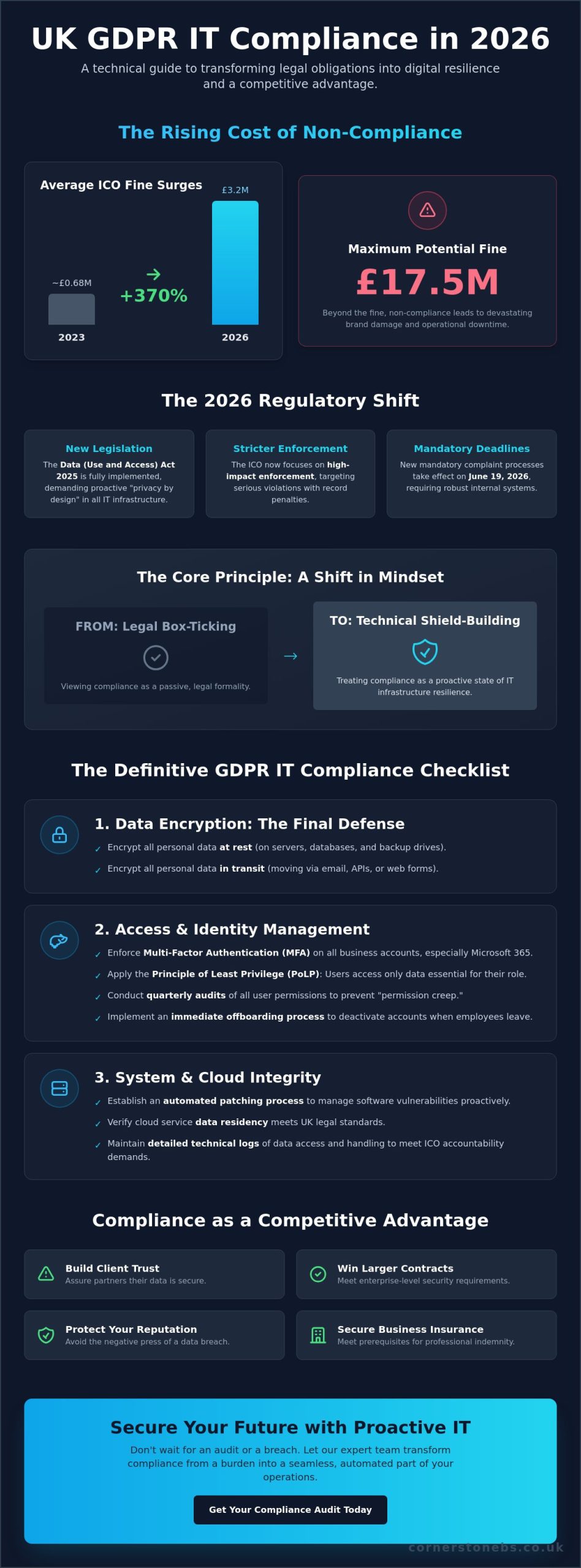
Did you know the average ICO fine has surged to nearly £3.2 million in 2026? That is a staggering 370% increase since 2023, proving that maintaining a GDPR IT compliance checklist for UK businesses is no longer just a legal formality; it’s a fundamental pillar of your digital resilience. As a local team that prides itself on keeping our regional partners secure, we know how daunting these shifting regulations and high-stakes penalties can feel.
It’s perfectly natural to feel overwhelmed by the technical jargon of the Data (Use and Access) Act 2025 or to worry about the complexities of cloud data residency. You want to focus on serving your customers, not on the fear of a £17.5 million penalty. This guide moves past the legalese to provide a clear, technical to-do list for your modern infrastructure. We’ll walk you through the essential system updates, from automated decision-making safeguards to the mandatory complaint processes taking effect on June 19, 2026. You’ll gain a robust framework for business continuity and the peace of mind that comes from being truly prepared for the year ahead.
Key Takeaways
Move beyond legal theory by treating compliance as a proactive technical state of IT infrastructure resilience.
Build a secure foundation using essential technical controls, specifically focusing on advanced encryption for data at rest and in transit.
Use our GDPR IT compliance checklist for UK businesses to audit your hardware and software assets and locate every piece of personal data.
Navigate cloud complexities with confidence by verifying your data residency meets the specific requirements of the latest UK legal standards.
Ensure long-term stability by positioning managed IT support as a proactive monitoring strategy rather than just a technical necessity.
Think of UK GDPR IT compliance as the digital fortress that surrounds your business operations. It isn’t just about having a privacy policy tucked away in a filing cabinet; it’s the technical implementation of every data protection principle within your actual network. While the Data Protection Act 2018 provides the legal foundation, IT compliance is the mechanism that enforces those laws through encryption, access controls, and secure backups. In 2026, the gap between “saying” you are compliant and “being” compliant has never been wider.
Why Compliance is a Competitive Advantage
The Role of the ICO in 2026
The ICO’s current focus is on high-impact enforcement, targeting the most serious violations with record-breaking penalties. The accountability principle now demands that you maintain detailed technical logs to prove exactly how data is accessed and handled. If you can’t show the logs, the ICO assumes the protection wasn’t there. Beyond the £17.5 million maximum fine, the real cost of non-compliance lies in the devastating blow to your brand and the operational downtime that follows a breach. We want to help you avoid that stress by making compliance a seamless, proactive part of your daily operations.
Technical Controls: The Foundation of Digital Privacy
While legal policies provide the rules, technical controls are the actual locks on your digital doors. In 2026, the ICO expects more than just a signed document; they want to see robust, active defenses. Any effective GDPR IT compliance checklist for UK businesses must start with the hardware and software settings that protect your data from the inside out. We help our local partners move beyond theory by implementing the specific technical measures that keep sensitive information out of the wrong hands.
Encryption acts as your final line of defense. You must ensure that all personal data is encrypted both at rest, such as on your servers and backup drives, and in transit, when it’s moving through email or web forms. This ensures that even if a data packet is intercepted, it remains completely unreadable. Coupling this with Multi-Factor Authentication (MFA) across every business account creates a formidable barrier. MFA is no longer an optional extra. It’s a fundamental requirement for securing your Microsoft 365 environment and preventing unauthorized access from stolen credentials.
Hackers look for the easiest path. Often, that’s through unpatched software. A proactive approach to vulnerability management means your systems aren’t left open to known exploits. Regular, automated patching keeps your infrastructure resilient and stable. If managing these technical layers feels like a full-time job, our team provides the expert Cyber Security support you need to stay ahead of emerging threats without losing focus on your daily operations.
Access Control and Identity Management
We recommend the Principle of Least Privilege (PoLP) for every business network. This means users only have access to the specific data required for their job role, and nothing more. For those using Microsoft 365 or local servers, you should audit user permissions quarterly to prevent “permission creep.” When an employee leaves your organization, their accounts must be deactivated immediately. Leaving a dormant account active is a massive security hole that the ICO’s Guide to the GDPR specifically warns against.
Endpoint Security and Device Management
Hybrid work has made endpoint security a top priority. Laptops and mobile devices are easily lost or stolen, making them high-risk targets. You should use Mobile Device Management (MDM) to maintain control over these assets, allowing for remote data wiping if a device disappears. To meet strict compliance standards, you must implement full-disk encryption on all portable hardware to ensure data remains protected even if the physical device is compromised. These small technical steps provide immense emotional and financial security for your business.
Cloud Infrastructure and Data Residency Requirements
Storing your data in the cloud isn’t just about convenience; it’s about geography. Data residency refers to the physical location where your information sits. For UK businesses, ensuring your cloud provider uses UK-based data centers is a vital part of any modern GDPR IT compliance checklist for UK businesses. Platforms like Microsoft Azure and Microsoft 365 allow you to select specific UK data regions. This keeps your client information within our borders, which simplifies your legal obligations and provides a clear audit trail for the ICO. You should also remember that using any SaaS provider makes them a “data processor.” This requires a solid third-party agreement to ensure they meet the same high standards for security and privacy that you do.
Managing these cloud environments requires a proactive approach to ensure data doesn’t drift into unapproved regions. We help our local partners configure their cloud settings to prioritize regional storage, providing the peace of mind that comes from knowing exactly where your data lives. This technical oversight is a foundational element of business stability. It ensures you aren’t caught out by shifting international data transfer rules that can change without much notice.
Microsoft 365 Compliance Features
Microsoft 365 is more than just a set of productivity tools. It includes powerful security features like Microsoft Purview and Data Loss Prevention (DLP) settings. These tools allow you to set up auto-labeling, which automatically detects and protects sensitive business data like financial records or personal IDs. If you’re planning a move to a more secure environment, our Microsoft 365 Migration for Business UK guide offers a complete strategy for a secure transition. These built-in features help you stay organized and demonstrate your commitment to data protection.
Backup and Disaster Recovery as a GDPR Requirement
GDPR isn’t just about privacy; it’s about availability. If your systems go down and you can’t access personal data when a customer requests it, you’re technically in breach. A simple backup is a great start, but a compliant disaster recovery plan ensures your business can actually keep running during a crisis. We align our Cloud Solutions for UK Businesses with the NCSC’s 10 Steps to Cyber Security to ensure your infrastructure is resilient. This level of technical support provides the emotional and financial security you need to focus on growth. It transforms a technical necessity into a long-term partnership for success.
The Definitive GDPR IT Compliance Checklist for UK Businesses
While we’ve discussed the theory and cloud residency, compliance ultimately comes down to the specific settings on your devices and servers. To help you build a resilient foundation, we’ve compiled this GDPR IT compliance checklist for UK businesses. It moves beyond paperwork to focus on the technical enforcement required to satisfy the ICO in 2026. Start by auditing every piece of hardware and software in your building. You must identify exactly where personal data resides, whether it’s on a local desktop, a legacy server, or a staff member’s mobile phone.
Your next step is implementing end-to-end encryption for all email communications and file sharing. This ensures that sensitive information remains secure from the moment it leaves your network until it reaches the intended recipient. Combine this with a strict password policy and universal MFA deployment across every single business application. Finally, don’t wait for a crisis to test your defenses. Schedule regular Cyber Security audits and penetration testing to find the cracks before a hacker does. Proactive testing isn’t just a technical necessity; it’s a foundational element of your business stability.
Data Mapping and Asset Discovery
You can’t protect what you can’t see. “Shadow IT” often creeps into organisations when staff use unauthorized personal apps or hardware for work tasks. To combat this, create a technical data flow diagram for your IT network that maps every point where personal data enters, moves through, and leaves your systems. Robust IT inventory management is the only way to ensure your GDPR IT compliance checklist for UK businesses covers 100% of your digital footprint. It gives you the clarity of an expert and the confidence of a leader.
The 72-Hour Breach Notification Rule
The law requires you to report most data breaches within 72 hours, but you can’t report what you haven’t detected. This requires real-time technical monitoring to catch unauthorized access as it happens. Under technical guidelines, a reportable breach is defined as any security incident that leads to the accidental or unlawful destruction, loss, alteration, or unauthorized disclosure of personal data. If you aren’t sure if your current systems can spot these triggers, our Cyber Security Services provide the proactive monitoring you need for true peace of mind. We invite you to have a conversation with our local team to see how we can strengthen your defenses today at cornerstonebs.co.uk.
Securing Your Future: Proactive Managed IT as a Compliance Strategy
Completing a GDPR IT compliance checklist for UK businesses is a fantastic milestone, but true data protection is never a “one and done” task. Compliance is a living state of your infrastructure. To maintain the high standards required by the ICO in 2026, your systems need constant, proactive oversight. Managed IT Support bridges the gap between having a plan and actually living it. It provides the continuous monitoring necessary to detect unauthorized access attempts or system vulnerabilities the moment they appear, rather than weeks after a breach has occurred.
Think of an outsourced partner as providing “compliance-as-a-service.” At Cornerstone Business Solutions, we deliver bespoke technology solutions that go beyond generic software fixes. We understand that every organisation has a unique digital footprint. Our multi-award-winning expertise allows us to navigate complex technical audits with the clarity of a long-term partner. We don’t just sell you a license; we build a resilient framework that supports your business continuity and provides the emotional security you need to lead with confidence.
From Reactive Repairs to Proactive Compliance
The old “break-fix” model of IT support is now a major compliance risk. If you only call for help when something stops working, you’ve likely already left a window open for a data breach. GDPR demands “availability” and “integrity,” which are impossible to guarantee with reactive repairs. Moving to a fixed-term contract ensures your system health and security patches are always current. While we are proud of our roots and provide industry-leading Managed IT Services in Teesside, our technical reach and compliance expertise support businesses on a national scale. This proactive approach keeps your network stable and your data locked down tight.
Your Next Steps for 2026
The most effective way to start your journey toward total resilience is with a professional security audit. We’ll help you identify the specific gaps in your current setup and refine your GDPR IT compliance checklist for UK businesses to match your actual operational needs. Our award-winning support team is ready to simplify the technical hurdles of the Data (Use and Access) Act 2025, turning complex regulations into a clear path forward. We invite you to a conversation about your digital future. It’s time to move away from the fear of fines and toward the peace of mind that comes from expert protection. Book a consultation with our compliance experts today and let’s build something secure together.
Build a Resilient Future Through Technical Excellence
The transition toward strict technical enforcement in 2026 proves that data protection is no longer just a legal task. It’s a fundamental part of your business’s digital health. By moving from reactive repairs to a proactive GDPR IT compliance checklist for UK businesses, you ensure your infrastructure remains stable, secure, and ready for growth. You’ve learned that robust encryption, regional data residency, and universal MFA are the pillars of modern privacy by design.
We believe that every local business deserves the peace of mind that comes from expert protection. As a multi-award-winning IT services provider and strategic partner with industry leaders like Microsoft, IBM, and Cisco, we offer the 24/7 proactive monitoring required to stay ahead of evolving threats. We don’t just fix problems; we prevent them from happening in the first place. This collaborative approach turns a regulatory necessity into a powerful engine for client trust and operational stability.
Your journey toward total resilience starts with a single conversation. Start your journey to total technical compliance with a Cornerstone IT audit. Let’s work together to secure your data and protect your reputation for the long term. You’ve got this, and we are right here to support you every step of the way.
Frequently Asked Questions
Is UK GDPR compliance different from EU GDPR in 2026?
Yes, the Data (Use and Access) Act 2025 has created a distinct UK framework that diverges from the EU version. While the core principles of privacy remain, the UK has relaxed rules on automated decision-making and introduced “recognised legitimate interests” to simplify processing for specific cases like crime prevention. It is vital to ensure your systems reflect these specific UK legislative updates rather than relying on generic EU guidance.
Does a small business with fewer than 10 employees need a GDPR IT checklist?
Absolutely, because data protection laws apply to every organisation regardless of its size. A GDPR IT compliance checklist for UK businesses ensures that even the smallest team protects sensitive client data from rising cyber threats. Smaller businesses are often targeted because they lack robust defenses, so having a clear technical plan provides essential security and prevents devastating financial penalties.
What are the technical requirements for “Privacy by Design”?
Privacy by Design requires you to integrate data protection into your system architecture from the moment of purchase or development. This includes implementing pseudonymisation, setting automatic data deletion periods, and ensuring that default settings are always the most private options available. It moves privacy from a manual task to an automated technical standard within your network infrastructure.
Can I store UK customer data on US-based cloud servers?
You can store data in the US, provided you use appropriate safeguards like the UK-US Data Bridge or specific standard contractual clauses. However, the most reliable way to ensure compliance is to select a UK-based data region within your cloud platform. This keeps your information within our borders and simplifies your residency requirements under current UK law.
How often should we conduct a technical GDPR audit?
We recommend a full technical audit at least once a year or whenever you implement significant changes to your IT infrastructure. Regular quarterly reviews of user permissions and software patches are also essential. This proactive rhythm ensures your GDPR IT compliance checklist for UK businesses stays relevant as new cyber threats emerge throughout the year.
Is Multi-Factor Authentication (MFA) a legal requirement under GDPR?
While the law doesn’t name “MFA” specifically, it mandates that you use “appropriate technical measures” to protect personal data. In 2026, the ICO considers MFA a basic industry standard for any business network. Failing to implement it can be viewed as negligence, making it much harder to defend your actions if a breach occurs via stolen credentials.
What happens if our business suffers a data breach but we followed the checklist?
Following a technical checklist demonstrates that you took “reasonable and proportionate” steps to protect your data. While you must still report a reportable breach to the ICO within 72 hours, having a documented audit trail of your technical controls significantly reduces the likelihood of heavy fines. It proves you acted as a responsible and proactive data controller.
How does Managed IT Support help with GDPR accountability?
Managed IT Support provides the technical logging and continuous monitoring required to prove your compliance to regulators. By outsourcing to a local expert, you gain a detailed audit trail of every security patch, backup, and access request. This satisfies the accountability principle by providing concrete evidence that your systems are actively managed and secured 24/7.
If a retail giant like M&S can be compromised, your business’s digital front door might be more vulnerable than you think. The marks and spencer data breach serves as a stark reminder that even household names face evolving ransomware threats in 2026. You probably feel that the weight of GDPR compliance and the fear of a public leak are enough to keep any North East business owner awake at night. We understand that anxiety. It’s not just about a technical glitch; it’s about avoiding potential £17.5 million fines and protecting the hard-earned trust you’ve built with your local customers.
We agree that protecting your reputation is just as vital as securing your servers. Our award-winning team is here to ensure you have the tools to stay resilient. This guide explains the full impact of the M&S incident and shows you exactly how to shield your own operations from similar ransomware threats. We’ll break down the mechanics of the breach, provide a clear response plan for your business, and share proactive IT security tips to give you total peace of mind.
Key Takeaways
Uncover the critical details of the marks and spencer data breach to understand how modern ransomware-as-a-service models exploit even the largest UK retailers.
Learn the essential steps to isolate active infections and contain damage, protecting your customers’ sensitive data and your brand’s reputation.
Discover why immutable backups are a non-negotiable component of a modern recovery strategy for maintaining total business continuity.
Gain peace of mind by exploring how our award-winning North East team delivers the bespoke, proactive security your business deserves.
What Happened in the Marks and Spencer Data Breach?
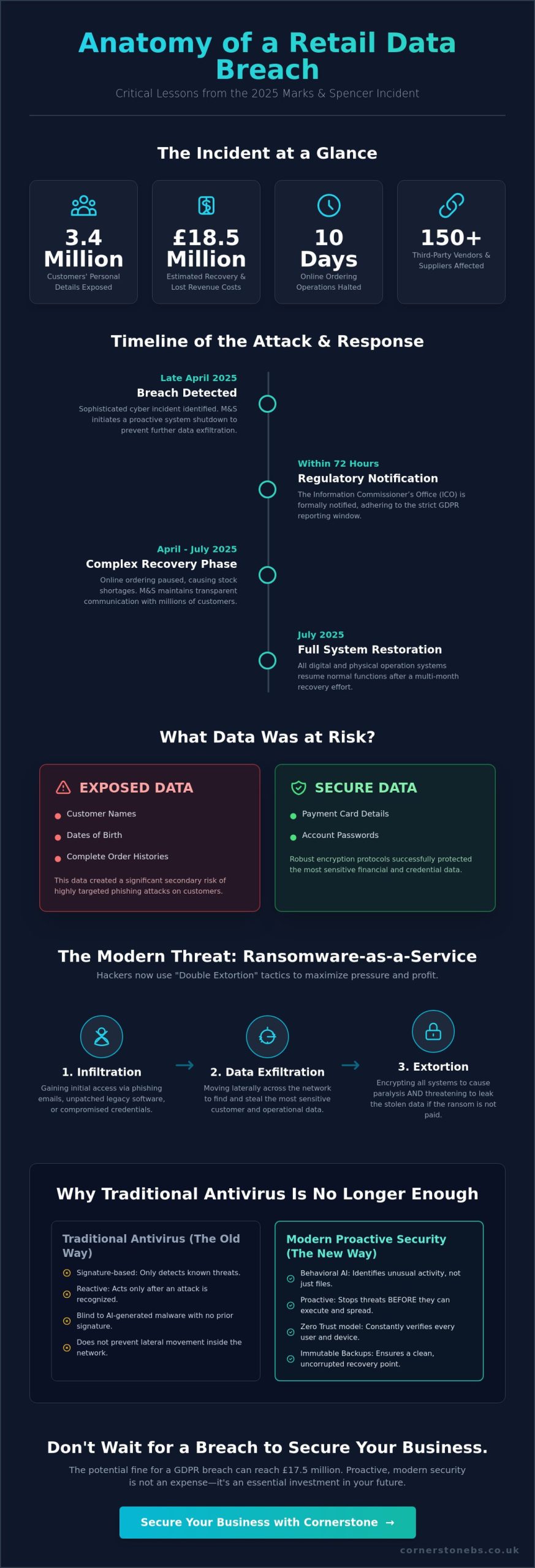
In April 2025, a sophisticated cyber incident targeted one of the UK’s most iconic retailers, causing widespread disruption across its digital and physical operations. This marks and spencer data breach forced the company to take immediate, drastic action to protect its infrastructure. To understand the gravity of this event, it is helpful to first define what is a data breach? and how it impacts a business of this scale. The incident resulted in the exposure of personal details for approximately 3.4 million customers, specifically targeting names, dates of birth, and order histories. While this caused significant concern, the retailer’s robust encryption protocols ensured that payment card details and account passwords remained secure and uncompromised.
The scale of the disruption was felt immediately by shoppers across the country. M&S made the proactive decision to pause online ordering for a period of 10 days to contain the threat. This led to noticeable stock shortages in physical stores, including those throughout the North East, as automated replenishment systems were taken offline. It was a stark reminder that digital security is the foundation of modern retail reliability.
The Timeline of the Incident
The breach was first detected in the final week of April 2025. Within hours, the retailer initiated a proactive system shutdown to prevent further data exfiltration. Our award-winning team at Cornerstone knows that speed is everything in these scenarios. However, the recovery phase was complex, and it took until July 2025 for all systems to resume normal operations. During this time, M&S followed a transparent communication strategy, notifying the Information Commissioner’s Office (ICO) within the 72-hour regulatory window and keeping millions of customers informed through direct, clear updates.
The Immediate Impact on Customers and Suppliers
The marks and spencer data breach echoed through the entire supply chain, affecting over 150 third-party vendors who relied on the retailer’s logistics platform. The financial toll was substantial, with estimated recovery and lost revenue costs reaching £18.5 million. For customers, the primary risk shifted to secondary fraud. M&S provided tailored guidance, urging users to be wary of phishing emails that might use their leaked order history to appear legitimate. They recommended heightened vigilance and immediate reporting of any suspicious activity to maintain peace of mind.
The Anatomy of a Retail Ransomware Attack
Modern cybercrime isn’t just a lone hacker in a basement; it’s a professionalized industry. Most high-street attacks now utilize the Ransomware-as-a-Service (RaaS) model. This allows entry-level criminals to lease powerful encryption tools from expert syndicates in exchange for a cut of the profit. Large retailers like M&S are high-value targets for these syndicates because they manage vast amounts of customer data and rely on constant uptime. A single hour of downtime for a major retailer can cost thousands in lost revenue and logistics delays.
In 2026, hackers have moved beyond simple encryption. They now use “double extortion” tactics. They steal sensitive customer information before locking the systems. If the business refuses to pay the ransom, the criminals threaten to leak the stolen data online. This approach makes a potential marks and spencer data breach a multi-layered disaster involving both operational paralysis and massive regulatory fines. Common entry points remain surprisingly simple, ranging from sophisticated phishing emails to unpatched legacy software that hasn’t been updated in months.
How Ransomware Penetrates Business Networks
The first 24 hours of a cyber attack are the most critical. Once a hacker gains initial access, they don’t usually strike immediately. Instead, they perform lateral movement. This involves jumping from a single compromised device to the main server to find the most sensitive data. Implementing Zero Trust security is the most effective way to stop this. It ensures that every user and device is constantly verified, preventing hackers from moving freely through your systems. If you suspect an intrusion, following an official data breach response guide can help your team contain the threat before it spreads to your entire infrastructure.
Why Traditional Antivirus is No Longer Enough
Old-school antivirus software relies on signature-based detection. It only catches threats it has seen before. By 2026, hackers are using AI to create unique malware for every attack, meaning it has no “signature” to track. You need behavioral AI monitoring that identifies unusual activity, such as a user account suddenly accessing thousands of files at 2 AM. A “set and forget” IT strategy is a recipe for disaster in the current climate.
Vulnerabilities often stem from simple human error or outdated patches. This is why 24/7 proactive monitoring by an award-winning IT provider is essential for modern business continuity. We focus on stopping threats before they reach your front door, giving you the peace of mind to run your business without fear. If you’re unsure if your current systems could withstand a marks and spencer data breach style event, we’d love to have a friendly chat about your security posture.
Critical Lessons from the M&S Cyber Incident
The marks and spencer data breach serves as a vital case study for UK business owners. M&S earned praise for their transparency, yet the incident exposed how even retail giants can stumble. Their proactive notification helped maintain customer trust, but the initial vulnerability reminds us that no one is immune. Our award-winning team at Cornerstone Business Solutions works with North East businesses to turn these lessons into action. We don’t just fix PCs; we build resilient systems. The breach highlights that your security is only as strong as your weakest supplier.
You need an immutable backup strategy to ensure your data stays safe from encryption. This is a non-negotiable part of NIS2 compliance, especially when managing complex supply chains in 2026. Most breaches start with a single human error. Staff training isn’t just a box-ticking exercise; it’s your first line of defence. Expert advice on preventing ransomware attacks shows that technical fixes must be paired with a culture of security. Under 2026 regulations, you’re responsible for your entire digital chain. We help you vet partners and secure your perimeter so you aren’t left vulnerable.
Communication as a Defence Mechanism
Speed is your best friend when things go wrong. You must report serious breaches to the Information Commissioner’s Office (ICO) within 72 hours. Promptly telling your customers protects your reputation and can lower potential fines. It’s a delicate balance. You should share enough to be helpful without giving hackers a roadmap of your ongoing investigation. Transparent communication shows you’re in control, which is essential for long-term brand loyalty in the North East market.
The Cost of Inaction vs. Proactive IT Support
Emergency recovery costs can easily spiral into thousands of pounds per day. Compare that to a fixed monthly fee for award-winning managed IT support, and the choice becomes clear. Proactive maintenance stops problems before they start. Business Continuity is a proactive strategy that ensures your SME can keep operating during and after a technical crisis. This approach gives you the peace of mind to focus on growth. Investing in a partnership with a local expert ensures your systems are robust, tailored, and ready for any challenge 2026 brings. High-quality support isn’t an overhead; it’s an investment in your company’s survival.
Proactive monitoring: Detects threats before they breach the perimeter.
Immutable backups: Ensures data cannot be deleted or changed by attackers.
Staff empowerment: Reduces the risk of successful phishing attempts by 70%.
How to Respond to a Data Breach: A Step-by-Step Guide
When a security incident occurs, your first 60 minutes determine the next six months of your business’s health. Taking a structured, calm approach is the only way to protect your reputation and your bottom line. Whether you are dealing with a localized issue or studying the fallout of a major marks and spencer data breach, the response framework remains the same. You must act with speed, but you must also act with precision.
Immediate Containment Strategies
Isolate and contain the infection as your first priority. Stop the spread by disconnecting affected hardware from the network. Don’t simply pull the power cables. Keeping devices powered on while disconnected from the internet helps preserve volatile forensic evidence that our award-winning team uses to trace the attacker’s path. This evidence is vital for understanding how the breach happened.
Law enforcement advice from the National Cyber Security Centre (NCSC) is clear: never pay the ransom. Paying doesn’t guarantee your data’s return and often marks your business as an easy target for future hits. Instead, engage with a specialist IT partner for emergency professional services. We provide the technical muscle needed to secure your perimeter and begin the recovery process without rewarding criminal activity.
Managing Stakeholder Communications
Transparency builds trust. You have a legal obligation under UK GDPR to notify the Information Commissioner’s Office (ICO) within 72 hours if personal data is at risk. Failing to meet this window can lead to significant fines. Draft a clear, honest statement for your customers and employees. Avoid technical jargon and focus on what they need to do to stay safe, such as changing passwords or monitoring bank statements.
Set up a dedicated support line or FAQ page to handle inquiries.
Be specific about what data was accessed, such as names or contact details.
Explain the proactive steps you’re taking to prevent a recurrence.
Ensuring your IT company solutions include disaster recovery planning is essential for long-term peace of mind. We help North East businesses build these frameworks before a crisis hits. Once the immediate threat is gone, restore your systems from secure, offline backups. A post-incident review is the final step. We’ll help you update your security protocols and close the gaps that allowed the breach to occur, ensuring your business is more resilient than ever.
The fallout from a high-profile incident like the marks and spencer data breach shows that no organisation is immune to sophisticated cyber threats. For UK firms, the stakes have never been higher. Cornerstone Business Solutions delivers bespoke technology designed to protect your assets and your reputation. We don’t just fix computers; we act as your dedicated long-term partner. Based in the North East, our team brings a mix of regional warmth and professional authority to every project. We help you move toward a Zero Trust architecture. This security model ensures that every user and device is verified, effectively eliminating the “single point of failure” that hackers love to exploit. We conduct proactive cybersecurity audits to find gaps before criminals do, ensuring your infrastructure is resilient against 2026 threat levels.
Award-Winning Managed IT Support
Our award-winning managed IT support gives you unlimited helpdesk access and proactive system monitoring. You won’t wait in a long queue when things go wrong. We partner with global leaders like Microsoft and Cisco to provide enterprise-grade security for local businesses. This means you get the same robust protection as a multinational corporation, delivered by a team that understands the local market. We build trust through transparency and reliability. Our “can-do” attitude ensures that your business stays operational 24/7. Benefits of our support include:
Proactive Monitoring: We identify and resolve issues before they cause downtime.
Global Partnerships: Access to the latest security protocols from Microsoft and Cisco.
Regional Expertise: A North East team that values community and personal service.
Scalable Solutions: Technology that grows alongside your business goals.
Building a Robust Defence-in-Depth
True security requires multiple layers. We integrate Microsoft 365 security features with rigorous hardware maintenance to create a defence-in-depth strategy. This includes regular digital checks and physical safety assessments. For instance, you should verify if PAT testing is a legal requirement for your specific equipment to ensure workplace safety and compliance. Our audits cover everything from cloud permissions to the physical state of your servers. We want to ensure your business remains resilient against the next marks and spencer data breach or similar industry-wide threat. By combining software intelligence with physical hardware reliability, we provide total peace of mind for business owners.
Don’t leave your security to chance. Chat with our expert team today to secure your business infrastructure and build a foundation for growth.
Secure Your Business Legacy Against Modern Cyber Threats
The marks and spencer data breach highlights why retail security requires a proactive rather than reactive stance. We’ve seen that a well-documented response strategy and robust infrastructure are the only ways to mitigate the impact of sophisticated ransomware. IBM’s 2023 Cost of a Data Breach Report confirms that UK organisations now face average breach costs of £3.4 million, a figure that demands serious boardroom attention. Protecting your reputation means staying one step ahead of the evolving tactics used by global cyber-criminal groups.
Cornerstone Business Solutions brings professional authority and North East warmth to your security strategy. As a multi-award-winning IT provider, we’ve built strong partnerships with Microsoft, IBM, and Cisco to ensure your systems remain impenetrable. We offer national UK coverage with a dedicated, personal approach that treats your business like our own. It’s about more than just software; it’s about providing the peace of mind you need to focus on growth. Let’s work together to build a resilient digital foundation for 2026 and beyond.
We’re ready to help you turn these insights into a powerful defence for your company’s future.
Frequently Asked Questions
Was my credit card stolen in the Marks and Spencer data breach?
You should check your official M&S account communications and bank statements for any unauthorised activity immediately. While M&S typically uses encrypted payment processors, hackers often target personal data to attempt identity fraud. If your financial details were compromised in the 2025 incident, the company would’ve notified you directly by 15 May 2025. We recommend monitoring your credit score via a provider like Experian to catch any suspicious applications for credit in your name.
Do I need to change my M&S password after the 2025 cyber attack?
Yes, you must update your password immediately to secure your account against the marks and spencer data breach. We recommend creating a unique password of at least 14 characters that you haven’t used on any other platforms. Our award-winning security team suggests enabling Multi-Factor Authentication (MFA) right away. This proactive step provides essential peace of mind by ensuring that a stolen password alone isn’t enough for a criminal to access your data.
How can I tell if an email from M&S is a phishing scam?
Check the sender’s email address carefully to ensure it ends exactly in marksandspencer.com. Scammers often use slightly altered domains or urgent, threatening language to trick you into clicking malicious links. According to the 2024 Cyber Security Breaches Survey, 84 percent of UK businesses experienced phishing attempts. If you’re unsure, don’t click any links. Instead, log in to your account through the official website or give our local North East team a chat for advice.
What are the legal requirements for a UK business after a data breach?
UK businesses must notify the Information Commissioner’s Office (ICO) within 72 hours of becoming aware of a personal data breach. This is a strict requirement under the UK GDPR and the Data Protection Act 2018 if the breach poses a risk to individuals. Companies must also inform the affected customers without undue delay. Failure to comply can result in significant fines of up to £17.5 million or 4 percent of total annual global turnover.
How much does it cost to recover from a ransomware attack?
The average cost of a cyber breach for a UK medium or large business reached £10,830 in 2024, according to government data. This figure only covers the immediate response and doesn’t account for long-term lost revenue or reputational damage. For smaller firms, the financial impact often forces a total halt in operations. Our tailored recovery strategies focus on getting your systems back online quickly to minimise these rising costs and protect your bottom line.
What is the best way to prevent a data breach in a small business?
Achieving Cyber Essentials certification is the most effective way to block 99 percent of common cyber attacks. This government-backed scheme ensures you have robust firewalls, secure configurations, and up-to-date software. As a dedicated North East partner, we simplify this technical process for you. We focus on proactive maintenance and employee training, turning your staff into a human firewall. This approach creates a foundation of security that supports your long-term business growth and stability.
Does GDPR apply to the Marks and Spencer data breach?
Yes, the UK GDPR applies to the marks and spencer data breach because the company processes the personal data of UK residents. These regulations require M&S to implement technical and organisational measures to protect consumer information. If the ICO finds that the company failed to meet these standards, they have the authority to issue enforcement notices or financial penalties. This legal framework ensures that your right to data privacy is protected by law across the United Kingdom.
How long does it take for a company to recover from a cyber incident?
It takes an average of 277 days for an organisation to identify and fully contain a data breach, according to industry reports from 2023. The initial technical recovery might happen within days, but the forensic investigation and data restoration often take months. Our award-winning managed services aim to slash this timeline through seamless backup solutions and rapid response protocols. We focus on business continuity so you can return to normal operations without the usual lengthy delays.