

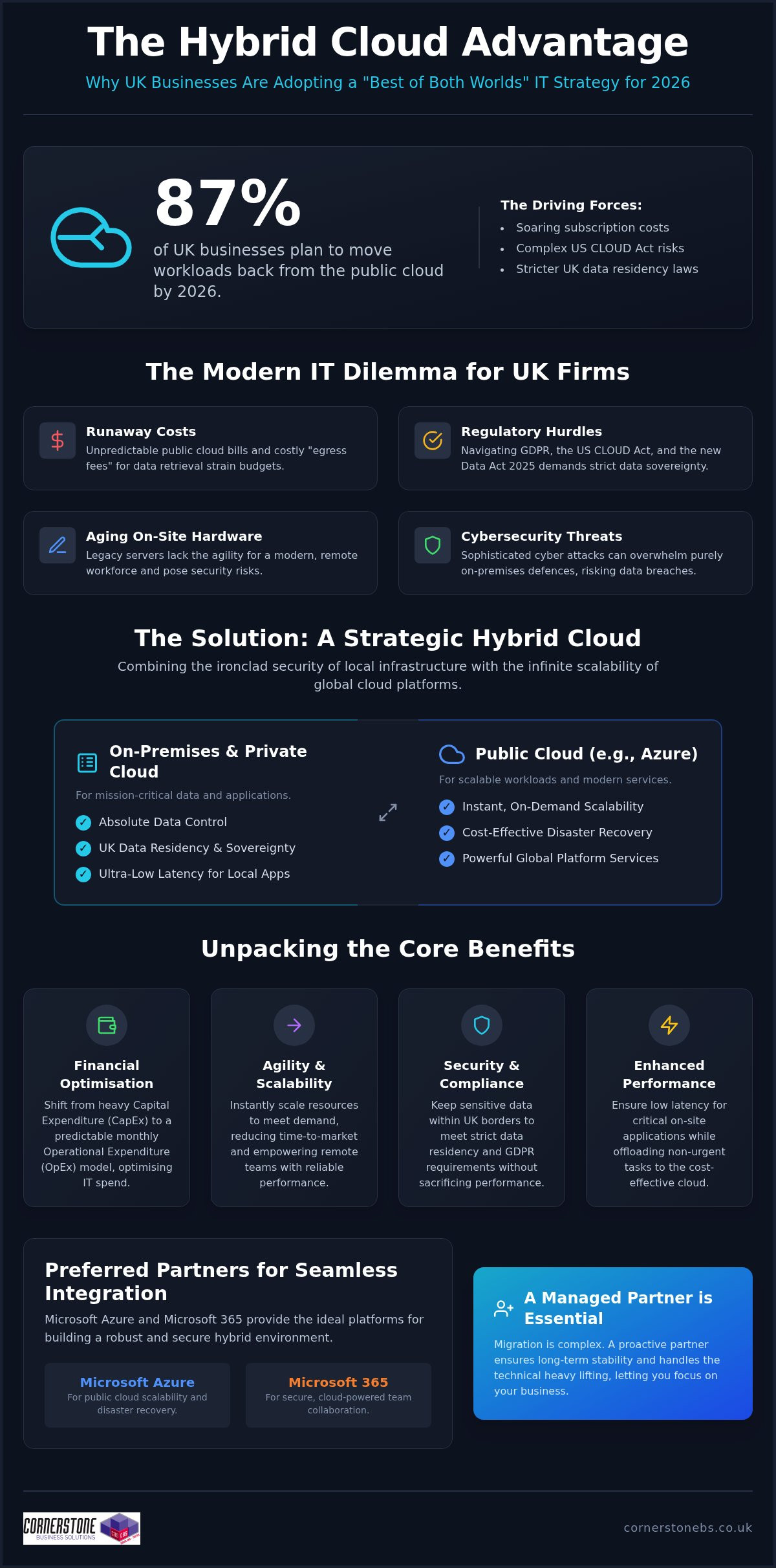
Did you know that 87% of UK businesses are planning to move at least some of their workloads back from the public cloud by the end of 2026? While the “all-in” cloud promise once seemed like the only way forward, many local firms now face soaring subscription costs and the complex jurisdictional risks of the US CLOUD Act. Understanding the hybrid cloud benefits for UK business is no longer just a technical choice. It’s a vital strategy to ensure your infrastructure remains agile and compliant in a rapidly shifting regulatory landscape.
We know how stressful it is to manage aging on-site hardware while trying to navigate the new Data (Use and Access) Act 2025. You need a system that supports your remote team without leaving your sensitive data exposed. This guide reveals how a bespoke hybrid model provides the emotional security of knowing your data is residency-compliant while slashing your capital expenditure. We’ll show you how to balance security, cost, and performance to create a scalable, bulletproof IT environment that’s ready for whatever 2026 throws your way.
Key Takeaways
- Learn how a strategic mix of on-premises and private cloud systems provides the foundation for a modern, agile UK business infrastructure.
- Discover the core hybrid cloud benefits for UK business, including the ability to scale resources instantly while moving from heavy CapEx to predictable monthly costs.
- Understand how to keep your sensitive client data within UK borders to meet strict data residency and GDPR requirements without sacrificing performance.
- Explore why Microsoft Azure and Microsoft 365 are the preferred partners for local firms looking for seamless integration and bulletproof disaster recovery.
- Gain insights into why a proactive managed IT partner is the best way to handle migration complexity and ensure long-term business stability.
The Evolution of Infrastructure: Why Hybrid Cloud is the 2026 Standard
The days of the dusty server humming away in a back office cupboard are fading fast. For years, many UK SMEs relied on that “server in the corner” to run every aspect of their operations. While that model felt simple, it lacked the agility needed to support a modern, distributed workforce. By 2026, the standard has shifted toward a more sophisticated, distributed environment. One of the primary hybrid cloud benefits for UK business is the ability to maintain absolute control over sensitive data while tapping into the massive processing power of the public cloud.
When asking What is Hybrid Cloud?, it’s essentially a strategic orchestration between on-premises infrastructure, private cloud environments, and public platforms like Microsoft Azure. With 73% of organizations now running a hybrid environment, the UK market has matured significantly. Local firms are now balancing the need for seamless remote team access with the strict security demands of the Data (Use and Access) Act 2025. This model ensures you aren’t forced to choose between legacy reliability and modern innovation.
Hybrid cloud represents the “best of both worlds” for UK operational flexibility by combining the ironclad security of local hardware with the infinite scalability of global cloud platforms.
The “Best of Both Worlds” Philosophy
Public clouds are fantastic for cost-effective scalability and handling generic workloads like email or web hosting. However, mission-critical data often requires the dedicated environment of a private cloud or on-premises server to meet UK residency requirements. This hybrid bridge allows your business to pursue digital transformation without abandoning the reliable systems that have served you for years. It’s about placing the right workload in the right place to maximize efficiency and peace of mind.
Overcoming the Limitations of Single-Cloud Models
Relying 100% on a pure public cloud can lead to “egress fee” shocks. These are the hidden costs UK businesses face when trying to move their own data out of a provider’s ecosystem. Conversely, staying entirely on-premises is increasingly risky. Modern cyber threats are too sophisticated for a single local server to handle alone. A hybrid model eliminates vendor lock-in and provides the technical freedom to move data where it’s most efficient. It ensures your business isn’t held hostage by a single provider’s pricing or a single point of technical failure.
Unpacking the Core Hybrid Cloud Benefits for UK Business Growth
Performance is another area where the hybrid model shines. For latency-sensitive applications, such as local databases or heavy design software, keeping them on-site ensures your team isn’t slowed down by “lag.” Meanwhile, you can offload non-urgent tasks like disaster recovery and long-term backups to the cloud. This strategic split is one of the primary benefits of a hybrid cloud, providing speed where it’s needed and storage where it’s most cost-effective.
Operational Agility and Scalability
Optimising IT Spend and Resource Allocation
Financial stability is the backbone of any successful firm. Moving from heavy Capital Expenditure (CapEx) to a predictable, monthly Operational Expenditure (OpEx) model is a game-changer for budgeting. Many businesses discover they’ve been over-provisioning on-site servers “just in case.” A hybrid approach eliminates this waste. By using tailored cloud solutions, SMEs can finally access the same enterprise-grade technology as their larger competitors without the massive upfront price tag.
Managing this balance requires a steady hand and proactive oversight. To get the maximum ROI from these systems, many leaders choose to pair their infrastructure with professional Managed IT Support. This ensures your resources are always allocated correctly. It lets you focus on your business goals while a dedicated partner handles the technical heavy lifting. If you’re curious about how this could work for your specific setup, we’re always happy to have a quick, informal chat about your goals.
Security, Compliance, and Data Sovereignty in the UK
“Is the cloud actually safe for my sensitive client data?” This remains the most common question we hear from business owners across the UK. With PECR fines now reaching up to £17.5 million or 4% of global turnover as of February 2026, the stakes for data protection have never been higher. A hybrid approach provides the reassurance you need. It allows you to keep your most sensitive files on local, physical hardware while leveraging the cloud for general operations. This setup is a cornerstone of a modern security strategy that doesn’t compromise on speed or safety.
Data sovereignty is a major part of this conversation. Many firms don’t realize that using a standard US-based cloud provider can expose them to the US CLOUD Act. This legislation allows foreign law enforcement to request data regardless of its physical location. By using a hybrid model, you ensure your sensitive UK data stays strictly within our borders. This is vital for meeting the requirements of the Data (Use and Access) Act 2025. As of July 13, 2026, the UK government designated providers like Microsoft and Amazon as “Critical Third-Party Providers,” bringing their services under the direct oversight of the Bank of England and the FCA. Integrating robust Cyber Security Services into your hybrid environment creates a layered defence that protects your reputation.
Navigating UK GDPR and Data Residency
Knowing exactly where your data sits physically is the first step to true compliance. Hybrid models are perfect for sectors like finance, legal, and education where data residency is a legal necessity. You can store Personally Identifiable Information (PII) on-site or in a secure UK-based private cloud. This makes passing a GDPR audit much simpler. It also helps you achieve Cyber Essentials certification, proving to your clients that you take their privacy seriously. It’s about building trust through transparent, locally-focused data management.
Enhanced Disaster Recovery and Business Continuity
One of the most powerful hybrid cloud benefits for UK business is the ability to use the cloud as a high-speed “failover” site. If your local hardware fails or an office incident occurs, your team can keep working without missing a beat. Automated backups in the cloud protect you against the growing threat of ransomware by providing a clean point-in-time restore. Building a comprehensive disaster recovery plan is far easier when you aren’t relying on a single physical location. It gives you the emotional security of knowing your business is resilient, no matter what happens.
Integrating Hybrid Cloud with Microsoft 365 and Azure
For most UK firms, Microsoft Azure is the natural choice for a hybrid setup. As of July 13, 2026, Microsoft is officially designated as a Critical Third-Party Provider by the Bank of England and the FCA. This provides a level of regulatory oversight that other platforms simply cannot match. While Microsoft recently increased the price of Microsoft 365 plans, such as Business Basic rising to £5.33 and E3 to £33.48, the added value remains significant. These plans now include enhanced Microsoft 365 Copilot Chat and increased mailbox storage, making them even more central to your daily operations.
The real magic happens when you integrate Microsoft 365 with your on-premises Active Directory. This creates a “single source of truth” for your staff identities. Your team uses one login for their local PC, their email, and their cloud files. This seamless integration is one of the most practical hybrid cloud benefits for UK business, as it reduces password fatigue and closes security gaps. To ensure a smooth transition, we recommend following a structured Microsoft 365 Migration Guide to avoid data silos or sync errors.
The Synergy of Azure and On-Premises Systems
Azure Virtual Desktop (AVD) is another game-changer for the hybrid workspace. It allows your staff to access a high-performance, secure Windows environment from any device, anywhere in the UK. Your sensitive data stays safe in the cloud while your team enjoys the familiarity of their office desktop. Azure Stack essentially brings the immense processing power of the global cloud directly into your physical office, allowing you to run Azure services on your own local hardware. This ensures that even if your internet connection wavers, your core systems stay online.
Modernising Communication with Hybrid VoIP
As we approach the final stages of the UK PSTN switch-off, modernising your phone systems is no longer optional. A hybrid approach allows you to integrate cloud-based Business VoIP with your existing network infrastructure. This ensures your office phones and business mobiles work as one unified system. It provides the reliability of a physical network with the flexibility of a cloud-based exchange. You get crystal-clear calls and advanced features without having to rip and replace your entire setup.
Navigating these integrations can feel like a lot to take on alone. If you are ready to future-proof your setup, we invite you to explore our bespoke cloud solutions and see how we can build a system that works for you.
Navigating the Migration: Why a Managed Partner is Essential
Migration to a hybrid environment is a major strategic shift that requires much more than a simple “lift and shift” of your files. While the hybrid cloud benefits for UK business are clear, the process of getting there is often fraught with technical hurdles. Many firms attempt to manage this transition internally, only to be met with unexpected data loss or security misconfigurations that leave them vulnerable. A managed partner provides the expertise to map out your infrastructure correctly from day one, ensuring your move is smooth, secure, and tailored to your specific goals.
The real value of a dedicated partner lies in proactive monitoring. The old “break-fix” model, where you only call for help when a system goes down, is no longer sufficient for the fast-paced 2026 business environment. You need a team that identifies potential bottlenecks or security threats before they disrupt your operations. This proactive stance is one of the greatest hybrid cloud benefits for UK business, as it provides the emotional security of knowing your systems are resilient and your data residency is always compliant with the latest UK regulations.
Avoiding the Pitfalls of Do-It-Yourself Cloud
One of the biggest hidden costs in DIY cloud migration is the “security gap” created by misconfigured settings. Without expert oversight, it’s easy to leave sensitive directories exposed or fail to set up proper encryption for data in transit. Expert guidance ensures that legacy software continues to function in a distributed world without specific network adjustments. Investing in professional IT company solutions saves you money in the long run by avoiding these expensive mistakes and ensuring your essential tools remain fully operational throughout the transition.
The Cornerstone Business Solutions Approach: Bespoke, Award-Winning Support
At Cornerstone Business Solutions, we’re proud to be a multi-award-winning IT services provider with national UK coverage. Our approach is built on partnership rather than just transactions. We don’t just sell you a service; we become a long-term extension of your team. Our experts take the time to simplify complex technical jargon into clear, actionable business benefits, so you always know exactly what your investment is doing for you. We focus on building bespoke, reliable systems that grow alongside your firm, backed by our strong partnerships with industry leaders like Microsoft, IBM, and Cisco.
Every business infrastructure is unique, and your cloud strategy should be too. We invite you to join us for a no-obligation audit of your current IT setup. It’s a chance to have a friendly, informal conversation with our local experts about your challenges and goals. Let’s work together to build a secure, scalable foundation that keeps your business moving forward. Reach out today to start the conversation.
Future-Proofing Your Infrastructure for 2026 and Beyond
The landscape of UK business IT is moving fast. You’ve seen how a hybrid model balances the need for ironclad security with the flexibility of the public cloud. It’s the most reliable way to handle the Data (Use and Access) Act 2025 while keeping your operational costs predictable. By embracing the hybrid cloud benefits for UK business, you’re building a foundation that respects local data residency while leveraging global innovation.
As a multi-award-winning IT provider and proud partner of Microsoft, IBM, and Cisco, we specialize in building bespoke systems that fit your specific needs. We don’t believe in one-size-fits-all solutions. Instead, we focus on providing the emotional security and technical stability you need to grow your firm with confidence. Our team is ready to help you navigate the complexities of migration and proactive monitoring.
Are you ready to see how a tailored strategy could transform your operations? Book a free Hybrid Cloud readiness audit with our award-winning team today. Let’s start a conversation about securing your business’s future.
Frequently Asked Questions
What are the main hybrid cloud benefits for UK businesses in 2026?
The primary hybrid cloud benefits for UK business include the ability to scale resources instantly while maintaining absolute control over sensitive data. This model allows you to keep mission-critical files on-site for security and speed, while offloading backups and generic workloads to the cloud to reduce capital expenditure. It is the most effective way to stay agile in a competitive market without sacrificing the stability of your local infrastructure.
How does hybrid cloud help with UK GDPR compliance?
Hybrid cloud simplifies compliance by allowing you to choose exactly where your data is stored. You can keep Personally Identifiable Information on secure, UK-based physical servers to meet strict residency requirements. This prevents your sensitive client data from being subject to foreign laws like the US CLOUD Act. It provides a transparent audit trail that makes meeting UK GDPR and Data (Use and Access) Act 2025 standards much more manageable.
Is hybrid cloud more expensive than traditional on-premises servers?
While there is an initial setup cost, hybrid cloud is often more cost-effective over time. It shifts your IT spend from heavy upfront capital expenditure to a predictable monthly operational model. You no longer need to pay for high-end hardware that sits idle most of the year. By scaling your cloud usage to match your actual workload, you eliminate the waste of over-provisioned local servers while enjoying enterprise-grade technology.
Can I use hybrid cloud if I already have Microsoft 365?
Yes, Microsoft 365 is designed to work seamlessly within a hybrid environment. You can sync your on-premises Active Directory with the cloud so your team uses a single login for everything. This integration improves security and reduces password fatigue for your staff. It allows you to keep large databases on-site for speed while your team uses cloud-based tools like Teams and Outlook for daily communication and collaboration.
What is the difference between hybrid cloud and multi-cloud?
Hybrid cloud combines your private on-premises infrastructure with a public cloud provider like Microsoft Azure. It is about bridging the gap between your local office and the digital world. Multi-cloud refers to using several different public cloud providers at once to avoid relying on a single vendor. Most UK firms find that a hybrid model offers the best balance of security and performance without the complexity of managing multiple external contracts.
How long does it take to migrate to a hybrid cloud environment?
Migration timelines vary depending on the size of your data and the complexity of your current software. A straightforward setup might take a few weeks, while a full enterprise transition could take several months. We always recommend a phased approach to ensure zero downtime for your team. This allows us to test each system thoroughly before moving to the next stage, providing a smooth experience for your staff and customers.
Do I need a managed IT partner for hybrid cloud migration?
While you could attempt it alone, a managed partner ensures your migration is secure and efficient. Partnering with experts allows you to unlock the full hybrid cloud benefits for UK business, as we handle the complex technical heavy lifting and network adjustments. A partner provides proactive monitoring that identifies potential issues before they cause downtime. This gives you the emotional security of knowing your business is in expert hands.
How does hybrid cloud improve disaster recovery for UK firms?
Hybrid cloud creates a bulletproof safety net by using the cloud as a secondary failover site. If your physical office suffers an incident, your team can switch to the cloud version of your systems instantly. Automated, point-in-time backups protect you against ransomware by providing a clean copy of your data for quick restoration. It is a foundational element of business stability that ensures your firm remains resilient against any local hardware failure.
Tags: Cloud Compliance, Cloud Costs, Data Residency, GDPR, Hybrid Cloud, IT strategy, Managed IT, Microsoft Azure, UK business