The biggest cloud setup isn’t automatically the best fit. If you’re searching for reliable cloud hosting, the right choice depends on what each workload needs, how much control your team wants and who will manage security and ongoing support.
Shared, virtual private, public, private and hybrid environments come with different trade-offs. Technical descriptions don’t always explain what happens when something goes wrong, or which responsibilities stay with your organisation. The key question is whether the setup supports your business priorities without adding unnecessary complexity.
This guide compares the main hosting models and sets out how to assess requirements workload by workload, including availability, security, management and future growth. Cornerstone Business Solutions brings Cloud Solutions together with wider IT Support and Cyber Security considerations. A full site survey can assess existing network cabling, workstations, servers, switches and internet devices, helping you understand the environment around your systems.
Key Takeaways
Compare shared, dedicated and cloud infrastructure by control, scalability and who manages each part, not by labels alone.
Cloud hosting decisions should start with each workload’s requirements and how it connects to existing systems.
Separate provider responsibilities from your own duties for access, data and governance to clarify security and continuity.
Assess workloads, dependencies, access, data, recovery needs and internal responsibilities before deciding which requirements are essential.
Cornerstone’s Cloud Solutions can sit alongside IT Support, Cyber Security and Off-Site Backups as part of a joined-up approach.
What cloud hosting means for a business and when it helps
Cloud hosting uses computing resources provided through hosted infrastructure, rather than relying solely on servers managed at your business premises. Those resources can support business applications, files and online services, with access typically provided over a network. Search phrases such as “cloud hosting rotherham” can bring up different kinds of services, so focus on what the technology would do for your organisation rather than the label attached to it.
Cloud hosting isn’t one fixed setup. The infrastructure, applications, data and day-to-day management can involve different responsibilities, depending on the arrangement. A hosted environment may allow capacity to change as requirements evolve, or give staff access to systems away from the office. Those outcomes depend on the workload, design and support in place. Moving to hosted infrastructure doesn’t automatically make every system faster, easier to manage or more resilient.
How does cloud hosting work in practical terms?
A hosting environment supplies resources such as processing power, memory and storage. A business accesses the systems running on those resources through a network. The hosting environment is the foundation; the application is the tool people use, and the data is the information that tool stores or handles. Cloud computing covers a wider range of service and deployment models, which is why the word “cloud” alone doesn’t tell you exactly what’s included.
For example, a business might run a stock-management application on hosted infrastructure. Employees use the application to update stock records, while the hosting environment provides the computing resources it needs. The application, data and infrastructure are connected, but they are not the same thing. Understanding that distinction helps clarify what is managed, what staff need to access and where responsibility sits if a change or issue arises.
Which business situations can prompt a hosting review?
A review can make sense when existing servers are ageing, maintenance is becoming harder to plan, or a workload has changed. For instance, a business introducing a new service may need to consider whether its current setup can support the application and the people who rely on it. A team with changing demand may also want to understand whether capacity can be adjusted without replacing all its infrastructure.
Start with the business objective. Is the priority to support a particular application, make access more practical for staff, plan for growth, or improve how systems fit together? Then map dependencies, including network connections and other systems the workload relies on. These questions are more useful than choosing a setup simply because it is described as “cloud-first” or “modern”.
A hosting review doesn’t mean every system should move. Some workloads may suit hosted infrastructure; others may continue to meet business needs where they are. First establish what each workload does, who relies on it and what the organisation needs from it. That gives you a clearer basis for comparing options and deciding whether a change would solve a real business problem.
Cloud hosting models explained: shared, dedicated and cloud infrastructure
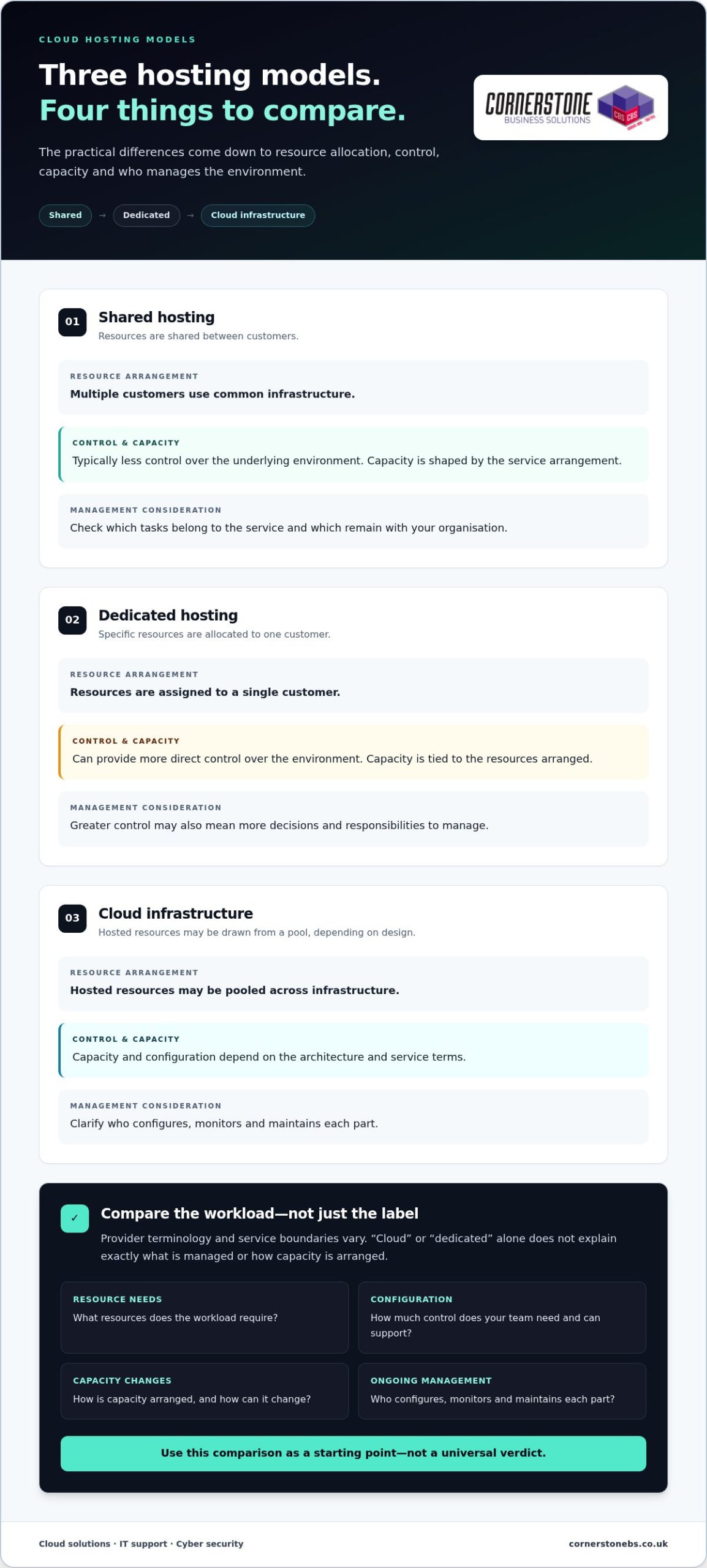
Hosting labels can sound similar, but the practical differences often come down to how resources are allocated, how much control you need and who manages the environment. Shared hosting places multiple customers on common infrastructure. Dedicated hosting allocates specific resources to one customer. Cloud infrastructure uses hosted resources that may be drawn from a pool, depending on its design.
Use this comparison as a starting point, not a universal verdict. Provider terminology and service boundaries vary, so “cloud” or “dedicated” alone won’t tell you exactly what’s managed or how capacity is arranged. Compare the same points for each option: resource allocation, configuration control, capacity changes and ongoing management.
Model
Resource arrangement
Control and capacity
Management consideration
Shared hosting
Infrastructure is shared between customers.
Typically offers less control over the underlying environment; capacity is shaped by the service arrangement.
Check which tasks sit with the service and which remain with your organisation.
Dedicated hosting
Specific resources are allocated to one customer.
Can provide more direct control over the environment; capacity is tied to the resources arranged.
Greater control may also mean more decisions and responsibilities to manage.
Cloud infrastructure
Hosted resources may be pooled across infrastructure.
Capacity and configuration depend on the architecture and service terms.
Clarify who configures, monitors and maintains each part.
What distinguishes shared hosting from dedicated hosting?
With shared hosting, customers use an environment that shares underlying resources. A dedicated arrangement assigns specific resources to one customer instead. That distinction may matter if a workload has particular configuration needs or requires clearer resource allocation. It doesn’t, by itself, predict how an application will perform. Consider the workload’s resource requirements, access needs and the level of control your team can support.
How does cloud infrastructure differ from a single hosted server?
A single hosted server is one defined computing environment. Cloud infrastructure can draw on a pool of hosted resources, but the architecture and ability to adjust capacity depend on its configuration. Management can range from customer-led to supported arrangements. Before comparing technical descriptions, map the workload’s dependencies, expected demand and management needs. That gives you a fairer basis for evaluating the setup.
For example, a steady internal application with predictable needs may call for a different balance of control and capacity from a service whose demand changes. Neither scenario automatically points to one model. In your “cloud hosting rotherham” research, compare the same criteria across options: resource allocation, configuration control, capacity changes, maintenance and the division of responsibilities.
For broader context on how cloud services fit into business technology, explore our cloud solutions guide. Cornerstone can help you consider a joined-up cloud and IT approach around your business requirements.
Cloud hosting concerns: security, control and business continuity
Moving systems into a hosted environment changes where some responsibilities sit, but it doesn’t automatically make security or continuity someone else’s problem. The hosting arrangement, the services included and your organisation’s own processes all matter. Understanding those boundaries helps you make practical decisions without assuming that cloud automatically means safer or more resilient.
Hosting security depends on configuration, clearly defined responsibilities and ongoing management. A provider may manage parts of the underlying infrastructure, while your business still needs to oversee who can access its systems, what information is stored and how accounts are managed. The exact division depends on the service and operating model.
Who is responsible for cloud hosting security?
Map responsibilities to the parts of the service. Clarify who looks after the hosting environment, who configures applications and who manages user access. Then identify who reviews permissions and responds when staff roles change. Shared responsibility doesn’t mean responsibility is unclear; it means each party needs to understand its part and how the handover works.
For your organisation, access controls and routine oversight are important considerations. Limit access according to people’s roles, review permissions as responsibilities change and establish a process for handling accounts that are no longer needed. Also define how data is governed internally, including who can use it and what processes apply. These steps remain relevant whether systems are hosted locally or remotely.
Security tools and provider controls can support a considered approach, but no hosting model is automatically secure or compliant. When comparing “cloud hosting rotherham” options, look beyond which one sounds most protected. Assess how configuration, access, oversight and responsibilities fit together for each workload.
How should hosting fit into business continuity planning?
Consider the effect of disruption before choosing a setup. Which applications must be available for essential work? How long could the organisation manage without them, and how much recent data could it afford to lose? These answers help define recovery needs and guide decisions about the systems and support processes that should sit around hosting.
Hosting, backups and disaster recovery are related, but they aren’t interchangeable. Hosting provides the environment in which systems run. A backup is a separate copy of data intended to support recovery, while disaster recovery concerns the broader process of restoring systems and services after disruption. A hosted workload still needs a suitable recovery plan; the hosting choice alone doesn’t describe that plan.
Useful questions to settle as part of planning include:
Which workloads are essential to keep business operations moving?
Who is responsible for maintaining access and reviewing permissions?
How will important data and services be restored after disruption?
Who coordinates the response across hosting, IT support and security?
For a wider view of how security supports resilience, explore the cyber security services guide. Bringing cloud decisions together with IT Support, Cyber Security and Off-Site Backups can help your organisation plan responsibilities as one connected picture.
How to assess cloud hosting needs before choosing a setup
A useful hosting review starts with the work your systems support, not a preferred technology label. Map each workload, its connections and the people who rely on it. Then separate essential requirements, such as access to a critical application, from desirable features that could be considered later. This keeps the decision grounded in business priorities and helps avoid planning a change before you understand what it needs to achieve.
Which workloads and dependencies should you map first?
Build an inventory of the applications under review, their users, connected systems and the data moving between them. Note who owns each application and how important it is to day-to-day operations. A system supporting a core business process may need different attention from a tool used occasionally. Mapping integrations and access needs also helps reveal dependencies that could affect operations if a component changes.
What should a cloud hosting readiness review cover?
Assess existing infrastructure alongside security priorities, access needs and continuity requirements. Cornerstone’s full site survey assesses network cabling, workstations, servers, switches and all internet devices, giving you a view of the environment around your workloads. This context can inform a considered cloud discussion without assuming migration is the right answer or that every system should move.
Use this sequence to organise your review:
Workloads: List the applications and services under consideration, what each one does and how critical it is.
Dependencies: Record connected systems, integrations, network links and data flows that support each workload.
Access: Identify who needs access, from where, and what access controls the work requires.
Data: Note what information each workload handles, where it is used and who is responsible for it.
Recovery needs: Decide which services need restoring first after disruption and what level of interruption the business can accept.
Internal responsibilities: Assign ownership for oversight, access changes, routine decisions and coordination with technical support.
Once the sequence is complete, mark each requirement as essential or desirable. For example, if staff need an application for daily operations, dependable access may be essential. A new feature that doesn’t address a defined business need may be optional. This distinction makes later comparisons clearer and helps keep the scope focused.
Existing equipment and network arrangements can influence what needs attention, but they don’t dictate a single migration path. A readiness review should clarify how the current environment supports each workload and where responsibilities sit. For a broader view of how ongoing support can fit into this planning, see the managed IT services guide.
If you’re assessing “cloud hosting rotherham” options, bring your workload inventory and priorities into a conversation with Cornerstone. Discuss your cloud hosting requirements as part of a joined-up view of your IT environment.
How Cornerstone can help shape a joined-up cloud approach
Cloud decisions work best when they account for the technology around each workload, not just where its computing resources sit. Cornerstone Business Solutions brings Cloud Solutions together with IT Support, Cyber Security and Off-Site Backups, helping businesses consider hosting alongside the wider systems and support that keep work moving.
A joined-up view can make the discussion more useful. A change to one workload may affect how people access it, how it connects to other systems and what the business needs if disruption occurs. The aim is to understand those connections and objectives before shaping an approach, rather than assume a particular hosting design is right from the outset.
What does a joined-up technology conversation cover?
Start with the business requirement. Which applications or services are in scope? Who relies on them, and what should the technology help the organisation do? From there, consider existing systems, access, security priorities and operational needs together. This keeps the focus on practical outcomes, not technical labels in isolation.
Cornerstone offers a one-call option across technical environments, including hardware, software, networking, cloud and security. This provides a connected way to discuss how different parts of an organisation’s technology relate to one another. Cornerstone partners with Microsoft, IBM and Cisco. These partnerships provide context for its technology work, but don’t mean a particular product or platform is automatically part of a cloud arrangement. The discussion should stay focused on your business requirements.
What is a practical next step for your organisation?
Before a conversation, gather notes about the workloads you’re considering and what each one supports. Include who needs access, the security concerns you want to address and what the organisation would need to recover after disruption. You don’t need a finished technical design. A clear picture of the business need is a useful place to begin.
Existing infrastructure matters too. Cornerstone’s full site survey assesses network cabling, workstations, servers, switches and all internet devices. This provides a structured view of the current environment to inform project discussions. It doesn’t assume that every system needs to move or prescribe a migration outcome in advance.
If you’re considering “cloud hosting rotherham”, bring your objectives and questions into a discussion that includes cloud, IT support and security requirements. Discuss your cloud requirements with Cornerstone.
Make your next cloud decision with confidence
The next step doesn’t need to be a commitment to a particular platform. Start by turning your business priorities into a brief: what needs to work, what could change and what would make a setup worthwhile. That gives your team a practical reference point as requirements evolve and keeps technology decisions connected to the way your organisation plans to grow.
If you’re considering “cloud hosting rotherham”, Cornerstone’s award-winning service can help you discuss how cloud needs fit with wider business technology. Bring your objectives and questions into focus without assuming the answer in advance.
Cloud hosting gives a business access to computing resources hosted away from its own premises. For example, a company might use a hosted environment to run a customer records application while staff connect to it over a network. The hosting resources support the application, but the application itself and the information it handles remain distinct parts of the setup. The precise arrangement depends on the service and its configuration.
Is cloud hosting suitable for small businesses?
It can suit a small business, but headcount alone doesn’t determine whether it’s a good fit. A small firm running a specialist application may have different requirements from one using basic online tools. Consider how essential each system is, who supports it and whether the business has the time and skills to manage its responsibilities. Compare options against those needs rather than assuming a smaller organisation needs a simpler setup.
Is cloud hosting secure?
Cloud hosting can be secure when the environment and business processes are configured and managed appropriately, but the label itself isn’t a security guarantee. A practical review should include who can create accounts, how access is removed when someone leaves and how unusual activity is handled. For example, a staff member changing roles may need different permissions. Define who oversees these tasks and how they fit into routine security management.
What is the difference between cloud hosting and a virtual server?
A virtual server is a software-based server environment, while cloud hosting describes a broader way of providing hosted computing resources. A virtual server may form part of a cloud arrangement, so the terms can overlap without meaning exactly the same thing. When comparing descriptions, look at how resources are provided, what can be adjusted and who manages the server environment. Those details matter more than the name used in a service description.
Can a business move existing workloads to cloud hosting?
Some existing workloads may be suitable to move, but each needs a compatibility review. Check whether the application depends on older software, a specific device or a connection to another system. For example, an accounts application linked to a local process may need more planning than a standalone tool. Document these dependencies and consider how the workload will be tested, accessed and supported before deciding whether a move makes sense.
How much does cloud hosting cost for a business?
There isn’t one cost that applies to every business. The amount depends on factors such as the workloads involved, resource requirements and the support or management included. To compare options fairly, list what each arrangement covers and separate initial setup from ongoing charges. Consider how usage could change as the business grows, too. That gives you a more useful comparison than a headline figure alone, since services may include different elements.
What should I prepare before discussing cloud hosting?
Bring a short inventory of the systems you use, who relies on them and what problems you want to solve. Note access requirements, connected equipment, security concerns and recovery priorities. Include relevant infrastructure details or a simple sketch of how systems connect. If you’re searching for “cloud hosting rotherham”, these notes can help make the conversation specific to your organisation, rather than focusing only on technical terminology.
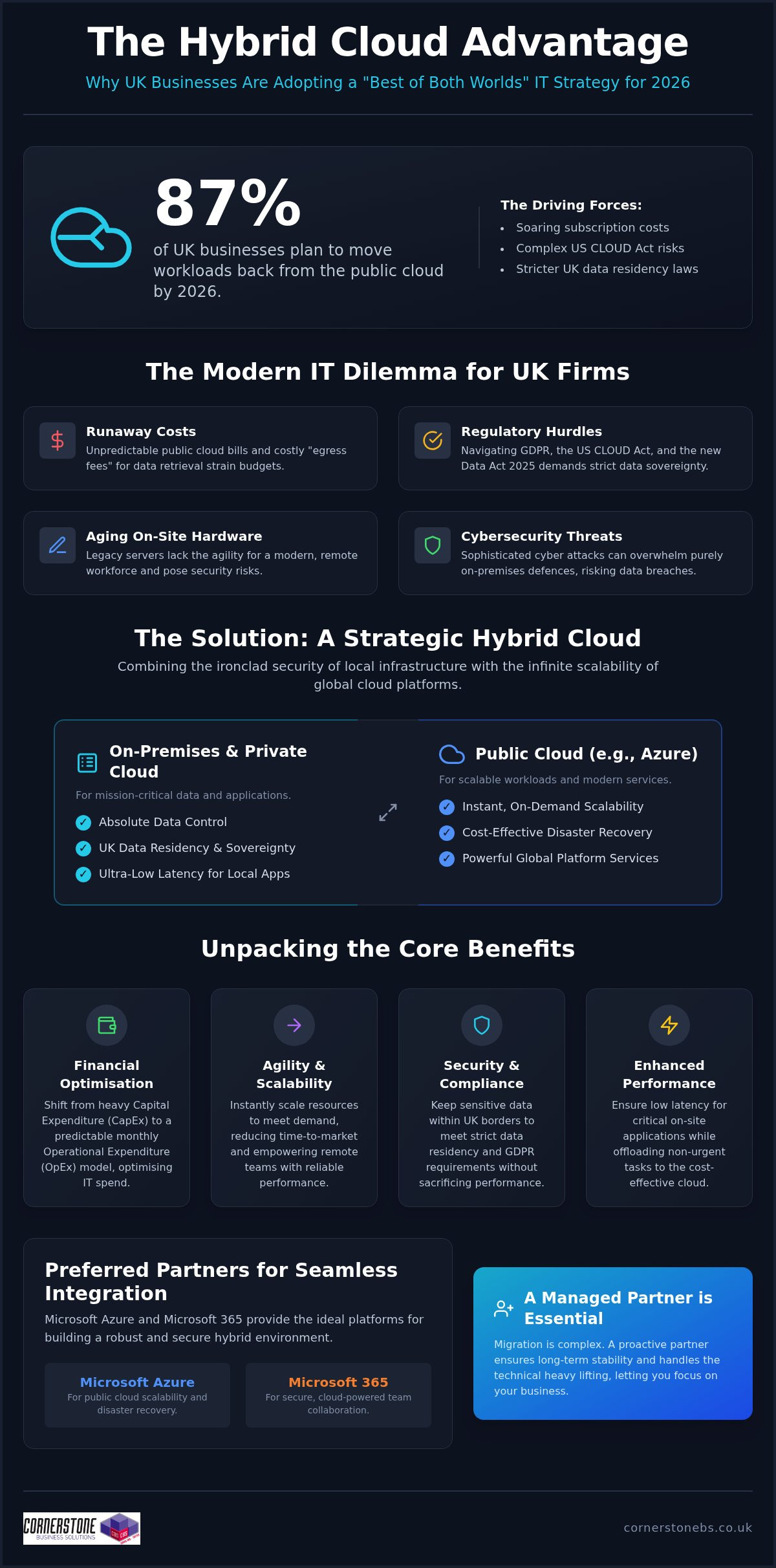
Did you know that 87% of UK businesses are planning to move at least some of their workloads back from the public cloud by the end of 2026? While the “all-in” cloud promise once seemed like the only way forward, many local firms now face soaring subscription costs and the complex jurisdictional risks of the US CLOUD Act. Understanding the hybrid cloud benefits for UK business is no longer just a technical choice. It’s a vital strategy to ensure your infrastructure remains agile and compliant in a rapidly shifting regulatory landscape.
We know how stressful it is to manage aging on-site hardware while trying to navigate the new Data (Use and Access) Act 2025. You need a system that supports your remote team without leaving your sensitive data exposed. This guide reveals how a bespoke hybrid model provides the emotional security of knowing your data is residency-compliant while slashing your capital expenditure. We’ll show you how to balance security, cost, and performance to create a scalable, bulletproof IT environment that’s ready for whatever 2026 throws your way.
Key Takeaways
Learn how a strategic mix of on-premises and private cloud systems provides the foundation for a modern, agile UK business infrastructure.
Discover the core hybrid cloud benefits for UK business, including the ability to scale resources instantly while moving from heavy CapEx to predictable monthly costs.
Understand how to keep your sensitive client data within UK borders to meet strict data residency and GDPR requirements without sacrificing performance.
Explore why Microsoft Azure and Microsoft 365 are the preferred partners for local firms looking for seamless integration and bulletproof disaster recovery.
Gain insights into why a proactive managed IT partner is the best way to handle migration complexity and ensure long-term business stability.
The Evolution of Infrastructure: Why Hybrid Cloud is the 2026 Standard
The days of the dusty server humming away in a back office cupboard are fading fast. For years, many UK SMEs relied on that “server in the corner” to run every aspect of their operations. While that model felt simple, it lacked the agility needed to support a modern, distributed workforce. By 2026, the standard has shifted toward a more sophisticated, distributed environment. One of the primary hybrid cloud benefits for UK business is the ability to maintain absolute control over sensitive data while tapping into the massive processing power of the public cloud.
When asking What is Hybrid Cloud?, it’s essentially a strategic orchestration between on-premises infrastructure, private cloud environments, and public platforms like Microsoft Azure. With 73% of organizations now running a hybrid environment, the UK market has matured significantly. Local firms are now balancing the need for seamless remote team access with the strict security demands of the Data (Use and Access) Act 2025. This model ensures you aren’t forced to choose between legacy reliability and modern innovation.
Hybrid cloud represents the “best of both worlds” for UK operational flexibility by combining the ironclad security of local hardware with the infinite scalability of global cloud platforms.
The “Best of Both Worlds” Philosophy
Public clouds are fantastic for cost-effective scalability and handling generic workloads like email or web hosting. However, mission-critical data often requires the dedicated environment of a private cloud or on-premises server to meet UK residency requirements. This hybrid bridge allows your business to pursue digital transformation without abandoning the reliable systems that have served you for years. It’s about placing the right workload in the right place to maximize efficiency and peace of mind.
Overcoming the Limitations of Single-Cloud Models
Relying 100% on a pure public cloud can lead to “egress fee” shocks. These are the hidden costs UK businesses face when trying to move their own data out of a provider’s ecosystem. Conversely, staying entirely on-premises is increasingly risky. Modern cyber threats are too sophisticated for a single local server to handle alone. A hybrid model eliminates vendor lock-in and provides the technical freedom to move data where it’s most efficient. It ensures your business isn’t held hostage by a single provider’s pricing or a single point of technical failure.
Unpacking the Core Hybrid Cloud Benefits for UK Business Growth
Performance is another area where the hybrid model shines. For latency-sensitive applications, such as local databases or heavy design software, keeping them on-site ensures your team isn’t slowed down by “lag.” Meanwhile, you can offload non-urgent tasks like disaster recovery and long-term backups to the cloud. This strategic split is one of the primary benefits of a hybrid cloud, providing speed where it’s needed and storage where it’s most cost-effective.
Operational Agility and Scalability
Optimising IT Spend and Resource Allocation
Financial stability is the backbone of any successful firm. Moving from heavy Capital Expenditure (CapEx) to a predictable, monthly Operational Expenditure (OpEx) model is a game-changer for budgeting. Many businesses discover they’ve been over-provisioning on-site servers “just in case.” A hybrid approach eliminates this waste. By using tailored cloud solutions, SMEs can finally access the same enterprise-grade technology as their larger competitors without the massive upfront price tag.
Managing this balance requires a steady hand and proactive oversight. To get the maximum ROI from these systems, many leaders choose to pair their infrastructure with professional Managed IT Support. This ensures your resources are always allocated correctly. It lets you focus on your business goals while a dedicated partner handles the technical heavy lifting. If you’re curious about how this could work for your specific setup, we’re always happy to have a quick, informal chat about your goals.
Security, Compliance, and Data Sovereignty in the UK
“Is the cloud actually safe for my sensitive client data?” This remains the most common question we hear from business owners across the UK. With PECR fines now reaching up to £17.5 million or 4% of global turnover as of February 2026, the stakes for data protection have never been higher. A hybrid approach provides the reassurance you need. It allows you to keep your most sensitive files on local, physical hardware while leveraging the cloud for general operations. This setup is a cornerstone of a modern security strategy that doesn’t compromise on speed or safety.
Data sovereignty is a major part of this conversation. Many firms don’t realize that using a standard US-based cloud provider can expose them to the US CLOUD Act. This legislation allows foreign law enforcement to request data regardless of its physical location. By using a hybrid model, you ensure your sensitive UK data stays strictly within our borders. This is vital for meeting the requirements of the Data (Use and Access) Act 2025. As of July 13, 2026, the UK government designated providers like Microsoft and Amazon as “Critical Third-Party Providers,” bringing their services under the direct oversight of the Bank of England and the FCA. Integrating robust Cyber Security Services into your hybrid environment creates a layered defence that protects your reputation.
Navigating UK GDPR and Data Residency
Knowing exactly where your data sits physically is the first step to true compliance. Hybrid models are perfect for sectors like finance, legal, and education where data residency is a legal necessity. You can store Personally Identifiable Information (PII) on-site or in a secure UK-based private cloud. This makes passing a GDPR audit much simpler. It also helps you achieve Cyber Essentials certification, proving to your clients that you take their privacy seriously. It’s about building trust through transparent, locally-focused data management.
Enhanced Disaster Recovery and Business Continuity
One of the most powerful hybrid cloud benefits for UK business is the ability to use the cloud as a high-speed “failover” site. If your local hardware fails or an office incident occurs, your team can keep working without missing a beat. Automated backups in the cloud protect you against the growing threat of ransomware by providing a clean point-in-time restore. Building a comprehensive disaster recovery plan is far easier when you aren’t relying on a single physical location. It gives you the emotional security of knowing your business is resilient, no matter what happens.
Integrating Hybrid Cloud with Microsoft 365 and Azure
For most UK firms, Microsoft Azure is the natural choice for a hybrid setup. As of July 13, 2026, Microsoft is officially designated as a Critical Third-Party Provider by the Bank of England and the FCA. This provides a level of regulatory oversight that other platforms simply cannot match. While Microsoft recently increased the price of Microsoft 365 plans, such as Business Basic rising to £5.33 and E3 to £33.48, the added value remains significant. These plans now include enhanced Microsoft 365 Copilot Chat and increased mailbox storage, making them even more central to your daily operations.
The real magic happens when you integrate Microsoft 365 with your on-premises Active Directory. This creates a “single source of truth” for your staff identities. Your team uses one login for their local PC, their email, and their cloud files. This seamless integration is one of the most practical hybrid cloud benefits for UK business, as it reduces password fatigue and closes security gaps. To ensure a smooth transition, we recommend following a structured Microsoft 365 Migration Guide to avoid data silos or sync errors.
The Synergy of Azure and On-Premises Systems
Azure Virtual Desktop (AVD) is another game-changer for the hybrid workspace. It allows your staff to access a high-performance, secure Windows environment from any device, anywhere in the UK. Your sensitive data stays safe in the cloud while your team enjoys the familiarity of their office desktop. Azure Stack essentially brings the immense processing power of the global cloud directly into your physical office, allowing you to run Azure services on your own local hardware. This ensures that even if your internet connection wavers, your core systems stay online.
Modernising Communication with Hybrid VoIP
As we approach the final stages of the UK PSTN switch-off, modernising your phone systems is no longer optional. A hybrid approach allows you to integrate cloud-based Business VoIP with your existing network infrastructure. This ensures your office phones and business mobiles work as one unified system. It provides the reliability of a physical network with the flexibility of a cloud-based exchange. You get crystal-clear calls and advanced features without having to rip and replace your entire setup.
Navigating these integrations can feel like a lot to take on alone. If you are ready to future-proof your setup, we invite you to explore our bespoke cloud solutions and see how we can build a system that works for you.
Navigating the Migration: Why a Managed Partner is Essential
Migration to a hybrid environment is a major strategic shift that requires much more than a simple “lift and shift” of your files. While the hybrid cloud benefits for UK business are clear, the process of getting there is often fraught with technical hurdles. Many firms attempt to manage this transition internally, only to be met with unexpected data loss or security misconfigurations that leave them vulnerable. A managed partner provides the expertise to map out your infrastructure correctly from day one, ensuring your move is smooth, secure, and tailored to your specific goals.
The real value of a dedicated partner lies in proactive monitoring. The old “break-fix” model, where you only call for help when a system goes down, is no longer sufficient for the fast-paced 2026 business environment. You need a team that identifies potential bottlenecks or security threats before they disrupt your operations. This proactive stance is one of the greatest hybrid cloud benefits for UK business, as it provides the emotional security of knowing your systems are resilient and your data residency is always compliant with the latest UK regulations.
Avoiding the Pitfalls of Do-It-Yourself Cloud
One of the biggest hidden costs in DIY cloud migration is the “security gap” created by misconfigured settings. Without expert oversight, it’s easy to leave sensitive directories exposed or fail to set up proper encryption for data in transit. Expert guidance ensures that legacy software continues to function in a distributed world without specific network adjustments. Investing in professional IT company solutions saves you money in the long run by avoiding these expensive mistakes and ensuring your essential tools remain fully operational throughout the transition.
The Cornerstone Business Solutions Approach: Bespoke, Award-Winning Support
At Cornerstone Business Solutions, we’re proud to be a multi-award-winning IT services provider with national UK coverage. Our approach is built on partnership rather than just transactions. We don’t just sell you a service; we become a long-term extension of your team. Our experts take the time to simplify complex technical jargon into clear, actionable business benefits, so you always know exactly what your investment is doing for you. We focus on building bespoke, reliable systems that grow alongside your firm, backed by our strong partnerships with industry leaders like Microsoft, IBM, and Cisco.
Every business infrastructure is unique, and your cloud strategy should be too. We invite you to join us for a no-obligation audit of your current IT setup. It’s a chance to have a friendly, informal conversation with our local experts about your challenges and goals. Let’s work together to build a secure, scalable foundation that keeps your business moving forward. Reach out today to start the conversation.
Future-Proofing Your Infrastructure for 2026 and Beyond
The landscape of UK business IT is moving fast. You’ve seen how a hybrid model balances the need for ironclad security with the flexibility of the public cloud. It’s the most reliable way to handle the Data (Use and Access) Act 2025 while keeping your operational costs predictable. By embracing the hybrid cloud benefits for UK business, you’re building a foundation that respects local data residency while leveraging global innovation.
As a multi-award-winning IT provider and proud partner of Microsoft, IBM, and Cisco, we specialize in building bespoke systems that fit your specific needs. We don’t believe in one-size-fits-all solutions. Instead, we focus on providing the emotional security and technical stability you need to grow your firm with confidence. Our team is ready to help you navigate the complexities of migration and proactive monitoring.
What are the main hybrid cloud benefits for UK businesses in 2026?
The primary hybrid cloud benefits for UK business include the ability to scale resources instantly while maintaining absolute control over sensitive data. This model allows you to keep mission-critical files on-site for security and speed, while offloading backups and generic workloads to the cloud to reduce capital expenditure. It is the most effective way to stay agile in a competitive market without sacrificing the stability of your local infrastructure.
How does hybrid cloud help with UK GDPR compliance?
Hybrid cloud simplifies compliance by allowing you to choose exactly where your data is stored. You can keep Personally Identifiable Information on secure, UK-based physical servers to meet strict residency requirements. This prevents your sensitive client data from being subject to foreign laws like the US CLOUD Act. It provides a transparent audit trail that makes meeting UK GDPR and Data (Use and Access) Act 2025 standards much more manageable.
Is hybrid cloud more expensive than traditional on-premises servers?
While there is an initial setup cost, hybrid cloud is often more cost-effective over time. It shifts your IT spend from heavy upfront capital expenditure to a predictable monthly operational model. You no longer need to pay for high-end hardware that sits idle most of the year. By scaling your cloud usage to match your actual workload, you eliminate the waste of over-provisioned local servers while enjoying enterprise-grade technology.
Can I use hybrid cloud if I already have Microsoft 365?
Yes, Microsoft 365 is designed to work seamlessly within a hybrid environment. You can sync your on-premises Active Directory with the cloud so your team uses a single login for everything. This integration improves security and reduces password fatigue for your staff. It allows you to keep large databases on-site for speed while your team uses cloud-based tools like Teams and Outlook for daily communication and collaboration.
What is the difference between hybrid cloud and multi-cloud?
Hybrid cloud combines your private on-premises infrastructure with a public cloud provider like Microsoft Azure. It is about bridging the gap between your local office and the digital world. Multi-cloud refers to using several different public cloud providers at once to avoid relying on a single vendor. Most UK firms find that a hybrid model offers the best balance of security and performance without the complexity of managing multiple external contracts.
How long does it take to migrate to a hybrid cloud environment?
Migration timelines vary depending on the size of your data and the complexity of your current software. A straightforward setup might take a few weeks, while a full enterprise transition could take several months. We always recommend a phased approach to ensure zero downtime for your team. This allows us to test each system thoroughly before moving to the next stage, providing a smooth experience for your staff and customers.
Do I need a managed IT partner for hybrid cloud migration?
While you could attempt it alone, a managed partner ensures your migration is secure and efficient. Partnering with experts allows you to unlock the full hybrid cloud benefits for UK business, as we handle the complex technical heavy lifting and network adjustments. A partner provides proactive monitoring that identifies potential issues before they cause downtime. This gives you the emotional security of knowing your business is in expert hands.
How does hybrid cloud improve disaster recovery for UK firms?
Hybrid cloud creates a bulletproof safety net by using the cloud as a secondary failover site. If your physical office suffers an incident, your team can switch to the cloud version of your systems instantly. Automated, point-in-time backups protect you against ransomware by providing a clean copy of your data for quick restoration. It is a foundational element of business stability that ensures your firm remains resilient against any local hardware failure.
Did you know that 87% of UK businesses are now planning to move workloads away from global hyperscalers and back to domestic providers? This shift is driven by leaders seeking the specific benefits of a hybrid cloud strategy to maintain local control and data sovereignty. We know that managing your IT in 2026 feels like a constant balancing act. You need the agility of the public cloud to stay competitive, yet the fear of losing grip on sensitive data or facing unpredictable monthly costs is a heavy burden. It is often exhausting to manage legacy systems alongside new tech while trying to stay compliant with the Data (Use and Access) Act 2025.
We believe that technical complexity should never be the price of your progress. This article explores how a balanced cloud approach provides the ultimate combination of security, scalability, and cost-efficiency for modern organisations. We will provide a clear framework for balancing security with speed, helping you reduce IT overhead and build a future-proof infrastructure. You will gain a clear understanding of how a tailored cloud approach acts as a foundational element of your business stability and emotional security, ensuring your growth remains steady and protected.
Discover how a unified ecosystem provides a level of reliability and agility that separate servers simply cannot match.
Uncover the core benefits of a hybrid cloud strategy, including the ability to burst capacity during busy periods without overpaying for idle resources.
Learn to bridge the complexity gap by preventing data silos and ensuring your public and private clouds work in perfect harmony.
Follow our five-pillar framework to conduct a thorough infrastructure audit, ensuring your journey to the cloud is stable and secure.
See how partnering with a local, multi-award-winning expert transforms your digital infrastructure into a long-term engine for growth.
Many business owners once viewed the hybrid cloud as a temporary compromise. They saw it as a halfway house for companies that weren’t quite ready to let go of their physical servers. By 2026, that perspective has completely shifted. We now recognize that a hybrid model is actually the most sophisticated and resilient architecture available. It is a unified ecosystem where public services, private clouds, and on-premises hardware work as a single, cohesive unit. It is not just a collection of separate parts; it is a strategic engine for growth.
One of the primary benefits of a hybrid cloud strategy is the powerful synergy it creates. You get the rock-solid reliability of on-premises systems alongside the rapid agility of the public cloud. This year, we have seen a move toward “smart cloud” strategies. Rather than a “cloud first” approach that pushes everything to the web regardless of the cost, smart cloud focuses on placing workloads where they perform best. This framework also serves as a cornerstone for modern disaster recovery. By spreading your data across different environments, you ensure that your business remains stable even if one platform experiences an outage.
The Three Pillars: Public, Private, and On-Premises
To understand the full strength of this model, we have to look at its three core components:
Public Cloud: Platforms like Microsoft Azure provide nearly infinite scale. They are perfect for handling general applications and massive data processing without the need for upfront hardware investment.
Private Cloud: These are essential for your high-security or bespoke applications. They offer a dedicated environment where you have total control over the configuration and security protocols.
On-Premises: Your local hardware still provides a critical anchor for data that requires immediate, high-speed access within your office.
Why “Cloud First” is Evolving into “Cloud Right”
The “cloud first” mantra often led to unpredictable monthly bills and a feeling of lost control. We are now seeing a significant trend where 87% of UK businesses plan to repatriate at least a portion of their workloads from global providers back to domestic ones. This “cloud right” movement is about regaining cost control and ensuring data sovereignty. A hybrid approach is the best way to prevent vendor lock-in, giving you the freedom to move your data as your business evolves. It provides the flexible foundation needed for modern cloud solutions that prioritize your specific business goals over generic tech trends. We focus on building a system that feels right for your team and your budget.
The true power of this model lies in its ability to adapt to your specific business cycle. One of the most immediate benefits of a hybrid cloud strategy is the ability to handle “burst” capacity. Imagine your website traffic spikes during a seasonal promotion or a major product launch. Instead of your local servers crashing under the weight, the system automatically offloads the extra demand to the public cloud. You only pay for that extra power while you need it. Once the rush is over, your operations return to their cost-efficient, steady-state environment on-premises or in a private cloud. This prevents you from over-investing in expensive hardware that sits idle for ten months of the year.
Security remains a top priority for every UK business owner we speak with. A successful hybrid cloud strategy allows you to keep your most sensitive customer data within a tightly controlled private environment. You get the best of both worlds: the speed of the public cloud for non-sensitive applications and the fortress-like security of a private cloud for your core assets. Additionally, hybrid setups allow for “edge” processing. By processing data closer to where it is generated, you reduce latency and ensure your team can work at peak performance without waiting for files to travel across the globe. It’s about making your technology work at the speed of your best ideas.
Data Sovereignty and UK Compliance
Compliance is no longer just a checkbox; it is a foundation of trust. With the full implementation of the Data (Use and Access) Act 2025, knowing exactly where your data resides is critical for meeting UK GDPR standards. A hybrid model ensures your “crown jewel” data stays within UK borders, providing total transparency for auditors and peace of mind for your clients. This level of control is a vital part of your broader cyber security services, protecting you from the rising fines associated with data mishandling. We believe that knowing your data is safe allows you to focus on growth rather than risks.
Operational Agility and Scalability
Speed is everything in a modern market. Hybrid cloud allows your team to test new applications in a public cloud sandbox without risking your core business systems. If the test succeeds, you can scale it up in minutes. If it doesn’t, you simply switch it off. This agility ensures you are always ready for the next opportunity. The ROI of hybrid scalability is far superior to fixed hardware investments because it transforms capital expenditure into manageable, predictable operational costs. If you want to see how these advantages fit your specific setup, our team can provide managed cloud expertise tailored to your long-term goals.
The most common objection we hear from business owners is a simple one: “Isn’t running two different environments twice the work?” It’s a valid concern. If your public and private clouds don’t communicate effectively, you risk creating “data silos” where information is trapped in one system and inaccessible to the other. This lack of integration leads to inefficiency and makes it difficult to maintain a clear view of your entire IT estate. We believe that the key advantages of using a hybrid cloud strategy only truly shine when your systems are unified. Without that visibility, you’re essentially flying blind.
Managing this dual environment requires a specific set of skills. Your internal IT team might be brilliant at maintaining your local servers, but they may not have the deep expertise required to optimize complex cloud platforms. Expecting a small team to master both worlds often leads to burnout and oversight. In fact, industry data shows that misconfigurations and data breaches are cited as key risks by 40-50% of IT leaders. This is why the human element of management is just as important as the technology itself. You need a partner who understands the nuances of both the physical and the virtual.
The Myth of the “Complicated” Hybrid Setup
Modern orchestration tools have changed the game. These platforms act as a single “pane of glass,” allowing us to manage your entire hybrid estate from one place. Automation plays a massive role here, too. It handles routine security patches and updates across both environments simultaneously, reducing the chance of human error. We handle the heavy lifting behind the scenes. You get all the benefits of a hybrid cloud strategy without the headache of day-to-day technical maintenance. It’s about giving you the freedom to run your business while we ensure the engine is always humming.
Bridging the Skills Gap with Managed IT
Hiring a full-time specialist for every cloud platform you use is rarely cost-effective for medium-sized enterprises. Partnering with a dedicated provider gives you access to a whole team of experts for a fraction of the cost. We provide proactive monitoring that spots potential issues before they become expensive problems. Our managed IT services provide the oversight you need to ensure your hybrid framework is always performing at its best. We act as an extension of your own team, offering the regional warmth and technical authority you can rely on for the long term.
Moving to a hybrid model is a strategic journey, not a one-time switch. It requires a thoughtful approach that respects your current setup while preparing for future growth. You’ll find that one of the long-term benefits of a hybrid cloud strategy is the ability to evolve your infrastructure without disrupting your daily operations. Success starts with a clear roadmap. We help you prioritise workloads based on risk, cost, and performance needs, ensuring that each piece of data sits in its most efficient home. This isn’t about moving everything at once; it’s about moving what makes sense, when it makes sense.
Understanding the benefits of a hybrid cloud strategy also means recognising that your network infrastructure acts as the glue for this entire framework. Without seamless connectivity, your public and private environments won’t talk to each other effectively. This is where many businesses stumble. They focus on the cloud but forget the physical links that make it work. We ensure your local network is strong enough to handle the constant flow of data between sites. It’s a proactive way to build a system that supports your team’s productivity instead of hindering it.
The Audit and Assessment Phase
Before moving a single byte of data, you must conduct a comprehensive audit. This phase identifies which applications thrive in the public cloud and which require the “anchor” of a private environment. We also evaluate your current hardware lifecycles to time your transition perfectly, avoiding unnecessary waste. It is vital to conduct thorough latency testing to ensure your hybrid connections don’t slow down your team’s daily workflows. This data-driven approach removes the guesswork from your digital transformation and keeps your costs predictable.
Security by Design
Security isn’t something you bolt on at the end. We implement a “Zero Trust” model across your entire hybrid estate, ensuring that every access request is verified, regardless of where it originates. This proactive stance keeps your sensitive information safe while maintaining the flexibility your team needs. A successful plan often involves a structured Microsoft 365 migration as part of your wider cloud strategy. Consistent backup and disaster recovery protocols across both environments provide the ultimate safety net for your business.
If you’re ready to build a more resilient future, our team is here to help. You can speak with our local experts to start your infrastructure audit today.
We believe that your technology should be a source of strength, not a source of stress. As a multi-award-winning partner for hybrid solutions, we don’t just provide a service; we act as your dedicated, long-term technology partner. We bring the professional authority of a team that works alongside global brands like Microsoft, IBM, and Cisco, yet we maintain the approachable, regional warmth of a locally based expert. By choosing a partner who understands the specific benefits of a hybrid cloud strategy, you transform your IT from a cost centre into a strategic growth engine. We take the time to simplify complex concepts so you can make informed decisions with confidence.
Our focus is always on your business continuity. We frame technical support as a foundational element of your emotional security, giving you the peace of mind to focus on your clients while we manage the background noise. This collaborative approach moves away from transactional relationships and towards a true partnership based on trust and reliability. Our goal is to ensure your infrastructure is as resilient as the business you have built. We are proud of our geographical roots and remain committed to helping organisations across the country scale securely.
Bespoke Solutions for National Growth
Every business is unique, and your infrastructure should reflect that. We design hybrid strategies that align perfectly with your specific commercial goals, whether you are managing a local office or a national operation. Our proactive monitoring systems are built to spot potential issues and prevent downtime before it ever reaches your team. You also gain the benefit of our unlimited helpdesk support, ensuring that an expert is always reachable for your staff. This level of customisation ensures that your technology supports your growth rather than holding it back. We provide the clarity of an expert who wants to see your business thrive.
Start Your Hybrid Journey Today
Digital transformation doesn’t have to be overwhelming. Our it company solutions are designed to simplify the process, providing a clear path toward a more resilient infrastructure. We invite you to an informal, no-obligation conversation about your current IT estate. It is an opportunity to explore how the benefits of a hybrid cloud strategy can be tailored to your specific needs. Let’s work together to build a future-proof foundation for your business stability and long-term success. We are ready to help you navigate the next chapter of your digital growth with confidence and ease.
A hybrid cloud approach is no longer a temporary fix. It is the most sophisticated way to ensure your business remains agile, secure, and cost-effective in an increasingly complex digital landscape. By integrating the scalability of public services with the ironclad security of private environments, you create a unified ecosystem that protects your “crown jewel” data while allowing your team to innovate at speed. Embracing the benefits of a hybrid cloud strategy means you are choosing stability over uncertainty and control over complexity.
We believe that every UK business deserves an IT infrastructure that works as hard as they do. As a multi-award-winning IT services provider, we combine our deep regional roots with global expertise through partnerships with Microsoft, IBM, and Cisco. Our team provides the proactive monitoring and unlimited helpdesk support required to keep your systems running flawlessly. We invite you to take the next step toward a more secure future. Book a free consultation with our cloud experts to build your bespoke hybrid strategy and discover how a partnership built on trust can transform your operations. Let’s start the conversation today.
What is the main difference between hybrid cloud and multi-cloud?
Hybrid cloud combines different types of infrastructure, such as public services, private clouds, and on-premises hardware, into a single ecosystem. Multi-cloud refers to using multiple providers of the same type, like having accounts with both Microsoft Azure and AWS. While multi-cloud focuses on avoiding provider lock-in, a hybrid model is about finding the perfect balance between local control and cloud agility for your specific workloads.
Is a hybrid cloud strategy more expensive than using a single cloud provider?
It is often more cost-effective in the long run. While initial setup requires careful planning, you avoid the “bill shock” of unpredictable public cloud costs by keeping steady workloads on fixed-cost local hardware. You only pay for public cloud “burst” capacity when you actually need it. This approach transforms your IT spend into a predictable operational expense that aligns with your actual usage.
How does hybrid cloud improve my business disaster recovery plan?
It creates a diversified safety net for your data. By spreading your assets between on-premises systems and the cloud, you ensure that a single provider outage or hardware failure doesn’t halt your operations. One of the core benefits of a hybrid cloud strategy is this built-in redundancy. It allows us to implement proactive monitoring and rapid recovery protocols that keep your business stable during unexpected events.
Can I keep my existing on-premises servers in a hybrid cloud setup?
Yes, your existing hardware remains a vital part of the framework. In a hybrid setup, your local servers act as a critical anchor for data that requires high-speed access or has specific residency needs. We don’t believe in wasting your current investments. Instead, we integrate your reliable on-premises assets into a modern environment, ensuring they work in perfect harmony with your new cloud-based solutions.
Is hybrid cloud secure enough for highly regulated industries like finance or healthcare?
It is often the preferred choice for regulated sectors. You keep sensitive patient records or financial data in a private, tightly controlled environment to meet UK GDPR and the Data (Use and Access) Act 2025. Less sensitive applications can then run in the public cloud. This separation ensures your “crown jewel” data stays isolated from broader risks while still giving your team the tools they need.
How long does it typically take to implement a hybrid cloud strategy?
A structured transition typically takes between three and six months. We treat this as a journey rather than a one-time switch to protect your business continuity. The process begins with a comprehensive audit of your current estate, followed by a phased migration of your workloads. This steady pace ensures that your team remains productive and your systems stay stable throughout the entire digital transformation.
What kind of internet connection do I need for a successful hybrid cloud environment?
You need a resilient, low-latency connection, such as a dedicated leased line. Because data flows constantly between your local office and the cloud, your network infrastructure must be strong enough to handle the traffic without bottlenecks. We assess your current connectivity as part of our initial audit. If an upgrade is needed, we ensure it provides the strength and reliability required for seamless operations.
Does a hybrid cloud strategy require me to hire more IT staff?
No, you don’t need to expand your internal team if you work with a managed partner. While managing a dual environment requires a specific set of skills, we handle that complexity for you. We act as your long-term technology partner, providing the expert oversight and helpdesk support you need. This allows your existing staff to focus on driving your business forward while we manage the technical engine.
Last Tuesday, a business owner in Teesside discovered that a single unpatched server could halt their entire production line for six hours. You already know that even a brief outage costs your business an average of £3,600 per hour in lost productivity, based on 2024 UK business continuity data. It’s a stressful, avoidable situation that leaves many local leaders questioning if their aging hardware can actually handle their 2026 growth ambitions.
We’re here to change that narrative and give you back your peace of mind. This guide shows you how award-winning it infrastructure support provides the robust foundation you need for total stability and proactive security. You’ll discover how to move past the confusion of hybrid cloud setups to achieve a seamless, “always-on” environment. We’ll outline a clear roadmap to help you eliminate hidden vulnerabilities, keep your technology costs predictable, and ensure your business is ready to scale with confidence.
Key Takeaways
Move beyond basic helpdesks to understand how strategic management provides a robust foundation for your business stability in 2026.
Discover why proactive it infrastructure support is the key to eliminating unpredictable costs and the frustration of extended system downtime.
Learn to identify the core physical and virtual pillars that require constant monitoring, with cybersecurity integrated as a fundamental layer.
Uncover the non-negotiable qualities of a top-tier partner and how vendor expertise with leaders like Cisco and Microsoft drives scalable growth.
See how our award-winning, UK-based team acts as a long-term partner to provide the peace of mind your business needs to flourish.
What is IT Infrastructure Support and Why Does Your Business Need It?
IT infrastructure support is the proactive management of your entire digital foundation. It covers every piece of hardware, software, and network component that keeps your North East business moving. Many leaders start by asking What is IT Infrastructure? to understand the physical assets they own, but support is the active layer that ensures those assets deliver value. It represents a shift from reactive fixing to strategic oversight. While a basic IT helpdesk is tactical and solves immediate user problems, it infrastructure support looks at the bigger picture to prevent those problems from occurring in the first place.
Our award-winning approach moves beyond the “break-fix” model. We treat your technology as a living ecosystem that requires constant tuning. This proactive stance provides business continuity and genuine peace of mind. You don’t just want your systems to work; you want them to drive your company forward. Effective support ensures that your servers, cloud platforms, and security protocols are always aligned with your commercial goals.
The Evolution of Infrastructure in 2026
The tech landscape has changed rapidly. In 2026, infrastructure isn’t confined to a server room in your office. It now includes sprawling cloud environments, mobile devices, and remote access points that span the globe. This “everywhere” infrastructure requires a sophisticated management style. A “set and forget” strategy is now a dangerous gamble because modern threats and software updates move too fast for static systems.
Businesses now rely on IT company solutions to manage this complexity. We help you integrate hybrid cloud models and secure remote workflows so your team stays connected without compromising safety. This evolution means your support partner must be as agile as the technology they manage. We focus on creating a seamless experience where the technical mechanism stays invisible, leaving you free to run your business.
The Business Impact of Poor Support
Weak support leads to more than just minor inconveniences. It creates “technical debt,” where outdated systems become so inefficient they actually hinder your ability to innovate. According to 2025 UK business data, mid-sized enterprises face significant hurdles when their tech can’t keep up with market demands. Poorly managed it infrastructure support results in frequent downtime, which carries a heavy price tag. Beyond lost revenue, you face a damaged reputation and a workforce that feels drained by unreliable tools.
Lost productivity costs UK SMEs an average of £5,000 per hour during major outages.
Security vulnerabilities in unpatched hardware increase the risk of data breaches.
Employee retention drops when staff are forced to use slow, clunky systems.
Downtime cost is the total sum of lost revenue, employee wages paid during idleness, and the specific financial resources required to restore system functionality after a failure. It’s a metric every CEO should track. By investing in robust support, you turn a potential liability into a stable platform for growth. We pride ourselves on being a local partner that understands these stakes, providing the reliability you need to compete on a national stage.
The Core Pillars of Modern IT Infrastructure Support
Reliable it infrastructure support requires a holistic view of your business technology. It isn’t enough to fix things when they break; you need a strategy that covers every layer, from the physical cables in your office to the virtual servers in the cloud. We build our support models on the principle that cybersecurity is a foundation, not an optional add-on. Every decision we make prioritises the safety of your data and the continuity of your operations. This proactive stance is what separates an award-winning partner from a standard helpdesk.
Communication systems now form a vital part of this ecosystem. VoIP and integrated mobile solutions allow your team to stay connected whether they’re in Teesside or working remotely. Managing these systems ensures your clients can always reach you without delay. We also focus heavily on hardware lifecycle management. Replacing equipment every 3 to 5 years prevents the performance dips that frustrate staff and slow down your business. Proactive planning helps you avoid the sudden £5,000 emergency bill when an old server finally gives up. Modern IT Infrastructure relies on this constant vigilance to stay ahead of potential issues.
Hardware, Servers, and Networking
Hardware remains the backbone of your office. Using proactive IT maintenance reduces the risk of hardware failure by 70% according to 2024 industry benchmarks. We monitor your physical and virtual servers to ensure they’re patched and optimised for peak performance. A slow network is a productivity killer. We maintain robust Wi-Fi and wired connectivity so your internal operations remain seamless and fast. Our North East based team keeps your backbone strong so you can focus on growth.
Cloud and Hybrid Environments
The shift to cloud solutions and Azure environments has changed how it infrastructure support works. You need 24/7 monitoring to prevent service outages in cloud-based systems that could halt your business. We ensure data synchronisation is perfect across your remote teams, so everyone sees the same information in real-time. This hybrid approach offers flexibility without sacrificing security. If you’re unsure if your current setup is truly resilient, we can have a quick chat about your goals to see where we can help. We aim to provide the peace of mind that comes with a perfectly managed environment.
Proactive Support vs. Reactive Fixes: Choosing the Right Strategy
Choosing how to manage your technology is a defining moment for your business growth. Many North East firms still rely on the “break-fix” model, calling for help only when a screen goes black or a server fails. This reactive approach creates a cycle of stress and financial volatility. It’s the difference between fire-fighting and fire prevention. Our award-winning it infrastructure support moves you away from this chaos and into a state of total operational stability.
The transition to managed support provides a level of peace of mind that reactive fixes simply cannot match. Instead of waiting for a disaster to strike, you have a dedicated partner watching your systems 24/7. We identify a failing hard drive or a security loophole before it impacts your staff. Understanding the importance of IT infrastructure helps business owners realise that these components require constant care, not just occasional repairs. This shift allows you to focus on your core business goals while we handle the technical heavy lifting.
The Hidden Costs of the Break-Fix Model
The “cheaper” option often ends up being the most expensive. When you rely on reactive fixes, you’re at the mercy of emergency call-out fees, which frequently exceed £150 per hour in the UK. If a critical component fails, you might face hardware rush-shipping costs of £100 or more just to get back online. The financial sting doesn’t stop there. The 2024 Cyber Security Breaches Survey found that 50% of UK businesses experienced a breach, often due to unpatched systems that a reactive model ignored. Proactive monitoring is the 2026 standard for UK SMEs, ensuring your business stays protected and operational without the shock of “emergency” invoices.
The Managed Support Advantage
Managed it infrastructure support replaces unpredictable bills with a fixed, transparent monthly fee. This makes budgeting simple and effective. You gain several strategic advantages that a local “man-with-a-van” IT service cannot provide:
Unlimited helpdesk access: Your team can call for help as often as they need without you worrying about per-hour billing.
Strategic roadmapping: We look ahead to see when your hardware will reach its end-of-life, allowing you to plan replacements 12 months in advance.
Seamless integration: Our award-winning support teams act as a natural extension of your own business, learning your specific workflows and preferences.
We pride ourselves on being a local partner with a global standard of expertise. If you’re tired of tech-induced headaches, let’s have a chat about how a proactive partnership can protect your bottom line.
Key Features to Look for in an Infrastructure Support Partner
Selecting the right partner for your it infrastructure support isn’t a decision to take lightly. You need more than a reactive helpdesk; you need a proactive team that treats your business goals as their own. In the UK, where 32% of businesses identified a cyber attack in 2023 according to government data, having a robust partner is a baseline requirement for survival. We believe the best partnerships are built on a “chat-first” philosophy. This means we prefer a quick conversation to solve a problem before it escalates, rather than hiding behind a faceless ticketing system.
Top-tier providers move away from rigid, one-size-fits-all packages. Your business is unique, so your support should be bespoke. Whether you’re a growing firm in the North East or a multi-site operation with a UK-wide reach, your infrastructure needs to be tailored to your specific workflows. We focus on creating seamless systems that allow you to work without technical friction, providing the peace of mind that everything is handled by experts.
Certifications and Industry Partnerships
Reliability starts with the company your partner keeps. Our award-winning status is backed by deep-rooted partnerships with global leaders like Microsoft, Cisco, and IBM. These aren’t just logos on a website; they represent direct access to advanced training and priority technical resources. When your local business uses systems supported by these global brands, you get the best of both worlds: world-class technology delivered with regional warmth and understanding. A Microsoft Solutions Partner designation ensures your cloud transitions are handled with precision, reducing the risk of downtime during critical migrations.
Service Level Agreements (SLAs) and Response Times
An SLA is your guarantee of service quality. You should look for clear, punchy uptime guarantees and response speeds that reflect the urgency of your operations. Even if your office door closes at 5:00 PM, your digital infrastructure never sleeps. Proactive 24/7 monitoring is essential to catch a failing server at 3:00 AM before your staff logs on the next morning. This proactive stance is what separates a standard provider from a true partner. We focus on disaster recovery and data backups that are tested regularly, ensuring that if the worst happens, your data is recovered in minutes, not days.
Our approach combines this technical rigour with a friendly, human face. We’ve built our reputation on being approachable experts who simplify complex tech. We don’t just fix things; we help you grow by ensuring your foundation is rock solid. If you’re looking for a partner that values your success as much as you do, it’s time to move beyond transactional IT support.
Cornerstone Business Solutions stands as an award-winning partner for businesses across the UK. We don’t believe in transactional relationships. Our philosophy centers on a true partnership; your growth directly fuels our own success. We’ve built a reputation for delivering robust it infrastructure support that spans everything from mobile communications to advanced cyber security protocols. We want to take you from a place of technology anxiety to a state of total technology confidence. It’s about giving you the peace of mind to focus on your core business while we handle the digital heavy lifting.
Our approach is proactive rather than reactive. We don’t wait for things to break before we step in. Instead, we monitor your systems 24/7 to catch potential issues before they impact your bottom line. This level of dedication has earned us our status as a trusted local expert with national reach. We remain deeply connected to our North East roots, bringing a sense of regional warmth and reliability to the high-tech world of managed services.
Bespoke Solutions for Every Sector
Infrastructure requirements vary wildly between sectors. A growing SME requires scalability, while an educational institution prioritises security and uptime for hundreds of users. We provide bespoke solutions tailored to these unique demands. Having a single point of contact for your IT, Cloud, and Comms simplifies your operations and removes the frustration of juggling multiple vendors. Our award-winning UK support team is known for its proactive, “can-do” attitude. We’re committed to making technology work for you, not the other way around. Whether you’re managing a single office or a multi-site national enterprise, our team ensures your systems remain seamless and efficient.
Tailored IT roadmaps for SMEs and schools
Unified communications including mobile and VoIP
Advanced cyber security protection as standard
Direct access to UK-based technical experts
Ready for a Chat? Your Next Steps
Identifying the weaknesses in your current setup doesn’t have to be a daunting task. Often, a quick conversation is all it takes to spot the vulnerabilities that could hinder your progress. When you join us, our onboarding process begins with a deep-dive system audit. We examine every corner of your network to ensure it meets the demands of a 2026 business environment. This clarity allows us to build a roadmap that supports your long-term goals. If you’re ready to move away from reactive fixes and toward a proactive strategy, let’s have a chat about your IT infrastructure support. We’ll show you how a local team with national reach can transform your business foundation and provide the stability you need to scale with confidence.
Secure Your Business Future Today
Success in 2026 requires more than just functional hardware; it demands a resilient digital foundation. Moving from reactive fixes to proactive monitoring ensures your operations remain uninterrupted, protecting your bottom line from costly downtime. By leveraging strategic partnerships with industry leaders like Microsoft, Cisco, and IBM, you gain access to world-class expertise tailored to your specific business needs.
Effective it infrastructure support isn’t just a technical service; it’s a partnership that provides genuine peace of mind. Our multi-award-winning team offers unlimited helpdesk access and 24/7 monitoring, ensuring your North East business stays ahead of the curve. We pride ourselves on being a local partner that understands your challenges and delivers clear, punchy solutions without the confusing jargon. It’s time to build a platform for growth that’s as ambitious as your vision.
We’re ready to help you take the next step toward a more secure and efficient future.
Frequently Asked Questions
What exactly is included in IT infrastructure support?
IT infrastructure support covers the management of your entire technology backbone, including servers, storage, network hardware, and cloud environments. Our award-winning team monitors your physical and virtual assets to ensure they remain stable and secure. We handle everything from routine software updates to complex server migrations. This proactive approach prevents downtime before it impacts your daily operations.
Is infrastructure support the same as an IT helpdesk?
No, infrastructure support focuses on the engine room of your business rather than individual user queries. While a helpdesk assists staff with password resets or printer issues, infrastructure support maintains the servers and networks that allow those tools to function. It’s the foundation of your digital environment. We ensure your core systems are robust enough to support your entire team without interruption.
How much does IT infrastructure support cost for a UK business?
UK businesses typically invest between £50 and £150 per user each month for managed IT services according to 2024 industry benchmarks. These costs vary based on the complexity of your network and the level of 24/7 monitoring required. We provide tailored quotes that reflect your specific needs. This ensures you only pay for the exact level of partnership your North East business requires to thrive.
Do we need on-site support, or can everything be managed remotely?
We resolve 95 percent of technical issues through remote monitoring and management tools, which provides the fastest possible fix. However, physical hardware failures or major office moves require a local expert on the ground. Being North East based allows us to reach your site quickly when a hands-on approach is necessary. You get the speed of remote support combined with the reliability of local engineers.
How does infrastructure support help with cyber security?
Robust it infrastructure support acts as your first line of defence by managing firewalls, encrypting data, and automating security patches. We ensure your backups run every day so you can recover quickly from any potential threat. Cyber security isn’t a one-time setup; it’s a constant process of monitoring and hardening your network. This proactive stance protects your reputation and keeps your data safe.
What happens if our business grows quickly, can the support scale?
Our support scales instantly to match your growth, whether you’re adding five new employees or opening a second location. We use cloud-based technologies and flexible service agreements to ensure your IT never becomes a bottleneck. As your dedicated partner, we plan your capacity requirements 12 months in advance. This foresight means your infrastructure is always ready for the next stage of your business journey.
What is the typical response time for an infrastructure emergency?
We aim to respond to critical infrastructure emergencies in under 60 minutes to minimise any impact on your productivity. Most high-priority issues receive attention within 15 to 30 minutes during standard UK business hours. Clear Service Level Agreements define these timelines so you know exactly what to expect. Our award-winning team prioritises urgent system failures to restore your peace of mind immediately.