
Is your on-site server room currently acting as an expensive, noisy heater while your electricity bills climb? For many UK business owners, the physical hum of hardware now represents a drain on the bottom line rather than a badge of stability. We understand the pressure of balancing rising energy costs with the need for seamless remote work and total data sovereignty. It’s a challenge that requires more than just a service provider; it needs a partner who understands the local landscape.
Deciding between Azure vs AWS for UK SMEs often feels like being caught between two giants with confusing price tags. You likely want a way to lower IT operational costs without compromising on UK GDPR compliance. This guide delivers the definitive comparison of these platforms for 2026, specifically tailored to the unique requirements of British small and medium enterprises. As a multi-award-winning IT provider, we’ve helped countless businesses manage this transition. We will show you how Azure serves as a natural extension for Microsoft-reliant offices, while AWS offers a high-performance engine for tech-heavy innovation. By the end, you’ll know exactly which platform secures your business continuity and supports your long-term growth.
Key Takeaways
- Azure provides a seamless transition for firms already using Microsoft 365, offering unified security through deep Active Directory integration.
- AWS stands as the premier choice for technical innovation, providing a vast depth of services for SMEs with complex or custom development needs.
- Learn how to maintain strict UK GDPR compliance by leveraging UK-based data regions in our definitive comparison of Azure vs AWS for UK SMEs.
- Moving to a managed cloud environment reduces IT operational costs while providing bulletproof disaster recovery and support for remote working.
The Cloud Landscape for UK SMEs in 2026
By 2026, the era of the “experimental” cloud is over for British businesses. We’ve moved into a period where being a “Cloud-First” SME isn’t just a competitive advantage; it’s the standard for survival. Most legacy on-site servers have reached their natural end-of-life, and the shift toward cloud computing has become the foundational step for any growing firm. This transition allows you to trade unpredictable hardware failures for the stability of world-class digital infrastructure.
Two giants currently dominate this space, making the debate over Azure vs AWS for UK SMEs more relevant than ever. Microsoft and Amazon have both poured billions into UK-based data centres to meet our local demands for speed and security. While they both offer incredible reliability, they approach the problem from different angles. Microsoft Azure focuses on creating a seamless, integrated environment for those already familiar with the Windows ecosystem. In contrast, Amazon Web Services (AWS) acts as a high-performance toolkit, offering a massive breadth of individual services for those who want to build bespoke technical solutions from the ground up.
Why UK SMEs are Moving Away from On-Premise Servers
The days of tucked-away server rooms acting as expensive, noisy heaters are drawing to a close. Running physical hardware in the UK has become increasingly difficult due to high energy overheads and the relentless need for maintenance. Cloud Infrastructure as a Service (IaaS) is the engine of modern business agility, removing the burden of physical maintenance while enabling your team to work with high-performance tools from any corner of the country. This shift doesn’t just save money on electricity; it provides a level of disaster recovery that a physical box in an office simply cannot match.
The Role of a Managed Service Provider in Cloud Adoption
While the cloud offers immense power, it also brings a level of complexity that can be overwhelming for a busy business owner. This is where an expert partner makes the difference. We believe that technology should serve your business goals, not the other way around. By choosing tailored cloud solutions, you ensure your migration is smooth and your security is ironclad from day one. We bridge the gap between these complex global platforms and your daily operations, providing proactive monitoring and bespoke configurations that out-of-the-box setups often miss. This collaborative approach turns a daunting technical migration into a strategic leap forward for your company.
Microsoft Azure: The Seamless Choice for Microsoft-Centric UK Firms
For most British businesses, Microsoft is already the backbone of daily operations. If your team starts their day in Outlook and spends their afternoon in Teams or SharePoint, moving to Azure feels less like a migration and more like a natural upgrade. It’s designed to be the logical evolution for firms that want to scale without relearning their entire IT environment. When evaluating Azure vs AWS for UK SMEs, the deciding factor often comes down to this existing familiarity and the ease of transition.
The real strength lies in unified security through Microsoft Entra ID, formerly known as Active Directory. This allows your team to use a single set of credentials to access everything from their email to complex cloud databases. It simplifies life for your employees while giving you total control over who sees what. For businesses still holding onto legacy hardware, Azure provides a bridge rather than a barrier. Its hybrid cloud capabilities allow you to keep specific data on-site while moving other workloads to the cloud, ensuring you get the most out of your previous investments.
Flexible working has become a non-negotiable standard across the UK. Azure Virtual Desktop is revolutionizing this by delivering a full, secure Windows 11 experience to any device. Whether your staff are in the office, at home, or on a train, they have the exact same tools at their fingertips. This level of consistency is a foundational element of business stability and emotional security for your workforce.
The Microsoft Ecosystem Advantage
Integration is the primary driver of productivity here. Because Azure is built by the same hands that created Microsoft 365, the synergy is flawless. Files move between SharePoint and cloud-hosted applications with zero friction. Implementing Single Sign-On (SSO) across your entire estate doesn’t just save time; it closes the security gaps that often appear when staff manage dozens of different passwords. If you’re planning your transition, our guide on Microsoft 365 migration for business UK provides a deep dive into these productivity wins.
Azure Licensing and Cost Benefits for SMEs
One of the most significant financial advantages is the Azure Hybrid Benefit. This allows you to repurpose your existing Windows Server and SQL Server licenses for use in the cloud, leading to significant savings compared to other platforms. When weighing up Azure vs AWS for UK SMEs, the ability to reuse software you’ve already paid for is a powerful argument for the Microsoft side. You can also leverage Reserved Instances, where you commit to specific resources over a set period in exchange for a lower price. To avoid the “bill shock” that many fear with cloud adoption, we provide proactive system monitoring. This ensures you only pay for what you actually use, keeping your budget predictable and lean. If you want to see how these savings apply to your specific setup, we’d love to chat about your cloud strategy.

AWS: The Powerhouse for Scalability and Technical Innovation
If Azure is the comfortable, integrated office environment, AWS is the high-performance workshop where technical innovation happens. As the pioneer of the cloud industry, Amazon Web Services offers a depth of features that remains unmatched. When we look at Azure vs AWS for UK SMEs, it’s clear that firms with a “tech-first” mindset often gravitate toward the Amazon ecosystem. This platform isn’t just about storage; it’s about having every tool imaginable at your disposal to build, test, and scale new ideas.
Scalability is the core promise here. For a rapidly growing UK business, the ability to increase computing power in seconds without hitting infrastructure bottlenecks is vital. You don’t need to worry about outgrowing your hardware. The AWS Marketplace further supports this agility, allowing you to deploy third-party software with a single click. This means your team can focus on growth rather than getting bogged down in complex installations. When comparing Azure vs AWS for UK SMEs, the sheer elasticity of Amazon’s infrastructure often wins over businesses with unpredictable or seasonal demand.
Unmatched Service Breadth for Bespoke Projects
AWS provides a granular level of control that developers and technical teams love. Whether you’re using S3 for secure data storage or RDS for managing complex databases, the system is built for performance. It’s widely considered the gold standard for custom software and app development because of this flexibility. AWS Lambda enables serverless cost savings for SMEs by ensuring you only pay for the exact milliseconds your code runs, which removes the financial burden of paying for idle server capacity. This efficiency allows you to run complex tasks without the overhead of a permanent server environment.
The AWS Learning Curve and Management Needs
The power of AWS comes with a trade-off in simplicity. The management console is incredibly capable but can feel like stepping into a flight deck, making it daunting for the uninitiated. This complexity is why professional managed IT support is a foundational element of a successful AWS strategy. We act as your expert partners, managing the technical heavy lifting so you can focus on your business. For UK firms looking to expand, AWS also makes global distribution simple. You can host applications in data centres across the globe, ensuring your international clients experience the same high speeds as your local customers.
UK-Specific Comparison: Compliance, Data Sovereignty, and Support
When you’re comparing Azure vs AWS for UK SMEs, the conversation often shifts from technical specs to legal safety. For a British business, knowing exactly where your data lives isn’t just a technical detail; it’s a legal necessity. Both Microsoft and Amazon have invested heavily in UK infrastructure to ensure that your sensitive information never has to leave our borders. This local presence is the foundation of your UK GDPR compliance and business stability. It’s about providing that emotional security that comes from knowing your digital assets are protected by local laws.
UK Data Sovereignty and the London Regions
Data residency is about more than just speed. While having servers in London significantly reduces latency for your staff across the country, the real win is legal certainty. Azure utilizes regions like “UK South” and “UK West” to provide high availability. Similarly, AWS operates its “eu-west-2” region in London. This means if one data centre faces an issue, your data seamlessly stays within the UK on a redundant system. It keeps you firmly on the right side of UK data laws. To ensure your transition is as secure as it is smooth, we recommend integrating robust cyber security services from the very start. This proactive approach protects your reputation and your bottom line.
The “Hidden” Cost of Management and Security
Setting up a cloud environment is one thing. Keeping it secure is another. Azure often feels more intuitive for those used to Microsoft’s interface, but both platforms require expert configuration to avoid exposed databases or misaligned permissions. Proactive IT maintenance is always cheaper than emergency repairs following a breach. We find that many SMEs struggle with global helpdesks that don’t understand the nuances of the UK market or the specific pressure of our local regulations.
Working with a multi-award-winning UK partner gives you a direct line to experts who speak your language and share your time zone. We don’t just fix problems; we prevent them. If you’re ready to secure your digital future, contact our UK-based team today to discuss a managed cloud strategy that fits your budget. Aligning your cloud setup with frameworks like Cyber Essentials demonstrates to your clients that you take their data seriously. Whether you choose the Microsoft or Amazon route, the goal remains the same: a stable, compliant, and high-performance environment that allows your business to thrive.
Decision Framework: Which Path Should Your UK SME Take?
Choosing between Azure vs AWS for UK SMEs isn’t about finding a generic winner. It’s about matching a platform to your specific business DNA. We’ve seen that the most successful migrations happen when the technology aligns with how your team already works. A misaligned choice doesn’t just cost money; it creates friction that slows down your growth. To help you navigate this, we’ve outlined three common scenarios we see across the UK market.
Scenario A covers the Microsoft-Reliant Business. If your staff spend their day in Outlook, Teams, and Excel, Azure is your natural home. It simplifies your licensing and provides a familiar environment that reduces the need for extensive retraining. Scenario B is for the Tech-First Startup or App Developer. If you’re building a bespoke digital product, the vast service breadth of AWS offers the granular control your developers need to innovate. Finally, Scenario C is for the Highly Regulated SME. For those in finance or legal sectors, a hybrid approach often provides the best of both worlds, keeping sensitive data on local hardware while using the cloud for scale.
The “If/Then” Choice Guide
Sometimes, the best way to cut through the complexity is with a few simple questions. We use these markers to help our partners find their footing quickly:
- If your team lives in Teams and Outlook, Azure is your winner because of its native, seamless integration.
- If you are building a custom product from scratch, AWS offers more tools and a deeper marketplace for developers.
- If security is your primary anxiety, Azure’s integrated identity management provides a superior, unified layer of protection.
Before you make the leap, it’s vital to conduct a cloud readiness audit. This process examines your current internet bandwidth, application compatibility, and data security requirements. It prevents the “bill shock” or performance bottlenecks that can occur when a migration is rushed without proper preparation.
Starting Your Migration Journey with Confidence
Moving to the cloud is a significant step, but you don’t have to take it alone. We believe the first step shouldn’t be a complex technical manual. Instead, it should be an informal invitation to a conversation. We want to understand your growth goals and the unique challenges your business faces. This collaborative approach ensures we build a bespoke technology solution that actually fits your needs and supports your team’s emotional security.
As a multi-award-winning IT provider, we’ve helped countless businesses navigate Azure vs AWS for UK SMEs with total clarity. We don’t just provide a service; we act as a long-term partner dedicated to your stability. We’d love to help you move forward with confidence. Contact the team at Cornerstone today for a professional cloud audit, and let’s start a conversation about securing your digital future.
Securing Your Digital Future in the Cloud
Transitioning to the cloud is a strategic move that defines your business’s agility and resilience for years to come. When weighing up Azure vs AWS for UK SMEs, remember that the winner is the platform that fits your existing workflows and future ambitions. Azure offers unmatched synergy for Microsoft 365 users, while AWS provides a high-octane environment for bespoke technical development. Both platforms ensure your data stays on British soil, keeping you firmly compliant with UK GDPR and data sovereignty requirements.
As a multi-award-winning IT support provider and official Microsoft Partner, we provide national UK coverage with the personal touch of a local expert. We’re here to turn technical complexity into business stability. Your migration journey starts with a simple conversation. We’ll help you navigate the licensing, security, and performance needs of your specific firm. Book a Cloud Readiness Audit with our award-winning UK team to begin your transition with confidence. Let’s build a reliable, scalable foundation for your business growth together.
Frequently Asked Questions
Is Azure cheaper than AWS for a small UK business?
Pricing depends on your specific workload, but Azure often provides better value for businesses already using Microsoft software. This is due to the Azure Hybrid Benefit, which lets you reuse existing Windows Server and SQL Server licenses. When comparing Azure vs AWS for UK SMEs, AWS remains competitive for technical startups, yet Azure’s integration often results in lower total costs for the average office-based firm.
Can I move from AWS to Azure (or vice versa) later?
You can certainly move between platforms, though it requires careful planning to avoid significant downtime. This process is known as a cloud-to-cloud migration. While both providers use similar technologies, the underlying configurations differ. We recommend building your infrastructure with portability in mind from the start. Our expert team simplifies this transition, ensuring your data remains intact and your business continuity is never compromised during the shift.
Does my data stay in the UK with these cloud providers?
Yes, both platforms allow you to select specific UK-based data centres to host your information. Microsoft uses regions like UK South and UK West, while AWS operates a major hub in London. Selecting these regions ensures your data residency remains within British borders, which is a foundational element for UK GDPR compliance. We configure your setup to guarantee that your sensitive business data never leaves the country.
Do I still need local IT support if I move to the cloud?
Moving to the cloud doesn’t remove the need for expert oversight; it simply changes the focus. While the physical hardware is managed by Microsoft or Amazon, you still need a partner to handle user permissions, security patches, and proactive monitoring. We act as your dedicated long-term partner, bridging the gap between complex global platforms and your daily operations. This ensures your environment stays secure and perfectly aligned with your growth goals.
How does Azure integrate with my existing Microsoft 365 licenses?
Integration is one of Azure’s greatest strengths for British firms. It uses the same identity management system as Microsoft 365, meaning your team can use a single login for everything. This synergy extends to security policies and data sharing across Teams and SharePoint. By leveraging your existing licenses, you often unlock significant cost savings. It’s a natural evolution that turns your separate tools into one unified, high-performance business system.
What happens to my cloud business if the internet goes down?
While cloud services require connectivity, modern setups are designed for resilience. Most applications, like those in Microsoft 365, allow you to work offline and sync your changes once you’re back online. We also recommend implementing redundant internet connections or business mobile failovers to keep your office running. Your data remains safe and accessible in the cloud data centre, ready for your team to log in from any location with a working signal.
Is cloud hosting more secure than having a server in my office?
In almost every case, a professionally managed cloud environment is significantly more secure than an on-site server. Global providers spend billions on physical security and advanced threat detection that a small office simply can’t match. You benefit from enterprise-grade protection against cyber attacks and hardware failures. We add an extra layer of safety through bespoke security configurations, ensuring your business stability is built on a rock-solid foundation.
How long does a typical cloud migration take for a UK SME?
A typical migration can take anywhere from a few weeks to several months depending on the complexity of your data. We start with a thorough cloud readiness audit to identify potential hurdles early. This preparation ensures the actual switchover is efficient and causes minimal disruption to your daily work. Our goal is always a seamless transition that respects your time and delivers a solution tailored to your specific growth goals.
Azure Cloud Migration Services UK: The 2026 Business Strategy Guide
Did you know that UK organisations are estimated to waste 29% of their cloud budget through inefficient resource management? It’s a frustrating reality for many business leaders who want the agility of the cloud but fear the “bill shock” or the nightmare of significant operational downtime. You want to modernise your infrastructure, but you don’t want to risk the stability of your daily operations or lose sleep over unpredictable monthly invoices.
We understand that moving your entire digital foundation feels like a high-stakes gamble. As a multi-award-winning Microsoft Partner, we’ve seen how the right approach turns that anxiety into a powerful competitive advantage. This guide reveals how to utilise professional Azure cloud migration services UK to achieve a transition that’s secure, cost-effective, and entirely undisruptive to your team. We’ll show you how to navigate the latest Data (Use and Access) Act 2025 regulations while finally slashing your hardware maintenance headaches. You’re about to discover a strategy for 2026 that replaces technical complexity with predictable IT spending and the peace of mind that comes from a dedicated, local partnership.
Key Takeaways
- Learn how shifting from heavy hardware investments to a flexible OpEx model improves your business resilience and cash flow.
- Discover the “6 Rs” framework to determine whether to rehost, refactor, or rearchitect your legacy applications for maximum efficiency.
- Master cloud cost management by using Azure cloud migration services UK to implement proactive governance and leverage Reserved Instance savings.
- Understand the critical phases of a successful move, from the initial discovery audit to building a secure, compliant Azure Landing Zone.
- See how partnering with a multi-award-winning expert provides the proactive monitoring needed to ensure your new environment remains stable and secure.
Why Azure Cloud Migration is Essential for UK Business Resilience in 2026
Business resilience isn’t just a technical goal; it’s the foundation of your company’s future. Azure cloud migration is the strategic process of moving your data, applications, and workloads into Microsoft’s robust infrastructure. It represents a fundamental shift in how you operate. By moving away from rigid, on-premise systems, you gain a digital backbone that’s ready for whatever the 2026 economy throws your way. By choosing the right Azure cloud migration services UK, you ensure your transition is handled by experts who understand the local regulatory environment.
One of the most immediate benefits is the financial transition from Capital Expenditure (CapEx) to Operational Expenditure (OpEx). In previous years, UK businesses were forced to sink thousands of pounds into physical servers that lost value every day. Today, that model is obsolete. Shifting to an OpEx model means you only pay for the compute power you actually use. It frees up your cash flow and allows you to invest in growth rather than maintenance. This flexibility is vital when over 90% of UK organisations already use some form of cloud computing as of early 2026. It’s the only way to support modern hybrid workforces, ensuring your team stays productive whether they’re in the office or working from home.
The End of the On-Premise Era
Maintaining physical server rooms has become a significant liability for UK SMEs. Beyond the initial purchase price, the ongoing costs for energy and cooling are spiralling. It’s a drain on your resources that offers no competitive edge. Scalability is another major hurdle. In a fast-moving market, you can’t afford to wait weeks for hardware delivery and configuration. By embracing cloud computing concepts, you remove these physical bottlenecks. You can scale your resources up or down in minutes, ensuring your IT infrastructure always matches your current business demand.
Azure and UK Data Sovereignty
Compliance is a top priority for any professional organisation. With the Data (Use and Access) Act 2025 now fully implemented, data residency requirements are stricter than ever. Utilising professional Azure cloud migration services UK ensures your sensitive information stays within UK-based data centre regions like UK South and UK West. This is vital for meeting UK GDPR standards and specific industry regulations. You aren’t just moving data; you’re placing it inside a fortress. Microsoft invests billions of pounds annually into security R&D, providing proactive protection that shields your business from the evolving cyber threats of 2026. It’s about more than just technology; it’s about the emotional security of knowing your business is protected by the best in the world.
Choosing Your Migration Path: Rehost, Refactor, or Rearchitect?
Selecting the right migration path isn’t just a technical decision; it’s a vital financial one. The “6 Rs” framework provides a clear roadmap for UK decision-makers. It helps you decide whether to Rehost, Refactor, Rearchitect, Replatform, Retire, or Retain each part of your infrastructure. While the UK Government’s Cloud First policy encourages a move away from legacy systems, your specific business needs must dictate the pace. A well-planned strategy ensures you don’t just move problems from your office to the cloud.
There is always a trade-off between the speed of migration and long-term cloud efficiency. Moving quickly might solve an immediate hardware crisis, but it may not immediately lower your monthly costs. Conversely, rebuilding applications for the cloud takes longer but offers the highest return on investment. Professional Azure cloud migration services UK provide the expertise needed to audit your legacy applications. We help you identify which workloads are ready for a direct move and which require a bit more preparation to thrive in a scalable environment.
The “Lift and Shift” (Rehosting) Approach
When your priority is exiting a failing data centre or meeting a lease deadline, rehosting is often the best choice. This approach moves your virtual machines directly to Azure with almost no changes to the underlying code. It’s the fastest way to migrate and carries the lowest initial risk. For many UK SMEs facing urgent hardware end-of-life, rehosting provides an immediate safety net. It gets you into the Microsoft ecosystem quickly, allowing you to focus on modernisation once your data is secure.
Modernising with PaaS (Refactoring)
Refactoring is the next step toward true cloud efficiency. Instead of just moving a server, you move to Platform-as-a-Service (PaaS) solutions. A common example is migrating your traditional SQL servers to Azure SQL Managed Instances. This move eliminates the burden of managing underlying virtual machines or patching operating systems. It significantly reduces your management overhead and improves application performance through cloud-native features. You gain a more resilient environment that scales automatically with your business growth.
Choosing the right path requires a balance of technical insight and commercial awareness. If you’re ready to see which strategy fits your goals, our experts can help you design a bespoke cloud roadmap that prioritises your business continuity.

Managing the Cloud Cost Crisis: Azure Governance and Financial Optimisation
“Bill shock” is a phrase that keeps many UK business owners awake at night. Without a firm hand on the tiller, cloud environments can quickly become bloated. This phenomenon, known as “cloud sprawl,” happens when resources are spun up for projects and then forgotten. It’s a significant drain on budgets, but it’s entirely preventable with the right Azure cloud migration services UK. By implementing strict governance from day one, you ensure every penny spent delivers actual business value. We use resource tagging and grouping to provide total financial clarity, so you know exactly which department is using which service.
Choosing between Pay-As-You-Go and Reserved Instances is a commercial decision as much as a technical one. Pay-As-You-Go offers flexibility for testing, but committing to Reserved Instances for predictable workloads can slash your costs by over 70%. We help you navigate these choices, ensuring your strategy aligns with the future of public sector cloud strategy and wider industry best practices. This proactive approach prevents “zombie” resources-idle virtual machines or unattached storage disks-from quietly draining your funds.
Azure Cost Management Tools
Microsoft provides powerful native tools like Azure Advisor. It acts as a digital consultant, highlighting underutilised resources and suggesting automated cost-saving measures. However, tools are only effective if someone is watching the dashboard. We set up granular budget alerts that notify us the moment spending patterns deviate from the norm. As your Managed Service Provider, we conduct continuous cost auditing to eliminate waste before it impacts your bottom line. It’s about moving from reactive panic to proactive control.
Right-Sizing Your Infrastructure
Right-sizing is the alignment of workload demand with resource capacity to minimise waste. Most legacy systems are over-provisioned because physical hardware was traditionally difficult to upgrade. In the cloud, this approach is a recipe for wasted funds. We analyse your real-world usage data to downsize resources that are working harder than they need to. We also implement auto-scaling. This ensures your infrastructure expands during peak business hours and contracts when the office is closed. You only pay for the compute power you actually consume, turning your IT infrastructure into a lean, efficient engine for growth.
The Step-by-Step Azure Migration Framework for Minimal Downtime
Transitioning your digital estate requires more than just a “move” button. It’s a five-phase journey designed to protect your business continuity. By partnering with professional Azure cloud migration services UK, you replace guesswork with a proven roadmap. We start by looking under the bonnet of your current setup to ensure the foundation is rock solid. This structured approach ensures that your transition is handled with the precision your business deserves.
The Discovery Phase: Uncovering the Unknown
We begin with a comprehensive inventory mapping of every server, application, and hidden dependency. It’s about spotting “low-hanging fruit”, those simple workloads that offer quick wins and immediate ROI. This phase often goes hand-in-hand with a Microsoft 365 migration for business UK strategy. By aligning your productivity tools with your infrastructure from the start, we create a seamless experience for your staff. We leave no stone unturned, ensuring that legacy software won’t cause unexpected hurdles later in the process.
Securing the Landing Zone
Before a single file moves, we build your Azure Landing Zone. This is your secure, governed environment in the cloud. We implement Identity and Access Management (IAM) through Microsoft Entra ID and establish secure connectivity via VPNs or ExpressRoute. We make sure your cyber security services extend seamlessly into this new perimeter. This proactive setup ensures that your data is protected by the highest standards of encryption and access control from the very first byte migrated.
We don’t believe in “big bang” migrations. We run a Pilot Migration first, testing critical workloads in a sandbox environment to iron out any kinks. When it’s time for the Full Migration and Cutover, we use advanced synchronisation tools to ensure a zero-downtime transition. Your team finishes work on Friday and starts on Monday with a faster, more reliable system. The process concludes with Phase 5: Post-Migration Optimisation. Here, we fine-tune your resources to ensure you’re getting the best possible performance for your spend. If you’re ready to start your journey, you can book a discovery audit with our team today to see exactly what your path to the cloud looks like.
Partnering for Success: Award-Winning Managed Azure Solutions from Cornerstone
Technical migration is only half the battle. The true value of a cloud transition lies in the long-term stability and growth it enables for your business. At Cornerstone, our multi-award-winning team doesn’t just treat your move as a one-off project. We view it as the start of a dedicated partnership. By choosing our Azure cloud migration services UK, you gain access to a national provider that still maintains the approachable warmth of a local expert. We combine professional authority with a genuine interest in your success, ensuring your infrastructure is always an asset, never a burden.
We integrate your move with broader cloud solutions to create a cohesive digital environment. This isn’t just about moving data; it’s about building a foundation for our comprehensive Managed IT Support. Our commitment to your business continuity means our proactive monitoring never sleeps. We spot potential issues before they can cause a flicker of disruption, providing the emotional security you need to focus on running your company. You get the power of a global cloud platform backed by the clarity and reliability of a team that knows your name.
Beyond the Migration: Proactive Managed Support
Many providers consider their job done the moment your systems are live. We believe the “Go-Live” date is simply the beginning of our journey together. Post-migration, your team receives unlimited helpdesk access, ensuring that any questions or minor adjustments are handled instantly. We also conduct regular strategic reviews. These sessions ensure your it company solutions continue to evolve as your business grows. We keep your environment lean, secure, and perfectly aligned with your 2026 objectives, preventing the “drift” that often leads to wasted resources.
Why Award-Winning Expertise Matters
Working with a verified Microsoft Partner brings a level of confidence that “one-size-fits-all” providers simply can’t match. Our accolades aren’t just for show; they’re a signature of the quality and precision we bring to every bespoke migration. We don’t force your business into a rigid template. Instead, we design a roadmap that respects your specific operational needs and geographical roots. This tailored approach is why we’re trusted by a national base of experts and diverse UK organisations. We’d love to hear about your vision for the future. We invite you to an informal, zero-obligation conversation about your 2026 technology roadmap to see how we can support your long-term goals.
Secure Your Business Future with a Smarter Cloud Strategy
Transitioning to Microsoft Azure is the most effective way to turn rigid hardware liabilities into a flexible, scalable engine for growth. We’ve explored how a structured approach eliminates the risk of downtime while proactive governance prevents the “bill shock” of cloud sprawl. It’s about creating a digital foundation that supports hybrid work and meets the strict requirements of the Data (Use and Access) Act 2025. By choosing professional Azure cloud migration services UK, you ensure your infrastructure is managed by experts who prioritise your business continuity above all else.
As a multi-award-winning Microsoft Partner, we offer national UK coverage backed by a proactive helpdesk that never sleeps. We don’t just move your data; we stay by your side to ensure your environment remains lean, secure, and perfectly aligned with your 2026 goals. Book your expert Azure Migration Assessment with Cornerstone today to discover a clearer path to the cloud. Your journey to a more resilient future is just one conversation away. Let’s start building your new digital foundation together.
Frequently Asked Questions
How long does a typical Azure cloud migration take for a UK business?
A typical migration project typically ranges from 8 to 24 weeks depending on your infrastructure’s complexity. Small environments with standard applications move faster, while legacy systems requiring refactoring take longer. We spend the first few weeks on a deep discovery audit to map every dependency. This meticulous planning ensures the actual transition is swift and controlled, allowing your team to stay focused on their daily operations without unnecessary delays.
Will my business experience downtime during the Azure migration process?
No, our framework is designed to achieve a zero-downtime transition for your critical services. We use advanced synchronisation tools to mirror your data in the cloud while your current systems remain live. The final “cutover” usually happens during a scheduled window, such as a weekend or evening, to ensure your staff start Monday morning in the new environment. This proactive approach eliminates the fear of operational paralysis during your move.
Is Azure more secure than keeping my servers on-premise?
Yes, Azure offers a level of protection that’s almost impossible for an individual business to replicate on-site. By utilising Azure cloud migration services UK, you benefit from Microsoft’s multi-billion pound annual investment in cyber security. Your data is protected by enterprise-grade encryption, multi-factor authentication through Microsoft Entra ID, and constant threat monitoring. It replaces the physical vulnerability of a local server room with a globally resilient, fortified digital environment.
Can I migrate my existing Microsoft licenses to the Azure cloud?
Yes, you can often bring your existing investments with you through the Azure Hybrid Benefit. This program allows businesses with Software Assurance to repurpose their Windows Server and SQL Server licenses in the cloud, significantly reducing your monthly subscription costs. We review your current licensing estate during the discovery phase to ensure you don’t pay twice for software you already own, keeping your transition as cost-effective as possible.
What are the most common hidden costs in Azure cloud migration?
The most frequent hidden costs include data egress fees and “zombie” resources that continue to run when not in use. Some businesses also struggle with over-provisioning, where they pay for more compute power than they actually need. Professional Azure cloud migration services UK prevent these surprises through strict governance and right-sizing. We implement automated alerts and regular cost audits to ensure your monthly billing remains predictable and aligned with your actual usage.
Do I still need local IT support if my servers are in the Azure cloud?
Yes, because while your servers have moved, your physical office environment still requires expert management. Your team still relies on laptops, tablets, and high-speed network infrastructure to access the cloud securely. Our Managed IT Support provides a holistic solution, combining cloud management with an unlimited helpdesk for your staff. We ensure that your local connectivity and hardware remain as robust and reliable as the Azure systems they connect to every day.
How does Azure migration help with UK GDPR compliance?
Azure supports compliance by allowing you to store and process data specifically within UK-based data centre regions. This ensures your sensitive information stays within the country, meeting the data residency requirements of the Data (Use and Access) Act 2025. Microsoft provides built-in compliance tools that simplify auditing and reporting. It gives you the documented proof needed to satisfy regulators that your business handles personal data with the highest level of care and legality.
What is the difference between Azure and Microsoft 365?
Azure is your underlying infrastructure, providing the virtual servers, storage, and networking required to run your business applications. Microsoft 365 is your cloud-based productivity suite, including familiar tools like Teams, Outlook, and Word. Think of Azure as the engine room of your digital operations and Microsoft 365 as the dashboard your team uses to work. They are designed to work in perfect synergy, creating a seamless and secure digital workspace for your entire organisation.
Hybrid Cloud Benefits for UK Business: 2026 Strategy Guide
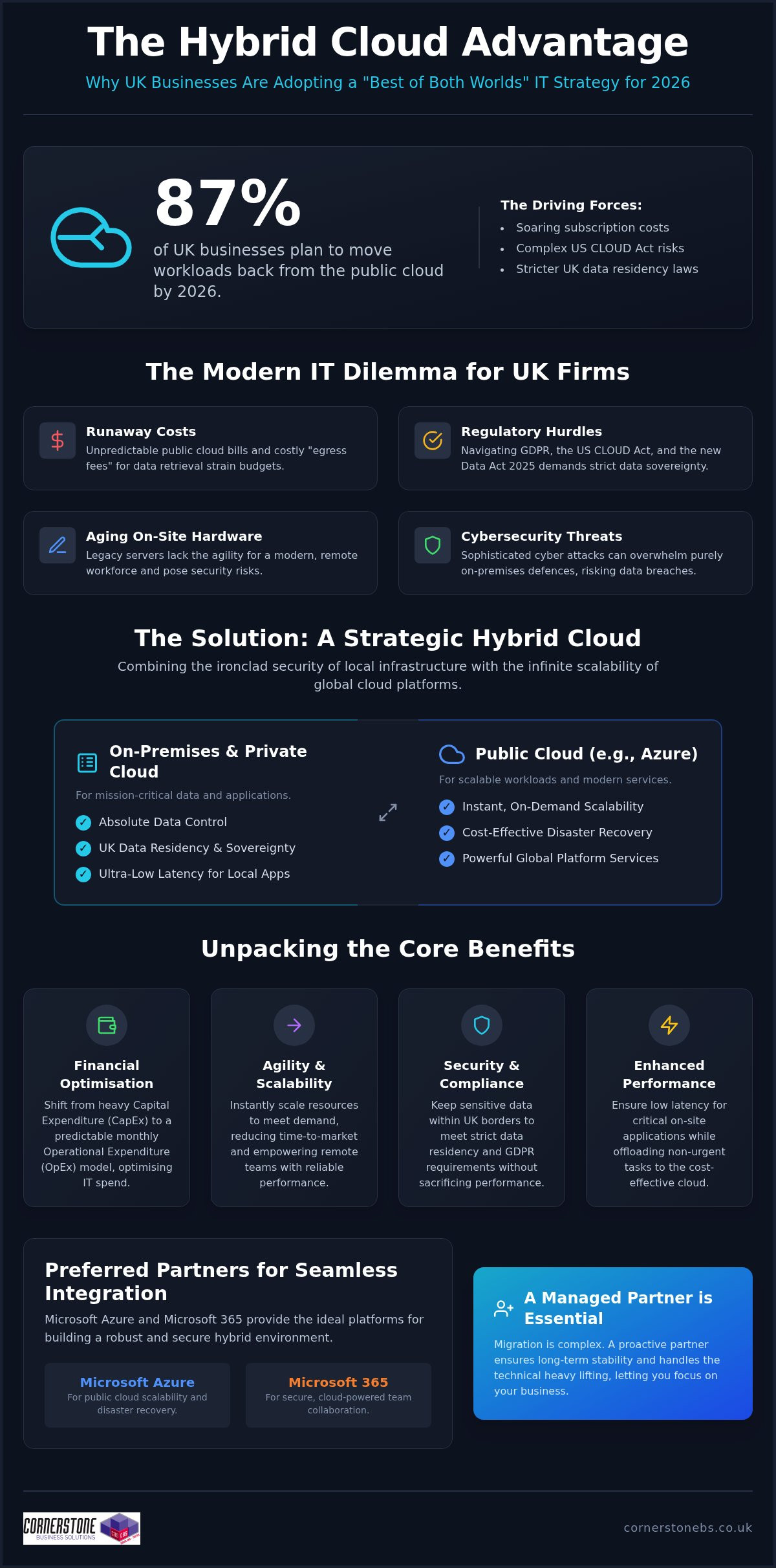
Did you know that 87% of UK businesses are planning to move at least some of their workloads back from the public cloud by the end of 2026? While the “all-in” cloud promise once seemed like the only way forward, many local firms now face soaring subscription costs and the complex jurisdictional risks of the US CLOUD Act. Understanding the hybrid cloud benefits for UK business is no longer just a technical choice. It’s a vital strategy to ensure your infrastructure remains agile and compliant in a rapidly shifting regulatory landscape.
We know how stressful it is to manage aging on-site hardware while trying to navigate the new Data (Use and Access) Act 2025. You need a system that supports your remote team without leaving your sensitive data exposed. This guide reveals how a bespoke hybrid model provides the emotional security of knowing your data is residency-compliant while slashing your capital expenditure. We’ll show you how to balance security, cost, and performance to create a scalable, bulletproof IT environment that’s ready for whatever 2026 throws your way.
Key Takeaways
- Learn how a strategic mix of on-premises and private cloud systems provides the foundation for a modern, agile UK business infrastructure.
- Discover the core hybrid cloud benefits for UK business, including the ability to scale resources instantly while moving from heavy CapEx to predictable monthly costs.
- Understand how to keep your sensitive client data within UK borders to meet strict data residency and GDPR requirements without sacrificing performance.
- Explore why Microsoft Azure and Microsoft 365 are the preferred partners for local firms looking for seamless integration and bulletproof disaster recovery.
- Gain insights into why a proactive managed IT partner is the best way to handle migration complexity and ensure long-term business stability.
The Evolution of Infrastructure: Why Hybrid Cloud is the 2026 Standard
The days of the dusty server humming away in a back office cupboard are fading fast. For years, many UK SMEs relied on that “server in the corner” to run every aspect of their operations. While that model felt simple, it lacked the agility needed to support a modern, distributed workforce. By 2026, the standard has shifted toward a more sophisticated, distributed environment. One of the primary hybrid cloud benefits for UK business is the ability to maintain absolute control over sensitive data while tapping into the massive processing power of the public cloud.
When asking What is Hybrid Cloud?, it’s essentially a strategic orchestration between on-premises infrastructure, private cloud environments, and public platforms like Microsoft Azure. With 73% of organizations now running a hybrid environment, the UK market has matured significantly. Local firms are now balancing the need for seamless remote team access with the strict security demands of the Data (Use and Access) Act 2025. This model ensures you aren’t forced to choose between legacy reliability and modern innovation.
Hybrid cloud represents the “best of both worlds” for UK operational flexibility by combining the ironclad security of local hardware with the infinite scalability of global cloud platforms.
The “Best of Both Worlds” Philosophy
Public clouds are fantastic for cost-effective scalability and handling generic workloads like email or web hosting. However, mission-critical data often requires the dedicated environment of a private cloud or on-premises server to meet UK residency requirements. This hybrid bridge allows your business to pursue digital transformation without abandoning the reliable systems that have served you for years. It’s about placing the right workload in the right place to maximize efficiency and peace of mind.
Overcoming the Limitations of Single-Cloud Models
Relying 100% on a pure public cloud can lead to “egress fee” shocks. These are the hidden costs UK businesses face when trying to move their own data out of a provider’s ecosystem. Conversely, staying entirely on-premises is increasingly risky. Modern cyber threats are too sophisticated for a single local server to handle alone. A hybrid model eliminates vendor lock-in and provides the technical freedom to move data where it’s most efficient. It ensures your business isn’t held hostage by a single provider’s pricing or a single point of technical failure.
Unpacking the Core Hybrid Cloud Benefits for UK Business Growth
Performance is another area where the hybrid model shines. For latency-sensitive applications, such as local databases or heavy design software, keeping them on-site ensures your team isn’t slowed down by “lag.” Meanwhile, you can offload non-urgent tasks like disaster recovery and long-term backups to the cloud. This strategic split is one of the primary benefits of a hybrid cloud, providing speed where it’s needed and storage where it’s most cost-effective.
Operational Agility and Scalability
Optimising IT Spend and Resource Allocation
Financial stability is the backbone of any successful firm. Moving from heavy Capital Expenditure (CapEx) to a predictable, monthly Operational Expenditure (OpEx) model is a game-changer for budgeting. Many businesses discover they’ve been over-provisioning on-site servers “just in case.” A hybrid approach eliminates this waste. By using tailored cloud solutions, SMEs can finally access the same enterprise-grade technology as their larger competitors without the massive upfront price tag.
Managing this balance requires a steady hand and proactive oversight. To get the maximum ROI from these systems, many leaders choose to pair their infrastructure with professional Managed IT Support. This ensures your resources are always allocated correctly. It lets you focus on your business goals while a dedicated partner handles the technical heavy lifting. If you’re curious about how this could work for your specific setup, we’re always happy to have a quick, informal chat about your goals.
Security, Compliance, and Data Sovereignty in the UK
“Is the cloud actually safe for my sensitive client data?” This remains the most common question we hear from business owners across the UK. With PECR fines now reaching up to £17.5 million or 4% of global turnover as of February 2026, the stakes for data protection have never been higher. A hybrid approach provides the reassurance you need. It allows you to keep your most sensitive files on local, physical hardware while leveraging the cloud for general operations. This setup is a cornerstone of a modern security strategy that doesn’t compromise on speed or safety.
Data sovereignty is a major part of this conversation. Many firms don’t realize that using a standard US-based cloud provider can expose them to the US CLOUD Act. This legislation allows foreign law enforcement to request data regardless of its physical location. By using a hybrid model, you ensure your sensitive UK data stays strictly within our borders. This is vital for meeting the requirements of the Data (Use and Access) Act 2025. As of July 13, 2026, the UK government designated providers like Microsoft and Amazon as “Critical Third-Party Providers,” bringing their services under the direct oversight of the Bank of England and the FCA. Integrating robust Cyber Security Services into your hybrid environment creates a layered defence that protects your reputation.
Navigating UK GDPR and Data Residency
Knowing exactly where your data sits physically is the first step to true compliance. Hybrid models are perfect for sectors like finance, legal, and education where data residency is a legal necessity. You can store Personally Identifiable Information (PII) on-site or in a secure UK-based private cloud. This makes passing a GDPR audit much simpler. It also helps you achieve Cyber Essentials certification, proving to your clients that you take their privacy seriously. It’s about building trust through transparent, locally-focused data management.
Enhanced Disaster Recovery and Business Continuity
One of the most powerful hybrid cloud benefits for UK business is the ability to use the cloud as a high-speed “failover” site. If your local hardware fails or an office incident occurs, your team can keep working without missing a beat. Automated backups in the cloud protect you against the growing threat of ransomware by providing a clean point-in-time restore. Building a comprehensive disaster recovery plan is far easier when you aren’t relying on a single physical location. It gives you the emotional security of knowing your business is resilient, no matter what happens.
Integrating Hybrid Cloud with Microsoft 365 and Azure
For most UK firms, Microsoft Azure is the natural choice for a hybrid setup. As of July 13, 2026, Microsoft is officially designated as a Critical Third-Party Provider by the Bank of England and the FCA. This provides a level of regulatory oversight that other platforms simply cannot match. While Microsoft recently increased the price of Microsoft 365 plans, such as Business Basic rising to £5.33 and E3 to £33.48, the added value remains significant. These plans now include enhanced Microsoft 365 Copilot Chat and increased mailbox storage, making them even more central to your daily operations.
The real magic happens when you integrate Microsoft 365 with your on-premises Active Directory. This creates a “single source of truth” for your staff identities. Your team uses one login for their local PC, their email, and their cloud files. This seamless integration is one of the most practical hybrid cloud benefits for UK business, as it reduces password fatigue and closes security gaps. To ensure a smooth transition, we recommend following a structured Microsoft 365 Migration Guide to avoid data silos or sync errors.
The Synergy of Azure and On-Premises Systems
Azure Virtual Desktop (AVD) is another game-changer for the hybrid workspace. It allows your staff to access a high-performance, secure Windows environment from any device, anywhere in the UK. Your sensitive data stays safe in the cloud while your team enjoys the familiarity of their office desktop. Azure Stack essentially brings the immense processing power of the global cloud directly into your physical office, allowing you to run Azure services on your own local hardware. This ensures that even if your internet connection wavers, your core systems stay online.
Modernising Communication with Hybrid VoIP
As we approach the final stages of the UK PSTN switch-off, modernising your phone systems is no longer optional. A hybrid approach allows you to integrate cloud-based Business VoIP with your existing network infrastructure. This ensures your office phones and business mobiles work as one unified system. It provides the reliability of a physical network with the flexibility of a cloud-based exchange. You get crystal-clear calls and advanced features without having to rip and replace your entire setup.
Navigating these integrations can feel like a lot to take on alone. If you are ready to future-proof your setup, we invite you to explore our bespoke cloud solutions and see how we can build a system that works for you.
Navigating the Migration: Why a Managed Partner is Essential
Migration to a hybrid environment is a major strategic shift that requires much more than a simple “lift and shift” of your files. While the hybrid cloud benefits for UK business are clear, the process of getting there is often fraught with technical hurdles. Many firms attempt to manage this transition internally, only to be met with unexpected data loss or security misconfigurations that leave them vulnerable. A managed partner provides the expertise to map out your infrastructure correctly from day one, ensuring your move is smooth, secure, and tailored to your specific goals.
The real value of a dedicated partner lies in proactive monitoring. The old “break-fix” model, where you only call for help when a system goes down, is no longer sufficient for the fast-paced 2026 business environment. You need a team that identifies potential bottlenecks or security threats before they disrupt your operations. This proactive stance is one of the greatest hybrid cloud benefits for UK business, as it provides the emotional security of knowing your systems are resilient and your data residency is always compliant with the latest UK regulations.
Avoiding the Pitfalls of Do-It-Yourself Cloud
One of the biggest hidden costs in DIY cloud migration is the “security gap” created by misconfigured settings. Without expert oversight, it’s easy to leave sensitive directories exposed or fail to set up proper encryption for data in transit. Expert guidance ensures that legacy software continues to function in a distributed world without specific network adjustments. Investing in professional IT company solutions saves you money in the long run by avoiding these expensive mistakes and ensuring your essential tools remain fully operational throughout the transition.
The Cornerstone Business Solutions Approach: Bespoke, Award-Winning Support
At Cornerstone Business Solutions, we’re proud to be a multi-award-winning IT services provider with national UK coverage. Our approach is built on partnership rather than just transactions. We don’t just sell you a service; we become a long-term extension of your team. Our experts take the time to simplify complex technical jargon into clear, actionable business benefits, so you always know exactly what your investment is doing for you. We focus on building bespoke, reliable systems that grow alongside your firm, backed by our strong partnerships with industry leaders like Microsoft, IBM, and Cisco.
Every business infrastructure is unique, and your cloud strategy should be too. We invite you to join us for a no-obligation audit of your current IT setup. It’s a chance to have a friendly, informal conversation with our local experts about your challenges and goals. Let’s work together to build a secure, scalable foundation that keeps your business moving forward. Reach out today to start the conversation.
Future-Proofing Your Infrastructure for 2026 and Beyond
The landscape of UK business IT is moving fast. You’ve seen how a hybrid model balances the need for ironclad security with the flexibility of the public cloud. It’s the most reliable way to handle the Data (Use and Access) Act 2025 while keeping your operational costs predictable. By embracing the hybrid cloud benefits for UK business, you’re building a foundation that respects local data residency while leveraging global innovation.
As a multi-award-winning IT provider and proud partner of Microsoft, IBM, and Cisco, we specialize in building bespoke systems that fit your specific needs. We don’t believe in one-size-fits-all solutions. Instead, we focus on providing the emotional security and technical stability you need to grow your firm with confidence. Our team is ready to help you navigate the complexities of migration and proactive monitoring.
Are you ready to see how a tailored strategy could transform your operations? Book a free Hybrid Cloud readiness audit with our award-winning team today. Let’s start a conversation about securing your business’s future.
Frequently Asked Questions
What are the main hybrid cloud benefits for UK businesses in 2026?
The primary hybrid cloud benefits for UK business include the ability to scale resources instantly while maintaining absolute control over sensitive data. This model allows you to keep mission-critical files on-site for security and speed, while offloading backups and generic workloads to the cloud to reduce capital expenditure. It is the most effective way to stay agile in a competitive market without sacrificing the stability of your local infrastructure.
How does hybrid cloud help with UK GDPR compliance?
Hybrid cloud simplifies compliance by allowing you to choose exactly where your data is stored. You can keep Personally Identifiable Information on secure, UK-based physical servers to meet strict residency requirements. This prevents your sensitive client data from being subject to foreign laws like the US CLOUD Act. It provides a transparent audit trail that makes meeting UK GDPR and Data (Use and Access) Act 2025 standards much more manageable.
Is hybrid cloud more expensive than traditional on-premises servers?
While there is an initial setup cost, hybrid cloud is often more cost-effective over time. It shifts your IT spend from heavy upfront capital expenditure to a predictable monthly operational model. You no longer need to pay for high-end hardware that sits idle most of the year. By scaling your cloud usage to match your actual workload, you eliminate the waste of over-provisioned local servers while enjoying enterprise-grade technology.
Can I use hybrid cloud if I already have Microsoft 365?
Yes, Microsoft 365 is designed to work seamlessly within a hybrid environment. You can sync your on-premises Active Directory with the cloud so your team uses a single login for everything. This integration improves security and reduces password fatigue for your staff. It allows you to keep large databases on-site for speed while your team uses cloud-based tools like Teams and Outlook for daily communication and collaboration.
What is the difference between hybrid cloud and multi-cloud?
Hybrid cloud combines your private on-premises infrastructure with a public cloud provider like Microsoft Azure. It is about bridging the gap between your local office and the digital world. Multi-cloud refers to using several different public cloud providers at once to avoid relying on a single vendor. Most UK firms find that a hybrid model offers the best balance of security and performance without the complexity of managing multiple external contracts.
How long does it take to migrate to a hybrid cloud environment?
Migration timelines vary depending on the size of your data and the complexity of your current software. A straightforward setup might take a few weeks, while a full enterprise transition could take several months. We always recommend a phased approach to ensure zero downtime for your team. This allows us to test each system thoroughly before moving to the next stage, providing a smooth experience for your staff and customers.
Do I need a managed IT partner for hybrid cloud migration?
While you could attempt it alone, a managed partner ensures your migration is secure and efficient. Partnering with experts allows you to unlock the full hybrid cloud benefits for UK business, as we handle the complex technical heavy lifting and network adjustments. A partner provides proactive monitoring that identifies potential issues before they cause downtime. This gives you the emotional security of knowing your business is in expert hands.
How does hybrid cloud improve disaster recovery for UK firms?
Hybrid cloud creates a bulletproof safety net by using the cloud as a secondary failover site. If your physical office suffers an incident, your team can switch to the cloud version of your systems instantly. Automated, point-in-time backups protect you against ransomware by providing a clean copy of your data for quick restoration. It is a foundational element of business stability that ensures your firm remains resilient against any local hardware failure.
Cloud Transformation UK: The 2026 Business Strategy Guide
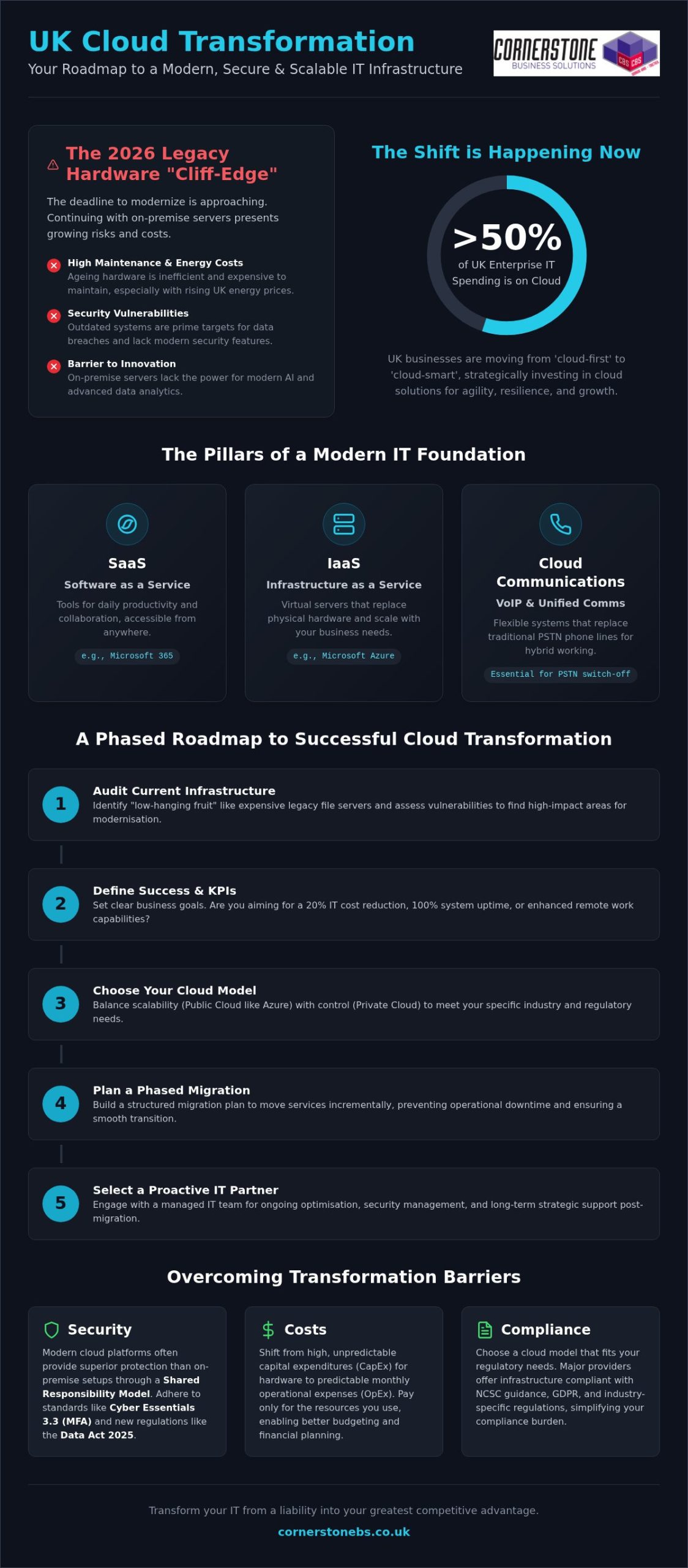
If your business is still anchored to a physical server room, you might be paying for a liability rather than an asset. With more than 50% of UK enterprise IT spending now focused on the cloud, the pressure to modernise has never been higher. We understand that the high costs of maintaining ageing on-premise hardware are frustrating. It’s even more stressful when you consider the technical complexity and the fear of a data breach during a cloud transformation uk project.
As a multi-award-winning IT provider with deep regional roots, we see this transition as a foundation for your stability, not just a technical task. This guide offers a comprehensive roadmap to modernising your infrastructure using tools like Microsoft 365 and Azure. You’ll learn how to secure your data under the Data (Use and Access) Act 2025 and meet the mandatory MFA requirements of Cyber Essentials 3.3. We will show you how to achieve predictable monthly costs, better remote working capabilities, and a scalable environment that grows with you. Let’s explore how to turn your IT from a headache into your biggest competitive advantage.
Key Takeaways
- Identify the “legacy hardware cliff-edge” and learn why 2026 is the critical year to act. We explain how to audit your current IT setup to find the most impactful areas for immediate modernisation.
- Compare Microsoft Azure and private cloud models to balance high scalability with regulatory control. Choose the infrastructure that fits your specific industry requirements while lowering your initial entry costs.
- Demystify security by understanding the Shared Responsibility Model. Learn how modern encryption and the Data (Use and Access) Act 2025 provide more protection than traditional on-premise servers.
- Master a strategic approach to cloud transformation uk that replaces high maintenance costs with predictable monthly IT spending. Use our roadmap to build a scalable environment that supports seamless remote working.
- Discover how a proactive partnership with an award-winning managed IT team ensures a smooth migration. Shift your focus from reactive technical fixes to long-term business growth and foundational system stability.
Understanding Cloud Transformation in the UK Business Landscape
Cloud transformation uk is no longer a luxury for the tech-savvy few; it’s a fundamental shift in how your business functions. When we talk about transformation, we’re describing the movement of your entire ecosystem; your data, your applications, and your team’s culture; into a secure, digital space. It’s about building a foundation for stability and growth that physical hardware simply can’t match.
The shift is clear. You need agility. Many UK firms are moving away from ‘cloud-first’ to ‘cloud-smart’ strategies. Instead of moving everything at once, they focus on where the cloud provides the best return on investment. This approach ensures your cloud solutions actually solve business problems rather than just moving them to a different location.
Why UK Businesses are Modernising Now
2026 is a pivotal year for the British economy. We’ve reached a legacy hardware cliff-edge. On-premise servers are becoming energy-hungry liabilities, especially with UK energy costs remaining a top concern for small and medium enterprises. The final phases of the PSTN switch-off mean traditional phone lines are disappearing, making cloud-integrated communications a necessity for survival.
The Core Components of a Cloud Environment
Building a reliable environment requires understanding different cloud computing models. Most successful UK organisations use a combination of these three pillars to keep their operations running smoothly:
- Software as a Service (SaaS): Tools like Microsoft 365 handle your daily productivity. They ensure your team can collaborate on documents and emails from any location with a secure internet connection.
- Infrastructure as a Service (IaaS): This is where you host your heavy-duty business applications. By using platforms like Microsoft Azure, you replace physical servers with virtual ones that scale as you grow.
- Cloud-based Communications and VoIP: These systems replace old phone lines with flexible, national connectivity. They are essential for maintaining professional standards in a hybrid working world.
By combining these elements, you create a resilient setup. It’s about making sure your team stays connected and your data stays safe, no matter what happens in the physical world. We see ourselves as your partner in this journey, helping you simplify these complex concepts to benefit your bottom line.
Designing Your Cloud Transformation Strategy for 2026
A successful cloud transformation uk isn’t a one-size-fits-all project. It requires a bespoke plan that respects your budget and your team’s specific needs. We recommend starting with a thorough audit of your current setup to identify “low-hanging fruit” like legacy file servers that are expensive to maintain. Once you’ve found these, define what success looks like for your business. Are you aiming for a 20% reduction in IT overhead, or is 100% system uptime your priority?
When choosing your cloud model, security should lead the conversation. We always point our clients toward the NCSC cloud security guidance to ensure their data sensitivity matches the infrastructure they choose. Whether it’s a public cloud for scalability or a private cloud for strict compliance, your strategy must be secure by design. Build a phased migration plan to prevent operational downtime; flipping the switch overnight rarely works for complex environments. Finally, select a proactive partner. Moving to the cloud is just the beginning; you need ongoing managed IT services to keep systems optimised and secure.
Setting Realistic KPIs for Your Migration
Success goes beyond just moving files. You should track user adoption rates to ensure your team is actually using the new tools. Monitor your cost-per-user compared to traditional hardware depreciation cycles to get a clear picture of your ROI. Lower system latency and improved employee productivity are the ultimate indicators that your migration worked. If you’re unsure where to start, our experts are always happy to chat about your current setup.
The Importance of a Bespoke Technology Roadmap
Generic cloud packages often fail UK SMEs because they don’t account for specific industry challenges. Your business is unique, and your technology should be too. A tailored Microsoft 365 migration aligns your productivity tools with your specific industry workflows. We help you build a 3-5 year roadmap that ensures your cloud growth supports your long-term business goals. This proactive approach prevents the “technical debt” that often comes from rushed, uncoordinated IT decisions.
Comparing Infrastructure: Public, Private, and Hybrid Cloud Models
Choosing your infrastructure is the most critical technical step in your cloud transformation uk. It’s the engine room of your digital strategy. Public cloud platforms like Microsoft Azure, which holds a 20% global market share, are the go-to for businesses that need to scale quickly. For organisations with tighter initial budgets, the public cloud offers lower entry costs because you only pay for the resources you consume. Conversely, a private cloud remains the gold standard for sectors with rigid regulatory demands, as it provides total control over your dedicated hardware.
Many forward-thinking firms are now looking at multi-cloud strategies. By using different providers like Azure and AWS, you can avoid vendor lock-in and pick the best features from each. This approach is becoming more accessible following the March 2026 CMA investigation, where major providers committed to lowering data egress fees. This makes it easier for you to switch or move data between clouds without facing punitive costs.
Is Hybrid Cloud the Right Choice for Your Firm?
Hybrid cloud is currently the default operating model for 73% of organisations. It allows you to balance the high security of on-premise servers with the immense flexibility of the cloud. This is often the best path for businesses running complex legacy software that isn’t yet compatible with modern SaaS platforms. While maintaining a dual environment requires more management and careful cost tracking, it provides a stable bridge for your transition. It ensures your core operations remain steady while you modernise at your own pace.
Public Cloud: Scaling with Microsoft Azure
Azure is a standout choice for UK firms because of its robust national data residency options. With major data centres in London and Cardiff, your sensitive information stays on British soil, which is a key requirement for many local contracts. It integrates perfectly with your existing Microsoft 365 environment, creating a familiar workspace for your team. We frequently recommend Azure Virtual Desktop to our partners. It allows your staff to access secure business environments from any device, which is essential for maintaining productivity in a hybrid work world. It’s a proactive way to ensure your cloud transformation uk delivers real-world results for your team.
Overcoming Transformation Barriers: Security, Costs, and Compliance
The most common hurdle for business owners is the fear of losing control. You might ask, “Is our data actually safer in the cloud than on our own server?” The short answer is yes. While your office server might be protected by a locked door, cloud providers invest billions in physical security and advanced encryption that most SMEs simply can’t match. This shift is governed by the Shared Responsibility Model. The provider secures the infrastructure, while you remain responsible for managing who has access to your data and how they use it.
Managing compliance becomes much easier with a strategic cloud transformation uk. Modern cloud environments are designed to align with UK GDPR and the Data (Use and Access) Act 2025. These platforms automate many of the reporting tasks that used to take your team hours to complete. However, you must stay vigilant against “cloud sprawl.” Without proactive oversight, unused subscriptions and unallocated resources can lead to hidden costs that eat into your ROI. We help you monitor these environments to ensure you only pay for what you actually use.
Building a Zero Trust Security Architecture
Traditional firewalls aren’t enough when your team works from home or on the road. You need a setup that doesn’t just trust someone because they’re “inside” the network. Zero Trust is a security model that assumes every access request is a potential threat. We help you implement robust cyber security services like multi-factor authentication (MFA) and identity management. Under the Cyber Essentials 3.3 standards effective since April 2026, MFA is now a mandatory requirement for all cloud services. This ensures your business remains resilient against modern credential-based attacks.
Budgeting for Long-Term Cloud Success
Ready to secure your digital future? Contact our local experts for a comprehensive cloud security audit.
Implementing the Change: The Role of Managed IT Support
A successful cloud transformation uk requires more than a simple migration. While many firms treat it as a one-time project fee, the reality is that your digital environment needs constant care to stay efficient. A proactive partnership is the difference between a system that merely works and one that drives growth. We move beyond reactive fixes by using advanced system monitoring to stop problems before they disrupt your day. This continuous support provides the emotional security every business owner deserves. Knowing your it company solutions are managed by award-winning experts allows you to focus on your clients instead of your servers.
What to Look for in a Cloud Transformation Partner
Technical expertise is essential, but it must be balanced with a deep understanding of your business goals. You need a partner who speaks your language and understands the local market. UK-based support is a massive advantage; it ensures your helpdesk team is in your time zone and understands the specific regulatory environment you face. Always evaluate a partner’s accolades and industry certifications. Our partnerships with Microsoft, IBM, and Cisco aren’t just badges. They are a recurring signature of quality that guarantees your infrastructure is built to the highest standards.
Your Next Steps: From Conversation to Implementation
Your journey begins with a comprehensive IT audit and a cloud readiness assessment. We don’t believe in guesswork. We look at your current setup, identify bottlenecks, and build a roadmap that makes sense for your 2026 strategy. The Cornerstone approach is intentionally direct and benefit-driven. We strip away the jargon to show you exactly how technology will improve your bottom line.
We invite you to an informal conversation about your business goals. There is no pressure and no complex sales pitch. We are a local team of experts who genuinely care about the success of our regional business community. Let’s talk about how we can build a stable, secure, and scalable future together. Our team is ready to help you navigate the complexities of cloud transformation uk with clarity and ease.
Secure Your Future with a Cloud-First Strategy
The landscape of 2026 demands more than just basic connectivity; it requires a resilient foundation that supports growth and protects your sensitive data. By moving away from energy-intensive on-premise servers and embracing platforms like Microsoft Azure, you gain the agility needed to lead in your industry. We’ve explored how a phased approach reduces downtime and how Zero Trust security keeps you compliant with the latest UK data regulations. A successful cloud transformation uk is a collaborative journey that transforms your IT from a high-maintenance liability into a scalable asset.
As a multi-award-winning IT services provider and partner to Microsoft, IBM, and Cisco, we specialise in bespoke technology solutions tailored to your unique needs. We don’t just provide a service; we act as your long-term partner in business stability. Ready to modernise? Let’s have an informal conversation about your cloud transformation strategy. Your business deserves a secure, modern environment that works as hard as you do. Let’s build it together.
Frequently Asked Questions
What is cloud transformation and how does it differ from cloud migration?
Cloud transformation is a complete business redesign, while migration is simply moving data from A to B. Transformation involves modernising your workflows and culture to leverage cloud-native features. It’s about changing how you operate to drive long-term growth. Migration is just the first technical step in a much larger cloud transformation uk journey that builds lasting business resilience for the future.
How much does cloud transformation cost for a UK business?
Costs vary significantly based on your organisation’s size and the complexity of your legacy systems. Instead of a large upfront Capital Expenditure for servers, you move to a monthly Operational Expenditure model. This makes your IT spending predictable and scalable. We always recommend a full audit to understand your specific requirements. This ensures you aren’t paying for “cloud sprawl” or unused subscriptions that drain your budget.
Is my data more secure in the cloud than on an on-premise server?
Yes, your data is typically much safer in the cloud because providers like Microsoft invest billions in security infrastructure. They offer advanced encryption and physical security that most small businesses cannot afford on-site. You also benefit from the Shared Responsibility Model. This means the provider secures the platform while we help you manage access and identity protection to keep your business safe.
How long does a typical cloud transformation project take to complete?
A typical project can take anywhere from three months to a year depending on your starting point. Smaller migrations might be faster, but a full cultural and technical transformation is a marathon, not a sprint. We favour a phased approach. This ensures every department transitions smoothly without feeling overwhelmed by new technology or changed workflows during the move to a digital environment.
Will our business experience downtime during the cloud migration process?
No, your business should not experience significant downtime if the migration is planned correctly. We use parallel environments to ensure your team stays productive while we move data in the background. By testing every application before the final “cut-over,” we maintain system stability. Our goal is to make the transition feel seamless for your staff and your clients alike.
What are the biggest challenges of cloud transformation in 2026?
The biggest hurdles in 2026 are cost optimisation and staying compliant with evolving regulations like the Data (Use and Access) Act 2025. Managing cloud spending in real-time requires a disciplined “FinOps” approach. Additionally, integrating AI workloads into your existing cloud infrastructure presents new technical challenges. These require expert management to ensure they deliver a genuine return on investment for your firm.
Can we move legacy software to the cloud if it wasn’t designed for it?
Yes, you can move legacy software by using a hybrid cloud model or virtualisation. While some old apps aren’t “cloud-native,” we can host them in environments like Azure Virtual Desktop to provide secure remote access. This allows you to keep using essential software while you plan for a more modern replacement over the next three to five years without disrupting operations.
How does cloud transformation help with UK GDPR compliance?
Cloud transformation uk simplifies UK GDPR by providing automated auditing tools and centralised data management. Using UK-based data centres in London or Cardiff ensures your sensitive information stays within national borders. This makes it easier to track data access and prove compliance during regulatory reviews. It turns a complex legal necessity into a manageable, automated process that protects your brand’s reputation.
Azure Security Best Practices: 2026 Guide for UK Businesses
A single misconfigured setting in your cloud environment could now cost your business up to £17.5 million or 4% of your global turnover. With the UK Data (Use and Access) Act 2025 now in full force, the stakes for your digital infrastructure have never been higher. It’s completely understandable if the sheer complexity of modern cloud settings feels overwhelming or if you’re worried that a small oversight might lead to a major exposure. You need a setup that protects your data and your reputation without breaking the bank or slowing your team down.
We’re here to help you master the latest azure security best practices to ensure your business remains resilient and compliant throughout 2026. This guide provides a clear roadmap to harden your environment against modern threats, giving you the peace of mind that your regional operations are backed by world-class protection. We will walk through the essential shift to TLS 1.2, the retirement of legacy tools like Azure Blueprints, and how to leverage AI-driven security within the unified Microsoft Defender portal to keep your business steady and secure.
Key Takeaways
- Learn how the Shared Responsibility Model defines your role in securing the cloud versus Microsoft’s role in protecting the underlying infrastructure.
- Discover why identity is the new perimeter and how to implement azure security best practices using Microsoft Entra ID for a mobile-first workforce.
- Harden your network layer by moving toward a Zero Trust model with Network Security Groups and centralised Azure Firewall configurations.
- Ensure strict data governance and compliance with UK standards by mastering encryption at rest and secure secret management with Azure Key Vault.
- Bridge the “security gap” between having tools and using them correctly through proactive monitoring and expert managed support.
Understanding Azure Security: The Shared Responsibility Model in 2026
The foundation of any robust defence starts with knowing who holds the keys. In 2026, the shared responsibility model remains the absolute cornerstone of cloud safety. It’s a simple concept with massive implications: Microsoft secures the cloud, while you secure everything you put inside it. They take care of the physical data centres, the underlying hardware, and the global networking infrastructure. Your business, however, is solely responsible for the non-negotiable duties: your data, your user identities, and the devices accessing your network. Following azure security best practices isn’t just about ticking boxes; it’s about building a resilient culture where your data stays private and your systems stay online.
The Three Pillars of Responsibility
The level of control you have depends entirely on how you’ve built your environment. With Infrastructure as a Service (IaaS), you’ve got maximum control but also the heaviest workload. You’re responsible for patching the operating systems and managing the middleware. If you move to Platform as a Service (PaaS), Microsoft takes over the OS maintenance and patching, which lets your team focus on application logic. Finally, Software as a Service (SaaS) shifts almost everything to the provider, leaving you to focus purely on identity and data governance. Even in 2026, as serverless computing grows, you can’t outsource the liability for your data.
Why Default Security is Never Enough
It’s a common mistake to assume that because Azure is a world-class platform, it’s secure by default for your specific business needs. Microsoft builds its out-of-the-box settings for accessibility and ease of use. They want you to get up and running quickly. However, these generic configurations rarely meet the strict requirements of UK compliance or the specific threat profile of a growing enterprise. Implementing azure security best practices means moving beyond these defaults to protect your business from sophisticated modern threats.
Relying on standard settings often leaves gaps in your logging, monitoring, and access controls. You need a proactive, bespoke strategy that aligns with your specific operational risks. Working with a dedicated cloud solutions provider ensures your environment isn’t just running, but is actively defended. We help you bridge that gap, turning generic tools into a hardened shield that protects your business continuity and gives you total peace of mind.
Identity as the New Perimeter: Best Practices for Microsoft Entra ID
The physical office wall is no longer your primary line of defence. In 2026, identity has officially become the new perimeter. Whether your team is working remotely, on the go, or from various company locations, the way you verify their access determines your safety. This shift is why Microsoft transitioned from Azure AD to the more comprehensive Microsoft Entra ID. It’s a suite designed to handle the complexities of a mobile-first world where users access data from multiple devices and locations. Implementing these azure security best practices starts with a simple truth: if you can’t verify the user, you can’t trust the connection.
Multi-Factor Authentication (MFA) remains the single most effective deterrent against account takeovers. It’s a basic step, but it stops the vast majority of identity-based attacks. Pair this with Role-Based Access Control (RBAC) to enforce the principle of least privilege. This ensures that a marketing assistant doesn’t have the same permissions as your IT head. By following the Shared Responsibility Model, you take ownership of these identity settings while Microsoft handles the underlying directory infrastructure. This clarity allows you to build a security layer that is both firm and flexible.
Mastering Conditional Access Policies
Think of Conditional Access as the “if-then” engine of your cloud security. It allows you to set specific rules: if a user is logging in from an unmanaged device or an unusual location, then they must provide extra verification or be blocked entirely. This level of control is vital during Microsoft 365 migration for business UK projects. It ensures that as you move data to the cloud, your access rules move with it. You can restrict logins to specific UK IP addresses or require a healthy, patched device before allowing access to sensitive files.
Privileged Identity Management (PIM)
Permanent admin accounts are a massive risk. If one is compromised, the attacker has the keys to your entire digital estate. Mastering azure security best practices involves moving away from these “always-on” roles. Privileged Identity Management (PIM) solves this by providing “just-in-time” access. Admins only get elevated permissions when they actually need them, and only for a set period. This creates a detailed audit trail, which is essential for meeting strict UK compliance standards like GDPR. If you’re looking to tighten your defences, our team can help you review your current cyber security posture to ensure your admin roles are properly managed.

Hardening the Network Layer: From Firewalls to Zero Trust
Securing your network layer in 2026 requires a fundamental shift in mindset. We no longer rely on the outdated idea of a “trusted” internal network. Instead, we embrace the Zero Trust philosophy: “never trust, always verify.” Every connection request, whether it’s coming from inside or outside your virtual network, must be fully authenticated and authorised. This proactive approach is a cornerstone of modern azure security best practices, ensuring that your business remains resilient even if a single device is compromised.
Network Security Groups (NSGs) provide the essential filtering you need for your subnets and individual network interfaces. They act as a digital bouncer, checking every packet against your specific rules. However, for larger environments, you need a centralised solution. Azure Firewall offers a managed, cloud-based security service that protects your Azure Virtual Network resources. It’s highly available and scales automatically, providing the professional-grade protection your UK business deserves without the headache of managing physical hardware. By using micro-segmentation to isolate different parts of your network, you ensure that even if one area faces trouble, your entire operation doesn’t come to a standstill.
Implementing Azure Bastion for Secure Access
Leaving RDP or SSH ports open to the public internet is a critical risk that many businesses still overlook. It’s effectively an open invitation for brute-force attacks. Azure Bastion removes this vulnerability by providing secure, browser-based access to your virtual machines. You don’t need to assign public IP addresses to your servers, which drastically reduces your attack surface. It’s a clean, efficient way to manage your infrastructure while keeping the “bad actors” firmly on the outside. This small change provides massive peace of mind for your IT team.
DDoS Protection and Application Gateway
If your business relies on web applications, you can’t afford the downtime caused by a distributed denial-of-service (DDoS) attack. Azure’s native DDoS protection monitors your traffic and automatically mitigates threats to keep your services running. When you pair this with an Application Gateway and a Web Application Firewall (WAF), you gain a powerful shield against common exploits like SQL injection and cross-site scripting. These tools are foundational to the cyber security services we provide, ensuring your digital presence is hardened against the latest threats. This multi-layered defence ensures that your customer data remains safe and your services stay accessible, regardless of the pressure your network faces.
Data Governance and Operational Security: Encryption and Monitoring
Protecting the perimeter is vital, but your data is the ultimate prize for any attacker. Implementing azure security best practices means ensuring that your sensitive information is encrypted at every stage of its lifecycle. Azure Disk Encryption uses industry standard technology to protect your virtual machine disks, making the data unreadable to anyone without the proper keys. To manage these keys securely, we rely on Azure Key Vault. It acts as a highly secure digital safe for your secrets, certificates, and encryption keys, removing the dangerous habit of hardcoding passwords into your applications. This setup ensures that even if a breach occurs, your core business data remains locked away from prying eyes.
Security isn’t a “set and forget” task; it requires constant vigilance. Microsoft Defender for Cloud provides a continuous security health check for your entire environment. It identifies misconfigurations, such as open ports or unencrypted databases, and gives you clear, actionable steps to fix them. When you pair this with Azure Monitor, you gain deep visibility into your operations. By collecting and analysing logs from every resource, you can spot unusual patterns before they escalate into serious incidents. This proactive monitoring is what separates a vulnerable setup from a truly resilient one, giving you the confidence to grow your business without fear.
Ensuring GDPR and UK Compliance
Meeting strict UK compliance standards is a primary concern for local business owners. We use Azure Policy to enforce data residency, ensuring your files never leave the UK South or UK West data centres. This is a critical step for adhering to the UK Data (Use and Access) Act 2025. Additionally, Microsoft Purview helps you discover and classify your data, making it easier to manage privacy requests. By mapping these azure security best practices to Cyber Essentials Plus requirements, we provide a clear path to certification that proves your commitment to data safety to your clients and partners.
The Role of Automated Backups
Backups are your final line of defence against the growing threat of ransomware. If your primary data is compromised, a secure, immutable backup allows you to restore your operations without paying a penny to criminals. We configure Azure Backup to provide long-term data retention that cannot be altered or deleted by unauthorised users. These automated routines should be a core part of your wider it company solutions and disaster recovery plan. If you’re ready to ensure your business can weather any storm, our local team is here to help you build a recovery strategy that actually works when you need it most.
The Strategic Advantage of Managed Azure Security Services
Outsourcing your security to a dedicated partner is often more cost-efficient than trying to build a comparable team in-house. You gain access to a pool of multi-award-winning expertise without the overhead of multiple full-time salaries or expensive training programmes. At Cornerstone Business Solutions, we don’t just act as a service provider; we become your long-term partner. We understand the specific challenges facing UK businesses and tailor our approach to ensure your cloud infrastructure is a stable foundation for growth, not a source of worry. Our proactive stance means we’re always looking for ways to strengthen your posture, giving you the peace of mind to focus on your core objectives.
Bridging the Skills Gap with an MSP
Hiring and retaining top-tier cloud security talent in 2026 is a major challenge for many organisations. The demand for experts who truly understand the nuances of Microsoft Entra ID and Zero Trust architecture far outweighs the supply. Choosing managed IT services Teesside and national providers gives you instant access to 24/7 protection. Our team stays awake so you don’t have to. We perform regular security audits and vulnerability scanning to ensure your defences evolve as quickly as the threats do, keeping your local operations safe and compliant with the latest UK standards.
Continuous Improvement in a Shifting Landscape
Security is a journey, not a destination. The threats your business faces today will look different by next month. We stay ahead of 2026 threat vectors by using AI-enhanced tools that spot anomalies the human eye might miss. This proactive stance allows us to adjust your configurations in real-time, ensuring your environment remains a “hard target” for cyber criminals. A secure cloud infrastructure is the essential foundation for your business growth. When you trust your security to experts, you free up your time to focus on what you do best: running your business. Let’s start a conversation about how we can protect your future together.
Securing Your Business Future in the Azure Cloud
Building a hardened cloud environment isn’t just a technical task; it’s a strategic investment in your business’s continuity and growth. By mastering identity through Microsoft Entra ID and embracing a Zero Trust network model, you’ve already taken the most critical steps toward total resilience. Remember that the shared responsibility model puts the power in your hands to protect your data and meet the latest UK compliance standards. Implementing azure security best practices ensures that your digital estate remains a “hard target” against evolving 2026 threats.
As an award-winning Microsoft Partner, we specialise in bridging the gap between having the right tools and using them to their full potential. Our UK-based team of certified cloud architects provides the proactive 24/7 security monitoring you need for true peace of mind. We’re ready to help you identify any hidden vulnerabilities and strengthen your defences before they’re ever tested. Take the first step toward a more secure future today and Book a Comprehensive Azure Security Audit with Cornerstone. Let’s work together to keep your business safe, steady, and successful.
Frequently Asked Questions
What is the most important Azure security best practice?
Enforcing Multi-Factor Authentication (MFA) through Microsoft Entra ID is the single most effective step you can take to protect your business. While there are many azure security best practices, securing user identities is the priority because the vast majority of breaches start with compromised credentials. By requiring a second form of verification, you stop almost all automated identity attacks. This simple change provides an immediate boost to your resilience and ensures that your sensitive data remains accessible only to authorised personnel.
Is Azure more secure than on-premises servers?
Azure is generally more secure than on-premises servers because Microsoft invests billions in security research and physical infrastructure that few SMEs could ever match. You benefit from enterprise-grade protection and automated threat detection right out of the box. However, the level of safety ultimately depends on how you configure your specific environment. While Microsoft secures the physical hardware and the hypervisor, you remain responsible for managing your data and access rules effectively to keep your business safe.
How does Azure help with GDPR compliance for UK businesses?
Azure helps you meet GDPR and UK Data (Use and Access) Act 2025 requirements by offering robust data residency options. You can choose to store and process your data exclusively within UK-based data centres like UK South or UK West. Built-in tools for encryption and data classification through Microsoft Purview make it much easier to manage privacy requests and audits. This ensures your customer information stays protected and your business remains compliant with local regulations, avoiding the risk of heavy fines.
What is the difference between Azure AD and Microsoft Entra ID?
Microsoft Entra ID is the new, expanded name for what was formerly known as Azure AD. It isn’t just a rebranding; it’s a more comprehensive suite that includes identity protection, verified IDs, and permissions management. This change reflects a shift toward a more holistic approach to security in a mobile-first world. You still get all the features you’re used to, but with extra tools designed to handle modern, complex identity threats across all your cloud and on-premises applications.
Do I need a third-party firewall if I use Azure?
You don’t necessarily need a third-party firewall because Azure Firewall provides highly capable, cloud-native protection for your virtual networks. It’s built to scale automatically and offers sophisticated filtering that meets the needs of most UK businesses. Some organisations with very specific legacy requirements might choose a third-party appliance from the Azure Marketplace, but for most, Azure’s native tools offer a more integrated and cost-effective solution. Our team can help you decide which path fits your specific risk profile and business goals.
How much does it cost to secure an Azure environment?
The cost of securing your environment varies depending on the specific services you choose to enable and your data volume. Many foundational features, like basic MFA and security defaults, are often included in your existing Microsoft 365 or Azure subscriptions. More advanced tools like Azure Firewall or Microsoft Sentinel carry additional monthly fees based on your data usage and traffic. We recommend starting with a professional security audit to identify which investments will provide the most value for your specific business needs without overspending.
What is the Azure Shared Responsibility Model?
The Shared Responsibility Model is a framework that clarifies which security tasks belong to Microsoft and which belong to your business. Microsoft takes full responsibility for the physical security of data centres and the underlying hardware. You are responsible for protecting your data, managing user identities, and configuring your applications correctly. Understanding this division is a core part of azure security best practices because it ensures no part of your defence is left to chance, allowing you to focus your efforts where they matter most.
Can Azure protect my business from ransomware?
Azure provides several powerful layers of protection designed specifically to mitigate the threat of ransomware. Features like Azure Backup offer immutable storage, which means your backups cannot be altered or deleted by a hacker even if they gain access to your network. When you pair this with real-time threat detection in Microsoft Defender, you can spot and stop suspicious activity before it has a chance to encrypt your files. This multi-layered approach gives you a reliable safety net and ensures your business can recover quickly from an incident.
Azure Cloud Benefits for UK Business: The 2026 Strategic Guide
Your local server room isn’t just a piece of hardware anymore; in 2026, it’s a growing financial liability and a potential security bottleneck. We understand the pressure you’re under. Between volatile energy prices and the constant threat of sophisticated cyber-attacks, managing physical infrastructure feels like a full-time job you didn’t sign up for. Many local business owners tell us they feel stuck between high capital costs and the need to support a hybrid workforce. As a multi-award-winning provider, we’ve seen how the azure cloud benefits for uk business can turn these challenges into advantages. It’s a strategic necessity for staying competitive and secure.
In this guide, we’ll show you how to swap unpredictable energy bills for a streamlined, pay-as-you-go model that scales as fast as your team does. We will explore how Microsoft Azure protects your data against modern threats while ensuring you stay compliant with the latest UK Data Act regulations. You’ll learn how to reduce capital expenditure and gain the peace of mind that comes with enterprise-grade security. We’re here to help you transform your IT from a cost center into a growth engine that supports your long-term success.
Key Takeaways
- Swap unpredictable capital outlays for a flexible monthly model that slashes energy costs and simplifies your budget.
- Discover how the azure cloud benefits for uk business provide a robust shield against 2026 cyber threats through Microsoft’s massive global security investment.
- Learn the secrets to scaling your infrastructure instantly, ensuring your hybrid team stays productive without waiting for new hardware.
- Explore our bespoke migration framework designed to move your operations to the cloud smoothly while meeting strict UK compliance standards.
- Understand the value of a proactive local partnership that monitors your systems 24/7, turning your IT into a reliable foundation for growth.
Why UK Businesses are Prioritising Microsoft Azure in 2026
The azure cloud benefits for uk business start with a simple reality: your office hardware is aging faster than ever. Microsoft Azure isn’t just a place to store files. It’s a vast ecosystem of over 200 services designed to replace or enhance your existing on-premises hardware. The Microsoft Azure platform provides everything from virtual desktops to advanced data analytics, allowing you to run your entire operation without a single server humming in the corner. In 2026, the shift away from physical infrastructure is accelerating as local firms realise that “on-prem” setups are becoming a strategic liability. They’re expensive to power, difficult to secure, and nearly impossible to scale quickly.
The End of the Physical Server Era
Maintaining a local server room comes with a list of hidden costs that quickly drain your budget. You aren’t just paying for the box itself; you’re paying for high-performance cooling, dedicated floor space, and increased insurance premiums. You’re also stuck in the “hardware refresh” trap. Every few years, you’re forced to spend thousands on new equipment just to keep up with software demands. Our cloud solutions eliminate this cycle entirely. With Azure, you never have to worry about hardware becoming obsolete. You simply adjust your subscription to match your current needs, ensuring you only pay for the processing power you actually use.
Azure as a Catalyst for Business Continuity
Resilience is the foundation of any successful company. If a pipe bursts or a power cut hits your office, a physical server can bring your entire business to a standstill. Azure provides a different level of security. It ensures your staff remain productive regardless of local infrastructure failures. For national UK service providers, “always-on” availability isn’t a luxury; it’s a requirement for maintaining client trust. Azure’s built-in redundancy means your data is mirrored across multiple locations, so if one site has an issue, another takes over instantly. This proactive approach to stability gives you the emotional security to focus on growth rather than worrying about your next IT headache.
Core Benefits: Security, Scalability, and UK Compliance
Security is no longer just an IT concern; it’s a fundamental pillar of your business’s reputation. When you look at the azure cloud benefits for uk business, the sheer scale of protection is often the most striking factor. Microsoft invests over $1 billion annually in cyber defence, providing a level of security that’s impossible for most local firms to replicate on their own. This means your data sits behind the same enterprise-grade shields used by global financial institutions. Whether you’re a growing SME or a national provider, you benefit from a proactive defence system that’s constantly learning from global threats.
Scalability is the second pillar. In a traditional setup, handling a sudden spike in demand meant buying and installing new hardware, a process that could take weeks. Azure changes the game by allowing you to increase your resources instantly. If you have a busy seasonal period or a new project launch, you can scale up your processing power with a few clicks. Once the rush is over, you scale back down. You only pay for what you use, ensuring your IT budget remains lean and efficient. It’s about having an agile infrastructure that supports your growth rather than holding it back.
Data residency is equally critical for UK organisations. Azure allows you to specify exactly where your data lives, with major data centres located in the UK South and UK West regions. This ensures your sensitive information never leaves the country, which is a vital requirement for many sectors. By following the UK government’s G-Cloud framework, Azure provides a transparent and compliant environment for public and private sector work alike. If you’re looking for a partner to help manage these complexities, our team can provide a bespoke cloud solutions strategy tailored to your specific needs.
Proactive Cyber Security in the Cloud
Azure doesn’t just wait for an attack to happen; it uses advanced AI and machine learning to spot suspicious patterns before they become breaches. This proactive approach is built on a “Zero Trust” architecture. In this model, the system never assumes a user is safe just because they’re on your network. Every access request is fully authenticated and authorised. This creates a much tighter security perimeter for your hybrid team. To ensure your defences are always sharp, it’s wise to pair this technology with professional cyber security services for continuous monitoring and expert oversight.
Meeting UK Regulatory Standards
The regulatory landscape in 2026 is complex, with strict requirements under UK GDPR and the NIS2 directive. Azure simplifies compliance by offering automated auditing and reporting tools. These features track your data handling and provide ready-to-use reports for regulators, saving your team hours of manual work. For industries like finance, legal, and education, this automation provides immense peace of mind. You can prove your compliance at any moment, knowing that your infrastructure is built on a platform that meets the highest national standards for data protection and resilience.

Financial Efficiency: Moving from CapEx to OpEx
The Power of Pay-As-You-Go
The beauty of Azure lies in its granular control. Unlike on-premises servers that draw power and cost money even when your office is empty, Azure allows you to “spin down” or even pause resources during weekends and bank holidays. If your team only works 9-to-5, why pay for 24/7 processing power? This pay-as-you-go flexibility ensures your billing matches your actual activity levels. Total Cost of Ownership (TCO) in this context is the combined sum of all expenses related to your hardware, including the initial purchase, energy for cooling, physical space, and the staff time required for maintenance.
Azure and the Green Business Agenda
Energy volatility is a significant pain point for any UK business owner right now. Local server rooms are notoriously inefficient, often requiring expensive, high-consumption cooling systems to prevent hardware failure. By offloading these workloads to Microsoft’s highly efficient data centres, you instantly mitigate these rising local electricity bills. It also helps you meet your carbon reduction goals. Microsoft is committed to running carbon-neutral data centres by 2030, meaning your move to the cloud isn’t just a win for your balance sheet; it’s a proactive step toward a more sustainable, environmentally responsible business model.
Navigating the Migration: A Framework for Success
Moving your operations to the cloud isn’t a leap of faith; it’s a calculated transition. To truly capture the azure cloud benefits for uk business, you need a structured approach that respects your current workflows while preparing for future growth. We don’t believe in one-size-fits-all transitions. Instead, we follow a rigorous four-phase framework designed to keep your business stable and your data secure throughout the process.
The journey begins with a comprehensive audit of your existing infrastructure. We look at every application and database to determine its cloud readiness. Once we understand your starting point, we design a bespoke Azure roadmap. This isn’t just a technical document; it’s a strategic plan that aligns your IT capabilities with your specific commercial goals for 2026 and beyond. From there, we execute a secure data transfer using zero-downtime strategies, followed by post-migration optimisation to ensure your new environment remains as cost-effective as possible.
If you’re ready to start this journey with a partner who understands the local landscape, we invite you to speak with our Azure experts today.
Assessing Legacy Applications
Many UK firms rely on older, “legacy” software for accounting or inventory management. These tools often require a specific approach during migration. You’ll likely hear the terms “Lift and Shift” versus “Refactor.” Lift and Shift involves moving an application to the cloud exactly as it is. It’s fast but doesn’t always take full advantage of cloud efficiencies. Refactoring means updating the app’s code to run more effectively in a cloud-native environment. We help you weigh these options based on your budget and long-term needs. This assessment is often part of a broader Microsoft 365 migration for business UK, ensuring all your productivity tools work in harmony.
Ensuring Minimal Business Disruption
The fear of downtime keeps many business owners awake at night. We mitigate this risk by using a phased migration approach. Rather than moving everything at once, we transition your systems in manageable stages. This allows us to test and verify each component before moving to the next. Our team handles the “heavy lifting” outside of your core business hours, ensuring your staff arrive at work to a system that simply works. We also prioritise staff training. A new cloud environment is only effective if your team knows how to use it, so we provide the guidance they need to master new, agile workflows from day one.
Why Partner with Cornerstone for Your Azure Journey?
We believe your cloud setup should be as unique as your business. That’s why we specialise in bespoke solutions rather than one-size-fits-all templates. Whether you’re based in the North East or operating across the country, our national support network ensures expert assistance is always within reach. We combine the sophisticated capabilities of a major IT provider with the friendly, approachable face of a local team that truly cares about your success. It’s about providing the technical strength you need with the personal reliability you deserve.
A Dedicated Long-Term Partner
We aim to be more than just a service provider; we want to be your strategic technology partner. This means moving beyond transactional fixes to focus on long-term planning that supports your commercial goals. By integrating your cloud environment with our wider managed IT services, we create a seamless technology stack that’s both resilient and efficient. It’s about building a foundation that gives you emotional security and technical stability. You get the strength of a national provider with the personal touch of a team that knows your business inside out.
Your Next Steps to the Cloud
The transition to a cloud-first economy doesn’t have to be overwhelming. We invite you to an informal conversation about your goals and the specific challenges your business faces. A professional cloud readiness audit is the best place to start. It provides a clear picture of your current setup and identifies the most effective path forward. When you look at our broader it company solutions, you’ll see a framework designed to help UK businesses thrive in 2026. Let’s talk about how the azure cloud benefits for uk business can work for your specific team.
Ready to Secure Your Digital Future?
The shift toward cloud-native operations is no longer a choice for businesses that want to thrive in 2026. By moving away from costly, depreciating hardware, you unlock a level of financial flexibility and cyber resilience that on-premises systems simply can’t match. We’ve seen how the azure cloud benefits for uk business transform IT from a source of stress into a foundation for stable, predictable growth. It’s about protecting your data while ensuring your team can work securely from anywhere in the country.
You don’t have to navigate this transition alone. Our team brings multi-award-winning expertise and deep Microsoft Partner knowledge to every project, offering national UK support with a friendly, regional heart. We’re ready to help you audit your current setup and design a bespoke roadmap that fits your specific commercial goals. Take the first proactive step toward a more efficient future today. Book a Cloud Readiness Audit with Our Award-Winning Team. We look forward to helping your business reach its full potential in the cloud.
Frequently Asked Questions
Is Microsoft Azure secure for small UK businesses?
Yes, it is exceptionally secure. Small businesses benefit from the same enterprise-grade protection as global banks because Microsoft invests at least $1 billion annually in security. By choosing this platform, you’re moving your data behind a proactive shield that uses AI to block threats before they reach your network. It’s a significant step up from the limited security of a typical on-premises server room.
How much does it cost to migrate to Azure in the UK?
Migration costs vary depending on the size of your team and the complexity of your current setup. Instead of a large upfront bill, the azure cloud benefits for uk business include a shift to a predictable monthly subscription. This pay-as-you-go model ensures you only pay for the resources you use. We recommend starting with a professional cloud readiness audit to get an accurate picture of your specific requirements.
Where is my data actually stored when using Azure?
Your data is stored in highly secure, UK-based data centres, specifically in the UK South and UK West regions. This is a critical feature for businesses that must comply with strict data residency laws. It ensures your sensitive information stays within our borders, providing both legal compliance and faster access speeds for your local staff. You have full control over where your data lives, which is vital for maintaining client trust.
Do I still need an IT support team if I move to the cloud?
Yes, you still need professional management. While Microsoft maintains the physical hardware, you are responsible for managing your data, user access, and security settings. This is known as the shared responsibility model. A managed IT support partner ensures your Azure environment is always optimised, secure, and aligned with your business goals. We monitor the system so you don’t have to worry about the technical details.
Can Azure help with GDPR compliance?
Yes, Azure provides sophisticated tools designed to simplify compliance with UK GDPR and the Data (Use and Access) Act 2025. It offers automated auditing and reporting features that make it much easier to prove you’re handling data correctly. This automation saves your team hours of manual work and provides peace of mind during regulatory checks. It’s a proactive way to manage your legal obligations without constant manual oversight.
How long does a typical cloud migration take?
A typical migration can take anywhere from a few weeks to several months. The timeline depends on how many applications you’re moving and whether they need to be updated for the cloud. We use a phased approach to ensure there’s minimal disruption to your daily operations, often handling the transition outside of your core business hours. This steady pace ensures your data remains secure and your team stays productive.
Can I use Azure alongside my existing Microsoft 365 subscription?
Yes, they are designed to work together perfectly. Using them together allows for a single identity system, meaning your staff use the same login for their email and their cloud applications. This integration is one of the key azure cloud benefits for uk business, as it creates a unified and secure digital workspace for your hybrid team. It simplifies management while improving the overall user experience for your staff.
What happens if the internet goes down and my data is in Azure?
You need an internet connection to access live cloud data, but modern workflows are designed for resilience. Tools like OneDrive and Teams allow for offline file syncing, so you can keep working on documents even without a connection. We also recommend implementing a Business Mobile or 4G/5G failover solution to ensure your office stays online if your primary line fails. This proactive planning ensures your business remains operational regardless of local connection issues.