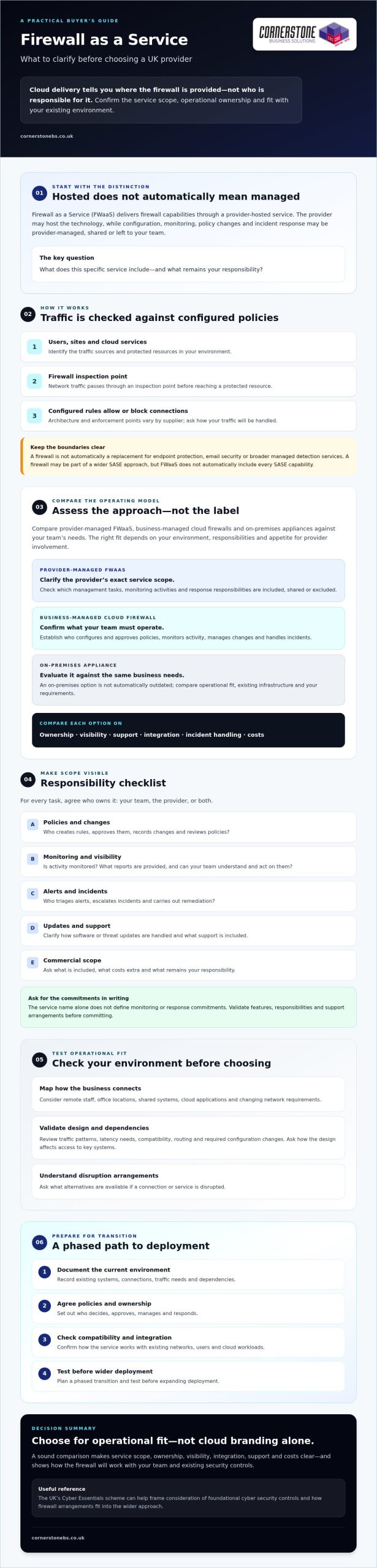
Cloud delivery alone doesn’t tell you who’s responsible for keeping a firewall effective. With firewall as a service UK options, the provider may host the technology, but responsibilities for configuration, monitoring, policy changes and incident response can vary. That distinction matters when a firewall is a core part of your business security.
Before relying on a provider, get clear on what the service includes, where its limits sit and how it will work with your existing systems and team. A cloud-delivered firewall isn’t automatically the right fit, just as an on-premises option isn’t automatically outdated.
This guide explains how Firewall as a Service works and what to compare across managed, cloud-delivered and on-premises approaches. It covers practical questions about security controls, support, accountability and costs, along with what to prepare before speaking with a provider. The aim is to help you assess operational fit, rather than choose based on cloud branding alone.
Key Takeaways
Understand what firewall as a service UK can mean in practice, and why the provider’s exact service scope matters.
Check how the proposal handles operational ownership, visibility and integration with your existing environment.
Compare provider-managed FWaaS, business-managed cloud firewalls and on-premises appliances against your team’s needs.
Ask providers to clarify who makes policy decisions, manages changes, handles incidents and oversees escalations.
Prepare for a phased transition by documenting your current environment, agreeing policies and testing before wider deployment.
What is Firewall as a Service UK & How Does It Work?
Keeping network protection consistent can be difficult when staff work remotely, offices connect to shared systems and business applications run in the cloud. Firewall as a service UK options can move firewall capabilities into a provider-hosted service, but the technology and level of management included can differ considerably.
Firewall as a Service (FWaaS) delivers firewall capabilities through a provider-hosted service. Buyers should verify which security functions, management tasks and response responsibilities the contract includes. Cloud delivery describes where or how the firewall is provided. It doesn’t automatically mean the provider configures policies, monitors activity or responds to incidents. Those responsibilities depend on the agreed service.
FWaaS is also distinct from the broader Secure Access Service Edge (SASE) concept, which brings cloud-delivered networking and security capabilities together. A firewall may form part of a wider SASE approach, but don’t assume a firewall service includes every other security or networking function.
How does Firewall as a Service process network traffic?
At a high level, network traffic passes through a firewall inspection point before a connection reaches a protected resource. The firewall checks traffic against configured policies, such as rules governing which connections are permitted or blocked. Architecture and enforcement points vary by supplier, so ask how traffic from your users, sites and cloud services will be handled.
The proposal should explain who configures and approves policies, and what happens when a rule needs changing. Inspection, logging, software or threat updates, and incident response may be included, shared or left to your team. Check each responsibility rather than relying on the phrase “managed firewall”.
Which business environments might use a cloud-delivered firewall?
A cloud-delivered model may be worth assessing if your organisation has distributed staff, several locations, cloud applications or network requirements that change as the business grows. It can provide a way to apply firewall controls across different connections, but suitability depends on your actual environment, not just the appeal of cloud delivery.
Review your traffic patterns, latency needs, existing network infrastructure and appetite for provider involvement. Ask how the proposed design would affect access to key systems, and what alternatives are available if a connection or service is disrupted.
Keep the boundaries clear, too. A firewall controls network traffic under its policies; it isn’t automatically a replacement for endpoint protection on devices, email security or broader managed detection services. Treat these as separate parts of your security plan and confirm which capabilities, if any, are included in the proposal.
What Should a Firewall as a Service Package Include?
A proposal should make clear what you’re buying, who does the work and how the service fits your existing environment. For firewall as a service UK options, don’t judge the package by its label or feature list alone. Features, responsibilities and support arrangements vary between providers, so validate each item in writing before you commit.
The service name alone doesn’t define monitoring or response commitments. A cloud-hosted firewall may be managed by your own team, by a provider, or through shared responsibilities. Ask for a clear description of what’s included, what costs extra and what remains yours to handle.
Which management and monitoring responsibilities should buyers clarify?
Start with operational ownership. Who creates firewall rules, who approves them, and how are changes recorded and reviewed? Clear answers help prevent gaps and unexpected changes to access. Establish whether monitoring, alert triage, incident escalation and remediation are included, separately scoped or assigned to your staff.
Request examples of the reports you’ll receive and ask how often policies are formally reviewed. Check whether reports show activity and changes in a way your team can understand and act on. The UK’s Cyber Essentials scheme provides a useful reference for considering foundational cyber security controls, including how firewall arrangements fit into your wider approach.
How should FWaaS fit with cloud, remote access and existing controls?
Ask the provider to explain how the proposed service will support your users, locations and cloud workloads, and interact with your existing network infrastructure. Don’t assume current systems will connect unchanged. Assess compatibility, traffic routing, dependencies and any required configuration changes before planning a migration.
Consider the wider cloud environment, too. Planning cloud services alongside network security can help you identify dependencies and decide where access controls need to apply. If you’re reviewing cloud arrangements, read Cloud Solutions for UK Businesses as part of that planning. Check how the firewall will work alongside existing controls rather than assuming it replaces them.
Before signing, make sure the proposal documents service scope, ownership, visibility and integration in plain language. You can also discuss your wider IT and cyber security requirements with Cornerstone Business Solutions, while confirming directly whether any proposed firewall service meets your needs.
Firewall as a Service vs Traditional Firewalls: Which Model Fits Your Business?
The right choice depends on how your organisation works and who can operate its security controls. A provider-managed service can shift some operational tasks outside your business. A business-managed cloud firewall changes where the control runs, not necessarily who manages it. An on-premises appliance keeps the firewall at your location, with your team or a provider responsible for its operation.
Cloud delivery isn’t automatically more secure or suitable. Compare the management model, visibility and workload each option brings, then check how well it supports your applications and network design. Vendor-neutral NIST firewall policy guidelines can also help inform your approach to firewall policies.
Model
Management ownership
Deployment considerations
Visibility and operational demands
Provider-managed FWaaS
Provider manages agreed tasks; your organisation retains responsibilities set out in the contract.
Assess how users, sites and cloud workloads connect through the service.
Confirm what logs and reports you can access, and which tasks still need internal oversight.
Business-managed cloud firewall
Your team manages configuration and day-to-day operation.
Check compatibility with your cloud environment, network design and applications.
Your team needs the skills and capacity to review policies, alerts and changes.
On-premises appliance
Your team or a contracted provider manages the firewall on site.
Consider local infrastructure, site dependencies and plans for hardware changes.
Confirm who maintains policies, checks activity and handles operational issues.
When could a managed cloud firewall be a practical fit?
A managed cloud firewall may suit an organisation seeking consistent policy management across distributed users or locations, particularly if its internal team has limited capacity to operate and review firewall controls. Provider involvement doesn’t remove the need for oversight. Check that the network design supports your applications and that the provider can meet your documented requirements.
When might an existing firewall or hybrid approach remain appropriate?
If you’re concerned about losing control, examine the contract and operating process. Who approves policy changes? Which accounts can access the system? Can you review audit trails of actions and configuration changes? What happens to your policies, logs and access if you leave the service? For firewall as a service UK options, clear answers to these questions matter as much as the delivery model.
How to Evaluate a Firewall as a Service Provider in the UK
A sound provider assessment looks beyond features and cloud terminology. For firewall as a service UK options, focus on whether the service fits your environment and whether responsibilities are clear before, during and after an incident.
Assess a provider by checking service scope, accountability, visibility and exit planning. Use this five-step process to compare proposals on practical terms:
Map your requirements. Record your users, locations, cloud workloads, key applications, existing controls and internal capabilities. Note what the firewall needs to protect and any operational constraints.
Confirm the scope. Ask what the provider will configure, monitor, report on and maintain. Identify what your organisation must do, and whether any tasks are separately scoped.
Test the operating model. Walk through a policy change and a sample security incident. Confirm who makes decisions, who acts, how incidents are escalated and how actions are communicated.
Review the terms. Check technical prerequisites, migration responsibilities, data handling, access permissions, subcontracting, contract changes and exit assistance. Ask how continuity arrangements work if the service or a connection is disrupted.
Compare like for like. Use the same requirements and questions for each provider. Record differences in responsibilities, reporting, dependencies and contract terms, not just quoted features.
What security, reporting and accountability questions should you ask?
Ask how firewall policies are documented, approved, changed and reviewed, including who can authorise exceptions. Request sample reports, alert escalation routes and incident communications so you can judge whether the information will support your team’s oversight. The provider should explain its controls and how they interact with your organisation’s own governance responsibilities.
Make responsibility boundaries explicit. Who decides whether a policy change is appropriate? Who responds to an alert, and who is contacted if an incident needs escalation? Validate any relevant UK regulatory or contractual obligations with suitably qualified advisers. A provider can explain its service, but that isn’t a substitute for advice on your organisation’s specific obligations.
How can you check compatibility, contract terms and resilience?
Before agreeing a migration, confirm technical prerequisites, dependencies and which party handles each change. Review access permissions, data handling, subcontracting arrangements, how contract changes are managed and what assistance is available if you exit. Consider these questions alongside your wider resilience planning, including the principles covered in a Cyber Security Services guide.
If you’d like to assess firewall requirements alongside wider IT and cyber security needs, discuss your requirements with Cornerstone Business Solutions. Confirm directly whether its current services and capabilities fit the scope you’re considering.
Moving to Firewall as a Service: Your Next Steps
A carefully planned move helps protect business continuity as well as network access. Treat firewall as a service UK adoption as a staged change, not a switch to make before you understand what depends on your current setup.
Document the environment. List locations, users, cloud services, critical applications and current firewall arrangements. Include known dependencies, such as systems that rely on specific network routes or access rules.
Agree the policies. Decide what the firewall should allow or block, who approves those rules and how exceptions will be handled. Confirm responsibilities with the provider before configuration begins.
Test the proposed setup. Where practical, trial it with a limited group, location or suitable workload. Check that essential applications work as expected, and record any issues or changes needed.
Migrate in phases. Expand only after reviewing the test results. A phased rollout can reveal overlooked dependencies before the new arrangement affects more users or services.
Review after transition. Check access, reporting and policy operation against the agreed requirements. Confirm who owns ongoing reviews and how future changes will be requested and approved.
Before work starts, agree rollback arrangements in case the change disrupts an essential service. Decide how staff and relevant stakeholders will be told about changes, and who owns the firewall after each transition stage. These details help teams respond calmly if the rollout needs adjustment.
What information should you prepare before discussing a firewall service?
Bring a concise picture of your environment and priorities. Note the users, locations, cloud services and critical applications involved, along with your current firewall setup. Add your security priorities, operational pain points, reporting needs and change approval requirements. Identify who in your organisation can make technical decisions, handle procurement and coordinate incident communications.
How can a managed IT partner support the evaluation?
A managed IT or cyber security provider may help you assess firewall requirements alongside your wider technology environment. Ask specifically which firewall services and technologies it currently provides, manages or supports, and which responsibilities it can take on. Confirm the answer against your needs rather than assuming a particular FWaaS offering is available.
For related context, explore the Managed IT Services and Cyber Security Services guides as you consider how firewall decisions fit into broader operational resilience. Cornerstone Business Solutions provides managed IT support and cyber security services across the UK. If you’re considering a move, discuss your business requirements with the team and confirm whether it currently supports the Firewall as a Service scope you need.
Make Your Next Firewall Decision with Confidence
The right firewall approach depends on more than where the technology is hosted. Compare who manages policies and incidents, what visibility your team receives, and how the service fits your network. For firewall as a service UK options, clear responsibilities and a planned transition matter just as much as the features on offer.
Prepare a picture of your users, sites, cloud services and critical applications before you speak with providers. Use it to confirm scope, test compatibility and agree how changes and escalation will work. These practical steps can help you choose an approach that supports security without adding avoidable disruption.
Cornerstone Business Solutions is a multi-award-winning UK IT services provider offering managed IT support and cyber security services, with technology partnerships including Microsoft, IBM and Cisco. Its available service information doesn’t confirm a specific Firewall as a Service package, so ask directly which firewall services, technologies and responsibilities it currently supports.
Firewall as a Service (FWaaS) delivers firewall capabilities through a provider-hosted service. It inspects network traffic against configured rules, but the provider’s role can range from hosting the technology to managing agreed operational tasks. For firewall as a service UK proposals, check who configures policies, reviews activity, handles updates and responds to incidents. The service name alone doesn’t confirm which functions or responsibilities are included.
Is Firewall as a Service suitable for small businesses?
It can suit a small business if the service matches its network needs and provides a workable level of support and control. Consider how many users and locations need protection, which cloud services and applications they rely on, and whether your team can manage firewall policies internally. Compare the proposed responsibilities and reporting with your capacity. A smaller organisation shouldn’t assume a cloud-delivered model is automatically simpler or more cost-effective.
How does Firewall as a Service differ from a traditional firewall?
The key difference is often how the firewall is delivered and managed, rather than its basic purpose of controlling network traffic. FWaaS uses a provider-hosted service, which may be provider-managed or operated by your own team. A traditional firewall is commonly an appliance at a business location, managed internally or by a contracted provider. Compare ownership, deployment needs, visibility and operational workload to determine which arrangement fits.
Does Firewall as a Service replace antivirus or endpoint protection?
No. A firewall applies rules to network traffic, while antivirus and endpoint protection help protect individual devices. These controls address different parts of your security environment, so a firewall service shouldn’t be treated as a replacement for device protection. Check which security measures your organisation already uses, where gaps may exist and how the proposed firewall works alongside them. Confirm exactly what the provider includes rather than relying on broad package descriptions.
Can Firewall as a Service protect remote workers?
It may help apply firewall controls to remote users, depending on how the service is designed and how their devices connect to business systems. Ask the provider to explain the traffic paths, access rules and any technical requirements for staff working away from an office. Also check how the arrangement fits with endpoint protection and other existing controls. Remote access needs should be tested against real applications and working patterns before wider deployment.
What should I check before choosing a Firewall as a Service provider?
Confirm the service scope, management ownership, reporting, technical prerequisites and migration responsibilities. Ask who approves and changes firewall policies, monitors alerts, handles incidents and manages escalations. Review access permissions, audit records, continuity arrangements, contract terms and exit support. Request examples of reports and incident communications so you can judge their usefulness. Compare providers against the same requirements, and clarify any responsibilities that remain with your organisation.
Does Firewall as a Service guarantee compliance with UK regulations?
No. Using a firewall service doesn’t by itself guarantee compliance. Whether your organisation meets relevant requirements depends on its circumstances, the controls it applies and how it manages its wider responsibilities. Ask the provider to explain its service controls and supply information you can use in your own governance. Validate applicable legal, regulatory and contractual obligations with suitably qualified advisers, rather than treating a product or provider statement as a compliance determination.
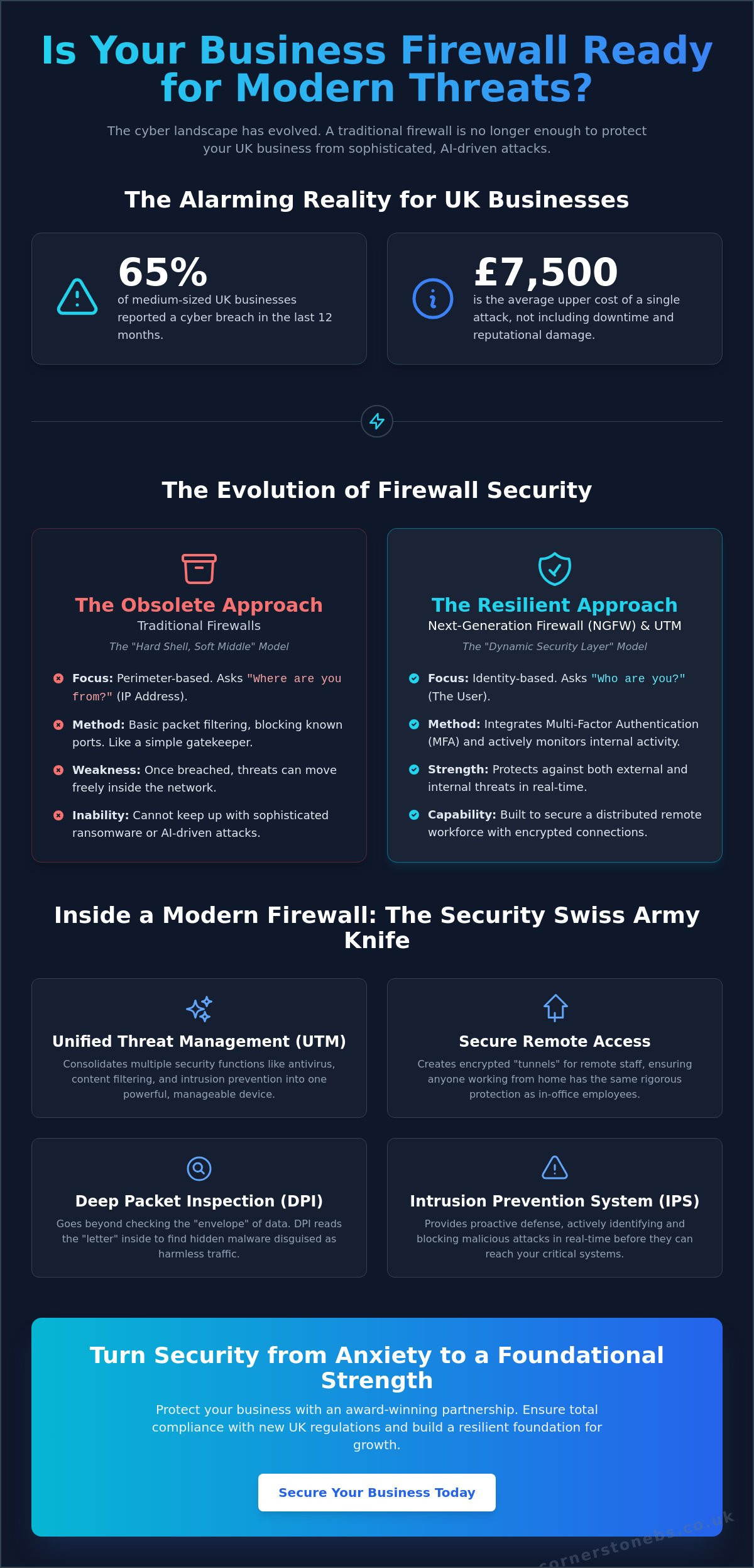
Did you know that 65% of medium-sized UK businesses reported a cyber breach in the last 12 months? With the average cost of an attack now hitting up to £7,500, the stakes for your digital infrastructure have never been higher. It’s a stressful reality for many local business owners who are trying to balance securing a remote workforce with the rising threat of sophisticated ransomware. You likely feel the pressure of keeping your data safe while lacking the internal expertise to monitor your network around the clock.
We understand that finding the right business firewall solutions UK organisations can trust is about more than just hardware; it’s about protecting your livelihood. This guide shows you how to select and manage a firewall that ensures zero downtime and full compliance with the 2026 Cyber Security and Resilience Bill. We’ll explore how AI-driven threat prevention and expert management can turn your security from a source of anxiety into a foundational strength for your business growth.
Key Takeaways
Learn why the old-school “hard shell” approach is obsolete and how a dynamic security layer protects you from 2026’s sophisticated ransomware.
Discover how Next-Generation Firewalls and UTM tools act as a “security Swiss Army knife” to keep your remote teams safe and productive.
Compare the true costs of unmanaged security against professional business firewall solutions UK experts provide to eliminate hidden downtime risks.
Identify whether physical hardware or cloud-native architecture is the right fit for your specific business infrastructure and growth plans.
Find out how a proactive, award-winning partnership ensures total compliance with new UK regulations while simplifying your digital security.
Why Traditional Business Firewall Solutions are No Longer Enough in 2026
The digital landscape for UK businesses has shifted dramatically over the last few years. If you are still relying on a basic router or a legacy system, your network is likely more exposed than you think. In the past, understanding what is a firewall meant thinking of it as a simple gatekeeper that blocked specific ports. Today, that is no longer enough. Modern business firewall solutions UK organisations depend on are dynamic security layers. They don’t just sit there; they actively inspect every packet of data for hidden threats in real-time.
We used to talk about the “hard shell, soft middle” approach to security. This involved building a strong perimeter while leaving the internal network relatively open. That model is now obsolete. Once a threat bypasses a traditional perimeter, it can move laterally through your systems with ease. In 2026, AI-driven threats can probe your network for weaknesses thousands of times per second. Standard business routers simply cannot keep up with this level of automated aggression. You need a system built for proactive resilience, creating a stable foundation that allows your business to grow without the constant fear of a breach.
The Shift from Perimeter to Identity-Based Security
Old-school firewalls focused on where a connection came from by looking at IP addresses. However, IP addresses are easily spoofed and change constantly in a mobile world. Modern systems have moved toward verifying the user. This means your firewall now asks “Who are you?” rather than “Where are you?”. By integrating multi-factor authentication (MFA) directly at the network edge, we ensure that only authorised personnel can touch your data. Identity-Based Security is the new standard for UK SMEs, providing a much higher level of precision than traditional methods.
Supporting a National Remote Workforce Securely
Understanding Next-Generation Firewall (NGFW) and UTM Capabilities
Choosing between different business firewall solutions UK providers can feel overwhelming. However, understanding the difference between a standard firewall and a Next-Generation Firewall (NGFW) is vital. Traditional firewalls act like a simple bouncer checking IDs at the door. NGFWs are more like an undercover security team. They don’t just check who is coming in; they monitor what people are doing once they are inside. This active monitoring is crucial when you consider that 43% of UK businesses reported a breach in the last 12 months.
For many local firms, Unified Threat Management (UTM) is the “security Swiss Army knife” they need. It bundles multiple security features like antivirus, content filtering, and intrusion prevention into one manageable device. This consolidation is perfect for businesses that want robust protection without the complexity of managing several different systems. Our team often recommends these integrated business firewall solutions UK SMEs can rely on for simplicity and strength.
Deep Packet Inspection and Intrusion Prevention
Standard packet filtering only looks at the “envelope” of a data packet. Deep Packet Inspection (DPI) actually opens the envelope to read the letter inside. This is how modern firewalls find hidden malware disguised as harmless traffic. An Intrusion Prevention System (IPS) takes this further by actively blocking attacks before they reach your servers. According to the latest cyber security statistics, phishing and malware remain top threats. We believe these tools provide more than just technical safety; they offer the emotional security you need to focus on your business goals while your digital borders are defended.
Application Awareness and Content Filtering
Your firewall should be smart enough to know the difference between a productive session and a risky download. Application awareness allows you to set granular rules. You might allow LinkedIn for your marketing team but block high-bandwidth streaming sites that slow down the office network. Content filtering goes a step further by preventing employees from accidentally visiting malicious websites. This proactive approach keeps your team focused and your bandwidth clear for essential tasks. If you’re curious about how these features could fit your workflow, our cyber security experts are always happy to have a conversation.
Managed vs. Self-Managed Firewalls: Evaluating the Real Cost of Security
Many UK business owners ask why their internal IT team can’t just handle the firewall. It’s a fair question. Your internal staff are brilliant at supporting your workflows and keeping your team productive. However, managing the business firewall solutions UK companies need in 2026 is a specialized, full-time commitment. It isn’t just about plugging in a high-tech box. It’s about constant vigilance and the ability to react to threats the moment they appear. Asking an internal team to handle this on top of their daily tasks often leads to burnout or, worse, overlooked vulnerabilities.
The hidden costs of unmanaged security are often far higher than a monthly service fee. When a system is left to its own devices, “configuration drift” sets in. This happens when small, undocumented changes are made to the network over time. Without professional audits, these tiny gaps eventually become wide-open doors for attackers. If a breach occurs, the average cost to a UK business can reach up to £7,500 in immediate recovery fees. We believe in a partnership model. We don’t just sell you hardware; we become a proactive extension of your team to ensure your network remains a stable foundation for growth.
The Burden of 24/7 Monitoring and Patching
A firewall is only as good as its last update. New exploits emerge every single day, and your defense must evolve just as fast. If your team only monitors the system during standard office hours, you are leaving your data exposed for the majority of the week. Cybercriminals don’t work 9-to-5, so your security shouldn’t either. Professional management ensures that critical patches are applied the moment they are released. This proactive approach eliminates the window of opportunity that attackers rely on. It’s about providing the emotional security that comes from knowing your business is defended while you sleep.
Compliance and Reporting Requirements
Staying on the right side of UK regulations is a significant part of modern network management. Our cyber security services help you navigate the complexities of GDPR and the upcoming requirements of the Cyber Security and Resilience Bill. For businesses in critical sectors, these aren’t just suggestions; they are legal mandates that require proof of active defense. Managed reports provide the third-party validation your stakeholders, insurers, and clients expect. We provide the clarity and documentation needed to prove your business is resilient, turning a complex technical necessity into a clear competitive advantage.
Selecting the Right Firewall Architecture for Your Business Model
Every UK business is unique. A small accounting firm in the Cotswolds has vastly different requirements than a large manufacturing plant in the Midlands. Selecting the right architecture for your business firewall solutions UK strategy depends entirely on where your data lives and how your team accesses it. We pride ourselves on being a long-term partner that looks at your whole business, not just a single piece of hardware. By working with global leaders like Cisco and IBM, we ensure our clients have access to world-class technology that fits their specific local needs.
The choice between physical hardware and cloud-native solutions isn’t just a technical one; it’s a decision about how your business will scale. For some, a physical appliance provides the raw power needed for high-speed local tasks. For others, the flexibility of the cloud offers the agility required to support a growing, mobile workforce. We help you navigate these choices with the clarity of an expert who wants to simplify the complex.
Hardware Firewalls for On-Premise Infrastructure
Physical appliances remain the gold standard for offices with high local data usage. If your team regularly handles large files or relies on on-site servers, a hardware firewall provides the dedicated processing power you need. We always recommend implementing “High Availability” (HA) pairs. This setup involves two identical firewalls working in tandem. If one unit fails, the other takes over instantly, preventing a single point of failure. This level of redundancy is a foundational element of our IT infrastructure support, ensuring your business stays online no matter what.
Virtual and Cloud-Native Firewall Solutions
As more organisations migrate to a cloud environment, traditional hardware isn’t always the most efficient path. Virtual firewalls offer incredible scalability, allowing you to increase security capacity the moment your business grows. For multi-site organisations, Firewall as a Service (FWaaS) is an excellent choice. It allows you to manage security policies from a central point, ensuring total parity between your physical office and your cloud applications. This ensures that a staff member in London has the exact same level of protection as someone in your head office.
Choosing the right path for your network security is a big step toward long-term stability. If you are ready to find the perfect fit for your organisation, contact our local team of experts for a friendly conversation about your requirements.
Strengthening Your Business Resilience with Cornerstone Business Solutions’ Managed Security
As a multi-award-winning IT provider, Cornerstone Business Solutions believes that network security is an ongoing journey. We don’t just sell you a box and walk away. Instead, we provide the managed business firewall solutions UK firms need to build lasting stability. Our goal is to simplify the complex technical jargon that often surrounds digital safety. We want you to focus on running your company with total peace of mind. By acting as a dedicated long-term partner, our team ensures your network is always a step ahead of evolving threats while maintaining the regional warmth you expect from a local expert.
Security should never be a barrier to your productivity. It should be the invisible engine that keeps your business moving forward. Cornerstone Business Solutions takes a collaborative approach to every project. We work closely with you to understand your specific challenges. Whether you’re dealing with the complexity of remote teams or the pressure of new UK regulations, we provide clear, benefit-driven results. This isn’t just about technical necessity. It’s about providing the emotional security that comes from knowing your livelihood is protected by a team that genuinely cares about your success.
Proactive Monitoring and Award-Winning Support
Our proactive system monitoring identifies and neutralises threats before they ever impact your daily operations. This constant vigilance is backed by our award-winning support team. You get unlimited helpdesk access for any security queries, no matter how small or specific they might be. Supporting a diverse national clientele has given Cornerstone Business Solutions the insight to handle almost any challenge with confidence. We catch the small issues before they become big problems. This ensures your team stays online and your data stays private. It’s the difference between reacting to a disaster and preventing one entirely.
Integration with Microsoft 365 and Cloud Ecosystems
A modern security posture requires a joined-up strategy across your entire digital footprint. Our firewall solutions perfectly complement a Microsoft 365 migration, creating a unified defense for your data and communications. We bridge the gap between daily IT maintenance and high-level cyber security. This ensures there are no weak links in your chain as you move more services to the cloud. This holistic approach provides the solid foundation for growth that every ambitious UK business deserves.
We’d love to help you secure your future. If you’re ready to move beyond transactional IT and find a partner who values your business as much as you do, let’s talk. Cornerstone Business Solutions invites you to an informal conversation with our local team to explore how we can strengthen your resilience together.
Securing Your Digital Future in 2026 and Beyond
The shift from passive filters to dynamic security is no longer optional for organisations. As we have explored, the landscape of 2026 demands a move away from the “hard shell” perimeters of the past toward identity-based, managed resilience. Selecting the right business firewall solutions UK providers offer is about more than just checking a box on a compliance list. It’s about ensuring your business has the stability to scale without the constant threat of disruption or configuration drift.
Cornerstone Business Solutions brings together the power of global partnerships with Microsoft, IBM, and Cisco to deliver world-class protection with an approachable, local face. We provide the 24/7 proactive system monitoring and award-winning support needed to keep your network secure while you focus on your core goals. If you’re ready to move from a reactive posture to a foundation of strength, our team is ready to support you. We invite you to book a proactive security conversation with our award-winning team. Let’s ensure your digital infrastructure remains a stable, secure asset for your long-term success.
Frequently Asked Questions
What is the difference between a home router firewall and a business firewall?
Business firewalls provide advanced security layers like deep packet inspection and intrusion prevention that standard home routers lack. While a home device simply blocks or allows traffic based on basic rules, business firewall solutions UK firms use today can identify specific applications and block hidden malware. This keeps your professional network stable and your sensitive client data protected from sophisticated attacks.
Do I still need a firewall if all my business data is in the cloud?
How much does a managed firewall solution cost for a UK SME?
The cost of a managed firewall depends on your business size, the number of users, and the specific security features you require. While pricing varies across the industry, we focus on providing a solution that balances robust protection with a clear return on investment. We always suggest a quick chat with our local team to get an accurate estimate tailored to your unique infrastructure.
Can a firewall protect my employees when they are working from home?
Firewalls protect remote employees by creating secure, encrypted tunnels between their home devices and your office network. This ensures that even if they are using a personal Wi-Fi connection, their data traffic is inspected and secured by your central security policies. It’s a foundational step in maintaining a consistent security posture across a national workforce.
What is Next-Generation Firewall (NGFW) and why is it recommended?
A Next-Generation Firewall (NGFW) is a more advanced version of traditional security that includes features like integrated intrusion prevention and application awareness. It doesn’t just look at where data is coming from; it looks at what the data is actually doing. We recommend it because it provides the granular control needed to stop modern, automated cyber threats in real-time.
How often does a business firewall need to be updated or patched?
Your firewall should receive threat intelligence updates in real-time to defend against the latest exploits. Critical security patches and firmware updates should be applied as soon as they are released by the manufacturer. Our managed service handles this automatically, so you don’t have to worry about your defenses falling behind the latest hacker techniques.
Does a firewall help with GDPR compliance for my UK business?
A firewall is a critical component of GDPR compliance because it helps satisfy the “security by design” requirement. By preventing unauthorised access to personal data and providing detailed logs of network activity, you can prove to regulators that you’ve taken proactive steps to protect privacy. It turns a complex legal obligation into a manageable part of your IT strategy.
What happens if our firewall hardware fails suddenly?
If your hardware fails and you have a High Availability (HA) pair, a second unit takes over instantly to prevent any downtime. In a managed environment, our team receives an immediate alert and begins the replacement process before you even notice a problem. This proactive approach ensures your business stays online and your emotional security remains intact.
Relying on a traditional firewall to protect your business in 2026 is like locking your front door while leaving every window wide open. With 50% of UK businesses reporting a cyber attack in the 2024 Cyber Security Breaches Survey, the old “castle and moat” approach to IT just doesn’t cut it anymore. You’ve likely heard the term mentioned in boardrooms, but you’re probably asking, what is zero trust security and why does it matter for your firm? At Cornerstone Business Solutions, we believe in making complex technology simple so you can focus on your success.
It’s natural to feel anxious about rising ransomware threats or confused about how to secure a team that’s split between the office and home. You want your data protected without making it a nightmare for your staff to get their work done. This guide breaks down the “Never Trust, Always Verify” model into plain English. We’ll show you how our award-winning approach to digital safety creates a robust shield around your assets. You will gain a clear roadmap to modernise your defences and the peace of mind that comes from a true security partnership.
Key Takeaways
Understand what is zero trust security and why the ‘Never Trust, Always Verify’ model is the essential new standard for protecting your UK business in the modern era.
Learn how to apply the core principles of explicit verification and least privileged access to ensure your team only ever sees the data they need to do their jobs.
Discover why traditional VPNs are becoming obsolete and how switching to granular, application-specific access provides a more robust shield for your remote workforce.
Follow our practical five-step roadmap designed for UK SMEs to help you identify your critical assets and secure your transaction flows with total confidence.
Realise how partnering with an award-winning IT expert can simplify your transition to a modern framework, providing long-term peace of mind and proactive protection.
What is Zero Trust Security? Defining the Modern Standard
Ask our award-winning team at Cornerstone Business Solutions what is zero trust security and we will tell you it is the only way to protect a modern UK business in 2026. This framework replaces the outdated idea that anything inside your office network is inherently safe. It builds on a foundation of Zero Trust Architecture to ensure every single access request is authenticated, authorised, and continuously validated before any data is shared. Whether a request comes from a desk in Middlesbrough or a laptop in a London coffee shop, the system treats it with the same level of scrutiny.
The old “Castle and Moat” model served us well for decades. You built a thick wall with a firewall and assumed everyone inside the moat was a friend. That logic failed as soon as the world changed. Today, your data lives in the cloud and your staff work from anywhere. Because 82% of data breaches now involve a human element or stolen credentials, trusting anyone by default is a massive risk. Zero Trust removes this vulnerability by assuming that threats already exist both inside and outside the network. It’s a proactive stance that provides genuine peace of mind for business owners who want to grow without fear.
The Death of the Traditional Network Perimeter
Firewalls are no longer enough to keep your business safe. In 2026, the office wall has effectively disappeared. With 75% of the UK workforce now operating in hybrid roles according to ONS data, your sensitive information is accessed from thousands of different locations and devices every day. Services like Microsoft 365 have moved your “crown jewels” out of the server room and into the cloud. This shift means the traditional perimeter is dead. If you rely solely on a perimeter fence, you leave your data exposed the moment an employee logs on from a home Wi-Fi connection. Our local experts focus on securing the data itself, not just the building it used to sit in.
The ‘Never Trust, Always Verify’ Mindset
In a Zero Trust world, identity is the new perimeter. This mindset requires us to “assume breach” at all times. By treating every login attempt as a potential threat, we stop hackers from moving laterally through your systems. If a cybercriminal steals a password, they shouldn’t automatically get the keys to your entire organisation. Zero Trust stops them at the first door. This approach reduces the impact of an attack by 40% on average, as it contains the threat to a single point. It’s about being smart, stayng local, and ensuring your North East business remains resilient against global threats. We don’t just manage your IT; we partner with you to create a secure environment where “trust” is earned through constant verification.
This strategic mindset, where you anticipate an opponent’s moves and protect your critical assets, shares much in common with the game of chess. Learning the fundamentals of classic strategy, with resources from experts like Official Staunton, can even help sharpen the analytical skills needed for modern cyber defence.
The Three Core Principles of a Zero Trust Architecture
Understanding what is zero trust security starts with three non-negotiable pillars. These aren’t just suggestions; they’re the framework defined in the NIST Special Publication 800-207, which sets the global standard for modern cyber defence. By following these rules, our award-winning team helps North East organisations move from reactive panic to proactive peace of mind. These principles work together to create a multi-layered shield that protects your data, even if a perimeter is breached.
Principle 1: Verify Explicitly and Continuously
The old way of working relied on “trust but verify.” Zero Trust flips this. You must always authenticate and authorise based on all available data points. We look beyond simple passwords. A 2023 report found that 81% of hacking-related breaches leveraged weak or stolen credentials. To counter this, your system must check user identity, location, device health, and the type of service being accessed in real-time. Multi-Factor Authentication (MFA) is the foundational requirement here. It’s the first step in ensuring that the person logging in from a home office in Middlesbrough is actually who they claim to be.
Principle 2: The Power of Least Privileged Access
This principle limits user access with “Just-in-Time” and “Just-Enough-Access” (JIT/JEA) protocols. You wouldn’t give every employee a master key to your entire office building, so don’t do it with your digital files. By restricting permissions to only what is necessary for a specific task, you ensure a single compromised account cannot sink the ship. We recommend auditing permissions every 90 days to ensure they remain relevant to current job roles. This strategy significantly reduces your “attack surface,” making it much harder for threats to spread across your network. To see how these same access principles apply to physical premises, you can discover London Locks.
Principle 3: Why You Must ‘Assume Breach’
Operating with an “assume breach” mindset means you act as if a threat is already present within your environment. It sounds pessimistic, but it’s actually a highly effective strategy for resilience. This involves using micro-segmentation to isolate sensitive workloads so that if one area is hit, the rest of the business stays safe. We also implement end-to-end encryption for all data, whether it’s sitting on a server or moving between staff. Continuous monitoring helps identify suspicious behaviour in real-time, often catching issues before they escalate into a £3.4 million data breach, which was the average cost for UK firms last year.
Implementing these layers doesn’t have to be a headache for your team. If you want to see how these principles fit your specific setup, you can always have a chat with our local experts to get a clear, jargon-free assessment of your current security posture.
Zero Trust vs. Traditional Security: Why the VPN is Becoming Obsolete
For years, UK businesses relied on Virtual Private Networks (VPNs) to secure their remote workforce. This “castle and moat” approach worked when everyone sat in the same office, but it’s now a liability. Traditional VPNs grant broad access to your entire network once a user is “inside.” If a hacker steals a single set of credentials, they have the keys to your whole kingdom. Our award-winning team at Cornerstone Business Solutions sees this vulnerability as the primary driver for local firms moving toward a more robust model.
The fundamental shift involves moving from broad network access to granular application access. Instead of connecting to the server, users connect only to the specific tools they need to do their jobs. This significantly reduces the “attack surface” of your business. According to IBM’s guide to Zero Trust, this framework assumes every connection is a potential threat until proven otherwise. This proactive stance is why Zero Trust is more resilient against modern credential-stuffing attacks, where hackers use billions of leaked passwords to try and force entry. Because Zero Trust verifies the user, the device, and the context of the login, a stolen password alone isn’t enough to cause a breach.
The Flaws in the ‘Trust but Verify’ Approach
The old “trust but verify” model is failing because it allows for lateral movement. In a traditional setup, if one laptop becomes infected with ransomware, the virus can spread through the entire server in minutes. When we explain what is zero trust security to our partners, we focus on how it isolates every user. In 2024, IBM reported that businesses using Zero Trust saved an average of £1.4 million in data breach costs compared to those that didn’t. Verifying a user once at the start of the day is no longer enough; security must be continuous. High-profile incidents like the Marks and Spencer data breach demonstrate exactly how devastating lateral movement can be when a trusted network is compromised.
The Business Benefits of Retiring Legacy Systems
Moving away from clunky legacy VPNs offers immediate performance gains for your team. You’ll see several key improvements:
Seamless User Experience: Remote workers enjoy direct, fast access to cloud applications without the bottleneck of a central VPN server.
Efficient Onboarding: Our North East clients find that setting up new staff or contractors is 40% faster when using automated identity policies.
Reduced IT Burden: Automated security policies mean your IT department spends less time resetting connections and more time on growth projects.
Retiring these legacy systems provides the peace of mind that your business is protected by modern, award-winning standards. Understanding what is zero trust security is the first step toward a more agile and profitable future for your organisation.
How to Implement Zero Trust: A 5-Step Roadmap for UK SMEs
Implementing a modern security framework doesn’t have to be an overwhelming task for your business. Our award-winning team at Cornerstone simplifies this transition into five clear, manageable stages. In 2024, the Cyber Security Breaches Survey revealed that 50% of UK businesses experienced a cyber attack. A structured roadmap is the most effective way to ensure you aren’t part of next year’s statistics.
Step 1: Identify your Protect Surface. You don’t need to secure every single file with the same intensity. We help you identify your “crown jewels,” such as sensitive client data or proprietary intellectual property, to focus your resources where they matter most.
Step 2: Map the transaction flows. We analyse how data moves across your network. Understanding these pathways is vital for determining what is zero trust security in the context of your specific operations.
Step 3: Build a Zero Trust architecture. This isn’t a one-size-fits-all solution. We design a bespoke environment that protects your unique data flows using modern tools like micro-segmentation.
Step 4: Create granular security policies. We move beyond simple passwords. Policies are created based on the “Kipling Method,” defining who, what, when, where, and how users access your protect surface.
Step 5: Monitor and maintain. Zero Trust is a journey, not a destination. Our proactive IT support involves constant monitoring to spot anomalies and refine your defences in real time.
Starting with Identity and Device Management
Your first move involves securing identities with robust Multi-Factor Authentication (MFA). Microsoft research indicates that MFA can block 99.9% of automated account compromise attacks. We also address the risks of unmanaged devices. In a world of Bring Your Own Device (BYOD), every smartphone or tablet must be verified before it touches your data. For a deeper look at protecting your hardware, see Cornerstone’s Cyber Security Guide.
The Human Element: Training and Behaviour
Technology is only half the battle. We help you communicate the “why” behind these changes to your employees. This reduces friction and ensures security doesn’t hinder daily productivity. When your team understands what is zero trust security and how it protects their own work, compliance becomes natural. Continuous awareness training ensures your staff remain vigilant against evolving threats like sophisticated phishing. We turn your workforce into a proactive line of defence rather than a vulnerability. For those looking to explore comprehensive educational programs that can empower staff, you might want to discover Trainetics Academy.
Strengthening this human defence layer also means supporting employee well-being, as factors like stress and distraction can lead to security mistakes. For companies invested in supporting neurodivergent team members, who may face unique challenges with focus and organisation, a specialised resource like the ADHD Clinic can provide assessments and care that empower employees to perform at their best.
This holistic view of employee well-being also includes proactive physical health management, which can reduce absenteeism and workplace transmission of infections. In sectors where staff may be exposed to healthcare environments or have concerns about antibiotic-resistant bacteria like MRSA, providing access to reliable testing is a key part of a corporate wellness strategy. Services such as mrsatest.co.uk offer confidential at-home screening kits that can provide peace of mind.
Future-Proofing Your Business with a Trusted Security Partner
Implementing a Zero Trust model isn’t a one-off project. It’s a continuous commitment to your company’s resilience. By 2026, cyber threats move at machine speed, meaning your defences must be equally agile. An award-winning IT provider doesn’t just install software. We manage the entire lifecycle of your digital safety. At Cornerstone, we deliver peace of mind by acting as an extension of your own team. Understanding what is zero trust security helps you see the value in a partnership that prioritises long-term safety over quick, transactional fixes.
We believe in a proactive approach. Security shouldn’t be a hurdle that slows your staff down. Instead, it should be the foundation that allows you to scale with confidence. Our team focuses on making complex technology simple for business owners across the North East. We handle the technical heavy lifting, so you can focus on your core goals. This partnership model ensures your security posture evolves as new threats emerge in the UK market. Real-world incidents like the Marks and Spencer data breach serve as a stark reminder of why continuous, proactive security management is essential for businesses of every size. For businesses that need to meet specific regulatory requirements, understanding NIS2 compliance requirements is becoming increasingly important alongside Zero Trust implementation.
Bespoke Solutions for Your Unique Infrastructure
Generic security packages often leave gaps in specialised business environments. Whether you’re a manufacturer in Teesside or a professional services firm in Newcastle, your infrastructure is unique. Cornerstone begins every journey with a deep-dive assessment. We don’t guess; we measure. We look at your users, your devices, and your data flow to map out the most efficient path forward.
We leverage our elite partnerships with industry leaders to your advantage. By working closely with Microsoft, IBM, and Cisco, we bring enterprise-grade tools to local businesses at a scale that makes sense. Our tailored approach means you get:
Custom access policies that match your specific workflow.
Seamless integration with your existing cloud or on-premise hardware.
Scalable security that grows alongside your headcount.
Direct access to North East-based experts who know your business by name.
Proactive Monitoring: The Cornerstone Advantage
The days of calling for help only after a screen goes blue are over. Reactive “break-fix” support is a liability in 2026. If you wait for a breach to happen, the damage to your reputation is already done. Our team provides 24/7 proactive monitoring to stop attackers in their tracks. We identify and neutralise suspicious activity before it impacts your business continuity. This same proactive mindset applies to physical resilience; to see how modern companies safeguard against power outages, you can check out Santiban Services Group.
This constant vigilance is a core part of our Managed IT Services Guide, which outlines how security fits into a total support package. We use advanced AI-driven analytics to spot anomalies that human eyes might miss. It’s about staying two steps ahead. If you’re ready to move away from stressful IT surprises, let’s have a chat about how we can secure your future.
This forward-thinking approach to risk management extends beyond digital threats. Securing the financial future of your business against unforeseen life events is just as critical for long-term stability. To understand how to protect your company’s continuity with financial planning, you can visit McBango Insurance Services.
Secure Your UK Business for 2026 and Beyond
The digital landscape for UK SMEs is shifting rapidly. By 2026, the traditional network perimeter will be a thing of the past. Moving away from outdated VPNs and adopting a “never trust, always verify” mindset isn’t just a technical upgrade; it’s a vital move for your business continuity. Understanding what is zero trust security allows you to protect your data across every device and location. You can implement this change through our 5-step roadmap to ensure your infrastructure remains robust against modern threats.
As a multi-award-winning IT services provider based in the North East, Cornerstone Business Solutions helps you navigate these complexities. We leverage our elite partnerships with Microsoft, IBM, and Cisco to build a framework that works for your specific needs. Our team provides proactive 24/7 system monitoring to give you total peace of mind while you focus on scaling your operations. Don’t leave your security to chance.
Is Zero Trust a specific software product I can buy?
No, Zero Trust is a strategic framework rather than a single piece of software you install. It’s a security philosophy based on the principle of “never trust, always verify” using a combination of identity management, multi-factor authentication, and network segmentation. Our award-winning team helps you integrate these tools into a unified defence. In 2024, the UK government’s Cyber Security Breaches Survey found that 58% of medium businesses now use at least one element of this framework.
Will implementing Zero Trust make it harder for my employees to work?
No, a well-designed Zero Trust model actually streamlines the user experience through technologies like Single Sign-On (SSO). Instead of entering passwords for every individual app, your team logs in once securely. This reduces password fatigue and helps prevent the 80% of data breaches that involve compromised credentials according to 2025 industry reports. We focus on making security seamless so your North East staff can stay productive without technical roadblocks.
Is Zero Trust only for large corporations, or do small businesses need it too?
Small and medium-sized enterprises need Zero Trust just as much as global corporations because they are often easier targets for cybercriminals. With 32% of UK businesses experiencing a cyber attack in 2024, size doesn’t protect you. What is zero trust security if not a way to level the playing field? It provides robust protection for your data regardless of your headcount. Our tailored approach ensures local businesses get enterprise-grade security that fits their specific budget.
How does Zero Trust relate to Microsoft 365 security?
Microsoft 365 provides the foundational tools needed to build a Zero Trust architecture, such as Microsoft Entra ID and Intune. These features allow you to verify every access request based on device health and location. By 2026, we expect 90% of UK Microsoft users to have enabled Conditional Access to meet insurance requirements. We’ll help you configure these settings to ensure your cloud environment remains a secure, proactive asset for your business peace of mind.
Just as insurers are now demanding robust cyber defences, it’s crucial to ensure your physical operations are equally protected. For businesses in high-risk sectors, it’s wise to also explore Construction Insurance.
Can I implement Zero Trust if I still have on-premise servers?
Yes, Zero Trust is compatible with hybrid environments that mix on-premise servers with cloud services. You don’t need to move everything to the cloud to stay safe. We use secure gateways and micro-segmentation to protect your physical hardware in the same way we protect your remote apps. This hybrid approach is common, as 45% of UK firms still maintain some local infrastructure while transitioning to modern security models. Just as digital security requires comprehensive protection, physical workplace safety demands the same attention to detail – understanding is PAT testing a legal requirement ensures your electrical equipment meets UK compliance standards alongside your cyber defences.
What is the first step a UK business should take towards Zero Trust?
The first step is identifying your “protect surface,” which includes your most sensitive data, applications, and assets. You can’t protect what you don’t know you have. Start with a comprehensive audit of your digital estate to clarify what is zero trust security in the context of your specific operations. We recommend beginning with Multi-Factor Authentication (MFA) across all accounts, as this single step can block 99.9% of automated account takeover attacks.
How much does a Zero Trust security model cost to maintain?
Maintenance costs typically range from £15 to £45 per user per month, depending on the complexity of your IT stack. While there’s an initial setup investment, many businesses find it reduces long-term costs by preventing expensive data breaches. The average cost of a UK data breach rose to £3.4 million in 2024, making proactive maintenance a smart financial move. Our transparent pricing ensures you get expert support without any hidden surprises or unexpected bills.
Does Zero Trust replace my current antivirus and firewall?
Zero Trust doesn’t replace your existing tools; it changes how they work together to create a more robust defence. Your firewall still blocks external threats and your antivirus handles local malware. However, Zero Trust adds layers that verify every user inside the network too. This layered approach is a cornerstone of modern IT. It ensures that even if a hacker bypasses your firewall, they can’t move through your systems to steal sensitive information. This comprehensive approach to business protection extends beyond digital security – ensuring compliance with essential safety regulations like PAT testing legal requirements creates the same multi-layered protection for your physical workplace.