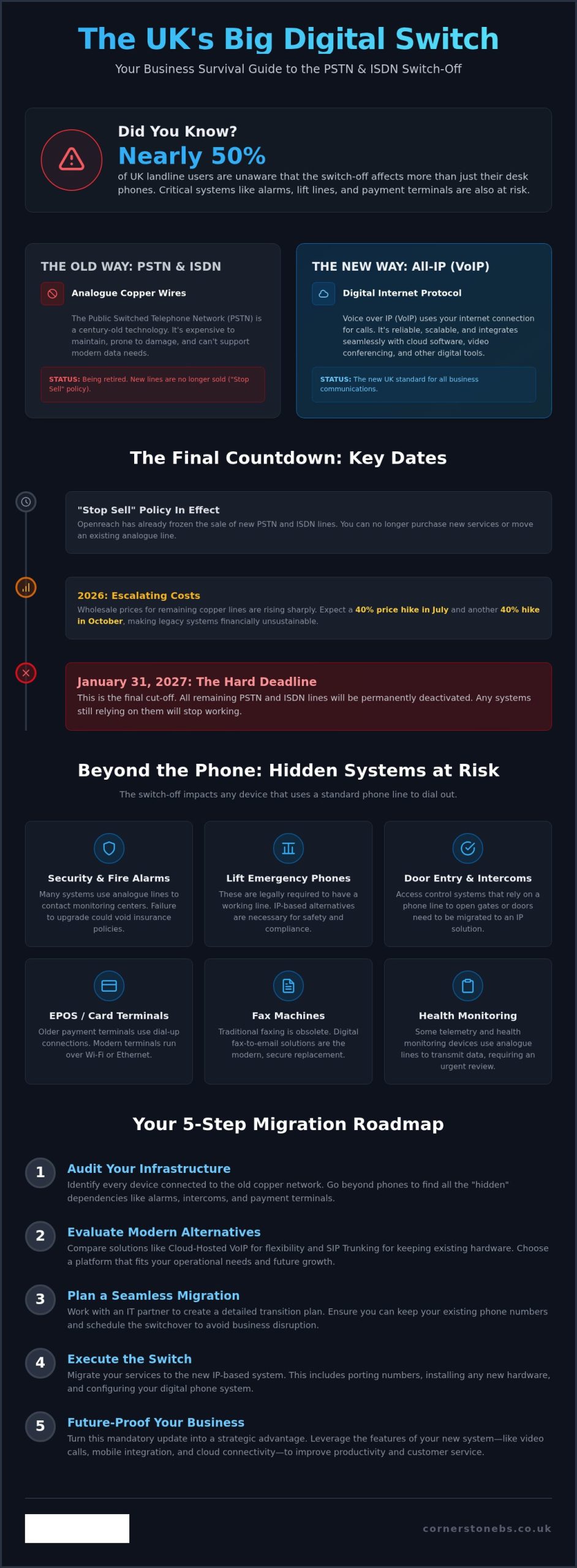

With over 350,000 UK business premises still tethered to legacy copper lines as of mid-2026, the countdown to the 31 January 2027 hard stop has officially entered the red zone. If you feel a sense of urgency about migrating from ISDN to VoIP, you aren’t alone. It’s natural to worry about downtime or hardware compatibility when your entire communication infrastructure is on the line. We understand that your business stability depends on a dial tone that never fails, and the thought of a messy transition is enough to keep any owner awake at night.
This guide provides the definitive roadmap you need to navigate the final months of the PSTN era with absolute confidence. We’ll show you how to secure a seamless transition that protects your existing numbers and slashes your monthly overheads while boosting your team’s remote working capabilities. From conducting a deep infrastructure audit to managing the final porting process, we’re laying out the exact steps to ensure your business stays connected, resilient, and ready for the digital future.
Key Takeaways
- Understand why the 31 January 2027 deadline makes late 2026 the practical hard stop for avoiding engineering bottlenecks and carrier porting freezes.
- Learn how to audit your local network infrastructure to ensure your bandwidth and router settings can handle high-definition voice traffic without jitter or drops.
- Discover the strategic differences between Hosted VoIP and SIP Trunking to determine which configuration best suits your existing hardware and remote working needs when migrating from ISDN to VoIP.
- Identify “invisible” analogue devices like lift alarms, security panels, and payment terminals that require specific digital upgrades to prevent critical service failures.
- See how a multi-award-winning partnership provides the proactive monitoring and emotional security needed to maintain business stability throughout the entire migration process.
The 2027 ISDN Switch-Off: Why Migration is Critical in 2026
The ISDN switch-off is the mandatory retirement of the UK traditional phone network by 2027. Openreach and BT have confirmed that the Public Switched Telephone Network (PSTN) and Integrated Services Digital Network (ISDN) will be fully decommissioned by 31 January 2027. This isn’t just a minor technical update; it’s a fundamental shift in how our nation communicates. Legacy copper lines, which have served British businesses for decades, are being phased out in favour of modern, fibre-based infrastructure. For many owners, migrating from ISDN to VoIP is no longer a project for the distant future. It’s a critical 2026 priority to ensure your dial tone remains active.
Unlike the old copper network that relies on physical exchanges and analogue signals, VoIP uses your internet connection to transmit voice data. This transition often utilizes Session Initiation Protocol (SIP) trunking to route calls over your data network instead of traditional phone lines. By making the move now, you’re choosing a system built for the demands of a modern, digital-first economy. It’s about moving from a fragile physical link to a robust, software-driven solution.
The Risks of Delaying Your Transition
Waiting until the final months of 2026 to make your move is a gamble with your business continuity. With over 350,000 UK business premises still needing to switch, industry capacity is expected to tighten significantly. You might face hardware shortages as demand for IP-compatible handsets and routers spikes. There’s also the financial impact; Openreach has already implemented steep price hikes throughout 2026 to discourage the use of legacy lines. Perhaps the biggest risk is the “porting bottleneck.” Moving your existing numbers requires coordination between carriers. If you wait until the Q4 2026 rush, you risk losing your established business numbers during a period of carrier freezes and high demand.
Immediate Benefits of Moving to VoIP
The shift to digital isn’t just about avoiding a deadline; it’s a massive upgrade for your daily operations and your bottom line. Transitioning to VoIP provides several immediate advantages:
- Reduced Monthly Overheads: You’ll see a significant drop in monthly costs. VoIP eliminates expensive line rental fees and offers much lower call rates.
- Hybrid Work Support: Modern systems offer native support for remote working. Your team can take office calls on their mobiles or laptops from any location in the UK, ensuring they stay connected without being tied to a desk.
- Instant Scalability: You can scale users up or down instantly. There’s no need to wait weeks for an engineer to install physical lines when your team grows.
We see these systems as a foundational element of your business stability. Moving early gives you the breathing room to test your setup and ensure your staff are comfortable with the new features long before the copper network goes dark. It provides the emotional security of knowing your communications are future-proofed.
Essential Infrastructure Audits: Preparing Your Network for VoIP
Before you begin migrating from ISDN to VoIP, you need a clear picture of what’s currently running on your copper lines. It’s not just about the handsets sitting on your desks. Many UK businesses forget about “invisible” devices like lift alarms, fax machines, and security panels. These often rely on the same legacy infrastructure and need specific attention to avoid total failure when the switch happens. A thorough audit ensures no critical service is left behind during the transition.
Bandwidth and Connectivity Requirements
Your internet connection is the new backbone of your phone system. For a high-quality, uncompressed VoIP call, you’ll typically need around 100 kbps of symmetrical bandwidth. If you have 20 people on the phone at once, that’s 2 Mbps dedicated solely to voice traffic. We often recommend a partitioned voice circuit or a dedicated line to ensure your office file downloads don’t interfere with client calls. This level of reliability is a core part of broader cloud solutions for UK businesses, where scaling securely depends on a robust network foundation.
Your router plays a vital role in this setup. By configuring Quality of Service (QoS) settings, you tell your network to prioritise voice data over everything else. It’s like creating a VIP lane for your phone calls. This ensures they stay crystal clear even during peak data usage. Without these settings, you might experience jitter or dropped words during important client conversations.
Hardware: To Replace or Adapt?
You don’t always need to scrap every piece of hardware you own. For legacy analogue equipment that you aren’t ready to retire, Analog Telephone Adapters (ATAs) can bridge the gap. However, for most modern teams, the transition to softphones or mobile applications offers the most flexibility. If you prefer physical hardware, selecting high-grade Cisco VoIP handsets ensures long-term reliability and professional-grade audio quality. These devices are built to handle the demands of a busy office while providing the clarity your clients expect.
It’s vital to check the UK Government guidance on moving landlines to digital technologies to understand how specialized equipment like telecare and alarms are affected. These devices often require a complete hardware upgrade to function on a digital line. If you’re feeling overwhelmed by the technical requirements, we can help you design a bespoke VoIP solution that fits your specific business needs perfectly.

The 5-Step Migration Roadmap: Transitioning Without Business Downtime
Transitioning your communications shouldn’t feel like a leap into the dark. We believe that a successful move relies on a proactive, logical sequence that protects your operations at every turn. When migrating from ISDN to VoIP, following a structured roadmap ensures that your team stays connected and your clients never experience a busy signal. It’s about moving with the confidence of an expert who has already mapped out the pitfalls.
- Step 1: Communications Audit. Beyond the technical checks we’ve discussed, you must validate every Direct Dial Inward (DDI) number to ensure nothing is missed.
- Step 2: Configuration Choice. Decide between a fully cloud-based Hosted VoIP system or SIP Trunking for your existing hardware.
- Step 3: Number Porting. This is the most critical phase. We manage the coordination between your old and new carriers to move your numbers across safely.
- Step 4: Training and Deployment. Don’t just drop new phones on desks. We ensure your team knows how to use every feature before the switch.
- Step 5: Go-Live and Decommissioning. Only once the new system is verified do we safely shut down the legacy ISDN lines.
Mastering the Number Porting Process
Porting your numbers is often the part of the journey where businesses feel the most anxiety. In the UK, this process requires a signed Letter of Authority (LOA), which gives your new provider permission to request the numbers from your current carrier. Rejections are common if the data on the LOA doesn’t match your current billing records exactly. While the FCC guide on Voice over Internet Protocol outlines the broad technical standards for porting, UK businesses must navigate specific Ofcom-regulated timeframes. It’s vital to start this 2 to 6 weeks before your desired go-live date to avoid the Q4 2026 carrier embargoes.
Zero-Downtime Deployment Strategies
You don’t have to switch everything off at once. We recommend a “parallel running” strategy. This means your new VoIP system is installed and tested while your ISDN lines are still active. You can make outgoing test calls to verify audio quality and feature sets without affecting incoming traffic. To bridge the final gap, we use temporary call forwarding. Incoming calls to your legacy numbers are instantly diverted to your new digital handsets. This ensures a seamless experience for your clients, providing the emotional security of a transition that feels completely invisible to the outside world.
Strategic Configuration: Hosted VoIP vs. SIP Trunking for Modern Teams
Choosing the right architecture is the pivot point for your entire communications strategy. When migrating from ISDN to VoIP, you’ll generally face two main paths: a fully managed Hosted VoIP system or SIP Trunking. One moves your entire phone system to the cloud, while the other acts as a digital bridge for your existing on-site hardware. Both options offer the reliability you need, but the best fit depends on your current infrastructure and your plans for future growth. It’s about finding the balance between control and convenience.
Integrating your voice system with your wider digital environment is often the next logical step for a forward-thinking organisation. Many UK businesses find that aligning their phone setup with a Microsoft 365 migration for business creates a unified communications powerhouse. This allows your team to switch between calls, chats, and video meetings within a single interface, significantly improving efficiency. It turns your phone system from a standalone tool into a foundational element of your digital workspace.
When to Choose a Hosted Solution
If you’ve recently invested in high-quality on-premises PBX hardware, you don’t necessarily have to abandon it. SIP Trunking allows you to keep your existing physical phone system while switching the underlying connection from legacy copper to a digital IP pipeline. This is often the preferred route for larger organisations with complex internal routing, specialized call centre configurations, or specific security requirements. It gives your internal IT team greater control over the hardware while still delivering the cost savings and flexibility of a digital network. You’re effectively “sweating your assets” while future-proofing your connectivity.
Every business has unique requirements, and picking the wrong path can lead to unnecessary costs or technical friction. We take pride in helping you weigh these options to find the most stable and cost-effective fit for your specific team. If you’re ready to discuss which setup is right for your premises, talk to our team about a bespoke VoIP setup today.
Partnering for Success: How Cornerstone Delivers Bespoke Telecoms Solutions
Choosing a provider for migrating from ISDN to VoIP shouldn’t be a purely transactional decision. You’re selecting the team that will safeguard your dial tone and your digital reputation for years to come. As a multi-award-winning national UK IT provider, we don’t just supply a service; we act as your dedicated long-term partner. We believe that technical support is a foundational element of your emotional security. It’s about knowing that if a problem arises, a friendly expert is already working to fix it before you even notice.
Our proactive approach to system monitoring ensures that your communications remain stable as your business evolves. We customise every VoIP feature to match your specific growth goals, whether that’s expanding your customer service team or enabling seamless remote work. This resilience is backed by our comprehensive Cyber Security Services. By securing your voice data with the same rigour as your financial records, we provide the peace of mind that comes with true business resilience.
The Cornerstone Approach to Communication
We reject the “one-size-fits-all” mentality that often plagues the telecoms industry. Every organisation we support receives a bespoke design tailored to their unique call volumes and operational workflows. This commitment to quality is why we offer unlimited helpdesk access for your team. You shouldn’t have to worry about ticking clocks or hidden fees when you need assistance. Our communication solutions also integrate seamlessly with our Managed IT Services, creating a unified support structure where your hardware, software, and phones all work in perfect harmony.
Next Steps for Your Business
The 31 January 2027 deadline is approaching fast, but you still have time to make a strategic, stress-free move. Your first step should be booking a no-obligation communications audit. We’ll help you identify every legacy line and hidden analogue device, ensuring nothing gets cut off unexpectedly. This is also the ideal time to prepare your 2026/27 technology budget, shifting away from expensive line rentals toward a more efficient digital model. We invite you to start a conversation with our national team of experts. Let’s simplify your technical landscape together and ensure your business remains connected, resilient, and ready for the future.
Securing Your Business Connectivity for the Digital Era
The 31 January 2027 deadline is no longer a distant date on a calendar; it’s a hard stop for the traditional UK phone network. By taking action now, you avoid the inevitable engineering bottlenecks and price hikes that will define late 2026. We’ve explored how a thorough audit, a clear roadmap, and the right strategic configuration can turn a technical necessity into a competitive advantage. Migrating from ISDN to VoIP is about more than just keeping your dial tone; it’s about building a resilient, flexible foundation for your team’s future.
As a multi-award-winning IT provider with strategic partnerships with Cisco and Microsoft, we provide the expertise needed for a seamless transition. Our proactive 24/7 monitoring ensures your systems remain stable long after the final copper line is decommissioned. We’re here to simplify the complex and provide the emotional security you need to focus on growing your business. Ready to future-proof your communications? Book a free communications audit with Cornerstone today. We look forward to helping your business stay connected and thrive.
Frequently Asked Questions
What happens to my existing phone numbers when I migrate to VoIP?
You can keep your existing phone numbers by using a process called number porting. When migrating from ISDN to VoIP, we manage the coordination between your current carrier and the new digital network to ensure your established business numbers move across safely. This requires a signed Letter of Authority (LOA) to verify ownership. Starting this process early is vital to avoid carrier bottlenecks as the nationwide 2027 deadline approaches.
Do I need to buy new hardware to switch from ISDN to VoIP?
You don’t always need to invest in entirely new hardware. While migrating from ISDN to VoIP, many businesses choose modern IP handsets or softphones for better features, but you can often adapt legacy analogue equipment using Analog Telephone Adapters (ATAs). For those with existing IP-capable PBX systems, SIP Trunking allows you to maintain your current hardware while switching the underlying connection. We help you audit your current kit to decide whether to replace or adapt.
Will my alarm system or lift phone still work after the ISDN switch-off?
These “invisible” devices often rely on the low-voltage power from legacy copper lines, which won’t be available after the switch-off. Most lift alarms and security panels require a digital upgrade or a specialized mobile failover solution to remain compliant with safety regulations. We recommend a full physical infrastructure audit to identify these lines early. It ensures your critical safety systems continue to operate without interruption when the PSTN goes dark.
How much internet bandwidth does a VoIP system require?
A standard high-definition VoIP call requires approximately 100 kbps of symmetrical bandwidth. To ensure crystal-clear audio, you should calculate your maximum number of concurrent calls and add a buffer for standard data traffic. For many UK businesses, we recommend a dedicated or partitioned voice circuit. This prevents large file downloads or video streaming from degrading your call quality, providing the stability your clients expect during every conversation.
Can I use VoIP on my mobile phone while out of the office?
Yes, modern VoIP systems are designed for hybrid and remote working. By using mobile applications or “softphones” on your smartphone, you can make and receive calls using your professional office number from any location with an internet connection. This ensures your team stays connected without being tied to a physical desk. It’s an excellent way to maintain a professional image while your staff are on-site or working from home across the UK.
What is the actual deadline for the UK PSTN and ISDN switch-off?
The official hard stop for the UK Public Switched Telephone Network (PSTN) and ISDN is 31 January 2027. While Openreach previously targeted late 2025, this final date is now confirmed and won’t be extended further. However, the nationwide “Stop Sell” is already in effect, meaning you can’t buy new legacy lines. We treat late 2026 as the practical deadline to avoid the inevitable rush and potential engineering shortages in the final weeks.
Is VoIP as reliable as traditional ISDN lines?
VoIP is exceptionally reliable when supported by a robust internet connection and proactive monitoring. Unlike traditional copper lines, which are prone to physical degradation and weather damage, digital systems offer built-in disaster recovery features. If your office loses power, calls can automatically reroute to mobile devices or other locations. We provide the emotional security of a system that stays active, backed by our strategic partnerships with industry leaders like Cisco and Microsoft.
How long does the migration process typically take?
A typical transition takes between 2 to 6 weeks, primarily driven by the number porting process. While the technical setup of a hosted system can happen very quickly, coordinating with legacy carriers to move your DDIs requires specific lead times. Larger organisations with complex on-site hardware may require more time for infrastructure audits and user training. We work with you to create a bespoke timeline that ensures a seamless switch with zero downtime.