

Your biggest cyber threat probably isn’t a sophisticated state-sponsored attack. It’s the routine vulnerability your business doesn’t know it has. For SMEs across the region, finding reliable cyber security services in North East England that genuinely understand your business, rather than offering a generic, off-the-shelf fix, remains one of the most pressing challenges of 2026.
You’re right to be concerned. The consequences of a serious data breach aren’t just financial; they can shake the confidence of your clients, disrupt your operations overnight, and leave you scrambling to meet UK compliance standards at the worst possible moment. That feeling of uncertainty is something business owners across the North East know all too well.
This guide is here to change that. Drawing on the expertise of multi-award-winning specialists with partnerships across Microsoft, IBM, and Cisco, we’ll walk you through what genuinely proactive cyber security looks like in practice, which threats are most relevant to your business right now, and how a bespoke security partnership can give you the peace of mind to focus on growth. By the end, you’ll know exactly what to look for in a trusted local partner and how to build a resilient, compliant security foundation for the year ahead.
Key Takeaways
- Traditional firewalls are no longer enough – modern cyber security demands a holistic, multi-layered defence strategy built for today’s cloud-first business environment.
- Businesses seeking reliable cyber security services across the UK should prioritise bespoke, proactive partnerships over generic, off-the-shelf solutions that leave critical gaps unaddressed.
- Managed security offers round-the-clock protection that in-house IT teams working standard hours simply cannot match against threats that don’t keep office hours.
- A structured cyber security audit is the essential first step toward building genuine business resilience – you can’t protect what you haven’t properly assessed.
- The right security partner acts as a long-term strategic ally, not just a vendor, giving you the confidence to focus on growth rather than risk.
Beyond the Firewall: Why Modern Cyber Security is Non-Negotiable
A firewall was once considered the cornerstone of business protection. Today, it’s closer to a locked front door on a building with open windows. The digital environment your business operates in has changed fundamentally, and a single perimeter defence simply can’t keep pace with the threats that exist in 2026.
Modern cyber security isn’t a product you install and forget. It’s a holistic, multi-layered defence strategy that wraps around every element of your business, from your cloud-hosted Microsoft 365 environment and remote working endpoints to your network infrastructure and the human behaviours of your own team. The shift from reactive “fixing” to proactive “prevention” isn’t just best practice; it’s the only approach that genuinely works.
The 2026 threat landscape has made this non-negotiable. AI-driven phishing attacks now generate highly personalised, convincing emails at scale, making it far harder for employees to spot the difference between a legitimate message and a malicious one. Automated ransomware tools can identify vulnerabilities, infiltrate systems, and encrypt critical data faster than a traditional IT team working standard hours can respond. These aren’t theoretical risks. They’re the daily reality for businesses across the UK.
The True Cost of a Data Breach
The financial damage from a breach extends far beyond any immediate ransom payment or regulatory fine. Operational downtime alone can cripple a business for days or weeks, with every idle hour translating directly into lost revenue and missed opportunities. Beyond the balance sheet, the reputational damage can be longer-lasting and harder to quantify. Clients who lose confidence in your ability to protect their data don’t always announce their departure; they simply don’t return. For SMEs, rebuilding that trust takes time that many businesses don’t have.
The Evolution of Digital Threats in 2026
Threats haven’t just grown more frequent; they’ve become sharper, faster, and more targeted at businesses that assume they’re too small to be noticed. Social engineering, where attackers manipulate people rather than technology to gain access to sensitive systems, has become one of the most effective and difficult-to-detect attack vectors in 2026. Defending against it requires more than software. It demands a security-first culture embedded throughout your organisation.
For businesses seeking cyber security services in North East England, this cultural shift is where genuine resilience begins. A bespoke security partnership, built around the specific shape of your business rather than a generic package, is what separates businesses that recover quickly from those that don’t recover at all. Understanding the true scope of modern threats is the first step toward building that foundation.
Proactive Protection: The Core Elements of a Secure Business Infrastructure
Knowing that threats exist is one thing. Having the infrastructure to stop them is another entirely. For SMEs across the region, the gap between awareness and genuine protection is often where breaches happen. Building a robust security stack isn’t about buying the most expensive tools; it’s about layering the right defences across every surface of your business, and maintaining them consistently.
This is where Security by Design becomes a practical philosophy rather than a buzzword. For growing businesses, it means building security into every new system, process, and digital workflow from the outset, rather than bolting it on as an afterthought when something goes wrong. Managed IT Support plays a critical role here, ensuring that security patches are applied promptly, configurations stay current, and vulnerabilities are closed before they’re exploited. A missed patch isn’t a minor oversight; it can be the precise entry point an attacker needs.
Cloud security deserves particular attention. Protecting a cloud-hosted environment isn’t simply a digital version of traditional on-premise security. Data flowing between users, applications, and cloud platforms creates a far broader and more dynamic attack surface. Access controls, identity verification, and data encryption all need to be actively managed, not assumed. If your business has migrated to cloud solutions without revisiting your security posture, that’s a gap worth addressing urgently.
Endpoint Security and Device Management
Every device connecting to your business network is a potential entry point. Laptops, mobile phones, tablets used by remote workers – each one represents a door that needs to be properly secured. For distributed teams, remote monitoring tools allow your security partner to detect unusual behaviour and respond before damage is done. Microsoft 365 includes a strong suite of built-in security features, from multi-factor authentication to device compliance policies, but these tools only deliver their full value when they’re correctly configured and actively managed as part of a wider strategy.
Network Integrity and Secure Connectivity
A secure network is the backbone of everything else. VPNs and encrypted Wi-Fi connections protect data in transit, particularly for employees working from home or client sites. Network infrastructure support ensures that your connectivity remains both fast and safe, without compromising one for the other. Regular security audits and structured penetration testing are equally essential; they reveal how your defences actually perform under pressure, not just how they look on paper.
For businesses exploring cyber security services in North East England, this layered approach is the difference between a security posture that holds and one that doesn’t. If you’d like to understand where your current infrastructure stands, speak to the team at Cornerstone Business Solutions about a thorough security assessment tailored to your business.

Managed Security vs. In-House IT: Evaluating the Best Path for Growth
There’s a fundamental mismatch at the heart of most SME IT setups. General IT maintenance and modern cyber security are not the same discipline. Keeping printers running, managing software licences, and troubleshooting connectivity issues are all valuable skills. But detecting a sophisticated intrusion attempt, responding to a zero-day exploit, or managing a security incident in real time requires an entirely different depth of specialist knowledge. Asking one person, or a small internal team, to do both well is an increasingly unrealistic expectation.
Cyber threats don’t observe office hours. Attacks frequently occur outside of the standard working day, precisely because that’s when defences are at their thinnest. An in-house IT team working a 9-to-5 schedule, however talented, creates a predictable window of reduced visibility. A managed security partner fills that gap with consistent, structured monitoring, ensuring that unusual activity doesn’t go unnoticed simply because it happened at the wrong time.
Outsourcing security also frees your internal team to focus on what drives your business forward. Instead of being pulled into reactive firefighting, they can concentrate on the projects, improvements, and operational goals that actually generate value. That’s not a reduction in capability; it’s a smarter allocation of it.
Access to Global Expertise and Partners
Working with a multi-award-winning provider that holds established partnerships with Microsoft, IBM, and Cisco means you’re not relying on a single person’s knowledge base. You’re accessing a pool of specialists who work across these platforms daily, who understand how global threat trends develop, and who receive early intelligence about emerging vulnerabilities before they become widespread problems. Internal IT teams, however capable, often carry a genuine knowledge gap in niche security disciplines simply because it’s not their primary focus. That gap is exactly where attackers look for opportunity. For businesses evaluating cyber security services in North East England, this breadth of expertise is one of the clearest advantages a managed provider delivers.
Predictable Costs and Scalable Protection
Fixed-fee managed security makes budgeting straightforward. You know what you’re spending each month, without the unpredictable costs that come with incident response, emergency consultancy, or unplanned recruitment. As your business grows, whether you’re adding new users, opening additional locations, or expanding your cloud footprint, your security provision scales with you rather than lagging behind. Compare that to the alternative: hiring a dedicated Chief Information Security Officer carries a significant salary commitment, and that’s before factoring in training, tooling, and ongoing development. For most SMEs, managed security delivers considerably more coverage for a more manageable investment.
The right partner doesn’t just protect your business. They grow alongside it, adjusting your security posture as your needs evolve and ensuring that resilience remains a constant, not a catch-up exercise.
Securing Your Future: A Practical Roadmap to Business Resilience
Awareness without action leaves your business exactly where it started. The good news is that building genuine resilience doesn’t require an overnight transformation. It requires a structured, prioritised approach that addresses your most critical vulnerabilities first and builds outward from there. Here’s what that looks like in practice.
Start with a comprehensive cyber security audit. You can’t protect what you haven’t properly mapped, and most SMEs are surprised by what a thorough assessment uncovers. Misconfigured cloud permissions, unpatched legacy systems, weak password policies across remote devices; these aren’t edge cases. They’re common findings that represent real, exploitable risk. Once you have a clear picture of your current posture, the path forward becomes considerably less daunting.
From there, prioritise high-impact changes that close the most dangerous gaps quickly. Multi-Factor Authentication is the single most effective step most businesses can take immediately. It doesn’t require complex infrastructure, but it dramatically reduces the risk of compromised credentials being used to access your systems. Pair that with updated access controls and a reviewed patching schedule, and you’ve already meaningfully reduced your exposure before moving on to more layered protections.
Disaster recovery sits at the far end of this roadmap, but it’s no less critical. Even the most robust defences aren’t a guarantee. A well-tested disaster recovery plan ensures that if the worst does happen, your business can restore operations quickly, with minimal data loss and without the panic that comes from having no plan at all.
Achieving Cyber Essentials and Compliance
The UK Government’s Cyber Essentials scheme gives businesses a clear, independently verified baseline of protection. Achieving certification isn’t just a security milestone; it’s increasingly a commercial one. Many public sector contracts and larger enterprise tenders now require suppliers to hold Cyber Essentials as a minimum. If you’re looking to grow your client base or win government work, certification can be the difference between being considered and being ruled out entirely. With NIS2 requirements also shaping how organisations across the UK and Europe manage and report cyber risk in 2026, building compliance into your security roadmap from the outset avoids costly reactive adjustments later. For businesses seeking cyber security services in North East England, a bespoke partner can guide you through the certification process efficiently, without it becoming a distraction from day-to-day operations.
Implementing a Zero Trust Architecture
Zero Trust is built on a simple but powerful principle: never trust, always verify. Rather than assuming that anyone inside your network is safe, every user and every device must prove they’re authorised, every time they request access. For businesses with remote workers connecting from multiple locations and devices, this approach closes the gaps that traditional perimeter-based security simply can’t address. It’s one of the most significant shifts in modern security thinking, and understanding what Zero Trust security means for your business is a strong next step toward building a genuinely resilient infrastructure.
Ready to take the first step? Talk to the team at Cornerstone Business Solutions about a tailored security audit that gives you a clear, honest picture of where your business stands and exactly what to do next.
Partnering for Peace of Mind: The Cornerstone Approach to Cyber Security
There’s a meaningful difference between buying a security product and building a security partnership. Products get installed and forgotten. Partners stay engaged, ask the right questions, and adapt as your business changes. That distinction sits at the heart of how Cornerstone Business Solutions works with clients across the region.
As a multi-award-winning provider with established partnerships across Microsoft, IBM, and Cisco, Cornerstone brings a depth of expertise that goes well beyond what any single vendor relationship can offer. But the accolades aren’t the point. What matters is how that expertise translates into practical, day-to-day protection for your business. Not a generic package handed over at sign-off. A bespoke security strategy built around the specific shape of how you operate.
Bespoke Solutions for Every Sector
Proactive monitoring sits at the centre of this. Rather than waiting for something to go wrong before responding, Cornerstone works to identify and address risk before it becomes an incident. That continuity of oversight is what keeps operations running without disruption. For businesses looking at broader IT support alongside their security needs, it’s worth exploring managed IT services in Teesside to understand the full scope of support available.
The Foundation of Your Business Growth
For businesses seeking cyber security services in North East England, Cornerstone offers something that’s harder to find than it should be: expert-level protection delivered with genuine regional understanding and a team that’s genuinely invested in your success. No jargon. No overselling. Just honest, practical guidance from people who know this landscape.
The first step is simply a conversation. If you’re ready to understand where your business stands and what a tailored security strategy could look like, book your security audit today and take the first step toward building something genuinely resilient.
Your Next Step Toward a More Resilient Business
The threat landscape isn’t waiting for businesses to catch up. Across the North East, SMEs that treat cyber security as a one-time purchase rather than an ongoing commitment are the ones that find themselves most exposed when something goes wrong. The businesses that thrive are those that build resilience into their foundations early, with the right partner alongside them.
Three things matter most as you move forward: knowing your current vulnerabilities through a proper audit, choosing protection that’s built around your business rather than borrowed from a template, and working with specialists who stay engaged long after the initial setup. That’s what genuine cyber security services in North East England should look like in practice.
Cornerstone Business Solutions brings multi-award-winning expertise, official partnerships with Microsoft, IBM, and Cisco, and proactive 24/7 system monitoring to every client relationship. Not as a vendor, but as a long-term partner invested in your growth.
The first conversation costs nothing. Book a bespoke cyber security audit with our multi-award-winning team and take the first confident step toward protecting everything you’ve built.
Frequently Asked Questions About Cyber Security Services in North East England
What is the difference between cyber security and IT support?
IT support keeps your systems running day to day, covering things like software updates, hardware troubleshooting, and connectivity issues. Cyber security is a specialist discipline focused specifically on protecting your business from threats, detecting intrusions, managing vulnerabilities, and ensuring your data stays safe. The two disciplines complement each other, but they’re not interchangeable, and assuming one covers the other is a gap attackers actively exploit.
Many SMEs discover this distinction at the worst possible moment. A capable IT support team may keep your printers working and your email flowing, but responding to a live ransomware incident or configuring a Zero Trust architecture requires a different depth of specialist knowledge entirely.
Is Cyber Essentials a legal requirement for UK businesses in 2026?
Cyber Essentials isn’t a blanket legal requirement for all UK businesses, but it functions as a commercial necessity for many. If your business supplies goods or services to the public sector, Cyber Essentials certification is typically a contractual requirement rather than optional. Some larger enterprise clients and insurers also require it as a minimum standard before entering into agreements.
Beyond contractual obligations, certification gives you an independently verified baseline of protection that carries genuine weight with clients and partners. For businesses actively seeking growth, achieving it removes a barrier that can otherwise quietly disqualify you from opportunities before you’ve had a chance to compete.
How often should my business conduct a cyber security audit?
At minimum, a thorough cyber security audit should happen annually. In practice, any significant change to your business, such as adopting new cloud platforms, expanding your team, opening additional locations, or onboarding a major new client, warrants a review of your security posture at that point too. Threats evolve quickly, and an audit that was accurate twelve months ago may not reflect your current risk exposure.
Regular audits aren’t a sign that something’s wrong. They’re how resilient businesses stay ahead of vulnerabilities rather than discovering them after an incident. Think of it as the same logic as a financial audit: essential, routine, and far cheaper than the alternative.
Can managed cyber security services help with insurance premiums?
Yes, demonstrably so in many cases. Cyber insurers assess risk when calculating premiums, and businesses that can evidence strong security controls, active monitoring, and certifications like Cyber Essentials typically present a lower risk profile. That can translate directly into more favourable terms or reduced premiums. Some insurers now ask detailed questions about your security posture as a standard part of the application process.
Beyond premiums, having documented security measures in place can also affect whether a claim is accepted if an incident does occur. Insurers increasingly scrutinise whether reasonable precautions were taken. A managed security arrangement provides that evidence trail in a way that ad hoc measures simply don’t.
What are the most common cyber threats facing UK SMEs right now?
Phishing remains the most prevalent threat, with attackers using increasingly convincing, personalised emails to trick employees into revealing credentials or authorising fraudulent payments. Ransomware continues to cause serious operational disruption, often entering through unpatched systems or compromised remote access tools. Business email compromise, where attackers impersonate senior staff or trusted suppliers to redirect payments, is also a growing concern for SMEs across the UK.
Social engineering more broadly, manipulating people rather than technology to gain access, is particularly difficult to defend against with software alone. It’s why staff awareness sits alongside technical controls as a core component of any credible security strategy for businesses seeking cyber security services in North East England.
How does Microsoft 365 help with business cyber security?
Microsoft 365 includes a strong set of built-in security features that, when properly configured, provide meaningful protection. Multi-Factor Authentication reduces the risk of compromised credentials being used to access your accounts. Device compliance policies help ensure that only authorised, up-to-date devices can connect to your environment. Threat protection tools within the platform can detect and respond to suspicious activity across email, files, and user behaviour.
The critical word is “configured.” These tools deliver their full value only when they’re actively set up and managed as part of a wider security strategy, not left at default settings. Many businesses are paying for Microsoft 365 licences that include security capabilities they’re not yet using, which is a straightforward gap worth closing.
What should I do if I suspect my business has been breached?
Act quickly and don’t attempt to investigate alone. Isolate any affected devices from your network immediately to limit the spread of any potential compromise, but don’t switch them off entirely, as this can destroy forensic evidence needed to understand what happened. Contact your IT security provider or managed security partner as your first call; they’ll have incident response processes to follow that protect both your systems and your legal position.
If personal data belonging to clients or employees may have been accessed, you have a legal obligation to assess whether the incident needs to be reported to the Information Commissioner’s Office within 72 hours under UK GDPR. Document everything from the moment you suspect a breach. A clear timeline of events is essential for both the investigation and any subsequent regulatory or insurance process.
How long does it take to implement a full cyber security strategy?
The honest answer is that it depends on the size and complexity of your business, but meaningful protection doesn’t have to wait for a complete strategy to be in place. High-impact measures like enabling Multi-Factor Authentication, reviewing access controls, and applying outstanding patches can be implemented quickly and reduce your exposure significantly in a short timeframe. These aren’t replacements for a full strategy; they’re the sensible first steps while the broader work progresses.
A comprehensive security strategy, covering network integrity, endpoint management, cloud security, staff awareness, and disaster recovery, typically takes several weeks to assess, design, and implement properly for an SME. Rushing it creates gaps. The right approach is prioritised and structured, addressing your most critical vulnerabilities first and building outward from there with a partner who understands your specific environment.
IT Compliance Requirements UK: The 2026 Business Strategy Guide
Could your business survive a £17.5 million fine? With the ICO now empowered to levy penalties of that scale or 4% of your global turnover, it’s no wonder many local leaders feel overwhelmed. We know the pressure you’re under. Between the updated Data Protection Act requirements that kicked in this June and the constant hum of cyber threats, managing it compliance requirements uk can feel like chasing a moving target. You want to protect your hard-earned reputation, but the technical jargon often gets in the way.
We’re here to simplify the complex and help you breathe easier. This guide offers a clear, proactive roadmap for 2026 to ensure your systems are resilient and your data stays locked down. We’ll compare key standards like Cyber Essentials and ISO 27001, explain the latest MFA mandates, and provide a practical checklist for your next audit. By the end, you’ll have the clarity needed to turn compliance from a box-ticking exercise into a strategic edge that helps you win bigger contracts and grow with confidence.
Key Takeaways
- Master the 2026 updates to the Data Protection Act to avoid high ICO fines and ensure your data handling remains transparent and secure.
- Navigate it compliance requirements uk with confidence by selecting the right security framework to protect your supply chain and win more contracts.
- Identify how new regulations like NIS2 and DORA impact your specific sector and what you must do to stay ahead of upcoming implementation deadlines.
- Use our practical roadmap to audit your infrastructure and map data flows, giving you total visibility over where your business information lives.
- Shift from reactive fixes to proactive resilience by leveraging Managed IT Support to maintain continuous compliance and operational stability.
The Foundation of UK IT Compliance: GDPR and the Data Protection Act
In 2026, staying ahead of it compliance requirements uk isn’t just about avoiding a legal headache. It’s a strategic move that builds deep trust with your clients and local partners. We define IT compliance today as the proactive management of your digital infrastructure to meet strict legal standards while ensuring business continuity. It’s the bedrock of a resilient organization. When your systems are compliant, they’re inherently more secure, efficient, and ready for growth.
The core of this framework remains the synergy between the UK GDPR and the Data Protection Act 2018. While the GDPR provides the broad strokes for data privacy, the Act tailors these rules for the UK. A critical update arrived on June 19, 2026, which granted data subjects a specific right to complain directly to a controller. You must now acknowledge these complaints within 30 days. This shift underscores why accountability is the most vital principle for company directors. You don’t just need to be compliant; you must be able to prove it at a moment’s notice.
The Seven Core Principles of Data Protection
Success starts with mastering the seven core principles. You must process data with lawfulness, fairness, and transparency. This means being open with people about how you use their information. Purpose limitation ensures you only collect data for specified, legitimate reasons. We often see businesses falling into the trap of storage limitation; keeping data “just in case” is now a major compliance risk. Finally, integrity and confidentiality demand robust technical security to prevent unauthorized access or accidental loss.
Individual Rights and Subject Access Requests (SARs)
Your IT systems must be built to respect individual rights, such as the right to erasure and the right to be informed. Handling a Subject Access Request (SAR) shouldn’t be a manual scramble. Modern infrastructure allows you to locate, verify, and export personal data quickly. This efficiency is essential for data portability, allowing your customers to move their information between services. If your systems are cluttered or disorganized, meeting the 30-day response deadline becomes nearly impossible.
Essential Security Frameworks: Cyber Essentials vs. ISO 27001
Choosing the right framework is a pivotal decision for your 2026 business strategy. Baseline security has evolved from a “nice to have” into a non-negotiable entry requirement for most UK supply chains. If you’re looking to scale, you’ll find that meeting it compliance requirements uk often starts with proving your technical mettle. Cyber Essentials is the minimum entry point for UK government contracts. This government-backed scheme provides a solid foundation, while ISO 27001 offers an internationally recognized Information Security Management System (ISMS) for those managing more complex risks.
The Cyber Essentials scheme focuses on five key technical areas that stop the majority of common cyber attacks. It’s practical, effective, and tailored for businesses of all sizes. Since April 27, 2026, the scheme has also mandated that multi-factor authentication (MFA) must be enabled on every cloud service that supports it. This proactive step significantly reduces the risk of unauthorized access. We see this as a foundational element of your digital stability.
The Five Technical Controls of Cyber Essentials
- Firewalls: These act as your digital perimeter, screening incoming traffic to block known threats before they reach your network.
- Secure Configuration: We ensure you strip away unnecessary software and change default passwords that hackers often exploit.
- User Access Control: You should follow the principle of least privilege; staff only get access to the data they need for their specific roles.
- Malware Protection: This involves keeping active, updated defenses across all your devices to catch viruses and ransomware.
- Patch Management: Closing software vulnerabilities quickly is essential. Most breaches happen because a known “hole” wasn’t plugged in time.
Moving Toward ISO 27001 Certification
For larger organizations or those handling sensitive intellectual property, ISO 27001 is the natural progression. It moves beyond just technical “fixes” to create a complete culture of security. It’s about how you manage people, processes, and technology together. This standard requires a rigorous risk assessment methodology. You identify your specific business threats and build a custom plan to mitigate them. It’s a living document that thrives on continuous improvement, ensuring your security evolves as quickly as the threats do. Exploring our cyber security services is a great way to start your journey toward this global standard. We’ll help you bridge the gap between where you are now and where you need to be for maximum resilience.

Navigating Sector-Specific Regulations: NIS2, DORA, and NHS DSPT
If you operate in critical sectors like energy, finance, or healthcare, the goalposts have moved. While general laws set the bar, sector-specific it compliance requirements uk are becoming significantly more stringent in 2026. The UK’s new Cyber Security and Resilience Bill, which aligns closely with the EU’s NIS2 directive, is expected to receive Royal Assent this year. This isn’t just another layer of red tape. It’s a vital response to the increasing complexity of our digital supply chains. We believe that understanding these nuances now will give your business a massive competitive advantage when bidding for high-value contracts.
Critical Infrastructure and the NIS2 Directive
NIS2 distinguishes between ‘Essential’ and ‘Important’ entities. If you provide services in transport, water, or digital infrastructure, you likely fall into the ‘Essential’ category, facing the strictest oversight. A major shift in 2026 is the focus on supply chain security. You’re now responsible for the security posture of your third-party vendors. The UK Government’s Cyber Essentials Scheme is a fantastic starting point to ensure your own vendors meet a baseline standard. Perhaps most importantly, management bodies now face personal liability for non-compliance, making cybersecurity a top-tier boardroom priority.
Compliance for Financial and Health Services
For our partners in the financial sector, the Digital Operational Resilience Act (DORA) is now in full swing. Even if you’re UK-based, DORA applies if you have EU operations or provide ICT services to EU financial entities. DORA requires firms to map their entire ICT asset landscape for compliance. This mapping ensures you know exactly where your vulnerabilities lie before a crisis hits. You’ll also need to demonstrate resilience through regular stress testing and rigorous audits of your third-party ICT providers. It’s about moving from “if we get hacked” to “how we continue to operate during a disruption”.
Healthcare suppliers face their own unique hurdles. The deadline for meeting the requirements of the NHS Data Security and Protection Toolkit (DSPT) version 8 is June 30, 2026. If you handle NHS patient data, this annual self-assessment is mandatory. It ensures you’re following the latest 10 data security standards. We’ve seen a growing focus on AI governance in this year’s toolkit, requiring clear documentation on how machine learning systems handle sensitive information. Staying on top of these it compliance requirements uk ensures you remain a trusted partner in the national health ecosystem. We’re here to help you navigate these audits with ease, providing the technical evidence you need to prove your systems are rock-solid.
A Practical Roadmap to Achieving and Maintaining Compliance
Step 1: The Internal Audit and Gap Analysis
Your journey starts with a deep dive into what you already have. Legacy hardware that no longer receives security updates is a silent killer of compliance. If a device can’t be patched, it’s a wide-open door for attackers. We also recommend a thorough review of your cloud licensing and user permissions. Within Microsoft 365, it’s easy for permissions to drift over time. You must ensure that only the right people have access to sensitive data. Don’t forget the physical side; your servers and network switches need to be in secure, restricted areas to prevent unauthorized physical access.
Step 2: Technical Implementation and Disaster Recovery
Once you’ve identified the gaps, it’s time to harden your defenses. Modern cloud solutions offer built-in compliance advantages, such as automated encryption and real-time threat detection. However, technology alone isn’t enough. You need a robust disaster recovery plan that defines your Recovery Time Objective (RTO) and Recovery Point Objective (RPO). This tells you exactly how much data you can afford to lose and how quickly you need to be back online. Regular penetration testing and vulnerability scanning are also essential. These tests find the “holes” in your armor before a criminal does.
The human element is often the weakest link in any security chain. Your team needs regular training on how to spot phishing attempts and follow acceptable use policies. When your staff understands the “why” behind the rules, they become your most effective firewall. Finally, establish a regular review cycle. Regulations change, and your business evolves. A quarterly check ensures you’re always one step ahead of new it compliance requirements uk. If you’re ready to secure your future, let’s have a conversation about a comprehensive compliance audit for your business today.
The Role of Managed IT Support in Continuous Compliance
Achieving compliance is one thing; keeping it is another. In 2026, it compliance requirements uk change too fast for a set-and-forget approach. You need 24/7 monitoring to ensure your security posture doesn’t slip when you aren’t looking. We see compliance as a byproduct of high-quality Managed IT Support. By partnering with a multi-award-winning provider, you gain a dedicated long-term partner who treats your business stability as their own. Proactive maintenance is the best defense against the data breaches that lead to the heavy penalties and reputation damage we discussed earlier.
Transitioning from a reactive “break-fix” model to a strategic foundation is essential for any growing organization. Instead of waiting for a system to fail or a vulnerability to be exploited, we monitor your infrastructure in real-time. This proactive stance identifies risks before they escalate into legal liabilities. It’s about building a future-proof environment that supports your growth while keeping you on the right side of the law. When your IT is managed properly, compliance feels like a natural part of your daily operations rather than a looming deadline.
Proactive Monitoring vs. Reactive Compliance
Real-time alerts allow us to identify compliance drift immediately. If a critical security patch is missed or a user attempts to bypass security controls, we know about it instantly. Automated patching ensures your defenses are always current without disrupting your workday. We ensure our it company solutions are built on world-class partnerships with leaders like Microsoft, IBM, and Cisco. This gives you access to the same robust technology used by global enterprises, tailored specifically for your local business needs and regional identity.
Choosing a Partner for the Long Term
When selecting a partner, look at their own commitment to excellence. A provider should hold the same high standards they recommend to you. A dedicated helpdesk is also vital for rapid incident response. If a breach occurs, you have a very tight window to report it to the ICO; having an expert team ready to act provides essential emotional and financial security. Our managed IT services provide the clear, detailed documentation you need for external audits. This evidence proves you’ve taken every reasonable step to protect your data, making the audit process smooth and stress-free. We’re proud to be a local team that remains deeply connected to our roots while delivering sophisticated support. We invite you to a conversation about securing your business for 2026 and beyond.
Building a Compliant Foundation for Your Business Future
The 2026 landscape for it compliance requirements uk is undeniably complex, but it doesn’t have to be a source of anxiety. By mastering the core principles of the Data Protection Act and adopting frameworks like Cyber Essentials, you transform a technical necessity into a strategic asset. You aren’t just ticking boxes; you’re building a resilient, trustworthy brand that partners and clients can rely on for the long term. We’ve seen how proactive maintenance and real-time monitoring prevent the breaches that lead to devastating fines.
As a multi-award-winning managed IT support provider and trusted partner to Microsoft, IBM, and Cisco, we specialize in simplifying these technical hurdles. We’re proud to be a local team that brings world-class security to our regional community. Our proactive 24/7 system monitoring ensures your infrastructure stays rock-solid while you focus on growth. Ready to eliminate the guesswork? We invite you to Book a Comprehensive IT Compliance Audit with our Award-Winning Team and gain total peace of mind. Let’s work together to make your business secure, compliant, and ready for whatever 2026 brings.
Frequently Asked Questions
What are the main IT compliance regulations for UK small businesses?
The primary it compliance requirements uk focus on the UK GDPR and the Data Protection Act 2018. These laws govern how you collect, store, and protect personal information. As of June 19, 2026, you’re legally required to acknowledge any data subject complaints within 30 days. Failing to meet these standards puts your business at risk of significant fines and reputational damage in our local community.
Is Cyber Essentials a legal requirement for all UK companies?
Cyber Essentials isn’t a legal requirement for every business, but it’s mandatory for anyone bidding on central government contracts. It acts as a baseline security standard that protects you against the majority of common cyber threats. Since April 27, 2026, the scheme requires multi-factor authentication on all cloud services. We recommend it as a foundational step for any organization wanting to prove their commitment to data security.
How often should a business conduct an IT compliance audit?
You should conduct a comprehensive audit at least once a year. However, significant infrastructure changes or new regulations like the 2026 Cyber Security and Resilience Bill might require more frequent checks. For those in the healthcare sector, the NHS DSPT requires a fresh submission by June 30 every year. Regular audits ensure your defenses stay ahead of evolving threats and prevent compliance drift before it becomes a problem.
What happens if my business fails a GDPR audit by the ICO?
The ICO can issue enforcement notices, stop you from processing data, or levy heavy financial penalties. Fines can reach up to £17.5 million or 4% of your global turnover. With the average GDPR fine sitting at approximately €2.4 million, the financial impact is often devastating for small firms. We focus on proactive monitoring to ensure you never face these high-stakes enforcement actions in the first place.
Can managed IT support help with sector-specific compliance like NIS2?
Yes, a managed partner is essential for navigating complex regulations like NIS2. These rules now place a massive emphasis on supply chain security and personal liability for management bodies. We help you map your entire ICT asset landscape and implement the technical controls required by law. This partnership moves compliance from a stressful manual task to a seamless, automated part of your business strategy.
Is Microsoft 365 inherently compliant with UK data protection laws?
Microsoft 365 is built with compliance in mind, but it isn’t compliant out of the box. You’re responsible for configuring the privacy settings, access controls, and retention policies correctly. We specialize in optimizing these cloud environments to ensure they meet it compliance requirements uk. Without professional setup, you might accidentally leave data exposed or fail to meet the strict storage limitation principles of the GDPR.
What is the difference between IT security and IT compliance?
IT security refers to the technical measures you use to protect your data, like firewalls and encryption. IT compliance is the process of proving those measures meet specific legal or industry standards. Think of security as the lock on your door and compliance as the certificate proving that lock meets your insurance company’s requirements. You need both to ensure your business remains resilient and legally protected.
How much does it cost to achieve IT compliance in the UK?
The cost depends on your organization’s size, the complexity of your network, and the specific certifications you need. Standard certification fees for schemes like Cyber Essentials are tiered based on employee headcount, while ISO 27001 requires a larger investment in audits and auditor day rates. We view these costs as an investment in your business’s stability and competitive edge rather than just another operational expense.
Business Cyber Security Audit UK: The 2026 Resilience Guide
Did you know that over 50% of medium-sized UK businesses were hit by a cyber attack in the last year? It’s a sobering statistic from the latest DSIT/NCSC findings, especially as we look toward the challenges of 2026. As a multi-award-winning IT provider, we see how the fear of ransomware and surging insurance premiums weighs on local business owners. That’s why a professional business cyber security audit uk has moved from a technical hurdle to a foundational asset for any company aiming to scale safely.
You’re likely feeling the pressure of complex new regulations like the Data (Use and Access) Act 2025 or the updated Cyber Security and Resilience Bill. It’s frustrating when compliance feels like a moving target. This guide promises to clear the fog, showing you how a bespoke audit protects your UK business from evolving 2026 threats while securing operational continuity. We’ll preview the roadmap to lower insurance premiums and the peace of mind that comes from knowing your digital estate is truly resilient.
Key Takeaways
- Understand why evolving AI-driven threats and new UK legislation make a proactive approach essential for protecting your commercial reputation and client trust.
- Learn the critical difference between a basic vulnerability scan and a comprehensive business cyber security audit uk that examines your people, processes, and technology.
- Identify the vital components of a robust audit, from checking cloud infrastructure health to ensuring only the right people have access to your digital kingdom.
- Get a clear, two-step roadmap to prepare your organisation for an audit, including how to define your scope and gather essential documentation efficiently.
- Discover how to turn audit findings into a long-term resilience strategy by integrating expert recommendations into a bespoke Managed IT Support plan.
Why Your UK Business Needs a Cyber Security Audit in 2026
The digital world moves fast. By 2026, the traditional “basic antivirus” approach is no longer enough to keep your doors locked. Cyber criminals now use sophisticated AI-driven phishing and deepfakes to bypass standard filters, making it harder than ever for your team to spot a scam. A business cyber security audit uk provides the deep-dive analysis needed to identify these modern gaps before they’re exploited. It’s about moving from a reactive “hope for the best” stance to a proactive, multi-layered defence strategy that protects your hard-earned reputation.
There’s also a direct link between your security posture and your bottom line. In the current market, UK cyber insurance providers have significantly tightened their eligibility criteria. They don’t just want to see a policy document; they want proof of resilience. A professional Information security audit serves as that proof, often leading to lower premiums and better coverage terms. It shows insurers and partners alike that you take your digital responsibilities seriously.
Beyond Compliance: Security as a Competitive Edge
The True Cost of a Data Breach in the UK
The financial impact of a breach goes far beyond a simple ransom demand. When you factor in the cost of total operational downtime, the investment in a professional audit looks like a wise insurance policy. Under the UK GDPR and the 2026 Cyber Security and Resilience Bill, regulatory fines are just the beginning. You also face the “hidden” costs of losing intellectual property and the long-term damage to your brand that takes years to repair. We’ve seen that 43% of UK businesses faced a cyber attack in the last year; the goal of an audit is to ensure you aren’t part of that statistic next year. It’s about protecting your cash flow, your staff, and your future.
The Core Components of a Comprehensive IT Security Audit
Data protection is another heavy hitter in our review process. We verify that your encryption is active and effective, making sensitive information unreadable to anyone without specific permission. In our hybrid working world, endpoint security is vital too. We assess the protection on laptops, mobiles, and remote devices that often sit outside the traditional office perimeter. This ensures your data stays safe, whether your team is at a desk in Teesside or working from a home office.
Evaluating Your Technical Controls
Technical controls are your first line of defence. We review firewall configurations and network segmentation to ensure a single breach can’t take down your entire system. A key part of this process involves checking your alignment with the NCSC Cyber Essentials scheme, which sets the gold standard for technical hygiene in the UK. We also look at Multi-Factor Authentication (MFA). It’s one of the most effective tools we have, but it only works if it’s applied consistently across all platforms. Finally, we check your patch management. Under the latest “Danzell” standards, high-risk security updates must be installed within 14 days of release. We make sure your business never leaves these doors open.
The Human Element: Policy and Awareness
Technology is only half the battle. We audit your internal security policies to make sure they aren’t just “shelfware” gathering dust. Are they actionable? Do your people actually know what’s in them? We review training records to see if your team is equipped to spot the latest deepfakes or phishing attempts. A strong culture of security is your best protection. We also stress-test your incident response plans. If a breach happens, your team needs to know exactly what to do to minimize downtime. If you’re looking to strengthen your foundations, a professional IT assessment is a great place to start. A business cyber security audit uk provides the clarity you need to move forward with total confidence.

Cyber Security Audit vs. Vulnerability Assessment: Which Do You Need?
One of the most common questions we get from business owners is about the difference between a scan and a full audit. Many believe they’re fully protected after a quick automated scan. While scans are useful, they only tell part of the story. Understanding the difference between a vulnerability assessment, a penetration test, and a business cyber security audit uk is the first step toward true resilience in 2026. Each serves a specific purpose. Choosing the wrong one can leave you with a false sense of security or a bill for services you don’t actually need yet.
A vulnerability assessment is essentially an automated “health check” for your network. It looks for known holes or missing patches. Think of it as a digital version of checking that all your windows and doors are shut. A penetration test goes a step further. It’s an active, ethical hacking attempt to see if those defences can actually be broken. However, a full security audit is the most comprehensive. It’s a deep-dive review that looks at your technology, your people, and your internal processes. Your choice depends on your specific risk profile. For example, if you process card payments, PCI DSS v4.0 mandates annual penetration testing. When assessing cybersecurity risks, you must consider your industry’s unique regulatory landscape and growth goals.
When to Choose a Vulnerability Scan
Vulnerability scans are ideal for regular maintenance. We often recommend them as monthly health checks between your major annual reviews. They’re a low-cost entry point for smaller firms just starting their security journey. If your main goal is identifying missing software patches or basic configuration errors, a scan is a great place to begin. It keeps your basic hygiene in check without the overhead of a full manual review. It’s a proactive way to keep the “low-hanging fruit” away from opportunistic hackers.
Why the Full Audit is the Gold Standard
A business cyber security audit uk is the gold standard because it captures the “why” behind your vulnerabilities. It doesn’t just list a problem; it explains the systemic failure that caused it. This level of detail is essential if you’re aiming for ISO 27001 or Cyber Essentials Plus. It provides your board with a strategic roadmap for investment. You’ll move away from “firefighting” individual bugs and toward a stable, growth-focused technology foundation. It’s the ultimate tool for long-term peace of mind.
How to Prepare Your Organisation for a Security Audit
Identify the key people who need to be available. This usually includes your IT lead and perhaps someone from HR to discuss policy enforcement. It’s also vital to review previous findings. If you had an audit last year, ensure those specific vulnerabilities are closed before the new assessment begins. Finally, brief your team. Make sure they understand this is a “no-blame” process designed to protect their jobs and the company’s future. When staff feel safe, they provide more honest insights into how they actually use technology on a daily basis.
Mapping Your Digital Assets
Shadow IT is a significant concern for UK businesses in 2026. Staff often use unauthorised AI tools or personal cloud storage to get work done faster, often without realising the risk. Mapping your digital assets means creating a complete inventory of every piece of hardware, every software license, and every cloud subscription. Comprehensive asset mapping acts as the mandatory foundation for any security audit because you cannot protect a device or service that you don’t know exists within your network.
Ensuring Business Continuity During the Audit
We know your business can’t stop just because we’re checking the locks. We schedule technical scans during low-traffic periods to avoid disrupting your daily operations or slowing down your network. Coordination is key here. We work closely with your internal team or current IT partner to ensure access is granted smoothly and securely. This proactive approach ensures you get the deep insights you need without the headache of system downtime. If you’re ready to see where your defences stand, start a conversation with our local experts today to plan your assessment.
Future-Proofing Your Business with Cornerstone’s Security Solutions
At Cornerstone, we don’t believe in “one and done” reports. A business cyber security audit uk is the start of a journey, not the end. We move from being your auditor to your long-term technology partner, focusing on the emotional security that comes from knowing your systems are stable. Our goal is to translate technical findings into a clear, jargon-free roadmap that empowers you to make informed decisions for your firm’s future. We want you to feel confident, not overwhelmed, by your technology.
The real value of an audit comes from the action you take afterward. By integrating our findings into a comprehensive Managed IT Support plan, we ensure that vulnerabilities are closed permanently. We leverage our elite partnerships with Microsoft and Cisco to implement enterprise-grade security that was once only available to global corporations. This proactive approach means we don’t just find problems; we provide the foundation for your business to grow without fear of digital disruption.
Bespoke Technology Solutions for UK Growth
Every industry has its own unique pressures. We tailor our security controls to your specific requirements, ensuring you meet compliance without slowing down your operations. As your business expands nationally, our systems scale with you. Our multi-award-winning team is proud of our regional roots, and we bring that community-focused dedication to every project we manage. You get the sophistication of a modern, forward-thinking organisation with the personal touch of a local expert who cares about your success.
Your Next Steps to a Secure Future
The transition from audit results to proactive system monitoring is seamless with our team by your side. We help you achieve and maintain the Cyber Essentials certification, ensuring you remain eligible for government contracts and large-scale supply chains. It’s about building a fortress around your digital assets while keeping your team productive. We invite you to have a no-obligation conversation with our approachable team about your current security posture. Let’s talk about how a business cyber security audit uk can become your strongest commercial asset in 2026.
Empowering Your Business Resilience for 2026
The digital landscape of 2026 demands more than just basic survival; it requires a strategy that turns security into a commercial advantage. We’ve explored how a business cyber security audit uk identifies hidden vulnerabilities, streamlines your path to insurance eligibility, and ensures your team is ready for the next wave of AI-driven threats. By mapping your assets and choosing a deep-dive audit over a surface-level scan, you aren’t just ticking a compliance box. You’re building a fortress that supports your long-term growth and protects your professional reputation.
As a multi-award-winning UK IT provider and official partner with Microsoft, IBM, and Cisco, we provide expert support for businesses of all sizes. We’re proud of our regional roots and dedicated to making complex technology feel accessible and safe. Don’t wait for a breach to test your defences. Book your comprehensive 2026 Cyber Security Audit with Cornerstone today and enjoy the peace of mind that comes from a truly resilient digital estate. We’re here to help you lead with confidence and look forward to securing your future together.
Frequently Asked Questions
How long does a typical business cyber security audit take to complete?
A typical business cyber security audit uk usually takes between one and four weeks to complete from start to finish. This timeline depends on the size of your organisation and the complexity of your digital infrastructure. We begin with a discovery phase to map your systems and conclude with a detailed, jargon-free report that outlines your specific resilience roadmap.
Is a cyber security audit a legal requirement for UK businesses?
While there isn’t a blanket requirement for every firm, the 2026 Cyber Security and Resilience Bill and UK GDPR Article 32 make regular assessments effectively mandatory for many. If you handle sensitive personal data or operate within critical supply chains, you must demonstrate “appropriate technical and organisational measures” to remain compliant with UK law and avoid significant regulatory fines.
What is the difference between Cyber Essentials and a full security audit?
Cyber Essentials is a foundational certification focused on five core technical controls, acting much like a digital MOT for your business. A full security audit is a deep-dive investigation that goes much further, reviewing your internal policies, staff awareness training, and complex cloud configurations. It identifies the systemic “why” behind vulnerabilities, providing a more strategic level of protection than a basic certification alone.
Will a security audit cause downtime for my employees?
No, a professional audit will not cause downtime or disrupt your team’s productivity. We schedule our technical scans during low-traffic periods to ensure your network remains fast and responsive for everyone. Our experts work quietly in the background, coordinating closely with your IT lead to gather information without interrupting your daily operations or causing system outages.
How often should a UK business conduct a professional security audit?
Most UK businesses should conduct a professional security audit at least once every twelve months to stay ahead of evolving threats. You should also consider a fresh review if you undergo major changes, such as migrating to new cloud services, opening a new regional office, or shifting your remote working policy. Continuous vigilance is the foundation of emotional and digital security in 2026.
What happens if the audit identifies major vulnerabilities in our system?
If we find major vulnerabilities, we don’t just hand you a list of problems; we provide a prioritised remediation plan to fix them. We act as your proactive partner, explaining the risks in plain English and helping you implement the necessary solutions. Our goal is to move you quickly from a position of risk to a state of total operational resilience.
Can a cyber security audit help lower my business insurance premiums?
Yes, a business cyber security audit uk is a highly effective tool for reducing your cyber insurance costs. Insurers are significantly raising premiums for businesses that cannot prove their resilience. By presenting a professional audit report and evidence of remediation, you demonstrate to insurers that your business is a lower-risk prospect, which often leads to better coverage terms and lower annual rates.
Do we need an audit if we already use cloud services like Microsoft 365?
You definitely still need an audit if you use cloud services. While providers like Microsoft secure the underlying infrastructure, you’re responsible for the “security in the cloud,” which includes user permissions, data sharing settings, and device access. An audit ensures your specific configurations aren’t leaving your sensitive data exposed due to simple human error or outdated access policies.
Managing Employee Leavers in Microsoft 365: The 2026 Security & Data Guide
What if your most sensitive client records walked out the front door the moment an employee handed in their notice? It’s a scenario that keeps many local business owners awake at night, and for good reason. Managing employee leavers in Microsoft 365 isn’t just a bit of admin work; it’s a critical security protocol that protects your reputation and your bank balance. We understand the frustration of paying for licenses that nobody is using or the sheer panic when you realize a former staff member still has access to the company SharePoint.
You deserve a process that’s as reliable as your best team member. This guide shows you exactly how to revoke access, secure your data, and optimize your licensing costs before the July 1, 2026 price increases take effect. We’ll also cover the vital new 93-day OneDrive retention policy to ensure you never lose important client history. By the end of this article, you’ll have a clear, repeatable offboarding plan that brings total peace of mind to your digital workspace.
Key Takeaways
- Understand why a standard password reset fails to secure your data and how to properly revoke access across every connected device.
- Follow our professional 5-step workflow for managing employee leavers in Microsoft 365 to preserve critical client history and maintain compliance.
- Reduce your monthly overheads by using the “Shared Mailbox” method to keep important emails accessible without paying for an active license.
- Learn how to remotely wipe corporate data from personal mobile devices and close security gaps in third-party “Shadow IT” applications.
- Discover how partnering with Managed IT Support can automate your offboarding, removing the risk of human error and ensuring a secure, repeatable process.
The Hidden Risks of Poor Employee Offboarding in Microsoft 365
When a staff member moves on, it’s tempting to think a quick password reset solves everything. It doesn’t. In fact, relying solely on a password change is one of the most common mistakes we see when businesses are managing employee leavers in Microsoft 365. Modern cloud environments are complex. Active sessions on laptops, tablets, and phones can remain open for days or even weeks without requiring a new login. This creates a massive security gap where sensitive company data remains accessible to someone who no longer has a right to see it. It’s a risk your reputation simply can’t afford.
Beyond security, there’s a significant commercial impact to consider. With Microsoft 365 price increases taking effect on July 1, 2026, every unused license is a direct hit to your bottom line. A team of 50 on Business Standard will see costs rise by $900 per year. Paying that for an empty desk is simply bad business. From a compliance perspective, The Employee Offboarding Process must align with UK GDPR. You’re legally required to ensure personal data is handled correctly, which means you can’t just leave “zombie” accounts sitting in your tenant indefinitely.
Security Vulnerabilities and “Zombie” Accounts
Zombie accounts are identities that stay active long after the human user has left. These are prime targets for hackers because nobody is monitoring them. If you use Microsoft 365 for Single Sign-On (SSO), an ex-employee might still have access to:
- Your cloud-based accounting software
- Customer CRM databases
- Industry-specific project tools
- Internal communication channels
You must revoke active tokens and kill all sessions immediately. This forces every device to disconnect, ensuring your digital perimeter stays tight. It’s about proactive protection rather than reacting to a breach after it happens. We want to see your business stay secure and resilient through every transition.
Data Sovereignty and Client Relationships
Your data is your most valuable asset. When someone leaves, their email history in Exchange Online and their files in SharePoint must remain under your control. There’s a real danger of “orphaned” files; documents stored in a personal OneDrive that nobody else can access once the account is deleted. Under the new policy effective January 2025, OneDrive data is only kept for 93 days after a license is removed. If you don’t act fast, that intellectual property is gone forever. We help you move that data to a secure, central location so your team stays productive and your client history remains protected.
The 5-Step Workflow for Managing Leavers in Microsoft 365
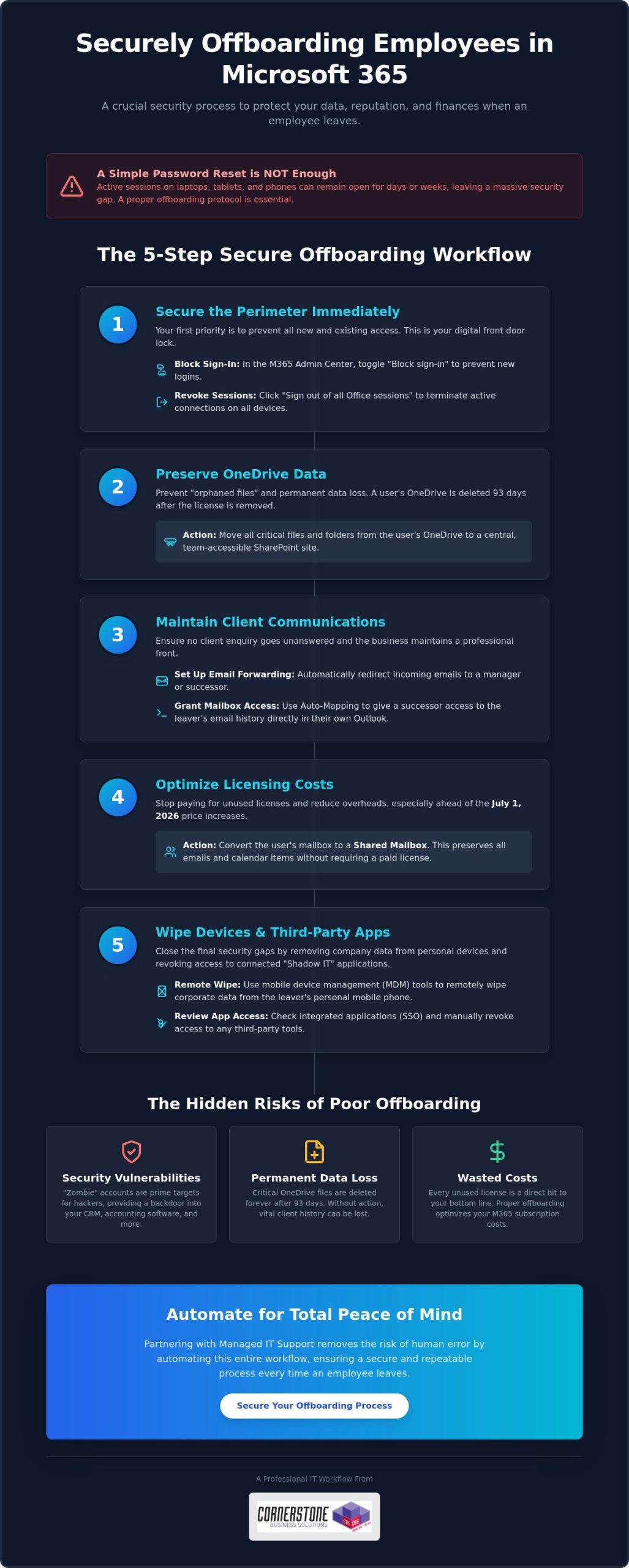
Creating a secure, repeatable process is the only way to ensure nothing slips through the cracks. This five-step workflow is the gold standard we recommend for managing employee leavers in Microsoft 365. It moves beyond simple admin tasks to provide a robust security framework that protects your business from the moment a resignation is handed in. By following these steps, you maintain control over your intellectual property while keeping your overheads lean.
Step 1: Securing the Perimeter
Your first priority is stopping unauthorized entry. Within the Microsoft 365 Admin Center, the “Block sign-in” toggle is your most effective tool for immediate defense. This prevents any new logins to the account across all services. To terminate every active session on laptops or mobile phones, simply click the “Sign out of all Office sessions” button within the user’s profile pane. For businesses with more complex setups, using Microsoft Entra ID ensures that access is revoked not just for email, but for every integrated corporate application in one go. It’s a clean, decisive way to secure your digital borders.
Step 2 & 3: Preserving Business Intelligence
Data shouldn’t stay locked in a departing user’s silo. We recommend moving vital OneDrive files to a central SharePoint site where the rest of the team can continue working without interruption. This prevents the “orphaned data” problem we discussed earlier. To keep your client relationships strong, set up email forwarding to a manager or successor so that no enquiry goes unanswered. Using a feature called Auto-Mapping is a brilliant way to grant access; it allows the successor to see the leaver’s email archive directly in their own Outlook sidebar without needing a separate login. Referencing a professional Secure Offboarding Checklist can help you stay organized during these transitions.
Step 4 & 5: Efficiency and Cost Savings
Once the data is secured, it’s time to stop the clock on your spending. Convert the leaver’s account into a Shared Mailbox. This allows you to keep all their historical emails searchable and accessible for free, provided the mailbox is under 50GB. After the conversion is complete, you can safely unassign the paid license. This reclaimed seat is then ready for your next hire, or you can remove it entirely to lower your monthly bill. If you’re looking to streamline these tasks, our Managed IT Support team can help you build an automated system that handles these steps perfectly every time. This proactive approach ensures your business remains agile, secure, and financially efficient.
Delete vs. Deactivate vs. Convert: Choosing the Right Path
Choosing the right path when a team member moves on is a balance between saving money and protecting your business intelligence. Simply hitting the delete button is often the first instinct, but it’s usually the riskiest. If you delete a user account without a plan, their mailbox is purged after 30 days. That’s a very short window to realize you’ve lost a vital client contract or a string of important project emails. For short-term or low-impact roles, deletion might be fine, but for most positions, you need a more considered approach to managing employee leavers in Microsoft 365.
We want to help you make the most cost-effective choice without leaving your data vulnerable. Whether you are dealing with a standard departure or a high-level exit, the strategy you choose today determines how easily you can recover information six months down the line. To see the technical steps for each option, you can consult Microsoft’s guide to removing a former employee, which outlines the official procedures for each path.
The Shared Mailbox Strategy
Shared mailboxes are the “gold standard” for a reason. They allow you to retain every single email from a departing staff member without paying for a monthly license. The process is straightforward: you convert the existing user mailbox into a shared one first, and only then do you remove the paid license. This keeps the data searchable and accessible for your team indefinitely.
There are a few technical rules to keep in mind. Shared mailboxes are free only if they remain under 50GB in size. If the leaver was a “power user” with a massive archive, you might need to trim the data or keep a license active. It’s also important to remember that nobody can log into a shared mailbox directly. You must grant another licensed user “Full Access” permissions to view the contents. This is a brilliant way to maintain continuity while slashing your IT spend.
Litigation Hold and eDiscovery
For directors, senior staff, or roles involving sensitive financial data, a standard conversion might not be enough. In these cases, we recommend using a Litigation Hold. This feature ensures that every item in the mailbox is preserved, even if someone tries to delete individual emails before they walk out the door. It’s an essential tool for legal compliance and internal audits.
Using these advanced features ensures your data remains searchable through the eDiscovery portal long after the user has gone. This level of data sovereignty is a core part of our Cyber Security Services, helping local businesses build resilience and achieve true peace of mind. By choosing the right path for each leaver, you protect your company’s history and its future.
A Checklist for Secure Mobile and Third-Party Offboarding
Managing Mobile Device Management (MDM)
When staff use their own phones for work, often called Bring Your Own Device or BYOD, you need a way to reclaim company data without deleting their personal photos. This is where the distinction between a “Full Wipe” and a “Selective Wipe” becomes vital. Using Microsoft Intune, you can perform a selective wipe that targets only corporate emails and files, leaving the user’s private data untouched. It’s a respectful yet secure way to handle departures. You must also revoke all Multi-Factor Authentication (MFA) app registrations. Removing these registrations ensures that a former employee cannot use their personal device to bypass security prompts if they somehow obtain a colleague’s credentials.
Beyond the Microsoft Ecosystem
Many employees sign up for third-party SaaS tools using their corporate email address. This creates “Shadow IT” that often goes unnoticed until a breach occurs. You need to audit logins for industry portals, research tools, and even shared social media accounts. Changing shared passwords immediately is a non-negotiable step for protecting your brand’s online presence. Integrating these checks into your wider Microsoft 365 Migration strategy ensures that your entire infrastructure remains clean and organized from day one.
Don’t forget the small administrative details that can lead to big headaches. To keep your communication channels clear, make sure to complete the following:
- Update internal directories to reflect the current team structure.
- Remove the leaver from “All Staff” and “Management” distribution groups.
- Deactivate access to physical security systems or key fobs if linked to IT profiles.
- Clear any delegated permissions they had over other staff mailboxes.
Taking these steps prevents sensitive internal announcements from landing in the inbox of someone who no longer works for you. It also maintains a professional, up-to-date directory for your current staff. If you’re feeling overwhelmed by these moving parts, contact our team today to discuss how we can secure your business through expert managed IT support.
How Managed IT Support Automates the Leaver Process
Manual offboarding is a high-wire act for any busy manager. Even with the best intentions, a single missed step can leave a gap in your defenses. When you’re managing employee leavers in Microsoft 365, the stakes are simply too high for “best efforts.” We’ve seen businesses accidentally leave global admin access active for months simply because it wasn’t on the primary checklist. This is where professional Managed IT Support turns a stressful manual task into a seamless, background operation that protects your business every time.
By using automated scripts, we ensure that every single action happens in the correct order. From blocking Entra ID sign-ins to converting mailboxes and wiping mobile devices, automation removes the risk of human error. This isn’t just about speed; it’s about building a fortress around your business data. You can rest easy knowing that as soon as an employee leaves, their digital presence is secured and their access is completely severed.
Peace of Mind Through Standardization
We help you create a formal “Leaver Protocol” that triggers automatically as soon as notice is given. This proactive approach prevents “access creep,” a common issue where long-term employees accumulate permissions for various folders and apps that are never fully revoked. Our expert helpdesk is always on hand to manage data requests, ensuring that managers get the files they need without compromising security. It’s about giving you the freedom to focus on your team while we handle the technical heavy lifting.
Optimising Your Cloud Investment
The commercial side of Microsoft 365 is just as important as the technical one. With the price increases effective July 1, 2026, paying for licenses that aren’t being used is a drain on your resources that no business should tolerate. We perform monthly license audits to keep your costs lean and predictable. If an employee leaves and isn’t replaced immediately, we don’t just leave the seat active. We unassign and remove it to save you money from day one.
Our team provides strategic advice on when to upgrade to tiers like Business Premium for better security or when to downgrade to save costs on low-impact roles. We position ourselves not just as a service provider, but as a long-term partner invested in your growth and stability. If you want to move away from transactional IT and toward a more secure future, we invite you to have an informal conversation about our Managed IT Services. Let’s work together to make your offboarding process a foundation of emotional and digital security.
Take Control of Your Digital Offboarding
Securing your business shouldn’t feel like a constant battle against technical complexity. By mastering the art of managing employee leavers in Microsoft 365, you protect your intellectual property while significantly reducing unnecessary licensing costs. We have explored how converting accounts to shared mailboxes and automating your revocation protocols are the most effective ways to maintain continuity without draining your budget. Closing the gaps in mobile access and third-party apps ensures your data stays exactly where it belongs: under your control.
As a multi-award-winning IT services provider and Microsoft Certified Partner, Cornerstone Business Solutions brings the clarity and expertise you need to stay ahead of regulatory and pricing changes. Our team provides 24/7 proactive system monitoring to give you total peace of mind. You don’t have to navigate these transitions alone. We are here to act as your dedicated long-term partner, ensuring every departure is handled with precision and care. Book a Microsoft 365 Security Audit with Cornerstone Business Solutions Today and let’s build a more resilient future for your business together. Your team and your data deserve nothing less than professional, local support you can trust.
Frequently Asked Questions
How long should I keep a former employee’s Microsoft 365 data?
You should generally retain data for at least 90 days to ensure a smooth transition, though your specific industry compliance rules might require longer. Under the policy effective January 2025, Microsoft only keeps OneDrive data for 93 days after a license is removed. We recommend moving vital files to SharePoint immediately to avoid losing intellectual property. This proactive step ensures your business stays compliant with UK GDPR while keeping your historical records accessible.
Can I still access a leaver’s OneDrive after I delete their account?
No, deleting the account starts a countdown that eventually purges the data forever. You cannot easily access OneDrive files once an account is fully deleted and the 30-day grace period expires. It is much safer to delegate access to a manager or move the files to a central SharePoint site before you hit delete. Managing employee leavers in Microsoft 365 effectively means securing the data first so you don’t risk losing orphaned files.
Do I need to pay for a license to keep a former employee’s email active?
You don’t need to keep paying for a license if you convert the user’s mailbox into a Shared Mailbox. This is a brilliant way to keep all historical emails searchable without the monthly overhead. As long as the mailbox stays under 50GB, Microsoft won’t charge you for the storage. It’s a simple, cost-effective strategy that helps you manage your IT budget while preserving important business intelligence for your team’s future use.
What happens to a user’s Microsoft Teams messages when they leave?
Teams messages sent within public or private channels remain visible to the rest of the team even after the user is gone. However, their one-on-one private chats are tied to their specific account and can be harder to retrieve without using advanced eDiscovery tools. We recommend setting up clear communication policies so that vital project decisions are always recorded in shared channels rather than private messages. This ensures your business continuity remains unbroken.
How do I stop a leaver from accessing the company’s mobile apps?
The most effective method is performing a selective wipe through Microsoft Intune, which targets only your business data. This removes corporate emails and files while leaving the employee’s personal photos and apps untouched. You must also revoke their Multi-Factor Authentication (MFA) tokens to prevent them from logging back in. This clean break is essential for maintaining your digital perimeter and protecting sensitive client information on the move, regardless of where the device goes.
Can I convert a former employee’s account to a Shared Mailbox after deleting them?
You must convert the account while it is still active or within the 30-day “soft delete” window. Once that period passes, the mailbox is purged and cannot be converted. Managing employee leavers in Microsoft 365 requires a specific sequence of events to be successful. We always advise our clients to convert to a Shared Mailbox as one of the very first steps in their offboarding checklist to ensure no vital data is lost.
What is the fastest way to block a disgruntled employee’s access?
The fastest route is to block their sign-in status and reset their password immediately within the Admin Center. You should also click the “Sign out of all Office sessions” button to kill any active connections on their laptops or phones. This decisive action prevents them from accessing SharePoint or sending emails within minutes. It provides the immediate security you need during sensitive departures, giving you total control over your digital environment when it matters most.
Is it possible to automate the leaver process in Microsoft 365?
Automation is the best way to ensure consistency and remove the risk of human error during offboarding. We use custom scripts that handle everything from license reclamation to data migration the moment a leaver is reported. This standardized approach means no “zombie” accounts are left active and no licenses are wasted. It’s a proactive way to manage your infrastructure, providing both emotional security for you and technical stability for your growing business.
How to Secure Microsoft 365 from Cyber Threats: The 2026 Business Guide
Did you know that 90% of organizations currently have major gaps in their essential Microsoft 365 security protections? It is a startling figure from recent research, especially since Microsoft disclosed over 1,200 vulnerabilities in 2025 alone. If you are wondering how to secure Microsoft 365 from cyber threats in this fast-moving environment, you aren’t alone. Many local business owners feel overwhelmed by the maze of settings in the Admin Center or worry that a single mistake could lead to a data breach and costly downtime.
We believe you should be able to focus on your team and your growth without worrying about 8.3 billion phishing threats or complex licensing tiers. You deserve the confidence that your sensitive data is protected by more than just a default password. This 2026 guide delivers the essential strategies and technical configurations you need to transform your environment into a digital fortress. We will walk you through the latest identity-based protections and show you exactly how to achieve a secure, compliant tenant that supports your long-term success.
Key Takeaways
- Understand why default settings aren’t enough and how the shared responsibility model puts you in control of your business data.
- Use your Microsoft Secure Score as a clear, prioritized roadmap to strengthen your environment without getting lost in technical menus.
- Master the latest strategies for how to secure Microsoft 365 from cyber threats, including modern defenses against Business Email Compromise and malicious collaboration.
- Implement a high-impact hardening checklist that covers essential configurations like biometric MFA and Conditional Access policies to stop hackers.
- Discover the peace of mind that comes with proactive managed support, ensuring your security stays ahead of evolving risks while you focus on your growth.
Why Microsoft 365 Default Settings May Leave Your Business Vulnerable
When you first sign up for the Microsoft 365 suite, the primary goal is usually getting your team up and running as fast as possible. This “Convenience First” approach is excellent for productivity, but it often creates a wide open door for modern hackers. Default settings are designed to be permissive so that services work without friction, which unfortunately means security often takes a back seat to ease of use. Relying on these out of the box configurations is one of the most common mistakes we see in our local business community.
The Myth of “Secure by Default”
Many business owners assume that because they are using a world class platform, Microsoft handles every aspect of their protection. In reality, security is a partnership. The Shared Responsibility Model is the foundational principle of cloud security that dictates Microsoft is responsible for the global infrastructure while you are responsible for securing the data and identities within it. Between 2021 and 2026, threats have evolved from simple malware to sophisticated identity based attacks. Old protections that relied on basic filters simply fail against modern tactics like session hijacking or AI driven phishing. Learning how to secure Microsoft 365 from cyber threats starts with realizing that the standard configuration is just the starting line, not the finish.
Common Blind Spots in Standard Configurations
One of the most dangerous oversights in a standard setup is disabled or limited audit logging. If an intruder enters your system and logging isn’t active, you have no forensic trail to follow. This makes recovery incredibly difficult because you won’t know exactly what was accessed, stolen, or changed. We also see significant risks with “User consent to apps” settings. By default, employees might be able to grant third party applications access to your corporate data without any IT oversight. This creates a shadow IT environment where sensitive information can leak through unvetted integrations.
Perhaps the most critical vulnerability involves “Global Admin” accounts. We often find these high level permissions assigned to accounts that people use for daily tasks like checking email or browsing the web. If that one account is compromised, the attacker has the keys to your entire corporate kingdom. A single misconfigured mailbox can serve as a launchpad for a full network compromise. Truly understanding how to secure Microsoft 365 from cyber threats requires closing these legacy gaps, such as old IMAP or POP3 protocols that often remain active and allow attackers to bypass modern multi-factor authentication. Securing your business means moving beyond convenience to build a proactive, customized defense.
Improving Your Microsoft Secure Score: The Foundation of Office 365 Security
Your Microsoft Secure Score is not just a vanity metric. In 2026, it serves as your security North Star, providing a real time numerical representation of your current protection levels. It is a dynamic roadmap that helps you understand where your vulnerabilities lie and which specific actions will offer the most protection for your effort. Understanding your Secure Score is a vital part of learning how to secure Microsoft 365 from cyber threats because it turns complex technical settings into a clear, prioritized to-do list.
Many of the recommendations within the Secure Score align directly with the Cyber Essentials certification, which is a key benchmark for businesses across our region. While seeing that number rise is satisfying, we always remind our partners that a 100% score is not always the goal. Security must exist in harmony with productivity. If a setting is so restrictive that your team cannot perform their daily tasks, it will lead to frustration and “shadow IT” workarounds. The goal is a resilient environment that protects your sensitive data while keeping your business moving forward.
Navigating the Security Center Dashboard
We recommend business owners or IT managers review the Security Center dashboard at least once a month. Focus on the “Improvement Actions” tab, where Microsoft ranks tasks by their impact on your score. This allows you to tackle high priority items, like enabling number matching for MFA, before moving on to lower impact settings. Maintaining these scores can be time consuming for a busy professional, which is why many local firms look for it company solutions that include regular security auditing and score optimization. If you are unsure where to start, our team is always here to help you find the right security balance for your specific needs.
Implementing Zero Trust Architecture
In 2026, the old idea of a “digital perimeter” or firewall is no longer enough. We now operate in a world where identity is the new perimeter. Implementing a Zero Trust architecture means moving away from the assumption that anyone inside your network is safe. This framework relies on three pillars: verify explicitly, use least privileged access, and assume breach. By utilizing digital forensics analysis to understand how attackers attempt to bypass logins, you can better configure your environment to stay one step ahead. Zero Trust prevents lateral movement during a breach by ensuring that a single compromised account cannot automatically access other sensitive areas of your network. Implementing these steps is the most effective way to master how to secure Microsoft 365 from cyber threats in 2026.
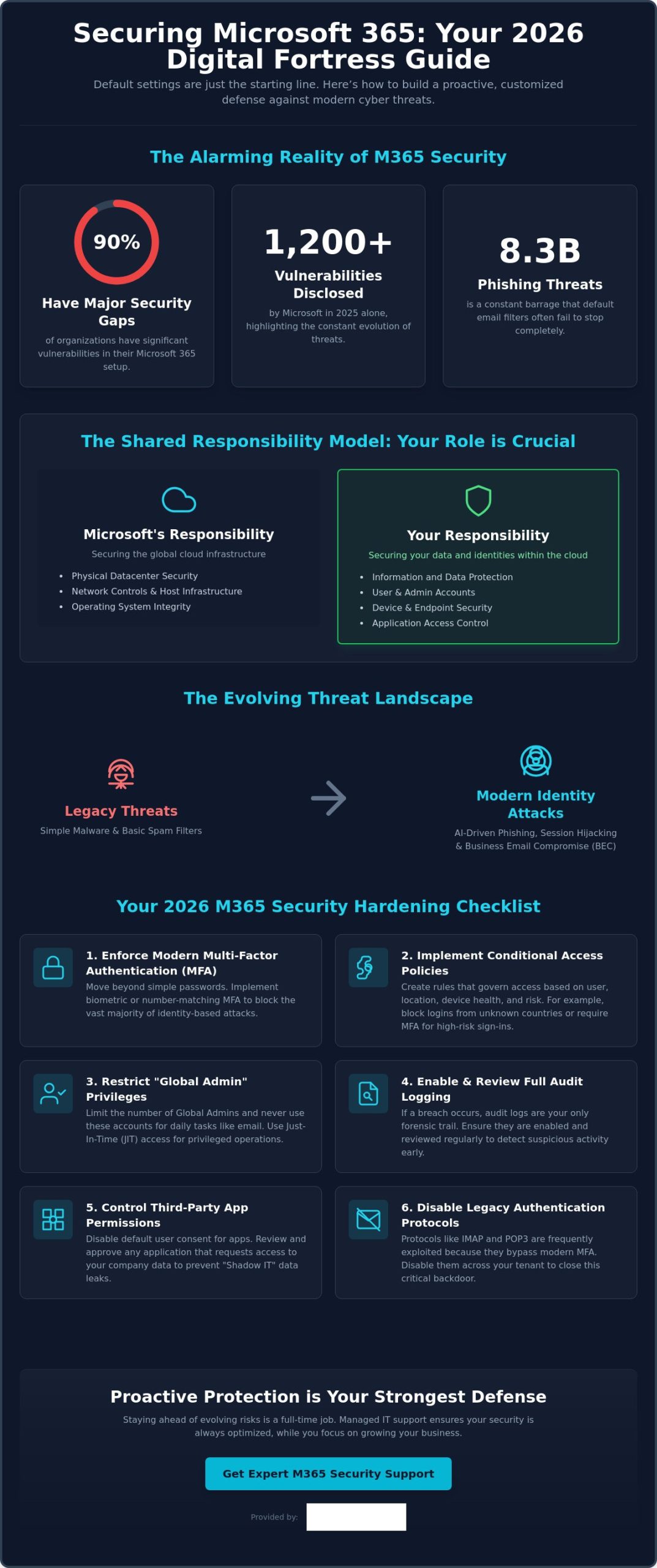
Defending Against Modern Threats: Phishing, BEC, and Malicious Collaboration
Cybercriminals don’t just hack in; they log in. Business Email Compromise (BEC) has become incredibly sophisticated in 2026, often bypassing traditional spam filters because the messages don’t contain malicious files. Instead, attackers use social engineering to mimic executive voices, relying on urgency and trust to redirect payments or steal credentials. Learning how to secure Microsoft 365 from cyber threats means looking beyond the inbox and understanding that your collaboration tools are now primary targets.
A major emerging risk we are seeing this year is “Quishing,” or QR code phishing. These attacks increased by 146% in the first quarter of 2026 alone. Because traditional scanners often miss a malicious URL hidden within an image, employees frequently scan them on personal mobile devices that lack corporate security controls. To counter this, we use Microsoft Purview to help you label and protect sensitive data at the source. This ensures that even if a file is accidentally shared, only authorized eyes can view the contents, keeping your business stable and your mind at ease.
Securing the “Big Three”: Teams, SharePoint, and OneDrive
Teams, SharePoint, and OneDrive are the lifeblood of modern work, but they are also the new frontiers for data exfiltration. Anonymous guest sharing is often left active by default, which can allow anyone with a link to access your internal files. We recommend implementing strict Data Loss Prevention (DLP) policies that automatically detect and block the sharing of sensitive information like credit card numbers or protected project details. For businesses looking to expand, our cloud solutions provide a robust framework for scaling these protections across your entire organization without slowing your team down.
Advanced Threat Protection with Microsoft Defender
Microsoft Defender for Office 365 is your frontline defense against the 8.3 billion email based phishing threats detected early this year. Many local business owners ask about the difference between Plan 1 and Plan 2. Plan 1 provides essential real time protection like “Safe Links” and “Safe Attachments,” which sandbox every link and file before they ever reach your user. Following CISA security recommendations ensures your configuration meets the highest standards for audit logging and legacy protocol management. Plan 2 takes this further with AI driven sentiment analysis, which can detect the subtle linguistic shifts that indicate a fraudulent executive request. This proactive approach is the most reliable way to master how to secure Microsoft 365 from cyber threats while maintaining a focus on your daily operations.
Your 2026 Microsoft 365 Security Hardening Checklist
Securing your digital environment is a proactive journey, not a destination. We have built this checklist to help you move beyond the basics and establish a truly resilient setup. By following these steps, you can significantly reduce your attack surface and protect your business from the most common entry points used by modern hackers. Implementing these configurations is the most practical way to master how to secure Microsoft 365 from cyber threats while keeping your team productive.
- Enforce modern MFA: Move away from basic passwords toward number matching and biometrics.
- Apply Conditional Access: Create policies that automatically block login attempts from high risk locations or unrecognized IP ranges.
- Automate offboarding: Ensure that when an employee leaves, their access is revoked instantly across all integrated apps to prevent “orphan account” vulnerabilities.
- Audit third party apps: Regularly review which external applications have permissions to read your data or send emails on your behalf.
- Conduct quarterly reviews: Schedule a deep dive into your security logs every three months and run simulated phishing tests to keep your team sharp.
Step-by-Step Identity Hardening
By 2026, SMS based MFA is no longer considered secure. Attackers frequently use SIM swapping or interception techniques to bypass these codes. We recommend using the Microsoft Authenticator app with number matching or FIDO2 security keys for your most sensitive accounts. While you are hardening these identities, don’t forget to set up “break glass” accounts. These are highly secure, emergency only accounts that ensure you never get locked out of your own tenant if your primary admin loses access. A microsoft 365 migration for business uk provides the perfect opportunity to audit these settings and start with a clean, secure slate.
Device and Application Management
Your data is only as secure as the device accessing it. We use Microsoft Intune to ensure that only compliant, patched, and encrypted devices can connect to your corporate network. For staff using personal phones, we implement Mobile Application Management (MAM). This allows you to secure corporate data within specific apps, like Outlook or Teams, without needing to manage the employee’s entire personal device. This balance protects your intellectual property while respecting staff privacy. Combined with endpoint detection and response (EDR), this creates a layered defense that stops threats before they can spread. If you want a professional eye on your configuration, book a security review with our local team today.
Learning how to secure Microsoft 365 from cyber threats involves constant vigilance. These technical steps provide the foundation, but they work best when paired with a culture of security awareness across your entire organization.
Proactive Protection: Why Managed IT Support is Your Strongest Defense
The technical configurations we have discussed provide a powerful foundation, but tools are only as effective as the hands that manage them. A common mistake is treating security as a one-time project. In reality, a “set and forget” approach is a gift to hackers. Real resilience comes from 24/7 proactive monitoring that identifies a suspicious login at 3 AM and neutralizes it before your team even starts their morning coffee. Moving away from a reactive “break-fix” model to a proactive partnership ensures that your business stays ahead of attackers who never stop evolving.
The Value of Continuous Compliance and Auditing
Security is a journey, not a destination. Microsoft releases updates and new features almost weekly, and each change can inadvertently create a new opening if not managed correctly. We ensure your tenant remains compliant and resilient by conducting ongoing audits and adjusting your settings to counter emerging 2026 threats. This level of constant vigilance is what provides true peace of mind. For a deeper look at building a resilient organization, explore our comprehensive cyber security services designed for modern business needs.
Building a Culture of Cyber Awareness
Even the most advanced technical fortress can be bypassed by a single well meaning employee clicking the wrong link. That is why user training is a foundational element of our multi-layered security strategy. We help simplify the complex world of cloud security for your staff, turning them from your biggest risk into your strongest first line of defense. A dedicated IT partner removes the technical burden from your shoulders, allowing you to focus on growth while we handle the digital infrastructure.
If you are ready to move beyond the defaults and build a more secure future, we invite you to a professional conversation. We can conduct a bespoke security audit of your current environment and show you exactly how to secure Microsoft 365 from cyber threats in a way that supports your team. Let’s work together to ensure your business remains a fortress in 2026 and beyond.
Building a Resilient Future for Your Business
The digital landscape of 2026 moves fast, but your business can stay ahead of the curve with the right strategy. We have explored why standard configurations are often a starting point rather than a complete defense. By prioritizing your Microsoft Secure Score and embracing a Zero Trust mindset, you turn your environment into a fortress. Truly understanding how to secure Microsoft 365 from cyber threats is about more than just checking boxes; it’s about creating a culture of continuous protection and awareness.
As a multi-award-winning IT services provider and Official Microsoft Partner, we specialize in transforming complex security challenges into clear, manageable solutions. You don’t have to manage these technical hurdles alone. Our team provides proactive 24/7 monitoring and support to ensure your data remains safe while you focus on what you do best. We are proud of our local roots and dedicated to the success of businesses throughout our community.
Ready to strengthen your defenses? Book your bespoke Microsoft 365 security audit with Cornerstone Business Solutions today. Let’s work together to build a stable, secure foundation for your future growth.
Frequently Asked Questions
Is Microsoft 365 secure enough for small businesses by default?
No, the default settings are designed for maximum accessibility and convenience rather than high level security. While Microsoft protects the physical data centers and underlying infrastructure, you are responsible for securing the identities, data, and devices that access your tenant. This shared responsibility means that out of the box configurations often leave doors open for attackers.
What is the most common cyber threat facing Microsoft 365 users in 2026?
Identity based attacks, specifically sophisticated phishing and Business Email Compromise, remain the top threats. Understanding how to secure Microsoft 365 from cyber threats requires focusing on identity, as attackers now use AI to create highly convincing messages that bypass traditional spam filters. These tactics aim to steal your login credentials to gain a foothold in your corporate network.
Does MFA stop all cyber attacks on Microsoft 365 accounts?
Multi-factor authentication is a vital layer of defense, but it is not a silver bullet. Modern attackers use advanced techniques like session token theft or MFA fatigue to bypass basic prompts. To stay secure, we recommend moving toward more resilient methods like biometric authentication or number matching, which require a much higher level of user verification.
How often should I audit my Microsoft 365 security settings?
We suggest performing a high level review of your security dashboard at least once a month. This helps you identify new vulnerabilities or misconfigured accounts before they can be exploited. A more comprehensive, deep dive audit should happen every quarter to ensure your overall security strategy remains aligned with the latest 2026 threat landscape.
What is Microsoft Secure Score and what is a “good” number?
Microsoft Secure Score is a numerical summary of your security posture based on your current configurations. While a 100% score sounds like the ultimate goal, it often creates too much friction for daily business operations. For most small and medium sized enterprises, a score between 70% and 80% represents a high performing balance of security and productivity.
Can Managed IT Support help with Microsoft 365 security compliance?
Yes, managed support provides the expert oversight needed to maintain complex compliance standards like Cyber Essentials. Our team simplifies the task of how to secure Microsoft 365 from cyber threats by providing continuous monitoring and regular auditing. We act as your long term partner to ensure your tenant stays compliant with evolving industry regulations.
What happens if our Microsoft 365 tenant is breached?
If a breach occurs, the priority is immediate containment to stop the spread of the attack. We isolate affected accounts, perform a forensic analysis to determine what was accessed, and then restore your systems from secure backups. Having a clear disaster recovery plan in place ensures that your business can return to normal operations as quickly as possible.
How much does it cost to secure Microsoft 365 properly?
The cost depends on your specific licensing needs and the level of proactive support your business requires. While there is an investment involved in proper configuration and monitoring, it is always more cost effective than the alternative. Preventing a breach is significantly cheaper than dealing with the financial and reputational fallout of stolen corporate data.
How to Report a Business Data Breach in the UK: A 2026 Step-by-Step Guide
With one in four small businesses in the UK falling victim to a hack, the question isn’t just about prevention anymore; it’s about your immediate response. If you’ve just discovered a security incident, the pressure to understand how to report a business data breach UK can feel overwhelming while the clock ticks on your 72-hour ICO window. We understand that the fear of heavy GDPR fines or a damaged reputation is enough to keep any business owner awake. You want to protect your customers and your hard-earned local legacy, but the legal requirements can often seem like a complex maze.
We’re here to turn that uncertainty into a clear, actionable plan. This 2026 guide provides a professional roadmap to help you navigate the latest regulations, including the Data (Use and Access) Act, with the confidence of a dedicated partner. You’ll learn exactly how to qualify a breach, the specific steps for reporting to the Information Commissioner’s Office, and how to secure your digital infrastructure to prevent future issues. We will show you how to satisfy your legal obligations while keeping your business continuity and reputation firmly intact.
Key Takeaways
- Identify which security incidents qualify as reportable under UK GDPR, including common 2026 threats like ransomware and unauthorised cloud access.
- Navigate the 72-hour countdown with a step-by-step guide on how to report a business data breach UK using the ICO’s official reporting tools.
- Learn to assess risks to individual rights and freedoms to determine when mandatory notification to the ICO and affected parties is legally required.
- Implement immediate containment and recovery strategies to isolate compromised systems and restore business continuity without delay.
- Build long-term resilience by moving from reactive reporting to a proactive security framework based on Cyber Essentials standards.
Understanding What Constitutes a Reportable Business Data Breach
Not every IT glitch is a crisis, but knowing the difference is vital for your compliance. A personal data breach under UK GDPR is more than just a leak. It’s a security incident that compromises the confidentiality, integrity, or availability of personal information. If you are currently investigating an incident, your first priority is determining how to report a business data breach UK properly. This starts with a clear assessment of whether the data has been lost, destroyed, altered, or accessed without permission.
In 2026, the digital landscape presents new challenges for business owners. We see more sophisticated threats like unauthorised cloud access and complex ransomware attacks. These incidents don’t just steal data; they often lock you out of your own systems, which qualifies as a breach of “availability.” Gaining a foundational understanding of what a data breach is helps you separate a minor technical fault from a legal reporting obligation. Even if an employee accidentally sends a spreadsheet to the wrong client, you must conduct a formal assessment. The law doesn’t distinguish between a malicious hacker and a simple human error when it comes to your duty to protect data.
The Broad Definition of Personal Data
Personal data is any information that relates to an identifiable individual. This goes far beyond names and home addresses. In our modern infrastructure, this includes IP addresses, location data, and even encrypted identifiers that could be linked back to a person. According to the latest ICO guidance, personal data is any information relating to an identified or identifiable living individual. You should be particularly cautious with “special category” data. This includes health records, financial details, or trade union memberships, as these carry a much higher risk if exposed.
Examples of Reportable vs. Non-Reportable Incidents
Context is everything when deciding whether to notify the authorities. Consider these scenarios:
- The Lost Laptop: If a staff member loses a laptop with full disk encryption and the keys are secure, it’s likely not reportable because the data is unintelligible. If that same laptop is unencrypted and contains customer names, you have a reportable breach.
- Cyber Attacks: A DDoS attack that causes temporary website downtime but doesn’t expose data is a security incident, not a personal data breach. However, a phishing attack that grants an intruder access to your Microsoft 365 environment is almost certainly reportable.
The Cyber Security Breaches Survey 2025 found that 93% of businesses were targets of phishing. This highlights why a proactive assessment is necessary for every “near miss.” If the incident is likely to result in a risk to the rights and freedoms of your customers, the 72-hour clock begins the moment you become aware of it.
The ICO Reporting Process: The 72-Hour Countdown
The clock starts ticking the moment you realize something is wrong. Whether it’s a suspicious login or a missing folder, you have exactly 72 hours to notify the Information Commissioner’s Office if there’s a risk to individuals. This deadline is strict, but it shouldn’t cause panic. The goal is to provide the ICO with as much information as possible as early as possible. Many business owners wonder exactly how to report a business data breach UK when they don’t yet have all the facts. The ICO understands that forensic investigations take time, which is why they allow for phased reporting. You can submit a preliminary report and follow up as you uncover more details.
To start the process, you’ll need to visit the ICO data breach reporting portal. This online tool walks you through the necessary questions. You’ll be asked to describe the nature of the breach, the categories of data involved, and the approximate number of people affected. Learning how to report a business data breach UK involves understanding that the regulator values honesty and speed over a perfect, final report on day one. If you’re struggling to pull these logs together during a crisis, our team can provide the Cyber Security expertise needed to pinpoint the source of the leak quickly.
What to Include in Your ICO Report
Managing the Deadline During Weekends and Bank Holidays
Cybercriminals don’t work nine to five, and neither does the law. The 72-hour window includes weekends and bank holidays. If you discover a breach on a Friday evening, you cannot wait until Monday morning to start the clock. If you find yourself in a position where you must report late, you must provide a “reasoned justification” for the delay. The ICO may accept these reasons if they are valid, but it’s always better to submit a partial report within the timeframe than a complete one after the deadline has passed. Our local team is here to help you build a resilient infrastructure so you’re never caught off guard by these tight windows.
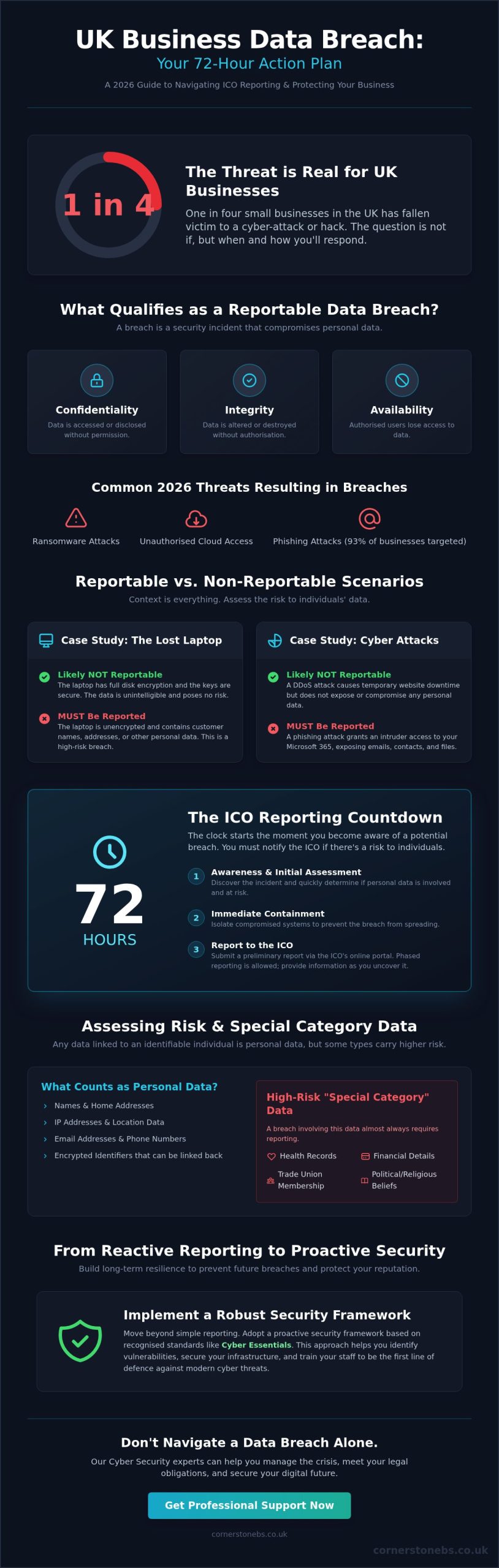
Assessing Risk to the Rights and Freedoms of Individuals
Determining whether an incident crosses the line from a technical glitch to a legal obligation is the most critical part of your response. It’s not just about the volume of data lost. It’s about the impact on the real people behind those records. Under UK GDPR, you only need to notify the ICO if the breach is likely to result in a risk to the rights and freedoms of individuals. If you’re currently weighing up how to report a business data breach UK, your first step is a thorough risk assessment. You must evaluate the potential for physical, material, or non-material damage to your customers or staff.
What does this “risk” actually look like in a business context? It encompasses a wide range of potential harms. This includes identity theft, financial loss, and even reputational damage to the individual. If sensitive data like health records or financial details are exposed, the risk of discrimination or fraud increases significantly. We recommend using a risk matrix to standardise your approach. By plotting the severity of the potential harm against the likelihood of it occurring, you can make an objective decision about how to report a business data breach UK without letting panic cloud your judgment. This structured method ensures your response is proportionate and legally sound.
When is a Breach “High Risk”?
There’s a vital distinction between a reportable breach and a “high-risk” breach. While a reportable breach requires you to notify the ICO, a high-risk breach triggers the additional requirement to inform the affected individuals directly. This is necessary when the incident is likely to result in a high risk to their rights and freedoms. In these cases, high-risk breaches require notification “without undue delay” to allow individuals to take their own protective measures, such as changing passwords or alerting their banks. This transparency, while difficult, is essential for maintaining long-term trust with your community.
The Role of Internal Documentation
Even if your assessment concludes that a breach isn’t reportable to the ICO, your work isn’t finished. You must document every single personal data breach in an internal register. This log should include the facts of the incident, its effects, and the remedial action you took. The ICO has the authority to audit these records at any time to ensure you’re making the right calls. Maintaining these logs is much easier when you have proactive managed IT services in place to track system changes and access logs. Following the NCSC incident management guidance ensures your internal processes meet the highest national standards, providing you with a solid foundation of evidence if your decisions are ever questioned.
Immediate Technical Response and Containment Strategies
While the 72-hour clock is running for the ICO, your technical team is fighting a different battle. Containment is your absolute priority. You need to stop the data from leaving your network immediately. This often means making tough calls, like isolating affected servers or disabling compromised accounts across the board. If you’re currently investigating how to report a business data breach UK, remember that the ICO expects you to take these containment steps as part of your formal response. They want to see that you’ve acted decisively to limit the damage from the very start.
Finding “patient zero” is essential for a complete and accurate report. You need to know exactly how the intruder got in. Was it a weak password, a phishing link, or a misconfigured firewall? Digital forensics plays a huge role here. However, you must be careful not to destroy evidence while you’re fixing the problem. We work closely with our partners to ensure that logs and system states are preserved correctly. This evidence is vital if the ICO or the police need to conduct a deeper investigation later. Coordinating with an expert IT partner ensures that your recovery is both fast and legally compliant.
Securing Your Perimeter Post-Breach
Once the immediate threat is contained, you must harden your defences. Start by resetting credentials for every user, prioritising those with administrative privileges. It’s also the time to review your firewall logs and cloud solutions for any lingering backdoors. Hackers often leave small entry points to return later. We recommend implementing temporary, heightened monitoring to catch any secondary attempts at entry. This proactive approach ensures that once you’ve closed the door, it stays locked. It’s about restoring stability and peace of mind for your team.
Notifying Affected Individuals
If your risk assessment shows a high risk to individuals, you must tell them. Drafting this notice requires a balance of transparency and calm. Tell them exactly what happened, what data was involved, and what you’re doing to fix it. Most importantly, give them clear instructions on how they can protect themselves, such as monitoring their bank accounts or changing passwords. Whether you choose email, post, or a public notice depends on the scale of the breach. A clear, honest message often does more to protect your reputation than staying silent ever could.
If you’re currently facing a breach and need an expert team to lead the containment, our Cyber Security services are ready to help you secure your infrastructure and meet your reporting duties.
Building a Proactive Cyber Security Framework for 2026
Reporting a breach is a legal necessity, but the real goal is to ensure you never have to do it again. Transitioning from a reactive “emergency mode” to a proactive framework is the best way to protect your local reputation. When you understand how to report a business data breach UK, you quickly realize that the most successful businesses are those that invest in cyber security services before an incident occurs. In 2026, a “set and forget” approach to IT simply doesn’t work. You need a dynamic strategy that evolves alongside new threats.
The foundation of any UK business’s security should be Cyber Essentials or Cyber Essentials Plus. These government-backed certifications provide a clear baseline for your digital safety. Beyond these basics, we advocate for Multi-Factor Authentication (MFA) and Zero Trust architectures. These systems operate on the principle of “never trust, always verify;” they make it significantly harder for an intruder to move through your network even if they steal a password. Small changes in your digital infrastructure create massive barriers for cybercriminals.
Technology is only half the battle. Your team is your first line of defence. Regular staff training is essential to reduce the human error that leads to most data leaks. When your employees know how to spot a sophisticated phishing attempt, your risk drops immediately. We believe in empowering your staff. This turns them from a potential vulnerability into a strong asset for your business’s stability. It’s about creating a culture where security is everyone’s responsibility.
The Value of Managed Security Providers
Disaster Recovery and Business Continuity
A tested backup strategy is your ultimate safety net. If a breach does occur, knowing your data is safe and recoverable allows you to focus on the legalities of how to report a business data breach UK without the fear of total data loss. Regularly auditing your data protection impact assessments (DPIAs) keeps your compliance sharp and your risks low. These audits help you identify gaps in your data handling before they become liabilities. We invite you to a conversation about your current setup. Contact Cornerstone for a proactive security audit today, and let’s build a resilient future for your business together.
Secure Your Resilience and Future Growth
Understanding how to report a business data breach UK is the first step in protecting your customers and your company’s hard-earned reputation. You’ve seen that the 72-hour ICO window is non-negotiable and that a thorough risk assessment is your best defence against unnecessary panic. By prioritising immediate containment and documenting every incident, you satisfy legal requirements while maintaining essential business continuity. Moving from a reactive stance to a proactive security framework ensures that your organisation remains strong in the face of evolving digital threats.
Our team brings the confidence of a multi-award-winning IT provider, backed by strategic partnerships with Microsoft, IBM, and Cisco. We offer proactive 24/7 monitoring and support that acts as a dedicated shield for your digital assets. You deserve the peace of mind that comes from knowing your security is managed by experts who genuinely care about your success. We’re proud to be your local partners, helping you navigate the complexities of 2026 with total confidence.
Secure your business with Cornerstone’s award-winning cyber security services. Let’s work together to build a safe, stable, and prosperous future for your business.
Frequently Asked Questions
Do I have to report a data breach if no data was actually stolen?
You must report a breach even if no data is stolen if the incident affects the availability or integrity of personal information. For instance, if a server failure permanently deletes customer records or ransomware encrypts them, this is a breach of availability. The law requires you to assess the risk to individuals’ rights regardless of whether a third party actually accessed the files. Integrity breaches, where data is altered without permission, also count.
What are the penalties for failing to report a data breach to the ICO in 2026?
Failing to notify the ICO of a reportable breach can result in a fine of up to £8.7 million or 2% of your global turnover, whichever is higher. This is separate from the fine for the actual security failure, which can reach £17.5 million or 4% of turnover. These penalties reflect the regulator’s focus on transparency and accountability. Reporting early acts as a mitigating factor in any enforcement action.
How much does it cost to report a data breach to the Information Commissioner?
There is no financial cost to report a data breach to the Information Commissioner’s Office. The online reporting tool is a free service provided to help businesses comply with their legal obligations. While the reporting itself is free, you may incur costs related to forensic investigations or technical recovery. We always recommend focusing on speed and accuracy rather than worrying about administrative fees. It’s an investment in your company’s long-term compliance.
Can I be fined if the breach was caused by a third-party software provider?
Yes, you can still be fined if the breach occurs through a third-party provider, as you remain the data controller responsible for the personal information. You must ensure your suppliers have robust security measures in place. If a provider suffers a breach, you are still the one who needs to know how to report a business data breach UK to protect your own customers. Your contracts should clearly outline the provider’s duty to notify you immediately.
How do I know if a breach is “likely to result in a risk” to individuals?
A breach results in a risk if it could lead to physical, material, or non-material damage for the individuals involved. Examples include potential identity theft, financial loss, or damage to reputation. You should consider the sensitivity of the data and the volume of records affected. If the data could be used to cause harm or distress, you must treat the incident as a reportable event. Documenting your decision-making process is vital for future audits.
What happens after I submit a report to the ICO?
Once you submit your report, the ICO will acknowledge receipt and assign a case officer to review the details. They may ask for more information or provide specific advice on how to mitigate the impact. In many cases, if you’ve taken proactive steps to contain the breach and notify individuals, the ICO may simply record the incident without taking further enforcement action. Their goal is to ensure you’ve learned from the event and improved your systems.
Do small businesses have different reporting requirements than large corporations?
No, the legal requirements for reporting a breach are the same for all organisations, regardless of their size. Whether you’re a local sole trader or a multinational corporation, the 72-hour window and the risk assessment thresholds apply equally. However, the ICO often provides more tailored support and guidance for small and medium-sized enterprises. They understand that smaller teams may have fewer resources to manage a complex technical response. We’re here to bridge that gap for local firms.
What is the first thing I should do if I suspect a ransomware attack?
Your first step is to isolate the affected systems by disconnecting them from your network and the internet to stop the encryption from spreading. Do not turn off the machines, as this can destroy volatile evidence needed for recovery. Once isolated, you can begin your investigation into how to report a business data breach UK while your IT partner works on restoring your latest clean backups. Quick containment is the key to minimising downtime.
ISO 27001 Certification Readiness: The 2026 Strategic Guide for UK Businesses
With the October 2025 transition deadline now behind us, any UK business still relying on the old 2013 standard is officially operating without a valid certificate. It’s a high-stakes reality that can stall commercial bids and leave your digital infrastructure vulnerable to modern threats. Achieving true ISO 27001 certification readiness in 2026 requires more than just a checkbox exercise. It demands a proactive shift toward the 2022 standard updates and the latest UK Data (Use and Access) Act requirements that came into force this February.
As a team recognized for our commitment to regional business excellence, we know it’s a challenge to document every process while keeping your daily operations running smoothly. It’s natural to feel some audit anxiety when you’re balancing growth with complex security controls. This guide is here to replace that uncertainty with a clear, strategic roadmap. You’ll discover how to benchmark your current security, close compliance gaps, and build a robust defense that protects your reputation. We’ve simplified the technical hurdles so you can achieve your goals with total confidence, treating your information security as the vital foundation of your business stability.
Key Takeaways
- Distinguish between identifying missing controls and verifying their performance through a formal readiness assessment before your audit begins.
- See how modern cloud solutions and Microsoft 365 configurations serve as the technical backbone for your compliance framework.
- Follow our five-step checklist to achieve ISO 27001 certification readiness while maintaining focus on your core business goals.
- Leverage the expertise of a local IT partner to automate evidence collection and handle the heavy lifting of digital security management.
- Build a culture where information security is a commercial advantage rather than just a technical necessity.
What is ISO 27001 Certification Readiness?
At its core, ISO 27001 certification readiness is the specific point where your Information Security Management System (ISMS) is fully documented, properly implemented, and supported by concrete evidence. It serves as the vital “pre-flight check” before you invite an external auditor for your formal Stage 1 and Stage 2 assessments. For businesses across the UK, achieving this state means you’ve moved past the planning phase and into a cycle of continuous improvement. This level of preparation is a significant commercial asset. It signals to your stakeholders and supply chain partners that you treat their data with the highest level of care. As your local expert, we believe this readiness creates the emotional security every business owner needs to grow with confidence.
The Shift to ISO/IEC 27001:2022
The recent shift to the ISO/IEC 27001:2022 standard changed the landscape for everyone. Since the transition deadline passed in October 2025, the old 2013 framework is no longer valid for new certifications. The 2022 update simplified the process by grouping 93 controls into four clear themes:
- Organisational controls like policy management and resource allocation.
- People controls such as remote working security and screening.
- Physical controls covering office security and equipment maintenance.
- Technological controls including authentication and data masking.
This structure makes it easier for business owners to understand where their responsibilities lie. Many firms fall into the trap of “false confidence,” assuming their old security habits will pass the new test. In reality, the 2022 standard requires a more integrated approach to modern digital risks and updated regulations like the Data (Use and Access) Act 2025. Modern readiness ensures your controls reflect the actual threats your business faces today.
Why Readiness Matters More Than Effort
Auditors are looking for “operating reality.” They want to see that your policies aren’t just sitting in a digital drawer. They’ll look for evidence that your team actually follows the rules you’ve set. If your documentation says you perform weekly backups, but you only have evidence for three out of the last four weeks, you’ll likely face a non-conformity. The cost of a failed audit goes far beyond the initial fee. You have to consider the time lost, potential re-booking charges, and the damage to your commercial reputation if a major contract is pending.
By focusing on ISO 27001 certification readiness, you turn your cyber security services into a permanent shield for your business. It ensures that when the auditor arrives, you can demonstrate your compliance with total ease. We view this as a foundational element of your stability, giving you the freedom to focus on your daily operations while we help manage the technical weight of compliance.
Readiness Assessment vs. Gap Analysis: Key Differences
Don’t mistake a gap analysis for a readiness assessment. While they share some DNA, they serve entirely different purposes on your journey toward compliance. We view these as distinct milestones in a bespoke technology roadmap, each designed to build your confidence and protect your investment. You can’t have a successful readiness assessment without first completing a thorough gap analysis; one identifies the work required, while the other verifies that the work actually functions as intended.
The Gap Analysis: Identifying the Holes
Think of the gap analysis as the “what is missing” phase. During this stage, we benchmark your existing security controls against the 93 controls defined in the official ISO 27001 standard. This isn’t about passing or failing; it’s about honest benchmarking. We look at your current digital infrastructure and identify where you fall short of the 2022 requirements.
The primary outcome of this phase is a prioritised “to-do” list for your IT team or managed partner. By using a formal risk assessment, we help you determine which gaps pose the greatest threat to your business continuity. This ensures you aren’t wasting resources on minor issues while major vulnerabilities remain open. If you’re feeling unsure about where to start, our local expert team is always available for an informal conversation to help you map out these initial steps.
The Readiness Assessment: The Mock Audit
Once you’ve implemented the necessary controls and policies, you move to the ISO 27001 certification readiness assessment. This is the “is it working” phase. We treat this as a full dress rehearsal conducted by an impartial expert who mimics the behaviour of a formal UKAS auditor. The focus shifts from “do you have a policy?” to “can you prove it’s working?”
During this mock audit, the expert will scrutinise your evidence, including:
- System logs and automated monitoring reports.
- Meeting minutes that show leadership engagement with security.
- Staff interviews to ensure your team understands their security responsibilities.
- Documented evidence of recent risk treatments.
This phase concludes with an Executive Briefing. This report gives you the green light to proceed or highlights specific areas that need one final polish. It’s the ultimate safety net that ensures you don’t pull the trigger on a formal audit until you’re absolutely certain of a positive outcome. This structured approach minimises disruption to your daily operations and keeps your certification journey on a steady, predictable path.
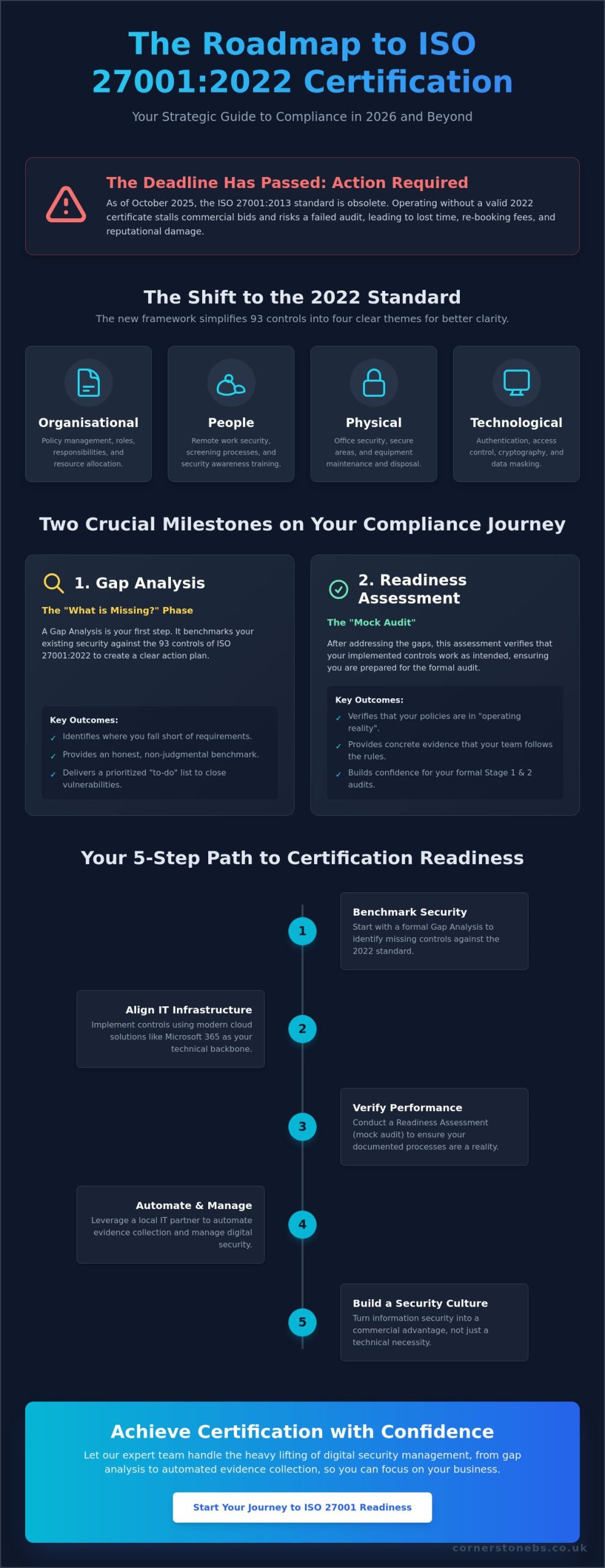
Aligning Your IT Infrastructure with 2026 Standards
Your digital foundation determines how smoothly you’ll reach the finish line. In 2026, a secure infrastructure isn’t just about speed; it’s about granular control and visibility. For most UK businesses, this starts with securing cloud solutions like Azure and AWS. These platforms offer incredible flexibility, yet they require expert configuration to ensure that data residency and access permissions align with your Information Security Management System (ISMS). When your infrastructure is built correctly, it acts as a silent partner in your ISO 27001 certification readiness journey.
A successful Microsoft 365 migration for business UK provides the perfect opportunity to bake security into your daily workflows. By moving away from legacy on-premise servers, you gain access to enterprise-grade tools that simplify the path to compliance. However, your chosen it company solutions must be designed to support these goals. If your technology stack is clunky or poorly integrated, your team will find workarounds that create security gaps and lead to audit failure. We’ve seen how a well-structured network provides the emotional security needed to scale without fear.
Securing the Microsoft 365 Ecosystem
Modern auditors love automation. Tools like Microsoft Intune and Purview allow you to automate the collection of evidence, proving that your devices are encrypted and your data is classified correctly. In a hybrid work environment, identity is the new perimeter. Protecting this perimeter requires Multi-Factor Authentication (MFA) and strict conditional access policies. Microsoft 365 Business Premium directly addresses at least five Annex A controls by managing access rights, securing authentication, protecting endpoint devices, automating information deletion, and restricting privileged access.
Network Infrastructure & Physical Security
The 5-Step ISO 27001 Readiness Checklist
Achieving ISO 27001 certification readiness doesn’t have to be an overwhelming ordeal. We’ve streamlined the process into five actionable steps that protect your time and your investment. By following this roadmap, you ensure that every part of your Information Security Management System (ISMS) is robust, compliant, and ready for the spotlight of a formal audit.
- Step 1: Define the Scope. Be precise about what you’re certifying. You don’t always need to include every department; focus on the areas that handle sensitive data or critical business processes.
- Step 2: Leadership & ISMS Policy. Auditors look for the “tone from the top.” Your senior management must demonstrate a clear commitment to security through documented policies and resource allocation.
- Step 3: Risk Assessment & Treatment. Identify the threats to your information and decide how to handle them. You must document why you chose to accept, transfer, or mitigate specific risks.
- Step 4: The Statement of Applicability (SoA). This is your auditor’s map. It lists which controls apply to your business and, crucially, which ones don’t.
- Step 5: Internal Audit & Management Review. This is your final check. You must conduct an internal audit to verify that your controls are working and present the findings to your leadership team.
If you’re worried about the technical burden of these steps, our locally based team can help you navigate the complexities with multi-award-winning expertise.
Mastering the Statement of Applicability (SoA)
The SoA is the most critical document you’ll present to a Stage 1 auditor. It lists which of the 93 Annex A controls from the 2022 standard are relevant to your operations. You cannot simply exclude controls because they seem difficult; every exclusion requires a valid, documented reason that the auditor will scrutinise. A well-crafted SoA proves you understand your unique risk landscape and have intentionally chosen the right safeguards to protect your business stability.
Preparing Your People for the Audit
Information security is as much about people as it is about technology. Staff awareness is a major component of ISO 27001 certification readiness. During a formal audit, the assessor may interview your team to see if they understand your security policies. We recommend regular training sessions and mock social engineering tests, such as simulated phishing emails, to keep security top of mind. You must document this training and any subsequent competency checks. This evidence shows the auditor that security is woven into your company culture, providing the emotional security your clients expect from a professional partner.
How Managed IT Support Accelerates Your Path to Certification
Achieving ISO 27001 certification readiness is often viewed as a daunting technical mountain to climb. However, partnering with a multi-award-winning managed IT provider shifts that weight off your shoulders. We don’t just give you a list of things to do; we implement the technical controls, configure the secure environments, and manage the ongoing monitoring that auditors demand. This proactive approach ensures your security controls are always active and functional, rather than just existing as words in a policy document. We treat your security as a foundational element of your business stability.
In the current 2026 threat landscape, staying ahead of sophisticated cyberattacks is a full-time commitment. Our team understands the specific nuances of the UK’s latest regulations, including the Data (Use and Access) Act 2025. We provide the technical evidence your auditor needs, from automated log reports to proof of encryption across all endpoints. This collaboration turns a complex certification process into a structured, manageable journey. We act as your long-term partner, ensuring your security foundation is strong enough to support your most ambitious growth plans while protecting your commercial reputation.
From Project to ‘Business as Usual’
Many businesses treat certification as a one-off project, but it’s actually a three-year cycle. After your initial success, you’ll face annual surveillance audits to prove you’re still meeting the standard. Managed IT support turns compliance into a standard operating procedure rather than a yearly scramble. Through regular technical audits and rigorous patch management, we ensure your systems remain secure every single day. This consistency removes the audit panic that often strikes when a surveillance date approaches. We keep the evidence trail warm so your ISO 27001 certification readiness is a permanent state, not a temporary achievement.
The Cornerstone Approach to Security
We pride ourselves on being more than just a service provider. Our approach blends professional authority with an approachable, regional warmth that makes complex technology feel manageable for any business owner. We design bespoke solutions that fit your specific needs, providing the emotional security that comes from knowing your digital assets are protected by experts. As a locally based team, we’re deeply invested in the success of our community’s businesses and the stability of their infrastructure.
Your path to a more secure, reputable, and commercially competitive business starts with a simple step. We invite you to have an informal conversation with our friendly team of experts. Let’s discuss your certification goals and see how we can build a resilient future together. Whether you’re just starting your gap analysis or looking to polish your final readiness assessment, we’re here to help you move forward with total confidence.
Securing Your Commercial Future with Confidence
Transitioning to the 2022 standard is more than a regulatory hurdle; it’s a strategic opportunity to build a more resilient, trustworthy organisation. We’ve explored how a robust Statement of Applicability and a well-configured Microsoft 365 environment provide the concrete evidence auditors demand. By shifting from a “project” mindset to a “business as usual” approach, you ensure your ISO 27001 certification readiness remains a constant state of excellence. This proactive stance protects your commercial edge and builds lasting trust with your stakeholders.
As a multi-award-winning IT services provider and certified partner for Microsoft, IBM, and Cisco, we provide the technical depth and national UK coverage needed to secure your infrastructure. We believe in a partner-led approach that prioritises your emotional security and business stability. You don’t have to navigate these complex global standards alone. Our team is here to simplify the technical mechanisms so you can focus on what you do best.
Book a consultation with our award-winning security experts to assess your ISO 27001 readiness.
We look forward to helping you turn compliance into a powerful engine for your long-term growth and success.
Frequently Asked Questions
How long does it take to achieve ISO 27001 certification readiness?
Most UK small and medium enterprises take between 6 and 12 months to reach full ISO 27001 certification readiness. The exact timeline depends on your current security maturity and the resources you can dedicate to the project. If you already have robust digital infrastructure in place, you might find the process moves much faster. We always recommend a steady pace to ensure your team truly adopts the new security culture.
Is ISO 27001 a legal requirement for UK businesses in 2026?
ISO 27001 isn’t a universal legal mandate, but it’s increasingly a commercial necessity for UK businesses. While the law doesn’t force you to certify, many public sector contracts and large corporate supply chains now require it. It also serves as powerful evidence that you’re meeting the “appropriate technical and organisational measures” required by the Data (Use and Access) Act 2025 and UK GDPR.
What is the difference between ISO 27001 and Cyber Essentials Plus?
Cyber Essentials Plus is a technical snapshot focused on five specific security areas, while ISO 27001 is a holistic management system. Think of Cyber Essentials as a vital baseline and ISO 27001 as the complete architecture for your business stability. The 2022 version of ISO 27001 manages 93 controls across people, physical, and digital domains, offering a much broader shield for your reputation.
How much does an ISO 27001 readiness assessment cost?
The cost of a readiness assessment depends on the size of your organisation and the complexity of your data processes. Larger firms with multiple sites or complex cloud environments will require more time for a thorough review. While audit day rates for UKAS accredited auditors have risen recently due to a shortage of qualified professionals, investing in a readiness assessment prevents the much higher costs of a failed formal audit.
Can a small business with under 10 employees get ISO 27001 certified?
Absolutely, businesses with fewer than 10 employees can and do achieve certification. The standard is designed to be scalable, meaning you only implement controls that are relevant to your specific risks. Small teams often reach ISO 27001 certification readiness faster than larger corporations because their communication lines are shorter and their internal structures are less complex.
What happens if we fail our ISO 27001 Stage 1 audit?
Failing a Stage 1 audit simply means you have some homework to do before the final assessment. Your auditor will provide a report detailing any non-conformities or areas where your documentation is thin. You’ll need to address these issues before you can proceed to Stage 2. It’s best to view this as a helpful safety net that prevents a more costly failure during the final certification stage.
Do we need to buy expensive software to manage our ISO 27001 compliance?
You don’t need to purchase dedicated compliance software to meet the standard. While automated platforms can be helpful, many successful businesses manage their compliance using their existing Microsoft 365 ecosystem. The key to ISO 27001 certification readiness is the quality of your processes and the evidence you produce, not the price tag of the software you use to track them.
How often do we need to renew our ISO 27001 certification?
Your ISO 27001 certificate follows a three-year cycle. Once you’re certified, you’ll undergo annual surveillance audits in years one and two to ensure your systems are still performing well. At the end of the third year, you’ll need a full recertification audit to maintain your status. This cycle ensures that your security remains a proactive, foundational element of your business rather than a one-off project.
GDPR IT Compliance Checklist for UK Businesses: The 2026 Technical Guide
Did you know the average ICO fine has surged to nearly £3.2 million in 2026? That is a staggering 370% increase since 2023, proving that maintaining a GDPR IT compliance checklist for UK businesses is no longer just a legal formality; it’s a fundamental pillar of your digital resilience. As a local team that prides itself on keeping our regional partners secure, we know how daunting these shifting regulations and high-stakes penalties can feel.
It’s perfectly natural to feel overwhelmed by the technical jargon of the Data (Use and Access) Act 2025 or to worry about the complexities of cloud data residency. You want to focus on serving your customers, not on the fear of a £17.5 million penalty. This guide moves past the legalese to provide a clear, technical to-do list for your modern infrastructure. We’ll walk you through the essential system updates, from automated decision-making safeguards to the mandatory complaint processes taking effect on June 19, 2026. You’ll gain a robust framework for business continuity and the peace of mind that comes from being truly prepared for the year ahead.
Key Takeaways
- Move beyond legal theory by treating compliance as a proactive technical state of IT infrastructure resilience.
- Build a secure foundation using essential technical controls, specifically focusing on advanced encryption for data at rest and in transit.
- Use our GDPR IT compliance checklist for UK businesses to audit your hardware and software assets and locate every piece of personal data.
- Navigate cloud complexities with confidence by verifying your data residency meets the specific requirements of the latest UK legal standards.
- Ensure long-term stability by positioning managed IT support as a proactive monitoring strategy rather than just a technical necessity.
Understanding UK GDPR IT Compliance in 2026
Think of UK GDPR IT compliance as the digital fortress that surrounds your business operations. It isn’t just about having a privacy policy tucked away in a filing cabinet; it’s the technical implementation of every data protection principle within your actual network. While the Data Protection Act 2018 provides the legal foundation, IT compliance is the mechanism that enforces those laws through encryption, access controls, and secure backups. In 2026, the gap between “saying” you are compliant and “being” compliant has never been wider.
Why Compliance is a Competitive Advantage
The Role of the ICO in 2026
The ICO’s current focus is on high-impact enforcement, targeting the most serious violations with record-breaking penalties. The accountability principle now demands that you maintain detailed technical logs to prove exactly how data is accessed and handled. If you can’t show the logs, the ICO assumes the protection wasn’t there. Beyond the £17.5 million maximum fine, the real cost of non-compliance lies in the devastating blow to your brand and the operational downtime that follows a breach. We want to help you avoid that stress by making compliance a seamless, proactive part of your daily operations.
Technical Controls: The Foundation of Digital Privacy
While legal policies provide the rules, technical controls are the actual locks on your digital doors. In 2026, the ICO expects more than just a signed document; they want to see robust, active defenses. Any effective GDPR IT compliance checklist for UK businesses must start with the hardware and software settings that protect your data from the inside out. We help our local partners move beyond theory by implementing the specific technical measures that keep sensitive information out of the wrong hands.
Encryption acts as your final line of defense. You must ensure that all personal data is encrypted both at rest, such as on your servers and backup drives, and in transit, when it’s moving through email or web forms. This ensures that even if a data packet is intercepted, it remains completely unreadable. Coupling this with Multi-Factor Authentication (MFA) across every business account creates a formidable barrier. MFA is no longer an optional extra. It’s a fundamental requirement for securing your Microsoft 365 environment and preventing unauthorized access from stolen credentials.
Hackers look for the easiest path. Often, that’s through unpatched software. A proactive approach to vulnerability management means your systems aren’t left open to known exploits. Regular, automated patching keeps your infrastructure resilient and stable. If managing these technical layers feels like a full-time job, our team provides the expert Cyber Security support you need to stay ahead of emerging threats without losing focus on your daily operations.
Access Control and Identity Management
We recommend the Principle of Least Privilege (PoLP) for every business network. This means users only have access to the specific data required for their job role, and nothing more. For those using Microsoft 365 or local servers, you should audit user permissions quarterly to prevent “permission creep.” When an employee leaves your organization, their accounts must be deactivated immediately. Leaving a dormant account active is a massive security hole that the ICO’s Guide to the GDPR specifically warns against.
Endpoint Security and Device Management
Hybrid work has made endpoint security a top priority. Laptops and mobile devices are easily lost or stolen, making them high-risk targets. You should use Mobile Device Management (MDM) to maintain control over these assets, allowing for remote data wiping if a device disappears. To meet strict compliance standards, you must implement full-disk encryption on all portable hardware to ensure data remains protected even if the physical device is compromised. These small technical steps provide immense emotional and financial security for your business.
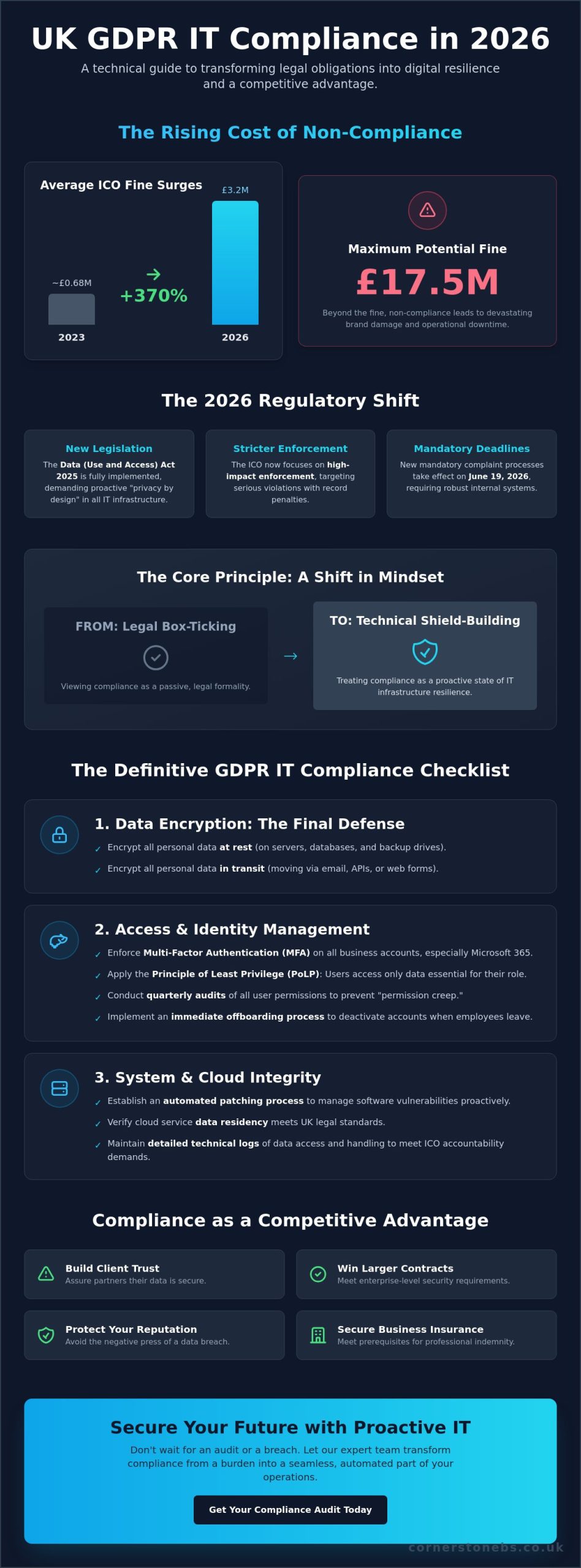
Cloud Infrastructure and Data Residency Requirements
Storing your data in the cloud isn’t just about convenience; it’s about geography. Data residency refers to the physical location where your information sits. For UK businesses, ensuring your cloud provider uses UK-based data centers is a vital part of any modern GDPR IT compliance checklist for UK businesses. Platforms like Microsoft Azure and Microsoft 365 allow you to select specific UK data regions. This keeps your client information within our borders, which simplifies your legal obligations and provides a clear audit trail for the ICO. You should also remember that using any SaaS provider makes them a “data processor.” This requires a solid third-party agreement to ensure they meet the same high standards for security and privacy that you do.
Managing these cloud environments requires a proactive approach to ensure data doesn’t drift into unapproved regions. We help our local partners configure their cloud settings to prioritize regional storage, providing the peace of mind that comes from knowing exactly where your data lives. This technical oversight is a foundational element of business stability. It ensures you aren’t caught out by shifting international data transfer rules that can change without much notice.
Microsoft 365 Compliance Features
Microsoft 365 is more than just a set of productivity tools. It includes powerful security features like Microsoft Purview and Data Loss Prevention (DLP) settings. These tools allow you to set up auto-labeling, which automatically detects and protects sensitive business data like financial records or personal IDs. If you’re planning a move to a more secure environment, our Microsoft 365 Migration for Business UK guide offers a complete strategy for a secure transition. These built-in features help you stay organized and demonstrate your commitment to data protection.
Backup and Disaster Recovery as a GDPR Requirement
GDPR isn’t just about privacy; it’s about availability. If your systems go down and you can’t access personal data when a customer requests it, you’re technically in breach. A simple backup is a great start, but a compliant disaster recovery plan ensures your business can actually keep running during a crisis. We align our Cloud Solutions for UK Businesses with the NCSC’s 10 Steps to Cyber Security to ensure your infrastructure is resilient. This level of technical support provides the emotional and financial security you need to focus on growth. It transforms a technical necessity into a long-term partnership for success.
The Definitive GDPR IT Compliance Checklist for UK Businesses
While we’ve discussed the theory and cloud residency, compliance ultimately comes down to the specific settings on your devices and servers. To help you build a resilient foundation, we’ve compiled this GDPR IT compliance checklist for UK businesses. It moves beyond paperwork to focus on the technical enforcement required to satisfy the ICO in 2026. Start by auditing every piece of hardware and software in your building. You must identify exactly where personal data resides, whether it’s on a local desktop, a legacy server, or a staff member’s mobile phone.
Your next step is implementing end-to-end encryption for all email communications and file sharing. This ensures that sensitive information remains secure from the moment it leaves your network until it reaches the intended recipient. Combine this with a strict password policy and universal MFA deployment across every single business application. Finally, don’t wait for a crisis to test your defenses. Schedule regular Cyber Security audits and penetration testing to find the cracks before a hacker does. Proactive testing isn’t just a technical necessity; it’s a foundational element of your business stability.
Data Mapping and Asset Discovery
You can’t protect what you can’t see. “Shadow IT” often creeps into organisations when staff use unauthorized personal apps or hardware for work tasks. To combat this, create a technical data flow diagram for your IT network that maps every point where personal data enters, moves through, and leaves your systems. Robust IT inventory management is the only way to ensure your GDPR IT compliance checklist for UK businesses covers 100% of your digital footprint. It gives you the clarity of an expert and the confidence of a leader.
The 72-Hour Breach Notification Rule
The law requires you to report most data breaches within 72 hours, but you can’t report what you haven’t detected. This requires real-time technical monitoring to catch unauthorized access as it happens. Under technical guidelines, a reportable breach is defined as any security incident that leads to the accidental or unlawful destruction, loss, alteration, or unauthorized disclosure of personal data. If you aren’t sure if your current systems can spot these triggers, our Cyber Security Services provide the proactive monitoring you need for true peace of mind. We invite you to have a conversation with our local team to see how we can strengthen your defenses today at cornerstonebs.co.uk.
Securing Your Future: Proactive Managed IT as a Compliance Strategy
Completing a GDPR IT compliance checklist for UK businesses is a fantastic milestone, but true data protection is never a “one and done” task. Compliance is a living state of your infrastructure. To maintain the high standards required by the ICO in 2026, your systems need constant, proactive oversight. Managed IT Support bridges the gap between having a plan and actually living it. It provides the continuous monitoring necessary to detect unauthorized access attempts or system vulnerabilities the moment they appear, rather than weeks after a breach has occurred.
Think of an outsourced partner as providing “compliance-as-a-service.” At Cornerstone Business Solutions, we deliver bespoke technology solutions that go beyond generic software fixes. We understand that every organisation has a unique digital footprint. Our multi-award-winning expertise allows us to navigate complex technical audits with the clarity of a long-term partner. We don’t just sell you a license; we build a resilient framework that supports your business continuity and provides the emotional security you need to lead with confidence.
From Reactive Repairs to Proactive Compliance
The old “break-fix” model of IT support is now a major compliance risk. If you only call for help when something stops working, you’ve likely already left a window open for a data breach. GDPR demands “availability” and “integrity,” which are impossible to guarantee with reactive repairs. Moving to a fixed-term contract ensures your system health and security patches are always current. While we are proud of our roots and provide industry-leading Managed IT Services in Teesside, our technical reach and compliance expertise support businesses on a national scale. This proactive approach keeps your network stable and your data locked down tight.
Your Next Steps for 2026
The most effective way to start your journey toward total resilience is with a professional security audit. We’ll help you identify the specific gaps in your current setup and refine your GDPR IT compliance checklist for UK businesses to match your actual operational needs. Our award-winning support team is ready to simplify the technical hurdles of the Data (Use and Access) Act 2025, turning complex regulations into a clear path forward. We invite you to a conversation about your digital future. It’s time to move away from the fear of fines and toward the peace of mind that comes from expert protection. Book a consultation with our compliance experts today and let’s build something secure together.
Build a Resilient Future Through Technical Excellence
The transition toward strict technical enforcement in 2026 proves that data protection is no longer just a legal task. It’s a fundamental part of your business’s digital health. By moving from reactive repairs to a proactive GDPR IT compliance checklist for UK businesses, you ensure your infrastructure remains stable, secure, and ready for growth. You’ve learned that robust encryption, regional data residency, and universal MFA are the pillars of modern privacy by design.
We believe that every local business deserves the peace of mind that comes from expert protection. As a multi-award-winning IT services provider and strategic partner with industry leaders like Microsoft, IBM, and Cisco, we offer the 24/7 proactive monitoring required to stay ahead of evolving threats. We don’t just fix problems; we prevent them from happening in the first place. This collaborative approach turns a regulatory necessity into a powerful engine for client trust and operational stability.
Your journey toward total resilience starts with a single conversation. Start your journey to total technical compliance with a Cornerstone IT audit. Let’s work together to secure your data and protect your reputation for the long term. You’ve got this, and we are right here to support you every step of the way.
Frequently Asked Questions
Is UK GDPR compliance different from EU GDPR in 2026?
Yes, the Data (Use and Access) Act 2025 has created a distinct UK framework that diverges from the EU version. While the core principles of privacy remain, the UK has relaxed rules on automated decision-making and introduced “recognised legitimate interests” to simplify processing for specific cases like crime prevention. It is vital to ensure your systems reflect these specific UK legislative updates rather than relying on generic EU guidance.
Does a small business with fewer than 10 employees need a GDPR IT checklist?
Absolutely, because data protection laws apply to every organisation regardless of its size. A GDPR IT compliance checklist for UK businesses ensures that even the smallest team protects sensitive client data from rising cyber threats. Smaller businesses are often targeted because they lack robust defenses, so having a clear technical plan provides essential security and prevents devastating financial penalties.
What are the technical requirements for “Privacy by Design”?
Privacy by Design requires you to integrate data protection into your system architecture from the moment of purchase or development. This includes implementing pseudonymisation, setting automatic data deletion periods, and ensuring that default settings are always the most private options available. It moves privacy from a manual task to an automated technical standard within your network infrastructure.
Can I store UK customer data on US-based cloud servers?
You can store data in the US, provided you use appropriate safeguards like the UK-US Data Bridge or specific standard contractual clauses. However, the most reliable way to ensure compliance is to select a UK-based data region within your cloud platform. This keeps your information within our borders and simplifies your residency requirements under current UK law.
How often should we conduct a technical GDPR audit?
We recommend a full technical audit at least once a year or whenever you implement significant changes to your IT infrastructure. Regular quarterly reviews of user permissions and software patches are also essential. This proactive rhythm ensures your GDPR IT compliance checklist for UK businesses stays relevant as new cyber threats emerge throughout the year.
Is Multi-Factor Authentication (MFA) a legal requirement under GDPR?
While the law doesn’t name “MFA” specifically, it mandates that you use “appropriate technical measures” to protect personal data. In 2026, the ICO considers MFA a basic industry standard for any business network. Failing to implement it can be viewed as negligence, making it much harder to defend your actions if a breach occurs via stolen credentials.
What happens if our business suffers a data breach but we followed the checklist?
Following a technical checklist demonstrates that you took “reasonable and proportionate” steps to protect your data. While you must still report a reportable breach to the ICO within 72 hours, having a documented audit trail of your technical controls significantly reduces the likelihood of heavy fines. It proves you acted as a responsible and proactive data controller.
How does Managed IT Support help with GDPR accountability?
Managed IT Support provides the technical logging and continuous monitoring required to prove your compliance to regulators. By outsourcing to a local expert, you gain a detailed audit trail of every security patch, backup, and access request. This satisfies the accountability principle by providing concrete evidence that your systems are actively managed and secured 24/7.
Securing Remote Worker IT Access: The 2026 Business Strategy Guide
What if the greatest threat to your business data isn’t a hacker in a distant country, but a poorly secured printer in your employee’s spare room? As we move into 2026, the traditional office walls have dissolved, leaving many business owners feeling exposed to ransomware and the complexities of managing personal devices. We know that securing remote worker IT access is no longer just a “nice-to-have” feature; it is the backbone of your operational stability. We understand the frustration of slow VPNs that hinder productivity and the fear that a single home Wi-Fi connection could compromise years of hard work.
You likely agree that your team should be able to work from anywhere with the same speed and safety they enjoy at their desks. This guide promises to show you how to protect your sensitive information while empowering a truly productive, mobile workforce. We will preview the shift toward Zero Trust architectures, the role of modern authentication, and a practical roadmap to achieving a “set and forget” security posture that keeps you compliant with UK data standards. Let’s explore how to make your remote setup your strongest asset.
Key Takeaways
- Learn why the old office perimeter is a dead concept and how to adopt a modern framework that protects data wherever your team chooses to work.
- Discover why Zero Trust Network Access is the essential successor to slow VPNs, offering both better protection and a faster experience for your staff.
- Explore the concept of “Seamless Security” to provide a background layer of protection that keeps employees productive without constant technical hurdles.
- Follow our practical 5-step roadmap for securing remote worker IT access, including how to audit your systems and roll out multi-factor authentication.
- See how award-winning managed IT support can take the security burden off your shoulders, giving you the freedom to focus on growing your business.
Understanding Secure Remote IT Access in a Post-Perimeter World
The concept of the “office perimeter” is officially a relic of the past. In 2026, your business network doesn’t stop at the front door; it extends to every home office, transit hub, and client site where your team logs in. Securing remote worker IT access is the comprehensive framework designed to protect your data the moment it leaves your physical server. It isn’t just about encryption anymore. It is about creating a consistent, safe environment for your staff, regardless of their postcode or the time of day they choose to work. This proactive stance ensures that your business remains resilient in a world where the traditional boundaries of the workplace have dissolved.
This modern approach stands on three essential pillars: Identity, Device, and Data. We no longer assume a connection is safe just because someone has the right password. Instead, we verify the person’s identity through multiple layers, check that their laptop is healthy and updated, and ensure the data they are accessing is appropriate for their role. This is the shift from “trust but verify” to “never trust, always verify.” It sounds strict, but it actually provides the emotional security you need to let your team work flexibly without staying up at night worrying about a breach. By verifying every request in real-time, we turn security into a silent, reliable partner in your daily operations.
The Evolution of Remote Work Risks in 2026
The landscape has shifted dramatically. AI-driven phishing attacks now use sophisticated frontier models to create highly convincing messages that can fool even the most cautious employees. We also see a rise in risks from domestic IoT devices. A smart doorbell or a home printer on an unsecured network can act as a silent gateway for ransomware. Because of these evolving threats, standard passwords are no longer a viable security layer. They are simply too easy to bypass in a world where automated hacking tools are constantly scanning for weaknesses. Keeping your team safe requires a move toward more robust, biometric-based protections.
Why a Strategic Approach Outperforms Ad-Hoc Solutions
Many businesses fall into the trap of “bolting on” security features only after a problem occurs. This ad-hoc approach is often more expensive and less effective than a unified strategy. A proactive plan for securing remote worker IT access actually improves your business continuity and can lead to lower cyber insurance premiums. We position security as a foundational element of your growth, not a barrier to it. When your systems are built with resilience in mind, you have the freedom to scale your team and your operations with total confidence. It is about building a stable platform for your future success.
The Core Technologies Powering Secure Remote Work
Building a resilient remote environment doesn’t require a massive enterprise budget; it requires the right tools used correctly. In 2026, the traditional VPN is fading away. It often grants too much access and slows down your team, creating a bottleneck for productivity. Instead, we recommend Zero Trust Network Access (ZTNA). Think of ZTNA as a smart digital bouncer. It checks who is trying to connect, which device they’re using, and their current location before granting access to specific apps. It’s precise, fast, and far more secure than older methods that once relied on a single point of entry.
Maximising Microsoft 365 for Remote Security
Most UK businesses already use Microsoft 365, but few use its full security potential. We help you set up Conditional Access policies, which allow you to block logins from suspicious locations or from devices that aren’t fully updated. Microsoft Intune takes this further by letting you manage every mobile and laptop from a central dashboard. A professional Microsoft 365 migration for business UK simplifies remote management by ensuring your cloud environment is built for security from the ground up. It turns a standard productivity tool into a powerful shield for your data.
Secure Hardware: Beyond the Software
Software is only half the battle. Securing remote worker IT access also depends on the physical kit your team uses. Business-grade laptops featuring TPM (Trusted Platform Module) chips provide hardware-level encryption that consumer models often lack. While “Bring Your Own Device” (BYOD) seems cost-effective, it is often a security nightmare. We find that company-issued hardware, pre-configured with encryption and security software, is the safest route. It ensures every device is protected the second it leaves the box. If you’re unsure if your current tech stack is up to the challenge, our team is happy to review your remote infrastructure and offer practical, local advice.
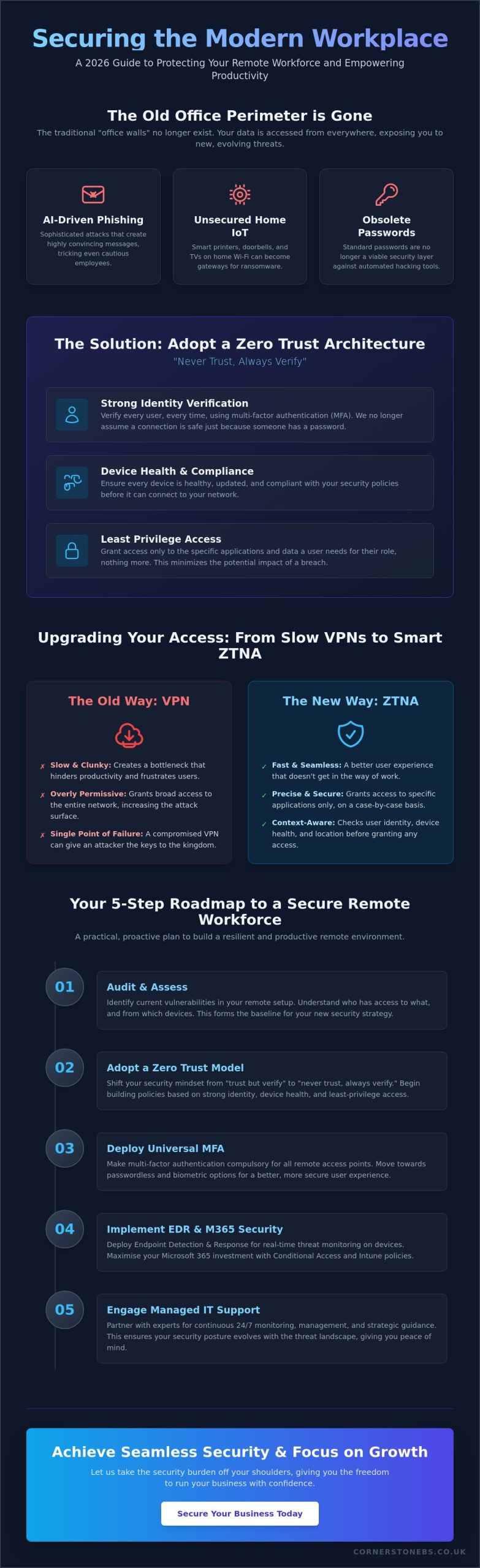
Balancing Robust Security with Employee Productivity
Many business owners worry that adding layers of protection will grind daily work to a halt. We’ve all heard the grumbles about slow VPNs or forgotten passwords that lock people out for hours. But securing remote worker IT access shouldn’t be a barrier to getting things done. We aim for “Seamless Security.” This means protection happens quietly in the background, allowing your staff to focus on their roles instead of wrestling with tech. By using Single Sign-On (SSO), we eliminate password fatigue. Your team logs in once and gains secure entry to all their essential business applications. It’s faster for them; it’s safer for you.
For cloud-heavy businesses, latency is the enemy. Modern access solutions provide much lower latency than legacy systems. This ensures that a staff member working from home in the morning feels just as connected as if they were sitting in your main office. A strategic approach to securing remote worker IT access prioritises the user experience just as much as the data protection protocols.
Reducing Friction with Modern Authentication
Moving to biometrics is a total game changer for staff morale. Using a fingerprint or facial recognition via Windows Hello or Touch ID is nearly instant and far more secure than a written password. We also implement context-aware security. If an employee is on a known device at their usual home address, the system stays quiet. It only prompts for extra verification if it detects something unusual, such as a login attempt from a different country. This reduces “verification fatigue” and keeps the workflow smooth and uninterrupted.
The Human Element: Training as a Security Layer
Even the best software can’t stop every mistake. That’s why we treat training as a vital security layer rather than a box-ticking exercise. We help you roll out bite-sized, regular cyber awareness training that fits into a busy day. It’s about building a culture where staff feel empowered, not policed. When your team understands the “why” behind the rules, they become your strongest line of defence. We encourage an open environment where reporting a suspicious email is met with a “thank you” rather than a reprimand. This collaborative approach is a foundational element of business stability and emotional security. If you’re concerned about how security is impacting your team’s output, we invite you to start a conversation with our local team today.
A 5-Step Roadmap to Securing Your Remote Workforce
Securing remote worker IT access shouldn’t feel like a guessing game. While the technology involves sophisticated layers, the path to implementation is straightforward when broken down into logical steps. We have developed a 5-step roadmap to help you move from a reactive posture to a resilient, modern framework that protects your team and your data without getting in the way of their work. This is about building a foundation for stability and growth.
Step 1: The Audit and Policy Phase
You can’t protect what you don’t know exists. We start by identifying “Shadow IT,” which often involves well-meaning staff using unapproved apps like personal Dropbox or WhatsApp to share sensitive business files. Clear remote work policies are vital. They define exactly what is expected of your team and how they should handle company data outside the office. Reviewing our cyber security services is a great way to benchmark your current posture against 2026 standards and identify where your biggest risks lie.
Step 2: Implement MFA. With 91% of companies now making multi-factor authentication compulsory, this is your baseline defence. It’s the simplest way to stop a stolen password from becoming a full-blown data breach.
Step 3: Standardise Hardware and Cloud. We recommend moving away from the “bring your own device” nightmare. Using company-issued, encrypted hardware and secure cloud platforms like Microsoft 365 ensures every device is managed under the same high standards.
Step 4: Deploy a Zero Trust Framework. It’s time to retire the legacy VPN. Replacing it with Zero Trust Network Access (ZTNA) ensures that your staff only access the specific files they need, keeping the rest of your network isolated and safe.
Step 5: Proactive Monitoring and Response
The final step is establishing ongoing oversight. Since your team might work irregular hours, 24/7 monitoring is essential to catch threats while you sleep. This isn’t just a “set and forget” task. It involves proactive threat hunting to stop attackers before they gain a foothold. Our managed IT services Teesside provide this level of national-standard protection with a friendly, local face. We act as your long-term partner, ensuring your systems stay healthy and your business remains compliant with UK data standards. If you are ready to move toward a more secure future, we invite you to book a remote security audit with our expert team today.
Why Managed IT Support is the Key to Long-Term Remote Security
Managing securing remote worker IT access in-house is a significant burden for most SMEs. It requires constant attention to emerging threats, software updates, and user support that can easily overwhelm a small team. When you partner with us, you gain access to award-winning expertise that stays ahead of the 2026 threat landscape. We act as your single point of contact for IT hardware, cloud infrastructure, and cyber security. This unified approach eliminates the gaps that often appear when using multiple different providers. It ensures that every part of your digital ecosystem is working in harmony to protect your business data.
24/7 Support for a 24/7 Workforce
Remote workers don’t always stick to a traditional nine-to-five schedule. Whether they are catching up on emails late at night or starting early to beat the school run, they need help that matches their rhythm. Our expert helpdesk provides immediate assistance regardless of where your staff are located. This level of support does more than just fix tech problems. It boosts remote employee morale by proving that they have the same reliable tools and backing as those in the office. Our tailored cloud solutions and managed support go hand-in-hand to ensure your digital workspace is always available and always secure.
Your Partner in Secure Growth
We don’t just set up your systems and walk away. We are here as your long-term partner to ensure securing remote worker IT access remains robust as your business evolves. As your remote team grows, we scale your security protocols and hardware deployment to match. There is a deep sense of reassurance that comes from working with a multi-award-winning IT provider deeply rooted in our local community. We take pride in our regional identity and our reputation for reliability. We handle the technical mechanisms so you can focus on your core business goals. We invite you to start a no-obligation conversation with our local team today about your remote setup.
Future-Proof Your Remote Strategy Today
Remote work is no longer a temporary fix. It’s a permanent pillar of modern business. We’ve seen how the old office perimeter has vanished and why a Zero Trust model is now the gold standard for protection. By focusing on identity and device health rather than just outdated passwords, you create a “seamless security” environment that keeps your team productive and your data safe. Implementing a clear 5-step roadmap ensures you aren’t just reacting to threats but building a resilient foundation for long-term growth.
Securing remote worker IT access is a journey that requires the right partner by your side. As a multi-award-winning IT services provider and official partners with Microsoft, IBM, and Cisco, we bring world-class expertise directly to our local community. Our proactive 24/7 system monitoring means we catch risks before they become breaches. We invite you to take the first step toward a more stable and secure future for your business.
Book a Free Remote Security Audit with our Award-Winning Team. We look forward to helping you build a workplace that is safe, efficient, and ready for whatever comes next.
Frequently Asked Questions
What is the most secure way for remote employees to access the company network?
Zero Trust Network Access (ZTNA) is the gold standard for remote security in 2026. It operates on the principle of “least privilege,” meaning staff only gain access to the specific applications they need for their roles. By verifying every user and device identity before granting entry, it prevents hackers from moving laterally through your systems. This granular control is far more effective than traditional perimeter-based security methods.
Is a VPN still enough for remote work security in 2026?
A traditional VPN is rarely sufficient on its own for modern business needs. While they provide an encrypted tunnel, older VPNs often grant broad access to the entire network once a user is authenticated. This creates a significant risk if a single set of credentials is stolen. We recommend moving toward ZTNA or SASE models that offer more precise, identity-centric protection and better performance for your team.
How do I secure remote workers using their own personal laptops (BYOD)?
The most effective way to manage “Bring Your Own Device” (BYOD) is through Microsoft Intune and virtual desktop solutions. These tools allow you to create a secure, encrypted workspace on a personal laptop that is entirely separate from the employee’s private files. You can enforce strict security policies and wipe business data remotely if the device is lost, all without invading the staff member’s personal privacy.
What are the biggest security risks for employees working from home?
Unsecured home Wi-Fi and domestic smart devices are the primary vulnerabilities we see today. Many home routers use outdated encryption, and “backdoor” entries through smart doorbells or printers are becoming common. Securing remote worker IT access requires a focus on these domestic weak points. We help you implement stronger encryption standards and provide awareness training so your team can identify AI-generated phishing attempts before they cause damage.
Does securing remote access slow down internet speeds for my staff?
Modern security solutions actually tend to improve internet performance for your team. Older VPNs often “backhaul” all data through a central office server, which creates a frustrating bottleneck. Newer cloud-native frameworks connect your staff directly to their applications via the nearest secure data centre. This results in a faster, more responsive experience that feels just like being in the office, even when working from home.
How much does it cost to implement a secure remote access strategy?
The investment required depends on your current technology stack and the size of your remote workforce. We find that many UK businesses already own the necessary tools through their existing Microsoft 365 subscriptions but haven’t configured them for maximum safety. Our approach focuses on maximising your current assets first. We work with you to build a customised, scalable strategy that provides long-term stability without unnecessary overheads.
What is the difference between MFA and 2FA for remote logins?
Multi-Factor Authentication (MFA) is a more robust evolution of Two-Factor Authentication (2FA). While 2FA requires two forms of evidence, MFA uses three or more independent factors, such as a password, a physical security key, and a biometric scan. This layered approach is vital for securing remote worker IT access because it makes it statistically much harder for an attacker to bypass your defences, even if they steal a password.
Can I monitor my remote workers’ IT security without invading their privacy?
You can maintain a high security posture without monitoring your employees’ personal activities. We use endpoint detection tools that focus on identifying malicious software and unusual system behaviours rather than tracking individual user actions. This protects your business from threats while respecting the trust you’ve built with your team. It’s a proactive way to ensure business continuity while maintaining a healthy, positive workplace culture for everyone.
Data Loss Prevention (DLP) Solutions UK: The 2026 Business Strategy Guide
Did you know that 43% of UK businesses reported a cyber security breach over the last year? For medium and large organisations, that figure sits even higher at 69%. It’s a sobering reality that makes finding the right data loss prevention (DLP) solutions UK providers offer more than just a technical box to tick; it’s a fundamental part of your business’s survival. We understand the anxiety that comes with managing a hybrid workforce while trying to avoid the eye-watering £17.5 million fines introduced by the Data (Use and Access) Act 2025.
You shouldn’t have to choose between keeping your data safe and keeping your business moving. We believe that true security comes from having clear visibility into where your sensitive files live and how they travel, without creating hurdles for your staff. This guide will walk you through modern DLP strategies tailored specifically for our UK market. You’ll discover how to safeguard your most critical information, stay on the right side of the ICO, and finally gain the peace of mind that a single accidental click won’t lead to a major disaster.
Key Takeaways
- Understand the vital distinction between accidental data loss and malicious theft to better target your security efforts.
- Discover why effective data loss prevention (DLP) solutions UK businesses implement require a multi-layered approach across endpoints, networks, and the cloud.
- Identify how to mitigate the “human element” by addressing the specific risks posed by malicious actors, negligent staff, and compromised users.
- Learn how to use a “crawl, walk, run” framework to build a robust security strategy that protects your data without slowing down your operations.
Understanding Data Loss Prevention (DLP) in the UK Business Landscape
At its heart, Data loss prevention (DLP) software is a set of tools and processes designed to ensure that your sensitive data isn’t lost, misused, or accessed by unauthorised people. It’s about more than just building a digital wall; it’s about understanding how your data moves through your business every day. In the context of data loss prevention (DLP) solutions UK businesses need, this means having the visibility to stop a spreadsheet of customer details from being accidentally emailed to the wrong person or uploaded to a personal cloud drive. We see DLP as a proactive partner in your growth, keeping your intellectual property safe while your team focuses on what they do best.
The Regulatory Driving Force: UK GDPR and Beyond
Compliance isn’t just a box to tick; it’s a legal necessity that has become even more stringent recently. The Data (Use and Access) Act 2025, which came into force on 5 February 2026, reinforces the requirement for “appropriate technical and organisational measures” to protect data. The Information Commissioner’s Office (ICO) now expects businesses to prove they have these measures in place. If they don’t, the penalties are severe. PECR breaches can now result in fines of up to £17.5 million or 4% of global turnover. Many organisations find that implementing robust DLP controls is the most direct way to meet the requirements of Cyber Essentials Plus, which increasingly focuses on how data is handled at the endpoint.
Data Loss vs. Data Breach: Why the Distinction Matters
We often hear these terms used interchangeably, but they represent different challenges for your team. Data loss is frequently accidental, such as an employee deleting a folder or losing a laptop. Data theft, on the other hand, is a malicious act where someone intentionally exfiltrates information. Both are damaging. While a public data breach brings immediate reputational harm, “silent” data leaks of intellectual property can slowly erode your competitive advantage without you even realising it. Ultimately, DLP acts as the vital bridge between your technical security measures and your legal compliance requirements.
For the modern business owner, DLP is no longer an optional extra. It’s a foundational element of any resilient strategy. When evaluating data loss prevention (DLP) solutions UK organisations must consider how these tools integrate with their existing workflows. By monitoring data in three states (at rest, in motion, and in use) you create an environment where your team can work freely and securely. This proactive approach ensures that a simple human error doesn’t escalate into a business-ending event, providing the stability you need to scale. It’s a natural extension of our broader cyber security services, focused on keeping your local business protected and compliant.
The Three Pillars of Modern DLP: Endpoint, Network, and Cloud
Building a resilient strategy requires more than a single piece of software. It’s about creating a multi-layered shield that follows your data wherever it travels. As businesses move toward more flexible cloud solutions, the traditional “castle and moat” security model has crumbled. Today, the data loss prevention (DLP) solutions UK professionals recommend must cover three specific states of data. First is “Data at Rest”, which includes files sitting on your servers or cloud storage. Second is “Data in Motion”, which is information moving across your network. Finally, “Data in Use” refers to the data currently being handled by an employee on their device.
Modern systems use “content-aware” detection to spot sensitive strings like credit card numbers or sort codes. However, the most effective data loss prevention (DLP) solutions UK providers now implement are also “context-aware”. They don’t just see what the data is; they see who is moving it and where it’s going. This intelligence allows your team to work efficiently while the system quietly blocks risky actions in the background.
Endpoint DLP: Protecting the Modern Remote Worker
With so many of us working from home or local offices, the endpoint is often the most vulnerable point. Endpoint DLP monitors physical transfers to USB drives or external hard drives. It can even prevent a negligent employee from “copy-pasting” client details into an unauthorised web app or a personal AI tool. If a company laptop is lost on a train, robust encryption ensures that the data at rest remains unreadable to unauthorised users. We’ve seen many lessons from government data breaches where a simple lost device led to massive exposure because these endpoint controls weren’t active.
Network and Cloud DLP: Securing the Digital Perimeter
Your digital perimeter now extends far into the cloud. Network DLP scans outgoing email and web traffic for sensitive keywords or patterns. For many businesses, this protection starts with a secure Microsoft 365 migration for business UK. By integrating DLP directly into Teams and SharePoint, you can automatically block the sharing of sensitive files with external guests. This also helps identify “shadow IT”, which are the unauthorised apps your team might use without realising the security risk. If you’re looking to strengthen your defences, a quick chat with a local security partner can help clarify your next steps.
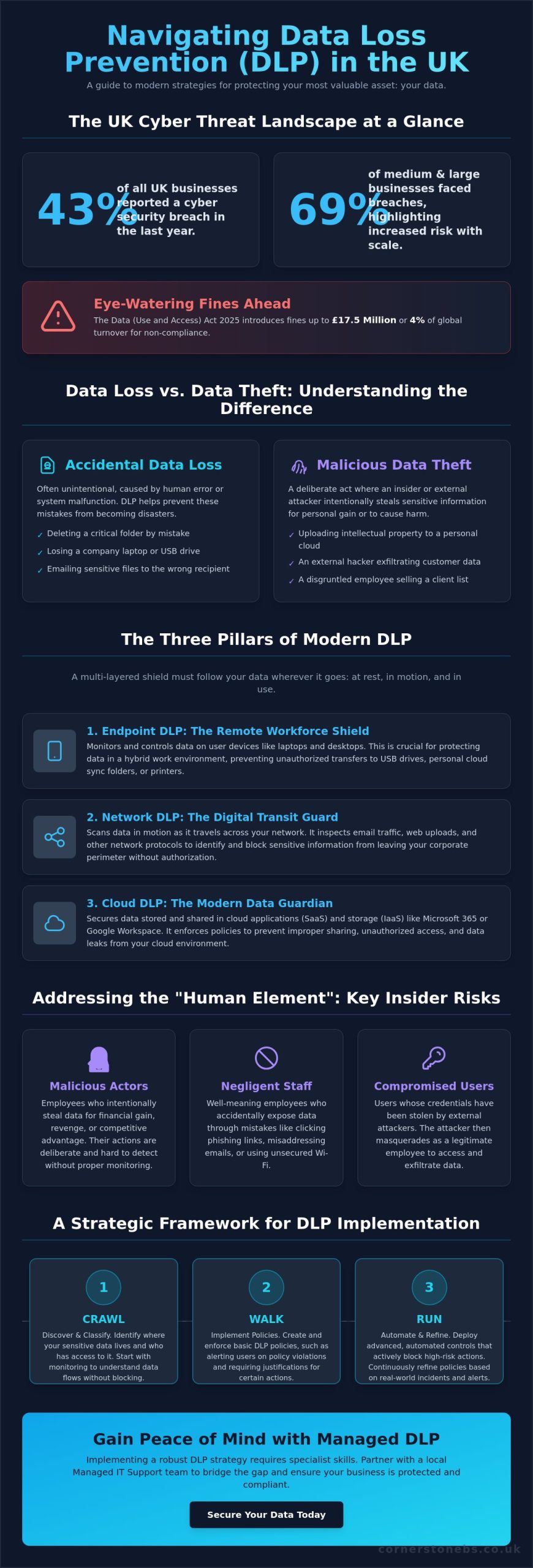
Beyond the Firewall: Addressing the ‘Human Element’ and Insider Risks
Most security incidents aren’t the result of sophisticated hackers bypassing your firewalls. They often start with a simple human error. In fact, the majority of UK data breaches involve a human element rather than a purely technical failure. This is why the most effective data loss prevention (DLP) solutions UK businesses use must look inward. We categorise these internal risks into three distinct groups. First is the Malicious Actor, someone intentionally stealing data for personal gain. Second is the Negligent Employee, who takes shortcuts or ignores policies to get work done faster. Finally, there’s the Compromised User, whose legitimate credentials have been stolen by an external attacker.
Modern DLP tools don’t just act as a digital police force; they serve as a coach. When an employee tries to upload a sensitive file to an unauthorised site, the system can provide “just-in-time” training. A simple pop-up explains the risk and suggests a safer, compliant alternative. This approach builds a culture of security without making your staff feel like they’re being constantly monitored. It’s about finding that vital balance between robust protection and employee trust. By empowering your team to make better decisions, you create a more resilient organisation from the inside out.
The ‘Accidental’ Insider: Stopping the Wrong Attachment
We’ve all had that moment of panic after hitting ‘send’ on an email. AI-driven DLP helps prevent these “oops” moments by flagging when an email recipient doesn’t match the attachment’s content. It looks for patterns that suggest a mistake is about to happen. These “nudge” factors can prevent up to 90% of accidental leaks by giving the user a second to think before the data leaves the business. Ultimately, an informed employee is a business’s strongest security layer.
Detecting Malicious Exfiltration and Unusual Behaviour
Sometimes, the risk is more intentional or the result of a hijacked account. Modern data loss prevention (DLP) solutions UK providers implement often include User and Entity Behaviour Analytics (UEBA). This technology identifies “bulk downloads” or unusual data movement that happens outside of standard UK working hours. For example, if a staff account suddenly accesses thousands of client records at 3 AM on a Sunday, the system can trigger an automatic alert or lockdown. This level of oversight is especially critical during employee offboarding or redundancy processes, ensuring that your intellectual property stays exactly where it belongs.
A Strategic Framework for Implementing DLP Solutions
Implementing data loss prevention (DLP) solutions UK businesses can trust is a marathon, not a sprint. We always advocate for a “crawl, walk, run” approach to avoid overwhelming your team. This measured pace ensures that your security grows alongside your operational needs without causing unnecessary friction. Before you commit to any it company solutions, a comprehensive data audit is essential. You need to define “Sensitive Information Types” that are unique to your industry, such as legal contracts, medical records, or specific financial data structures.
Step 1 & 2: Inventory and Classification
Step 3 & 4: Policy Creation and Monitoring
Effective policies must align with your actual business logic. For instance, your finance department may need to send encrypted documents to external partners, while your marketing team likely shouldn’t have that same requirement. We suggest starting in “Audit Only” mode. This allows you to observe how data moves through your business without blocking any legitimate work. It’s the perfect time to refine your rules and eliminate “false positives” that can frustrate your staff and slow down productivity.
Step 5: Enforcement and Continuous Optimisation
Once your policies are tuned, you can move from simple monitoring to active blocking for high-risk transfers. Regular reporting plays a vital role here, especially when demonstrating compliance to stakeholders or cyber insurers. Your DLP strategy shouldn’t be static. As your business grows and new threats emerge, your policies must evolve to keep your perimeter secure. If you’re looking for a dedicated partner to guide you through this process, we invite you to speak with our local experts today.
Why Managed DLP is the Logical Choice for Growing UK Businesses
Finding and retaining dedicated cyber security talent in the UK has become a significant challenge for many growing organisations. Most businesses simply don’t have the resources to run a 24/7 security operations centre or keep up with the rapid pace of regulatory change. This “skills gap” often leaves sensitive data vulnerable, even if you’ve already invested in security software. This is where managed data loss prevention (DLP) solutions UK providers like Cornerstone Business Solutions provide the most value. We bridge the vital gap between complex software and your actual business strategy. By choosing a managed approach, you gain proactive monitoring and immediate incident response without the overhead of a massive internal department.
Managed services turn a technical tool into a long-term partnership. We believe that security should act as a foundation for your growth, not a hurdle that slows your team down. When you work with a specialist team, you’re not just buying a license; you’re gaining a dedicated ally focused on your business continuity. This proactive oversight ensures that your data remains secure while you focus on scaling your operations and serving your customers.
The Cornerstone Business Solutions Approach: Bespoke Security, Not Off-the-Shelf
We don’t believe in one-size-fits-all security. Every business has unique operational workflows and specific goals. We align your DLP policies with how your team actually works every day. Our multi-award-winning expertise is backed by global partnerships with industry leaders like Microsoft, IBM, and Cisco. Despite these high-tech connections, we remain your local partner. We’re committed to clear, jargon-free communication. You’ll always understand exactly how we’re protecting your data and why it matters for your business’s stability. Our goal is to make complex technical concepts feel simple and manageable for every business leader.
Reducing ‘Alert Fatigue’ Through Managed Services
Most DIY DLP projects fail because of “alert fatigue.” When a system generates hundreds of false alarms every day, genuine risks get lost in the noise. It’s exhausting for a busy IT manager to investigate every single notification. Our team filters this data for you. We use our expertise to separate the noise from the genuine threats, only alerting you when a risk requires your attention. This allows your internal team to stay productive while we handle the technical heavy lifting. Investing in managed data loss prevention (DLP) solutions UK is ultimately an investment in your reputation. It ensures you remain a trusted partner for your clients. Ready to secure your data? Speak to our UK-based security experts at Cornerstone Business Solutions today to start the conversation.
Securing Your Business Legacy for 2026 and Beyond
The right data loss prevention (DLP) solutions UK businesses choose should feel like a natural extension of their daily operations. As a multi-award-winning IT provider, we combine our regional roots with global expertise through strategic partnerships with Microsoft, IBM, and Cisco. You don’t have to manage this complexity alone. Our team at Cornerstone Business Solutions provides proactive 24/7 system monitoring to filter out the noise and keep your perimeter secure. This allows you to focus on growth while we handle the technical heavy lifting.
We’re here to help you navigate these changes with the clarity of a local partner who truly cares about your success. Secure your business data with a bespoke DLP strategy from Cornerstone Business Solutions and let’s have a conversation about your goals. Your peace of mind is our priority.
Frequently Asked Questions
What is the difference between DLP and a standard firewall?
A firewall acts as a digital gatekeeper, controlling who can enter or exit your network based on IP addresses and ports. In contrast, DLP inspects the actual content of the data being moved. While a firewall stops unauthorised access, DLP ensures that a legitimate user doesn’t accidentally or intentionally send a spreadsheet of customer bank details to an external recipient. It’s the difference between guarding the door and checking what’s inside the outgoing post.
Is Data Loss Prevention a legal requirement for UK businesses under GDPR?
UK GDPR and the Data (Use and Access) Act 2025 require businesses to implement “appropriate technical and organisational measures” to safeguard personal information. While the law doesn’t explicitly name specific software, the Information Commissioner’s Office (ICO) expects robust controls. Using data loss prevention (DLP) solutions UK organisations trust is a standard way to prove you’ve taken necessary steps to prevent a breach, helping you avoid heavy fines.
Will implementing a DLP solution slow down my employees’ computers or internet?
You won’t notice a significant impact on your computer’s speed or internet performance with modern systems. Older tools were often resource-heavy, but today’s cloud-native agents are designed to be incredibly lightweight. They perform most of their analysis in the background or within the cloud itself. This ensures your team stays productive and focused on their tasks without the frustration of a lagging device or slow file transfers.
How much does a DLP solution typically cost for a UK SME?
Pricing for DLP is typically structured on a per-user, per-month subscription model. This makes it highly scalable for growing SMEs, as you only pay for the protection you actually need. The total investment depends on whether you require endpoint, network, or full cloud integration. We recommend a conversation to assess your specific risks, allowing us to find a cost-effective path that balances robust security with your business budget.
Can DLP protect data stored in personal cloud accounts like Dropbox or personal Gmail?
Yes, endpoint-based DLP provides visibility and control over data movement to personal accounts. It can prevent employees from dragging company files into a personal Dropbox folder or copy-pasting sensitive text into a personal Gmail window. This protection stays active even when staff are working remotely. It ensures that your business-critical information doesn’t bypass your security perimeter through “shadow IT” or personal web applications.
What happens if the DLP software incorrectly blocks a legitimate business email?
False positives can occur, but they are manageable with the right strategy. During the initial “Audit Only” phase, we identify these instances and refine the rules to match your actual workflows. If a legitimate email is blocked once enforcement is live, the system usually allows the employee to provide a business justification to release it. This creates an audit trail while ensuring that vital business communication never grinds to a halt.
How does DLP help with Cyber Essentials certification?
DLP significantly strengthens your application for Cyber Essentials and Cyber Essentials Plus. These certifications require evidence that you control how data is accessed and shared. By implementing data loss prevention (DLP) solutions UK providers recommend, you demonstrate a proactive approach to data security. It provides the technical proof that auditors look for, showing that you’ve mitigated the risk of accidental data leaks and unauthorised exfiltration.
Do I need a dedicated server to run a modern DLP solution?
You don’t need a dedicated on-site server to run modern DLP. Most contemporary solutions are cloud-delivered, meaning the management console and policy engines live in a secure data centre. This removes the need for expensive hardware maintenance and local storage. It’s an ideal setup for hybrid workforces, as it protects devices wherever they are located without requiring a constant connection to a central office server.