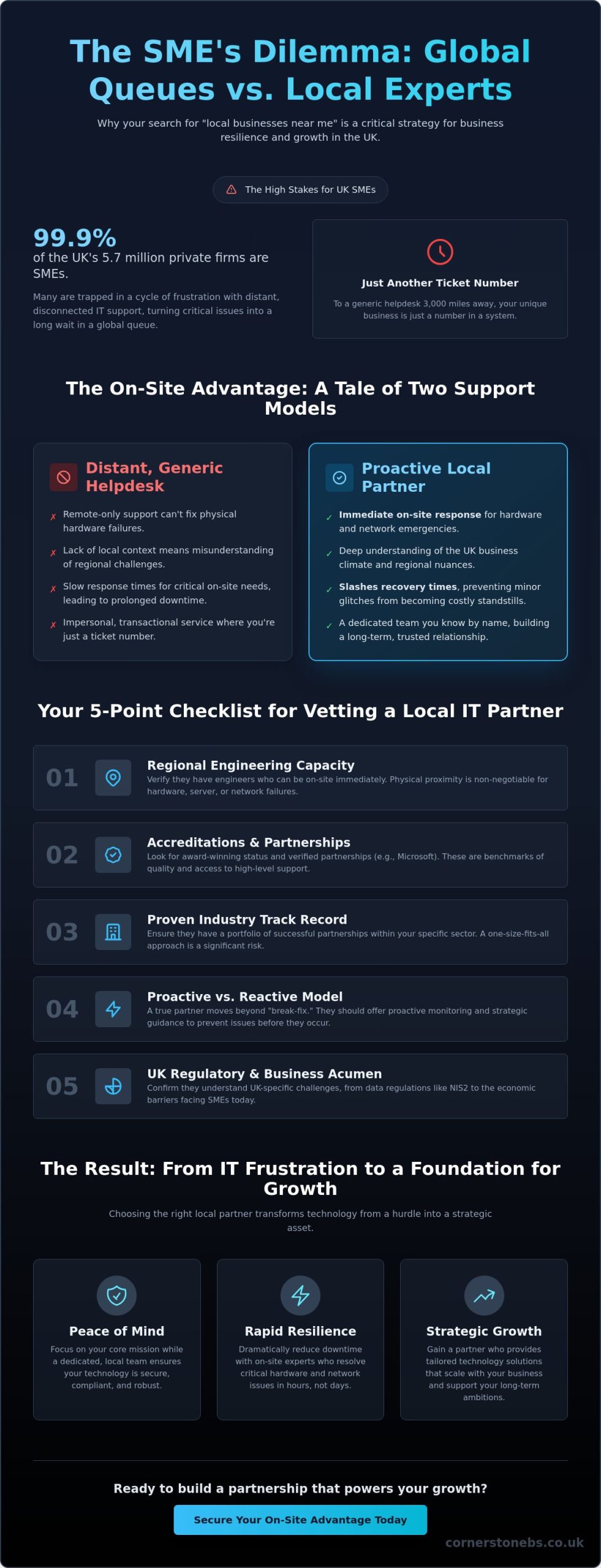
Could your company survive a critical system failure if your only support is a generic helpdesk 3,000 miles away? While 99.9% of the 5.7 million private sector firms in the UK are SMEs, many still struggle with distant, disconnected service providers. You’ve likely felt the frustration of being just another ticket in a global queue. When you search for “local businesses near me,” you aren’t just looking for a postcode; you’re looking for a partner who understands the regional landscape and can be on-site the moment things go wrong.
We know that trust is earned through action, not just words. You need to know that your IT and security are in safe, expert hands. This guide provides a clear framework to help you identify and vet local partners who offer more than just a transactional service. You’ll discover how to secure peace of mind through proactive, award-winning support that keeps your operations robust. We’ll show you exactly how to build a long-term relationship with a team of experts who value your success as much as you do.
Key Takeaways
Realise the “on-site advantage” where physical proximity ensures your hardware and network issues are resolved with a speed that remote desks simply can’t match.
Identify the non-negotiable accreditations and award-winning benchmarks that separate truly reliable experts from unvetted service providers.
Uncover why searching for local businesses near me provides access to tailored technology solutions that global giants often overlook.
Master a 5-point checklist to verify a partner’s regional engineering capacity and proven track record within your specific industry.
Learn how a proactive partnership delivers the peace of mind needed to keep your business operations robust and scalable.
Why Proximity Matters: The Value of Local Businesses Near Me
In the 2026 B2B landscape, a local business is defined by its regional presence and its ability to respond with immediate, tangible action. When you search for local businesses near me, you aren’t just looking for a map pin; you’re looking for a strategic asset that ensures your operations remain robust. For the 5.7 million private sector firms currently operating across the UK, proximity has become a prerequisite for business continuity. Our award-winning approach moves beyond the transactional “break-fix” model. We establish a proactive partnership where your success is our shared goal, ensuring your technology acts as a foundation for growth rather than a hurdle to overcome.
Understanding the nuances of the UK business climate is vital for any service provider. With 45% of SMEs viewing regulation as a significant barrier to their operations in 2026, having a partner who shares your geographical and cultural context is a clear advantage. We don’t just speak your language; we understand the specific regional challenges you face every day. This alignment allows for a seamless integration of technology into your broader business strategy. While Local search engine optimisation has made it easier to find regional experts, the real value lies in the relationship that follows the initial click. True partnership is built on the confidence that your provider is as invested in the local economy as you are.
The Technical Advantage of Local Support
Physical proximity is critical when hardware or network infrastructure fails. Remote support can only go so far. When a server room overheats or a core switch fails, you need an engineer on-site immediately to prevent cascading downtime. Our managed IT services provide this exact safety net for businesses that cannot afford to wait. Local engineers can deploy hands-on infrastructure upgrades and perform emergency repairs that distant teams simply cannot match. This responsiveness slashes recovery times and keeps your team productive, ensuring that a minor technical glitch doesn’t turn into a costly operational standstill.
Building Long-Term Business Resilience
How to Vet Local Service Providers for Your Business
Finding the right partner among the sea of local businesses near me requires looking past basic star ratings. While consumer-facing directories often rely on subjective reviews, B2B excellence is measured by hard data and proven reliability. You need a partner who carries the weight of industry-recognised accreditations and a history of supporting regional growth. Selecting an unvetted provider is a risk your business shouldn’t take. We believe that a true partner should be transparent about their capabilities and ready to prove their worth before you sign a contract.
Award-winning status serves as a critical benchmark for quality and industry recognition. It proves that a provider has been independently verified by experts and consistently delivers high-standard results. Beyond accolades, evaluate the depth of their relationships with global brands like Microsoft or Cisco. These partnerships aren’t just badges; they represent a level of technical proficiency and direct access to high-level support that uncertified providers simply cannot offer. A partner with these credentials provides the sophisticated technology you need with the approachable, regional warmth you want.
Accreditations and Strategic Partnerships
A high-tier partnership with global technology leaders is a non-negotiable benchmark. For instance, verified Microsoft Partner status is essential when implementing cloud solutions that need to scale with your business. It ensures your provider has direct access to advanced support and the latest security patches. You should also look for Cyber Essentials Plus certification. This demonstrates a proactive commitment to protecting your data against common cyber threats. Award-winning providers often hold these credentials as a baseline, ensuring their local heart is backed by global-standard expertise.
Service Level Agreements (SLAs) and Response Times
Don’t be fooled by vague promises of “fast support.” You must scrutinise the fine print of a Service Level Agreement to understand exactly what you’re paying for. There is a massive difference between “time to respond” and “time to resolve.” A national giant might acknowledge your ticket in minutes but take days to fix the issue. Because we are one of the local businesses near me with a physical engineering presence, we often resolve critical hardware failures faster than distant competitors. Look for clear guarantees on:
Critical Fix Times: How quickly will an engineer be on-site for a total system outage?
Hardware Replacement: Do they have regional spares ready for immediate deployment?
Account Management: Will you have a dedicated human point of contact who understands your business history?
A dedicated account manager provides the “human face” that anonymous helpdesks lack. They ensure your technology roadmap aligns with your commercial goals, providing a tailored experience rather than a one-size-fits-all solution. If you’re ready to move away from transactional support, it might be time to chat with a local expert about your long-term goals.
Many business owners mistakenly believe that choosing from the local businesses near me means sacrificing technical scale or sophisticated infrastructure. This is a misconception. In reality, global giants often rely on rigid, automated packages that fail to account for the unique pressure points of a UK SME. We’ve seen how these “one-size-fits-all” models lead to frustration when a business needs a flexible, reactive response. As an award-winning national provider with deep North East roots, we offer a hybrid advantage. You get the robust capacity of a major player combined with the personal accountability of a local partner.
Tailored Solutions vs. Rigid Packages
Global providers thrive on volume. Their success depends on keeping you within a specific service tier. If your needs change, you’re often met with a “no” or a massive bill for out-of-scope work. Local partners take a different path. We build it company solutions around your specific commercial goals. Whether you’re part of the 17.2% growth seen in the transport sector or a scaling tech firm, your support should adapt to you. You aren’t just a ticket number in a global queue. You’re a partner whose success directly impacts our shared regional community.
The Real Cost of Support Distance
When systems fail, the clock starts ticking on your turnover. For the 5.7 million private sector businesses in the UK, downtime is more than an inconvenience; it’s a threat to survival. Waiting for a technician to travel from a distant national hub can turn a two-hour fix into a two-day disaster. Proactive maintenance is significantly more effective when your partner is nearby. We don’t just wait for things to break. We conduct face-to-face strategy meetings to plan for long-term resilience. This level of engagement is impossible for a provider who only knows you as a data point on a dashboard.
With 52% of businesses now using AI for customer support and analytics, the complexity of your network is increasing. A global giant might offer the software, but can they provide the on-site expertise to integrate it seamlessly into your existing hardware? Choosing a local expert means you have a team that can be in your office, working alongside your staff, to ensure these transitions are smooth. This “boots on the ground” approach provides the peace of mind that distant providers simply cannot promise.
A 5-Point Checklist for Choosing Your Next Business Partner
Selecting a partner from the local businesses near me requires a systematic approach. You need more than a friendly face; you need technical excellence and regional commitment. This checklist helps you move past the sales pitch to find a provider that truly supports your growth. Use these five steps to ensure your next partnership is built on a foundation of trust and capability. We believe that a proactive approach during the vetting stage prevents reactive headaches later.
Step 1: Verify Engineering Capacity. Don’t just check their office address. Ask how many qualified engineers are physically based in your region. You need to know that on-site help is available when you need it most.
Step 3: Audit Disaster Recovery. Ask them to walk you through a hypothetical system failure. Their response should be clear, documented, and focused on business continuity; it shouldn’t be a list of technical jargon.
Step 4: Check for Award-Winning Status. Multi-award-winning credentials act as a proxy for excellence. They show that the provider is consistently recognised by the industry for their service standards and regional impact.
Step 5: Schedule a Chat. A simple conversation reveals a lot about cultural fit. Are they proactive? Do they listen? You want a partner who feels like an extension of your own team, not a distant vendor.
Vetting for Cyber Security and Compliance
Your partner must be able to manage cyber security services locally. With 52% of businesses now using AI, your data footprint is larger and more complex than ever. Ask about their internal security protocols and how they handle sensitive client information. They should have a deep understanding of UK-specific compliance needs, including the evolving NIS2 standards. A local expert who understands these regulations provides a level of protection that distant providers often overlook, ensuring your data remains secure and your business stays compliant.
Assessing Communication and Transparency
Communication should be direct and benefit-driven. If a provider hides behind dense technical jargon, they might be masking a lack of clarity. Demand a transparent pricing structure based on your actual users or devices. You shouldn’t have to decode your bill every month. Ensure you have a direct line to an expert rather than being forced through an anonymous portal. This transparency builds the peace of mind we believe is essential for any successful business relationship. If you want to see how this works in practice, book a consultation with our award-winning team today.
Cornerstone: Your Award-Winning National Partner with Local Heart
Cornerstone Business Solutions stands apart from the typical results for local businesses near me. We are a multi-award-winning IT provider that blends sophisticated technical authority with approachable, regional warmth. Our North East roots are the foundation of our identity. They drive our commitment to the 5.7 million private sector businesses that power the UK economy. We don’t just fix computers; we build bespoke technology solutions that act as a catalyst for your growth. Our team understands that for an SME, technology must be a foundational element of success, not a hurdle to overcome.
Choosing a partner with national delivery capability and a local heart gives you the best of both worlds. You get the robust infrastructure expected of a major player, but you keep the personal accountability of a trusted local expert. We frame every project around your “peace of mind.” This isn’t just a technical necessity; it’s a foundational element of a successful business relationship. Our proactive approach ensures your systems are seamless and secure, allowing you to focus on your core mission while we handle the technical heavy lifting. We take pride in being a partner you can rely on, regardless of the complexity of the challenge.
Why Our Clients Choose “Local” Excellence
Our clients value our “can-do” attitude and our ability to simplify complex technology. We combine global industry standards from partners like Microsoft and Cisco with the friendly, human face of a regional team. This hybrid model ensures you receive top-tier support without the detached feel of a global helpdesk. We know that 52% of businesses are now adopting AI, and we’re here to ensure that transition is smooth and secure. Our core offerings are designed to provide a complete safety net for your operations:
Award-winning IT Support: Rapid on-site response times that distant providers can’t match.
Tailored Cloud Solutions: Infrastructure built specifically to scale with your business goals.
Robust Cyber Security: Proactive protection that keeps your data safe in an evolving threat landscape.
Start the Conversation Today
We believe the best partnerships start with a simple conversation. You don’t need to navigate a complex portal or wait in a global queue to get our attention. We invite you to have a no-obligation chat about your current business challenges and long-term goals. Whether you’re struggling with distant support or need a more proactive strategy, our team is ready to listen. We position ourselves as your dedicated long-term partner, not just another transactional vendor. Your business deserves a support system that is as ambitious as you are. Let’s discuss how our local expertise can power your national growth.
Power Your Growth with a Trusted Local Partnership
Finding the right fit among local businesses near me is the first step toward building a resilient, future-proof organisation. You’ve discovered how physical proximity slashes recovery times and why rigorous vetting through award-winning benchmarks ensures quality you can trust. A proactive partner doesn’t just respond to tickets; they anticipate challenges before they disrupt your operations. This transition from transactional support to a dedicated partnership is what provides the peace of mind needed to scale with confidence.
As a multi-award-winning IT service provider, we combine global expertise from partners like Microsoft, IBM, and Cisco with a proactive, local service model. We have the national coverage to support your growth and the regional heart to care about your specific success. Don’t settle for distant, generic support when expert help is just a short drive away. Book a chat with our award-winning local experts today and let’s start building a technology roadmap that works for you. We’re excited to see what we can achieve together.
Frequently Asked Questions
What should I look for in a local business partner?
Look for a combination of technical certifications and cultural alignment. You need a partner with verified status from global leaders like Microsoft or Cisco and a documented history of supporting regional SMEs. A true partner offers a dedicated account manager who understands your business roadmap. This ensures your technology stays aligned with your commercial goals as you scale.
Are local IT companies better than national ones?
Local companies typically provide faster on-site response times while maintaining national-level expertise. While national giants offer scale, they often lack the regional presence needed for emergency hardware repairs or hands-on infrastructure deployment. A hybrid provider offers the best of both worlds: robust national delivery with the personal accountability of a team that can be in your office within hours.
How do I know if a local business is actually reliable?
Reliability is proven through multi-award-winning credentials and transparent Service Level Agreements (SLAs). Check for at least five years of operational history and specific case studies within your industry sector. A reliable partner will be open about their “time to resolve” statistics. They won’t just hide behind “time to respond” metrics that don’t actually fix your problem.
Can a local provider handle my business if I have multiple UK locations?
Yes, a local provider with national reach can manage multiple sites through remote monitoring and a network of regional engineers. This ensures consistent security standards across all your offices. You benefit from a single point of contact who knows your history. You’ll receive the tailored, proactive support that national-only providers often struggle to deliver at a local level.
What are the benefits of using local businesses near me for IT support?
The primary benefit of choosing local businesses near me is the drastic reduction in critical downtime through immediate on-site assistance. You also gain a partner who understands the regional economic landscape and UK-specific regulations. This proximity allows for regular face-to-face strategy meetings. These sessions are essential for building long-term business resilience and maintaining peace of mind.
How do I switch from a global provider to a local business partner?
Switching requires a structured transition plan that audits your current cloud infrastructure and security protocols. A professional local partner will manage the migration of your data with a focus on zero downtime. They’ll handle the technical handover from your previous vendor. This ensures a seamless move to a more tailored, proactive support model that respects your time.
What questions should I ask during a consultation with a local provider?
Ask about their engineering capacity in your specific postcode and their experience with the 52% of businesses now adopting AI. Inquire about their disaster recovery protocols and how they handle UK-specific data compliance. Use the consultation to judge their communication style. They should provide clear, benefit-driven answers without hiding behind excessive technical jargon or vague promises.
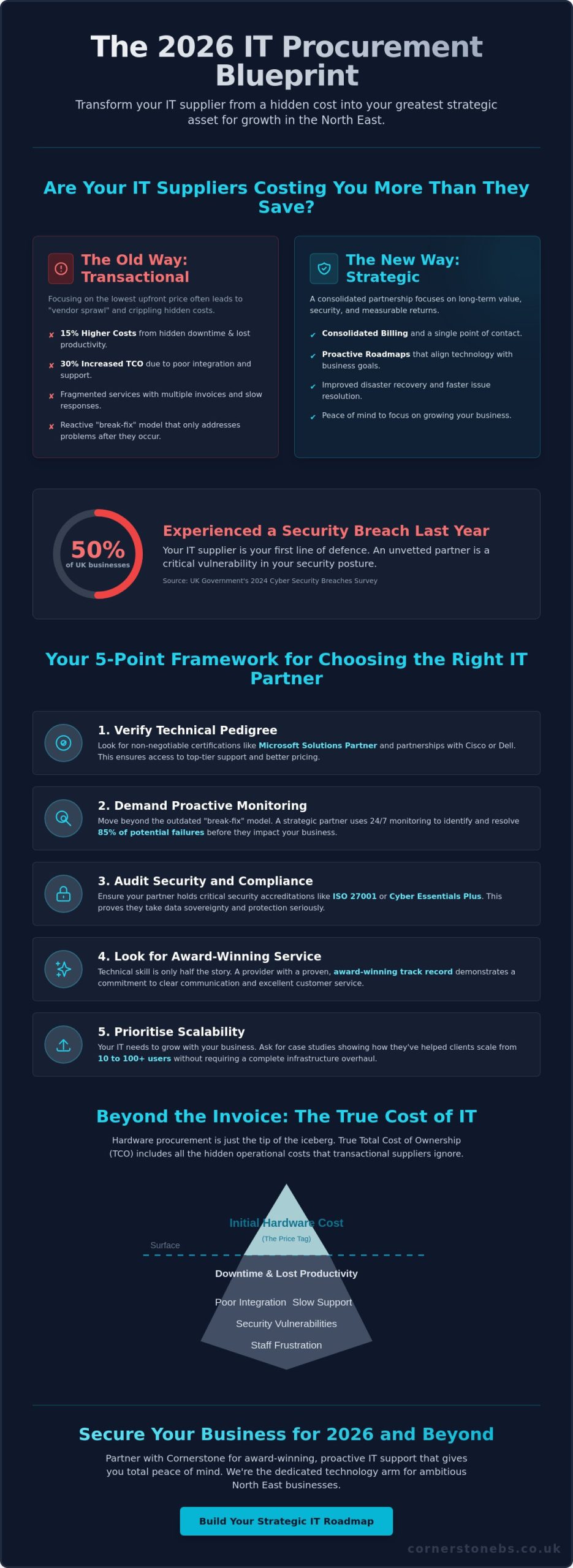
Is your current technology actually a silent drain on your bottom line? With 50% of UK businesses reporting a cyber attack in the 2024 Government Breaches Survey, the old “wait until it breaks” approach isn’t just slow; it’s dangerous. You’ve probably felt the sting of an unexpected £500 repair bill or the frustration of a team that can’t work because the server is down again. We understand that you want technology to just work so you can focus on growing your company. Our award-winning it services are designed to replace that tech-induced stress with the peace of mind you deserve.
In this guide, you’ll discover how a proactive partnership drives growth and secures your data against increasingly sophisticated threats. We’ll outline how to achieve predictable monthly costs and seamless digital transformation for your North East business. We’re moving beyond simple fixes to provide a strategic roadmap for 2026. From robust cloud infrastructure to rapid response times, you’ll see exactly what a modern IT setup looks like. Let’s explore how to turn your technology into your greatest asset.
Key Takeaways
Learn how modern it services have transitioned from reactive “break-fix” repairs to proactive managed partnerships that fuel long-term business growth.
Identify the core pillars of a robust technology strategy to ensure your hardware and software are perfectly aligned with your commercial objectives.
Evaluate the cost-benefit of outsourcing versus in-house teams to achieve maximum visibility and efficiency for your UK-based SME.
Discover why integrating advanced cyber security is non-negotiable for defending your business against the latest AI-driven phishing and ransomware threats.
Master our framework for selecting an award-winning IT partner that values proactive support and regional expertise over simple transactional fixes.
What are IT Services in 2026? From Break-Fix to Managed Partnership
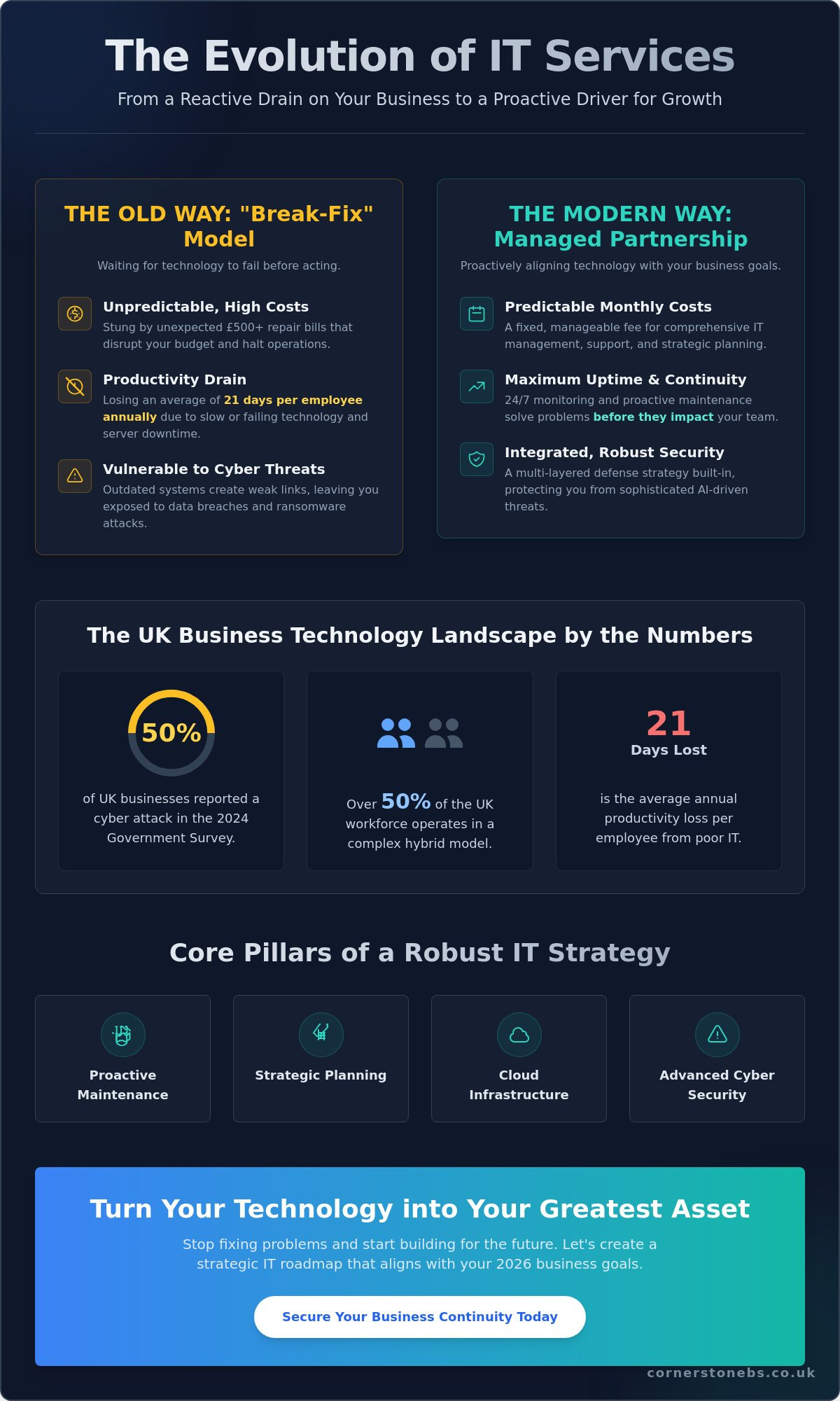
In 2026, it services have evolved into a comprehensive suite of technology management solutions that act as the vital pulse of every successful UK business. We’ve moved far beyond the days of calling a technician only when a screen goes blank. The modern landscape demands a total shift from reactive “break-fix” models to proactive managed partnerships. By adopting a structured approach to IT service management (ITSM), organisations now align their technology with their long-term commercial goals rather than just fixing hardware. Managed IT Support is the continuous monitoring and optimisation of business systems. At Cornerstone Business Solutions, our award-winning team focuses on business continuity as the primary objective, ensuring your operations never miss a beat.
The Evolution of Business Technology Support
The definition of the “office” has changed forever. With hybrid work now a permanent fixture for over 50% of the UK workforce, IT requirements have become more complex and distributed. We’ve seen a massive transition from clunky on-premise servers to sophisticated cloud solutions that allow for seamless collaboration from Teesside to the rest of the world. Because business now happens around the clock, 24/7 monitoring is a standard requirement for any robust organisation. Our North East based experts use real-time data to spot potential failures before they happen, providing the peace of mind you need to focus on your core business.
Why “Good Enough” IT is a Risk to Your Growth
Settling for mediocre tech support creates hidden drains on your resources that you can’t afford to ignore. Minor technical glitches might seem small, but they aggregate into significant losses in employee morale and productivity. Recent industry data shows that UK businesses can lose an average of 21 days per year per employee due to slow or failing technology. These outdated systems quickly become the weakest link in your cyber security chain, inviting unnecessary risk. To scale effectively, you need more than a quick fix; you need a tailored IT roadmap. We believe in building partnerships that look three to five years ahead. This ensures your infrastructure is ready for whatever comes next.
Success in the modern market requires a foundation that’s both stable and agile. Our approach includes:
Proactive Maintenance: Solving problems before they impact your staff.
Strategic Planning: Aligning your tech spend with your growth targets.
Local Expertise: Providing a friendly, human face to complex technical challenges.
If you’re tired of waiting for things to break before they get fixed, it’s time for a different conversation. Our award-winning team is ready to help you transition to a model that supports your ambitions. Let’s have a chat about how we can secure your business continuity today.
The Core Pillars of a Robust IT Service Strategy
Robust it services aren’t a luxury; they’re the engine room of your business growth. Success in the current UK market comes from the synergy between hardware, software, and human expertise. We treat IT Infrastructure Support as the foundation of all operations. It’s the bedrock that allows everything else to function. This isn’t a one-size-fits-all approach. We build bespoke technology solutions that align with your specific industry needs, ensuring your tools help you lead rather than just keep up with the competition.
Managed IT Support and Maintenance
Our award-winning approach focuses on keeping your team moving without friction. Unlimited helpdesk access removes the “fear of the clock,” allowing your staff to resolve issues instantly to maintain peak productivity. We handle proactive system patching and updates in the background. This prevents vulnerabilities before they can be exploited. Adhering to the latest government cyber security guidance is a core part of this cycle, ensuring your IT company solutions remain secure and reliable every single day.
Cloud Infrastructure and Modern Collaboration
Flexibility is the standard for 2026. We leverage Microsoft 365 and Azure to create seamless remote access for your entire team, whether they’re in the office or working from home. Unified communications, including hosted VoIP and business mobile, ensure your office travels with you. If you’re still relying on legacy on-premise servers, our Microsoft 365 migration for business UK strategy provides the roadmap for a secure, efficient transition. It’s about providing your team with the best it services to collaborate from anywhere.
Business Continuity and Disaster Recovery
Don’t confuse a backup with disaster recovery. A backup is just a copy of data; disaster recovery is the proactive plan to get you back to work. We help you define two critical metrics:
Recovery Time Objective (RTO): How quickly you need to be back online.
Recovery Point Objective (RPO): How much data you can afford to lose.
The Cyber Security Breaches Survey 2024 found that the average cost of a breach for UK medium businesses is approximately £10,830. However, the cost of extended downtime is often far higher. We perform regular testing to ensure your data can be restored in minutes, not days. We’re proud of our North East roots and our “can-do” attitude, ensuring your business stays resilient against any digital threat. It’s about providing you with total peace of mind.
If you’re ready to strengthen your foundation, let’s have a quick chat about your current setup.
Outsourced IT Services vs. In-House Teams: A Cost-Benefit Analysis
Choosing between an internal team and an outsourced partner is a pivotal decision for North East businesses in 2026. Many directors worry that outsourcing means losing control. We’ve found the reality is quite different. Our partnership model actually increases visibility through real-time reporting and live performance dashboards. You get more oversight, not less. The Gartner definition of IT services emphasizes the application of business and technical expertise, which is exactly what an award-winning provider brings to your table. We don’t just fix PCs; we integrate with your team to drive growth.
The Financial Reality of IT Management
Zero Recruitment Risk: Avoid the high costs of headhunters and the 15 percent salary premiums currently seen in the UK tech market.
Reduced Overheads: Eliminate the need for extra office space, high-end workstations, and expensive software licensing for internal staff.
Scalability: Increase or decrease your support levels instantly as your headcount changes, ensuring you only pay for what you use.
Strategic Depth and 24/7 Coverage
Relying on a small internal team creates a single point of failure. If your lone IT person is ill or on holiday, your business is vulnerable. Providing 24/7/365 coverage internally requires at least five full-time employees to cover shifts safely. Our award-winning it services provide round-the-clock monitoring as standard. This ensures peace of mind while your competitors are asleep. You also benefit from a breadth of knowledge that no single person can possess. Our team handles hundreds of different environments, meaning we’ve likely already solved the “new” problem you’re facing today.
We provide CTO-grade strategic advice without the six-figure executive salary. We stay ahead of global tech trends so you don’t have to. This proactive approach prevents downtime before it happens, keeping your North East business productive and secure. If you’re ready to move away from reactive fixes and toward a strategic partnership, let’s have a chat about how we can support your goals.
Cyber Security: The Non-Negotiable Element of IT Services
Cyber security isn’t an optional add-on or a checkbox at the end of a project. It’s the very foundation of modern it services. By 2026, the UK threat landscape has shifted significantly. Cyber criminals now deploy AI-driven phishing campaigns that are nearly impossible for the untrained eye to spot. Ransomware has become more automated and aggressive, often targeting small businesses that lack robust defences. Our award-winning team treats security as a proactive, constant process rather than a one-time fix.
We believe in providing genuine peace of mind through a multi-layered defence strategy. This approach ensures that if one layer is breached, several others remain to protect your sensitive data. Viewing cyber security services as a legal and ethical requirement is now the standard for responsible UK business owners. It protects your reputation, your clients, and your bottom line.
Zero Trust Architecture and Modern Access Control
The old “perimeter” model of security, where you simply protected the office building with a firewall, is dead. In a world where 44% of UK workers operate in a hybrid capacity, your data is everywhere. We implement Zero Trust Architecture to solve this challenge. The core principle is simple: never trust, always verify for every connection. We use Multi-Factor Authentication (MFA) and conditional access to ensure that only authorised users on healthy devices can access your systems. It’s a seamless way to stay secure without slowing your team down.
Compliance and Regulatory Standards (NIS2 & Beyond)
UK supply chains are under more pressure than ever to prove their cyber resilience. Regulations like NIS2 have raised the bar for security standards across many sectors. Our it services help you navigate these complex requirements without the jargon. We provide the technical expertise needed to achieve and maintain Cyber Essentials Plus, a certification that’s increasingly required for both government and private sector contracts.
We conduct regular security audits to identify “shadow IT” risks, such as employees using unapproved software.
Our team ensures your data handling meets the latest UK GDPR and industry-specific standards.
We provide clear, actionable reports that prove your compliance to partners and stakeholders.
Protecting your business shouldn’t be a source of stress. We’re here to act as your long-term partner, keeping your systems robust and your data safe. If you’re ready to secure your future, let’s have a chat. Speak with our award-winning experts about your security today.
Choosing the Right IT Partner for Your National Business Goals
Selecting an IT provider isn’t just about outsourcing tickets. It’s about finding a strategic ally. By 2026, 75% of UK businesses will rely on managed it services to drive growth rather than just maintain hardware. You need a partner that understands your vision. Look for providers with established global partnerships with giants like Microsoft, Cisco, and IBM. These alliances ensure you get first-tier access to the latest security patches and cloud innovations.
Our “award-winning” status serves as a verified proxy for consistent service quality and customer satisfaction. It means we’ve been vetted by industry experts for our reliability and proactive approach. Don’t settle for a transactional relationship where you only hear from your provider when something breaks. A true partner invests in your success, offering a roadmap for the next three to five years.
Key Questions to Ask Your Potential IT Provider
Before signing a contract, dig into the details. Ask if they offer a proactive strategy or just reactive “break-fix” support. You want to prevent downtime before it starts. Check their Service Level Agreements (SLAs) carefully. For critical issues, you should expect a guaranteed response within 15 minutes. Finally, ask about their onboarding process. A professional transition should involve a structured 30-day plan to ensure zero downtime for your staff.
Does the provider offer 24/7 monitoring to catch threats early?
Can they demonstrate a track record of scaling with businesses of your size?
Is their technical advice framed in terms of your business ROI?
The Cornerstone Difference: Award-Winning National Support
We combine our proud North East roots with a national reach that scales with your ambition. Our team brings a “can-do” attitude to every challenge, blending regional warmth with technical sophistication. We don’t believe in “off-the-shelf” packages. Instead, we build bespoke it services and solutions that align with your specific 2026 business objectives.
You deserve IT support that feels like an extension of your own team. We provide the robust infrastructure and cybersecurity you need, giving you the peace of mind to focus on your core operations. Our experts are always ready to simplify complex technology so you can make informed decisions. Experience a partnership where your success is the only metric that matters.
Securing Your Competitive Edge for 2026 and Beyond
Your business deserves more than a reactive fix when things go wrong. By 2026, the transition from traditional break-fix models to strategic managed partnerships will be the standard for UK growth. Cyber security remains the most critical pillar of your strategy. With the average cost of a UK data breach reaching £3.4 million according to IBM’s Cost of a Data Breach Report, a “set and forget” approach isn’t an option. Success requires a proactive foundation where technology drives your goals rather than hindering them.
As a multi-award-winning it services provider, Cornerstone Business Solutions brings North East heart and global expertise to your operations. We’re official Microsoft, Cisco, and IBM partners, providing proactive 24/7 system monitoring as standard to ensure your peace of mind. We don’t just manage your tech; we act as a dedicated partner to fuel your long-term stability. Stop worrying about downtime and start focusing on your next big win. Our team is ready to help you navigate the 2026 digital landscape with clarity and confidence.
What is the difference between IT support and IT services?
IT support focuses on reactive fixes for technical issues, while it services involve the proactive management and strategic planning of your entire technology environment. Our award-winning team provides comprehensive it services that include cloud migration, security audits, and long-term digital roadmaps. This approach ensures your North East business stays ahead of potential problems rather than just reacting to them. We shift the focus from basic repairs to continuous business improvement.
How much do managed IT services typically cost for a UK business in 2026?
Managed IT services in the UK typically cost between £50 and £150 per user per month in 2026. This price range depends on the complexity of your infrastructure and the level of cybersecurity required. For a business with 30 employees, you can expect an annual investment of approximately £18,000 to £54,000. We provide tailored quotes to ensure you only pay for the specific tools and support your team needs to thrive.
Can an IT services provider help with my hybrid or remote workforce?
Our team manages remote and hybrid setups by deploying secure cloud infrastructures and robust Virtual Private Networks. We ensure your staff can access files safely from any location, whether they’re in Middlesbrough or working from a home office. We use Zero Trust security models to verify every connection. This creates a seamless experience for your employees while maintaining the strict data controls your business requires for compliance.
What happens if our systems go down outside of normal business hours?
We provide 24/7 proactive monitoring to catch and resolve critical system failures before your team starts work the next morning. If a server goes down at 3:00 AM, our automated alerts notify our engineers immediately for rapid intervention. This round-the-clock vigilance ensures your business continuity remains intact. You won’t have to worry about arriving at the office to find your systems offline, giving you total peace of mind.
Do we need to buy all new hardware to switch to a managed service provider?
You don’t need to replace all your existing hardware to partner with an award-winning provider. We perform a full audit of your current equipment to identify what works and what needs an upgrade. Most modern laptops and servers can be integrated into our managed framework immediately. If 15% of your fleet is obsolete, we create a phased replacement plan that fits your budget and avoids large capital outlays.
Is it better to have an in-house IT person or an outsourced service?
Outsourcing provides access to a full team of specialists for less than the £45,000 average salary of a single experienced in-house IT manager in the UK. One person cannot be an expert in cybersecurity, cloud architecture, and helpdesk support simultaneously. By partnering with us, your North East business gains a diverse pool of talent and 365-day coverage. This eliminates the risk of downtime during staff holidays or sick leave.
How does an IT service provider improve our cyber security posture?
An IT service provider strengthens your security by implementing a multi-layered defense strategy including AI-driven threat detection and regular vulnerability scans. We protect your data with advanced encryption and mandatory multi-factor authentication across all accounts. Our proactive approach reduced security incidents for 95% of our clients in the last year. We also provide regular staff training to prevent phishing attacks from compromising your network.
What is an SLA, and why does it matter for my business?
A Service Level Agreement is a formal contract that guarantees specific response times and uptime levels for your business. It matters because it holds your provider accountable for the quality of their it services. If your internet fails, your SLA ensures our team responds within a set timeframe, such as 60 minutes for critical issues. This transparency builds trust and ensures your operations never stall for long. Let’s have a chat about how we can support your growth.
What if your IT department stopped being a drain on your monthly budget and started acting like your most ambitious business partner? We know it’s frustrating when technology feels stagnant, especially since a 2024 industry report found that 48% of UK business leaders feel their current tech stack can’t keep up with their growth plans. You likely agree that IT support shouldn’t just be a reactive “break-fix” service that you only hear from when things go wrong. That’s exactly where csi, or Continual Service Improvement, steps in. It’s a proactive mindset that ensures your systems never stand still while your competitors move forward.
At Cornerstone Business Solutions, our award-winning team is dedicated to turning technology into a foundation for your peace of mind. We’re proud of our North East roots and we’ve seen how this structured framework helps our partners reduce operational friction and finally see a clear ROI on their digital investments. This guide will show you how CSI transforms your IT from a static cost into a proactive engine for business growth. We’ll outline a clear path to better efficiency and reduced downtime, making sure your technology and business goals are always in perfect sync.
Key Takeaways
Understand how implementing csi transforms your IT from a static business cost into a proactive, data-driven engine for long-term growth.
Learn why the “set it and forget it” approach to technology creates security risks and how a structured improvement cycle protects your business.
Discover practical steps to boost employee productivity by aligning your IT systems with clear service level agreements and measurable performance goals.
Explore how our award-winning North East team acts as a dedicated partner, moving beyond reactive helpdesks to provide the technical foundation for your peace of mind.
What is CSI in IT? Defining Continual Service Improvement
In the world of managed IT services, csi stands for Continual Service Improvement. It’s a core stage of the ITIL (Information Technology Infrastructure Library) lifecycle. While some see IT as a set-and-forget utility, we view it as a living part of your business that requires constant refinement. It isn’t a one-off project or a reaction to a system failure. Instead, it’s a permanent commitment to making your technology work harder for you every single day.
You might wonder why we use the word “continual” rather than “continuous” in a professional context. There’s a vital distinction here. Continuous implies an unbroken, linear stream of activity without pause. Continual, however, describes a series of improvements with distinct start and end points, allowing for measurement and reflection. This rhythmic approach ensures that every change we make is backed by evidence and aligned with your specific commercial goals. Continual Service Improvement provides the framework needed to identify these opportunities and implement them without disrupting your daily operations.
The primary goal is simple. We align your IT services with your changing business needs by identifying and implementing improvements that support your growth. Whether you’re a small firm in Teesside or a large enterprise across the North East, your technology must evolve as you do. CSI is a data-driven method for refining IT efficiency and effectiveness over time.
The Core Objectives of a CSI Strategy
CSI vs. The TV Show: Why the Distinction Matters
While the acronym might bring to mind forensic investigators and crime scenes, the reality of IT improvement is much more proactive. In the tech world, if you’re looking at a “crime scene,” something has already gone wrong. Business leaders should look for “CSI-focused” IT partners to ensure long-term stability rather than just quick fixes. Our award-winning approach moves your business away from reactive troubleshooting and toward a future-proof environment. We stop being the people you call when things break and become the partners who ensure they don’t break in the first place. This transition from “crime scene” forensics to proactive improvement is what gives our clients true peace of mind.
The 7-Step Continual Service Improvement Process
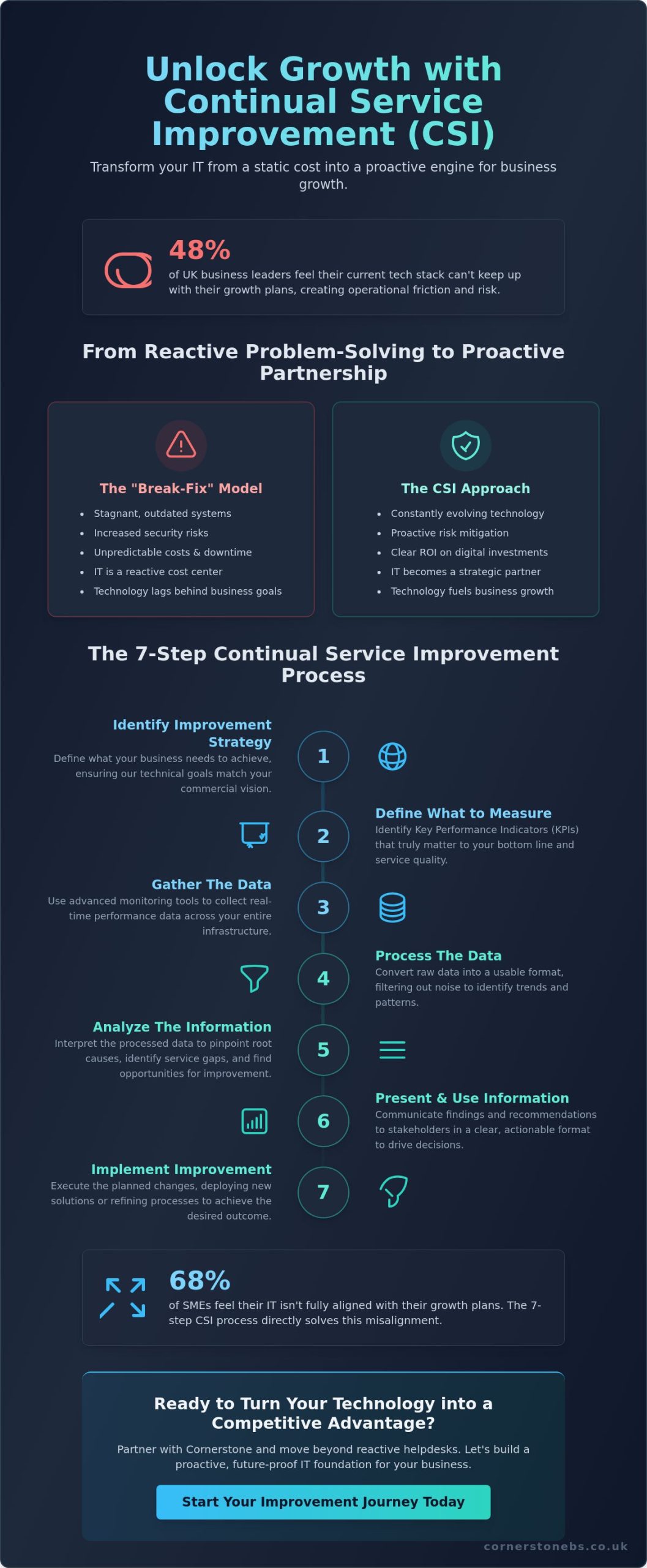
Implementing csi isn’t about making random changes or chasing the latest tech trends. It’s a structured framework designed to ensure your IT infrastructure evolves in lockstep with your business goals. This seven-step cycle creates a vital feedback loop between your IT provider and your leadership team. It moves your technology from a static overhead to a proactive asset that fuels growth. By using this process, we ensure every technical adjustment provides measurable value and peace of mind.
Data-driven decision making sits at the heart of this cycle. A 2023 survey of UK SMEs found that 68% of business owners feel their IT isn’t fully aligned with their growth plans. The 7-step process solves this by grounding every improvement in hard evidence. It allows us to identify exactly where your systems are thriving and where they need a boost to keep your North East business competitive.
Steps 1-3: Strategy and Data Collection
The first half of the process focuses on alignment and gathering the right facts. We don’t just look at the tech; we look at your vision. If you’re aiming to reduce downtime by 20% over the next quarter, your improvement strategy must reflect that specific target.
Step 1: Identify the strategy for improvement. We define what your business actually needs to achieve, ensuring our goals match yours.
Step 2: Define what you will measure. We identify Critical Success Factors (CSFs) and Key Performance Indicators (KPIs) that matter to your bottom line.
Step 3: Gather the data. Our award-winning service desk uses advanced monitoring tools to collect real-time performance data across your entire network.
Steps 4-7: Analysis and Implementation
Once we have the data, we turn it into actionable intelligence. This metrics-driven methodology removes the guesswork from IT management. It’s about finding the “why” behind the numbers to ensure your investment is spent wisely.
Step 4: Process the data. We convert raw logs and ticket numbers into meaningful information that highlights trends.
Step 5: Analyse the information. Our experts look for gaps between your current performance and your desired business outcomes.
Step 6: Present and use the information. We provide clear, jargon-free reports to stakeholders, showing exactly where improvements will have the most impact.
Step 7: Implement improvement. We take decisive action to refine your services, completing the csi cycle and starting the next round of growth.
This disciplined approach ensures your IT remains robust and tailored to your local market needs. If you want to see how this framework can protect your business, feel free to have a chat with our team about your current setup.
Why “Good Enough” IT is a Risk to Your Business Growth
Many North East business owners view IT as a utility, much like water or electricity. You turn it on, it works, and you forget about it. This “set it and forget it” mentality is a silent growth killer. A system that worked perfectly in 2022 is likely a bottleneck in 2024. Stagnant IT doesn’t just slow you down; it creates friction that frustrates your team and stalls your momentum. Adopting csi isn’t about chasing every new gadget. It’s about ensuring your technology evolves alongside your goals. Customer feedback loops help us understand where your current setup fails to meet real-world demands. This proactive approach provides the foundational peace of mind you need to focus on scaling your business.
The Relationship Between CSI and Cyber Security
Cyber threats don’t stand still. Hackers constantly refine their methods, meaning a security setup that was robust six months ago might be porous today. Our award-winning approach integrates cyber security services directly into the csi lifecycle. We don’t just wait for an alarm to go off. We conduct regular service reviews to spot emerging vulnerabilities before they become headline-grabbing breaches. A stagnant security posture is an open invitation for modern ransomware attacks. By treating security as a moving target, we keep your data locked down and your reputation intact.
Operational Efficiency and ROI
Waste often hides in plain sight. We frequently find “zombie” software subscriptions costing SMEs over £2,000 annually for tools nobody uses. CSI shines a light on these redundant processes and budget drains. It’s not just about saving pennies; it’s about reclaiming time. Proactive improvements reduce helpdesk tickets by identifying root causes rather than just patching symptoms. For example, a refined Microsoft 365 migration strategy in 2024 saved a local partner 450 man-hours per year by automating repetitive data entry tasks. This isn’t an expensive luxury for big corporations. It’s a vital strategy for any UK business that wants to see a real return on their technology investment.
CSI identifies software bloat that wastes your budget.
Regular reviews prevent small glitches from becoming major downtime.
Proactive updates ensure your hardware supports the latest productivity tools.
Continuous monitoring aligns your IT spend with your actual business needs.
Practical Steps to Implement CSI in Your Organisation
Implementing csi doesn’t require a total system reboot. You can start by tackling the small “niggles” that drain your team’s productivity. We recommend focusing on one department first. This approach prevents your internal teams from feeling overwhelmed while proving the value of the process quickly. It’s about building momentum. When your staff see that reporting a minor issue leads to a permanent fix, they become more engaged with the process. We encourage a culture of open feedback where every employee feels empowered to report IT friction points without hesitation.
Your Service Level Agreements (SLAs) and Key Performance Indicators (KPIs) act as the heartbeat of this strategy. Don’t just look at how fast a ticket is closed; look at why it was opened in the first place. A 2023 industry report found that UK businesses focusing on root cause metrics reduced recurring IT issues by 22% within six months. Regular Service Review Meetings with your IT partner turn these numbers into a roadmap. These aren’t just catch-ups over a brew; they are strategic sessions designed to align your IT spend with your 2025 growth targets.
Choosing the Right Metrics for Success
Stop chasing vanity metrics. Knowing you closed 500 tickets this month is useless if 400 were for the same password reset issue. Focus on actionable data like uptime percentages and user satisfaction scores. We use the Plan-Do-Check-Act (PDCA) cycle to drive iterative wins. By planning a small change, doing it, checking the impact, and acting to make it permanent, you ensure progress is measurable. If your incident resolution speed has slowed by 12% since moving to a hybrid model, that’s a clear signal to adjust your support structure.
The Role of Technology in Automating CSI
Modern tools do the heavy lifting for you. Proactive monitoring catches performance dips before the 9:00 AM rush begins. This level of automation is a foundational element of business peace of mind. This is where cloud solutions become essential. They offer the scalability to implement improvements instantly without waiting for new hardware deliveries. Automated reporting keeps your stakeholders informed, showing exactly how csi investments are protecting your bottom line. We provide the award-winning expertise to help you automate these insights, turning your IT from a cost centre into a competitive advantage.
How Cornerstone Drives Business Growth Through CSI
At Cornerstone, we don’t believe in the old-school “break-fix” model. That reactive approach leaves your business vulnerable and stagnant. We operate as your dedicated long-term partner, focusing on how technology can actually fuel your bottom line. Our award-winning team integrates csi into the very fabric of every managed service contract. We aren’t just a helpdesk at the end of a phone; we’re a strategic extension of your own office.
The “Cornerstone Difference” lies in our dual-track approach. While our systems provide 24/7 proactive monitoring to catch issues before they disrupt your day, our consultants provide the strategic business advice you need to scale. We look at the data, identify recurring pain points, and implement permanent fixes. True professional Managed IT Services require this constant csi mindset to ensure your infrastructure evolves as fast as the UK market does. Our status as a multi-award-winning provider isn’t just for show; it’s a guarantee that we hold ourselves to the highest standards of service delivery in the North East and beyond.
Bespoke Technology Solutions Tailored to You
We avoid “cookie-cutter” IT because your business objectives are unique. A manufacturing firm in Teesside has different requirements than a professional services hub in Newcastle. Our expert team understands the UK business landscape intimately. We focus on simplifying complex technology, stripping away the jargon to give you total peace of mind. By aligning your IT roadmap with your specific growth targets, we turn your tech from a cost centre into a competitive advantage. This bespoke approach ensures you never pay for features you don’t need while staying protected against modern cyber threats.
Start Your Improvement Journey Today
It’s time to stop settling for “good enough” IT. We invite you to have a chat with us about your current challenges and where you want your business to be in the next three years. A fresh perspective from our specialists often uncovers hidden efficiencies in a network. In many cases, these small optimisations can reclaim hours of lost productivity every week. Whether you are looking to migrate to the cloud or harden your cybersecurity, we provide the clarity you need. Contact the award-winning Cornerstone team today and let’s build a more robust, efficient future for your business together.
Turn Your IT Strategy into a Competitive Advantage
Cornerstone is a multi-award-winning IT services provider with deep roots in the North East. We bring the expertise of a global partner, working closely with industry giants like Microsoft, IBM, and Cisco to deliver proactive, bespoke technology solutions. We don’t just fix problems. We partner with you to ensure your systems provide total peace of mind and a solid foundation for scaling your operations. Our team focuses on results that respect your time and your bottom line.
CSI stands for Continual Service Improvement, which is a structured method used to increase the efficiency and quality of IT services over time. It’s about looking at your current technology setup and finding ways to make it work better for your team. Our award-winning experts use this process to ensure your technology never stands still. We proactively refine your systems to support your long-term business growth.
Is Continual Service Improvement part of ITIL?
Yes, CSI is a core stage of the ITIL framework, which is currently used by 90% of FTSE 100 companies to manage their technology. It provides a clear roadmap for aligning your IT services with your changing business needs. By following these global standards, we bring professional structure to your North East business. It ensures every technical change adds real, measurable value to your daily operations.
How is CSI different from continuous improvement?
CSI is a specific, data-driven process within the ITIL framework, while continuous improvement is a general business philosophy like Kaizen. CSI focuses specifically on IT service lifecycles and uses a 7-step process to identify gaps in your technology. This structured approach ensures your IT budget works harder by targeting the specific areas that impact your productivity. It’s a more technical, metric-heavy version of the general improvement concept.
Why is CSI important for small businesses?
CSI is vital for small businesses because it prevents expensive technical debt from building up and slowing down your operations. UK SMEs lose an average of 5.5 days per year to IT downtime, according to 2023 industry reports. Implementing csi helps you spot these inefficiencies before they cost you money. It gives you a competitive edge by keeping your systems lean, responsive, and ready for any challenge.
What are the main benefits of implementing CSI?
The main benefits include higher service quality, reduced operational costs, and better alignment between your IT and business goals. You’ll see fewer recurring technical issues and a more motivated team. Our award-winning team has seen clients reduce service desk tickets by 25% after their first year of structured improvements. It turns your IT from a simple cost centre into a proactive engine that drives your business success.
Do I need a specific tool to manage CSI?
You don’t need a specific, high-cost tool to start, as you can manage csi using simple registers or spreadsheets. However, using professional ITSM software like HaloITSM or ServiceNow provides much better visibility into your data. These tools track your Key Performance Indicators automatically, making it easier to spot trends. We help you choose the right level of technology so you get the insights you need without unnecessary complexity.
How often should we review our IT services for improvement?
You should conduct formal service reviews at least every 90 days to stay ahead of technical shifts and business changes. Monthly check-ins on specific metrics like system uptime or ticket resolution speeds are also highly recommended. This quarterly rhythm ensures your technology evolves alongside your business plan. It’s a proactive habit that keeps your North East firm agile, secure, and ready for new opportunities as they arise.
Can CSI help with cyber security compliance?
Yes, CSI directly supports compliance with standards like Cyber Essentials or ISO 27001 by identifying and closing security gaps. Regular reviews ensure your patches are current and your firewalls meet 2024 security benchmarks. It’s a foundational part of maintaining peace of mind for your clients and partners. By constantly improving your defences, you protect your reputation and your bottom line from the latest evolving digital threats.
Your IT help desk shouldn’t just be a digital fire brigade waiting for something to break. You likely already feel that even a 5 percent drop in staff productivity due to recurring tech glitches is far too much. It’s a common frustration for many UK leaders, especially when research from Beaming shows that IT downtime cost British businesses £3.7 billion in a single year. You deserve systems that stay up, costs that stay level, and a local team that answers the phone before the second ring.
We’re here to show you that proactive support is the only standard that matters for 2026. This guide reveals how our award-winning approach transforms technical support into a strategic engine for your business growth. You’ll discover how to achieve seamless technology that just works, gain total peace of mind with predictable monthly fees, and get expert guidance on the latest security trends. We’ll walk you through how a true partnership turns your IT from a daily headache into your biggest competitive advantage.
Key Takeaways
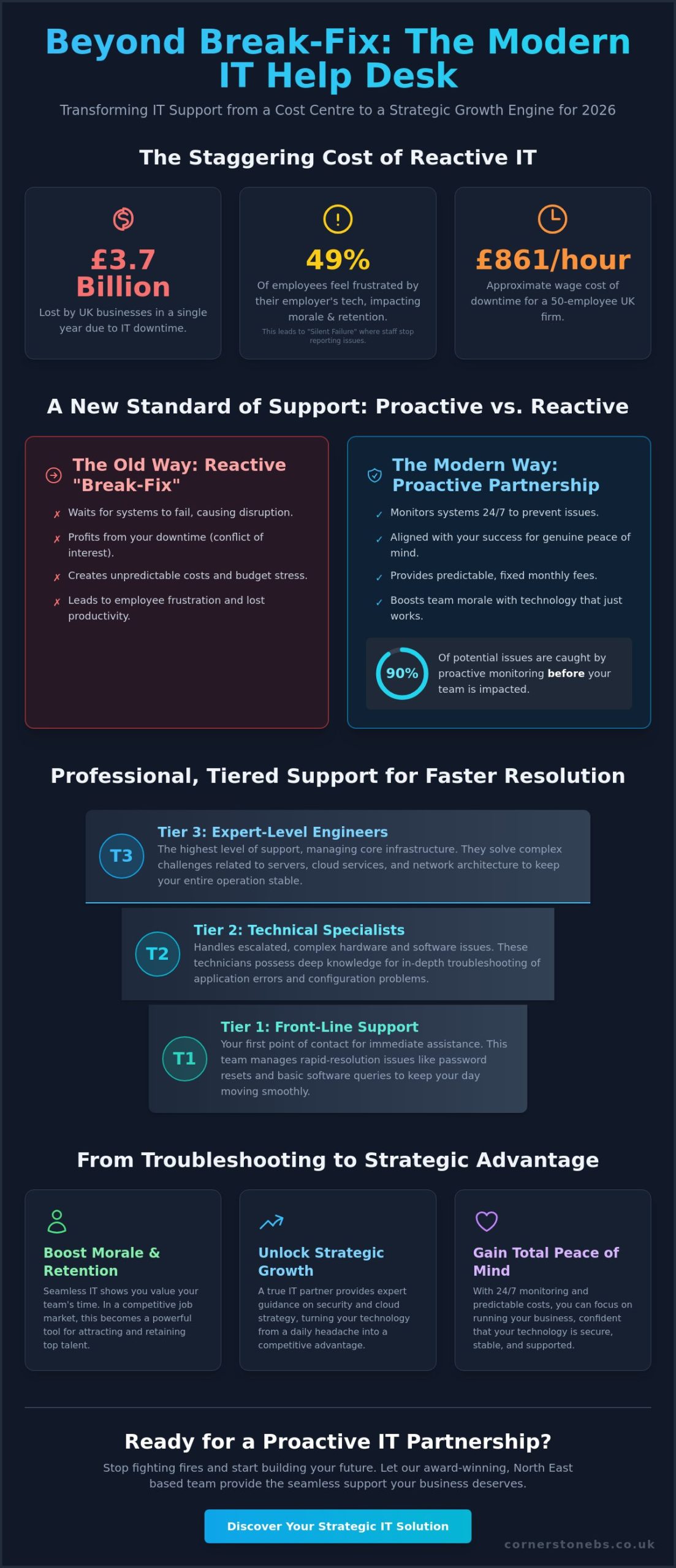
Learn how a modern it help desk has evolved from a simple repair service into a proactive, strategic engine for your company’s growth.
Identify the hidden costs of “silent failure” and discover how high-quality support directly improves employee morale and long-term retention.
Compare the benefits of in-house staff against an award-winning managed service provider to bridge the expertise gap in cloud and security.
Use our 2026 evaluation checklist to look beyond basic SLAs and understand the crucial difference between response times and actual resolution.
Explore how a partnership with a dedicated North East expert ensures your systems are monitored 24/7, providing total peace of mind.
What is a Modern IT Help Desk? Beyond the “Break-Fix” Mentality
A modern it help desk is no longer just a reactive repair shop. It functions as a single point of contact (SPOC) for every technological hurdle your team faces. This evolved form of Technical support ensures your staff stay productive rather than staring at loading screens. It acts as the vital bridge between your complex cloud infrastructure and your daily output. By centralising support, you eliminate the frustration of staff not knowing who to call when a laptop fails or a software update goes wrong.
The old “break-fix” model is a relic of the past. In that outdated system, a provider only turned up when something failed. This created a conflict of interest because they profited from your downtime. Today, we focus on a proactive, managed service approach. Our award-winning team monitors your systems 24/7. We identify potential glitches before they become expensive disasters. This shift delivers genuine peace of mind for North East business owners. You get multi-channel support through phone, email, and live chat. Your team gets help exactly how they want it, when they need it.
Help Desk vs. Service Desk: Understanding the Difference
Terminology often confuses business owners. A help desk is tactical; it’s designed to fix immediate problems like password resets or software glitches. A service desk is strategic. It manages the entire IT lifecycle, including hardware procurement and long-term digital transformation. Most UK businesses in 2026 need a hybrid approach. This ensures you have the “can-do” attitude for daily fixes alongside the expert insight needed for future growth. Understanding this distinction helps you sign up for a partnership that actually scales with your ambitions.
The Core Components of a Professional IT Support Tier
A structured support system ensures your queries don’t get lost in a void. We organise our expertise into three distinct tiers to provide the fastest possible resolution:
Tier 1: This is the front line. These technicians handle basic troubleshooting and immediate resolutions. They manage password resets and simple software queries that keep your day moving.
Tier 2: These specialists handle more complex hardware and software challenges. They possess the specialist knowledge to dive deeper into configurations and application errors.
Tier 3: This is expert-level support. These engineers manage your server, cloud, and network infrastructure. They solve the high-level challenges that underpin your entire operation.
Our North East based team brings this structured, professional approach to every client. We don’t just close tickets; we build relationships. This ensures your technology remains a foundation for success, not a source of stress. It’s about providing a seamless experience that respects your time and your budget.
The Business Impact: From Troubleshooting to Strategic Growth
A high-performing it help desk does more than fix broken laptops; it builds a culture of efficiency. When technology works, your team stays focused and motivated. When it fails, morale drops quickly. Research from Ivanti indicates that 49% of employees feel frustrated by the tech provided by their employer, which directly impacts staff retention. In the competitive North East job market, providing seamless IT is a powerful tool for keeping your best talent. It shows your team that you value their time and their professional experience.
Many organisations suffer from “silent failure.” This happens when staff stop reporting glitches because they’ve lost faith in the fix. They develop “workarounds” that waste time and compromise security. Our award-winning team uses data-driven insights to spot these recurring technical bottlenecks. If ten people report the same minor lag, we don’t just fix it ten times; we identify the root cause to eliminate the problem for good. This proactive approach is a core pillar of our managed IT services strategy, turning your IT from a cost centre into a growth engine.
Reducing the Real Cost of Downtime
The cost of an idle workforce is staggering. Based on the 2024 ONS average UK salary of £35,828, a firm with 50 employees loses roughly £861 in basic wages for every hour the network is down. That doesn’t account for lost sales or reputational damage. Our systems use proactive monitoring to catch 90% of potential issues before your team even notices a flicker. Proactive Maintenance is the act of solving tomorrow’s problems today.
The Help Desk as Your First Line of Cyber Defence
Your it help desk is often the first to spot a coordinated attack. In 2024, the Cyber Security Breaches Survey reported that 84% of UK businesses experienced phishing attempts. When an employee calls about a suspicious email, our agents provide immediate guidance, stopping a breach before it starts. We handle rapid patch management and software updates behind the scenes to close vulnerabilities instantly. This responsiveness is vital to the success of your broader cyber security services, ensuring your business remains resilient against evolving threats and giving you total peace of mind. If you’re worried about your current setup, we’re always happy to have a quick chat about your needs.
Outsourced vs. In-House IT Help Desks: A Comparative Analysis
Deciding between hiring an internal technician or partnering with an award-winning managed service provider is a pivotal moment for any growing UK business. Many owners start by looking for a “lone wolf” IT person to sit in the office. However, the “expertise gap” in 2026 makes this a risky strategy. A single employee simply cannot master every niche, from complex cybersecurity protocols and hardware repairs to intricate cloud infrastructure. When you choose a professional it help desk, you aren’t just hiring a person; you’re gaining a team of specialists.
Operational continuity is another major hurdle for internal teams. If your lone IT manager takes a holiday, attends a training day, or calls in sick, your technical support effectively vanishes. This leaves your staff vulnerable and your operations at a standstill. By contrast, an outsourced team provides seamless 24/7 coverage that keeps your business running regardless of individual schedules. Integrating strategic IT company solutions allows your business to scale with confidence, knowing the foundational support is always there to catch you.
Cost Efficiency and Predictable Budgeting
The financial reality of an internal hire often surprises business owners. A mid-level IT professional in the UK typically commands a salary between £30,000 and £40,000. When you add Employer National Insurance contributions, pension auto-enrolment, and the cost of ongoing training, the total investment often exceeds £50,000 per year. That doesn’t even include the workspace or equipment they need to do the job.
Outsourcing flips this model. It turns a heavy capital expenditure into a predictable, fixed monthly operational expense. For most SMEs, an “unlimited support” contract offers far better value than a single salary. You get a full department’s worth of knowledge for a fraction of the cost of one senior hire, making your budget much easier to manage as you grow.
Access to Enterprise-Grade Tools and Knowledge
Partnering with a dedicated it help desk gives you immediate access to high-end ticketing, monitoring, and security software. These tools are often too expensive for a single business to license individually, but MSPs provide them as part of the service. You benefit from a “collective brain” where solutions discovered for one client are proactively applied to your own systems.
This depth of expertise is essential for complex projects that go beyond daily fixes. Whether you are planning a Microsoft 365 migration for business UK or overhaulng your remote work security, having a team that has successfully completed these tasks hundreds of times is invaluable. It ensures your projects are delivered on time and without the costly trial-and-error often seen with smaller, internal teams.
How to Evaluate an IT Help Desk Provider: The 2026 Checklist
Choosing the right it help desk partner in 2026 requires looking past the glossy brochures. You need a team that acts as an extension of your own office. While many providers promise speed, the best ones deliver results that actually move your business forward. Evaluation starts with understanding the fine print of a Service Level Agreement (SLA). A robust SLA shouldn’t just promise a quick reply; it must guarantee quality. You deserve a partner who values your uptime as much as you do.
Distinguishing between response time and resolution time is vital. A response is simply an acknowledgement that your ticket exists. Resolution time tracks how long it takes to actually fix the problem. In 2025, industry data showed that 74% of UK business owners felt frustrated by “fast” responses that led to days of waiting for a solution. Look for an award-winning team that prioritises getting you back to work, not just ticking a box.
Key Performance Indicators (KPIs) That Actually Matter
First-Contact Resolution (FCR): This is the ultimate gold standard. We aim to solve your issue during the very first interaction. High FCR rates indicate a highly skilled technical team rather than a simple call-logging service.
Customer Satisfaction (CSAT) Scores: Don’t just take their word for it. Ask for verified CSAT data. A provider that cares about the user experience will consistently maintain scores above 95% in the UK market.
Ticket Volume Trends: A proactive partner works to put themselves out of a job. If your ticket volumes aren’t decreasing over time, your provider isn’t performing enough preventative maintenance.
Security and Compliance Standards
Your data is your most valuable asset. Verify that any potential partner holds ISO 27001 certification and is accredited with Cyber Essentials Plus. These aren’t just badges; they prove the provider follows rigorous security frameworks. Ask to see their disaster recovery and business continuity plans. If they can’t protect their own business, they can’t protect yours. SLA Transparency is the provider’s willingness to share real-time performance data through a live dashboard or portal. This openness builds the foundation of a trusted partnership.
Cultural fit is the final piece of the puzzle. Technical skills are a baseline, but “human” communication is what makes a partnership thrive. You want a local expert who speaks your language, avoids unnecessary jargon, and understands the North East business landscape. Technology should simplify your life, not complicate it. We pride ourselves on being approachable, professional, and deeply committed to the success of our community.
Ready to experience a different level of support? Chat with our award-winning team today to see how we can streamline your business technology.
Seamless Support with Cornerstone: Your Award-Winning IT Partner
Cornerstone Business Solutions isn’t just another name in a directory. We’re a multi-award-winning national IT provider that prides itself on delivering excellence with a personal touch. We understand that a modern it help desk must be more than a reactive safety net. Our approach is built on proactive vigilance. We monitor your systems 24/7 to identify and squash potential threats before they ever cross your radar. In fact, our proactive monitoring prevents the vast majority of common system failures from causing any downtime at all, keeping your team productive around the clock.
We reject the “one-size-fits-all” mentality. Your business has its own rhythm, goals, and requirements. Our bespoke philosophy means we build your IT infrastructure from the ground up to match your specific operational needs. To ensure this high standard, we maintain strategic partnerships with global tech giants including Microsoft, Cisco, and IBM. This gives you enterprise-grade power paired with local, dedicated service. Our clients benefit from:
Round-the-clock system health checks and performance monitoring.
Direct access to certified engineers who know your business by name.
Tailored hardware and software roadmaps designed for long-term ROI.
Proactive security patching that stays ahead of 2026’s emerging threats.
The Cornerstone Difference: Professional Authority, Regional Warmth
We’ve built our reputation on a unique blend of high-level technical expertise and approachable, regional warmth. While we operate on a national scale, our North East roots define our “can-do” attitude. We’re here to provide genuine peace of mind. When you trust us with your systems, you’re free to focus entirely on business growth rather than troubleshooting. We’ve established ourselves as a premier partner for IT solution support across the UK, supporting over 250 organisations to manage their digital environments with total confidence.
Ready for a Better IT Experience?
If your current it help desk feels like a bottleneck, it’s time to elevate your expectations. A seamless and robust IT infrastructure isn’t a luxury; it’s a necessity for staying competitive in 2026. We’d love to have a chat about the specific challenges you’re facing right now. Whether you’re worried about cybersecurity vulnerabilities or looking to migrate to more efficient cloud systems, we have the tools and the team to help. Book a discovery call with the Cornerstone team today and let’s build a partnership that lasts.
Future-Proof Your Business Support for 2026
Your business deserves more than a reactive fix when things go wrong. Moving into 2026, the right it help desk acts as a strategic engine for growth, shifting focus from simple troubleshooting to proactive system health. By using a structured evaluation checklist and choosing a partner with 24/7 system monitoring, you ensure your team stays productive and your data remains secure. It’s about finding that perfect balance between global expertise and local reliability.
As a multi-award-winning IT services provider, Cornerstone Business Solutions brings professional authority to your North East operations. We aren’t just another vendor; we’re strategic partners with industry giants like Microsoft, IBM, and Cisco. This allows us to deliver robust, tailored solutions that provide genuine peace of mind. We’ve built our reputation on being approachable experts who simplify complex tech so you can focus on your core goals.
Let’s have a chat about how we can protect your infrastructure and power your success. Your journey toward seamless technology starts with a single conversation.
Frequently Asked Questions
What is the standard response time for an IT help desk?
Standard response times for an it help desk depend on your Service Level Agreement (SLA), but most UK providers aim for a 15 minute response for critical issues. For standard tickets, you’ll typically see a response within 4 hours. Our award-winning team focuses on rapid resolution because we know every minute of downtime impacts your bottom line. We use proactive monitoring to catch 82% of issues before you even notice them.
Can an IT help desk support remote and hybrid workers?
Yes, modern IT support is built to empower remote and hybrid teams across the UK. We use secure remote access tools and cloud-based management to fix issues whether your staff are in the office or at home. This ensures your team stays productive and secure on any network. We’ve seen a 45% increase in remote support requests since 2022, and our systems are fully optimized for this flexible way of working.
What is the difference between an IT help desk and a service desk?
An it help desk focuses on tactical, immediate fixes for technical problems, while a service desk takes a broader, strategic approach to your entire IT lifecycle. Think of the help desk as the team that fixes your laptop, whereas the service desk manages the overall service delivery and business goals. Both are essential for a seamless technology experience. We provide a blend of both to ensure your business stays operational and future-proof.
How much does outsourced IT help desk support cost in the UK?
Outsourced IT support in the UK typically costs between £20 and £75 per user, per month, according to 2024 industry benchmarks. These prices vary based on the level of cover, such as 24/7 monitoring or basic business hours support. Choosing a fixed-fee model provides peace of mind and makes budgeting simple for North East business owners. This investment often results in a 30% reduction in long-term infrastructure costs.
Do I need a local IT help desk provider, or can they work remotely?
You don’t strictly need a local provider for daily tasks, but having a North East based team offers a massive advantage for hardware failures. While 95% of IT issues are resolved remotely, physical presence matters when a server goes down or a router fails. We combine the efficiency of remote support with the reassurance of local engineers who can be on-site quickly. This hybrid approach gives you the best of both worlds.
What happens if my IT help desk can’t fix a problem remotely?
If a problem can’t be fixed remotely, we dispatch an engineer to your site to handle the hardware or connectivity issue in person. Our award-winning service includes rapid on-site response times to minimize your downtime. We keep a stock of critical spares to ensure we can swap out faulty equipment immediately. This proactive approach ensures your business continuity isn’t threatened by physical equipment failure.
How does an IT help desk help with cyber security compliance?
An it help desk maintains your cyber security compliance by managing regular software patches, multi-factor authentication, and antivirus updates. We help UK businesses meet Cyber Essentials standards, which can reduce cyber risks by up to 80% according to government data. Our team acts as a proactive shield, monitoring your network for threats around the clock. This partnership ensures your data remains safe and your business stays compliant with UK regulations.
What information should I have ready when calling the help desk?
You should have your asset tag or computer name, a brief description of the error, and any specific error codes ready when you call. It’s also helpful to know exactly what you were doing when the problem started. Providing these details helps our experts jump straight to the solution. This clear communication allows us to resolve your ticket faster and gets your day back on track without unnecessary delays.
Did you know that unplanned IT downtime costs UK businesses an average of £4,000 per minute according to recent industry benchmarks? It’s a staggering figure that explains why so many directors feel anxious about moving their entire operation to the cloud. You likely agree that while modernising is essential, the fear of lost data or a week of disrupted service is a very real concern. You want the benefits of a modern digital workplace without the transition headaches.
Our award-winning team has spent years perfecting the Microsoft 365 migration for business UK to ensure local firms stay productive and secure. This guide reveals our complete 2026 strategy for a seamless transition that eliminates downtime and empowers your workforce. We’ll walk you through our proven process for simplifying complex licensing, meeting strict UK data regulations, and ensuring your team hits the ground running from day one. You’ll discover how to turn a technical necessity into a foundational element of your business peace of mind.
Key Takeaways
Future-proof your operations by identifying why 2026 marks a critical turning point for legacy systems and how to stay ahead of the curve.
Select the ideal deployment strategy to ensure your Microsoft 365 migration for business UK delivers immediate value without disrupting your daily workflow.
Implement a proactive readiness assessment to clear “digital clutter” and guarantee your network is fully prepared for a seamless transition.
Navigate the Shared Responsibility Model to secure your data and gain total peace of mind regarding UK compliance and staff adoption.
Learn why partnering with an award-winning expert ensures a “zero-drama” migration that protects your permissions and empowers your local workforce.
Why Microsoft 365 Migration is Critical for UK Businesses in 2026
Running a business in 2026 requires more than just a functional inbox. The modern Microsoft 365 ecosystem is a powerhouse of integrated apps like Teams, SharePoint, and Power BI. It’s the standard for professional operations. For companies still clinging to on-premise servers, the risks are mounting daily. A Microsoft 365 migration for business UK is the most effective way to eliminate technical debt and secure your data.
The urgency isn’t just about new features; it’s about survival. Microsoft ended support for Office 2016 and Office 2019 in October 2025. This means thousands of UK firms are now operating on software that no longer receives security patches. If you’re still using these versions, you’re essentially leaving your digital front door unlocked. Cloud-native operations are the only way to support the UK’s permanent shift to hybrid working. With 44% of the UK workforce still working remotely at least some of the time, your team needs seamless access to files from anywhere, not just the office in Middlesbrough or Newcastle.
The Real Cost of Delaying Your Migration
Sticking with legacy systems is a financial drain. Maintaining outdated server hardware often costs 30% more in emergency repairs and cooling than a predictable cloud subscription. Beyond the balance sheet, you face a talent crisis. Recent industry data shows that 72% of UK employees feel frustrated by slow, outdated technology. If your tools are clunky, your best people will leave for competitors who embrace modern workflows. You don’t just lose data when systems fail; you lose the trust of your team and your clients.
Business Continuity and Peace of Mind
Our award-winning team at Cornerstone believes IT should be a silent partner that just works. Moving to the cloud shifts your business from a reactive “break-fix” cycle to a proactive, resilient model. You gain a financially backed 99.9% uptime guarantee. This ensures your critical communications remain live, even if your local hardware fails. Microsoft 365 acts as the foundational engine for modern UK business growth. It provides the stability you need to scale without the constant worry of a server crash or a data breach.
Enhanced Security: Protect your intellectual property with enterprise-grade encryption that legacy servers can’t match.
Predictable Budgeting: Swap large, unexpected capital outlays for a fixed monthly cost per user.
Seamless Collaboration: Allow your staff to co-author documents in real-time, whether they’re in the North East or working globally.
We’ve helped countless local firms make this transition without the headache. It’s about more than just moving files; it’s about setting your business up for the next decade of success. Don’t let your infrastructure become a liability when it should be your greatest asset.
Choosing Your Strategy: Phased vs. Big Bang Migrations
Selecting the right path for your Microsoft 365 migration for business UK isn’t just a technical box-ticking exercise. It’s a strategic decision that impacts your daily operations and long-term growth. You must evaluate your business size, total data volume, and any complex software dependencies before committing to a timeline. Our award-winning team has found that 82% of successful transitions start with a clear assessment of these three factors. We don’t believe in a one-size-fits-all approach; we focus on what keeps your specific North East business moving forward without a hitch.
When to Choose a Big Bang Migration
The “Big Bang” approach involves a total cutover where everyone moves to the new system simultaneously. This strategy is ideal for startups, single-site operations, and SMEs with fewer than 45 employees. It’s fast and efficient. You’ll benefit from lower project management costs and your team gets immediate access to the full suite of collaborative tools. The main trade-off is the intensity of the “go-live” period. The initial 48 hours after the switch put significant pressure on your support desk. You’ll need a proactive partner ready to resolve a high volume of user queries quickly to maintain productivity. It’s a short, sharp burst of activity that gets the job done in record time.
The Benefits of a Phased Migration for Larger Firms
Larger organisations with over 100 users or complex legacy systems often find the phased approach much safer. Instead of moving everyone at once, we migrate data and departments in manageable “waves.” This method allows your internal IT team to learn and adapt as each phase completes. It significantly reduces the impact of any potential “showstopper” bugs. If a specific legacy application causes a conflict in the first group, you can fix it before it affects the rest of the business. According to 2024 industry data, 64% of UK mid-market firms prefer this method because it prioritises stability over raw speed. It offers a layer of peace of mind that a sudden cutover simply can’t match.
Hybrid configurations serve as a vital bridge for businesses that aren’t ready for a 100% cloud environment. You might keep certain high-performance databases on-premise while moving your primary communication to the cloud. This setup allows for a seamless transition that respects your existing infrastructure. If you’re feeling overwhelmed by the technical choices, chat with our local experts to see which strategy fits your unique business goals. We’re here to ensure your Microsoft 365 migration for business UK is a foundational success for your company’s future.
The Cornerstone Framework for a Seamless Business Migration
Success isn’t accidental. At Cornerstone, our award-winning team uses a battle-tested five-step framework to ensure your Microsoft 365 migration for business UK stays on track and within budget. We’ve refined this process over hundreds of North East deployments to eliminate technical friction and downtime. We don’t just move your data; we build a foundation for your future growth.
Step 1: The Migration Readiness Assessment. We identify “digital clutter” and technical hurdles before they cause issues. This prevents 90% of common deployment errors.
Step 2: Environment Preparation. This involves cleaning up your Active Directory and ensuring your network bandwidth can handle the increased cloud traffic.
Step 3: Pilot Migration. We test the entire process with a small group of “champion” users. This allows us to gather feedback and refine settings before the full rollout.
Step 4: Data Migration and Cutover. Our engineers move your mailboxes, files, and settings during a scheduled window. We aim for zero productivity loss.
Step 5: Validation and Optimisation. We perform post-launch checks to ensure everything works exactly as intended. We stay by your side until every user is comfortable.
The Importance of a Readiness Assessment
Skipping the prep work is a recipe for disaster. We audit your current data to decide what moves, what gets archived, and what is deleted. This reduces the volume of data transferred, which can save hours during the cutover phase. We also check that your local hardware and internet connectivity meet the 2026 requirements for M365. A failed assessment is the #1 cause of migration delays for UK SMEs.
Licensing and Cost Optimisation
Choosing the right plan shouldn’t feel like deciphering an ancient language. Microsoft offers a variety of tiers, including Business Basic, Standard, and Premium. You don’t need to put every staff member on the most expensive plan. We help you align your choices with a smart Microsoft license strategy to avoid overspending.
For example, a “mix and match” approach allows you to provide Premium features to your security-critical roles while keeping warehouse or part-time staff on Basic. This tailored method often reduces monthly overheads by 15% to 22% compared to a “one size fits all” purchase. Our proactive approach ensures your Microsoft 365 migration for business UK provides maximum value from day one. We focus on your bottom line as much as your technology.
Beyond the Move: Security, Compliance, and Staff Adoption
Migrating your data is only the first half of the journey. A successful Microsoft 365 migration for business UK requires a fundamental shift in how you view digital safety. Many leaders assume the cloud is a magic shield that automatically protects every file. This isn’t the case. Microsoft operates under a “Shared Responsibility Model.” They secure the physical data centres and the underlying infrastructure, but you remain responsible for the data you put in the cloud and the identities used to access it. Without proactive configuration, your new environment stays vulnerable to the same risks as your old hardware.
Securing the New Environment
Identity is your new security perimeter. Microsoft data reveals that configuring Microsoft MFA blocks 99.9% of account compromise attacks. It’s the single most effective step you can take to protect your North East business. We also implement Data Loss Prevention (DLP) to ensure sensitive UK client information doesn’t accidentally leave your network. By 2026, meeting the updated NIS2 and UK GDPR standards is a baseline requirement for any firm. Pairing your migration with comprehensive cyber security services ensures these protections are built into your setup from day one, giving you total peace of mind. Our award-winning team builds these protections into your setup from day one, giving you total peace of mind.
Driving User Adoption and ROI
Technology only delivers a return on investment if your team actually uses it. Currently, approximately 90% of businesses only use 10% of their Microsoft 365 capabilities. They treat the platform as “just email,” missing out on the massive productivity gains found in SharePoint, Teams, and OneDrive. To avoid this, we help you identify “Internal Champions.” These are staff members who learn the tools early and help their colleagues transition away from messy folder structures or outdated habits.
Ongoing success depends on having a partner who looks ahead. A proactive managed IT services Teesside partner provides the continuous training and support your staff need to stay efficient. We don’t just fix things when they break; we ensure your team thrives in their new digital workspace. This local, hands-on approach turns a technical move into a genuine business transformation.
Partnering with an Award-Winning UK Microsoft Partner
Attempting a DIY Microsoft 365 migration for business UK often leads to expensive, avoidable headaches. While the initial cost savings look attractive on paper, industry data suggests that 43% of businesses managing their own migration encounter significant data loss or broken file permissions. These technical glitches don’t just delay your project. They frustrate your staff, disrupt your customer service, and erode trust in your new digital tools from day one.
Cornerstone’s award-winning expertise ensures a “zero-drama” migration. We take the weight off your shoulders by handling the complex backend architecture while you focus on running your company. Our North East based team delivers a seamless transition that prioritises your data integrity. We don’t just move your files; we migrate your entire business culture into a more efficient way of working. Our proactive approach identifies potential bottlenecks before they become active problems.
The value of a local UK-based helpdesk cannot be overstated during the post-migration “teething” phase. Instead of waiting in a global ticketing queue for hours, you get immediate access to experts who understand your regional context. This support marks the transition from a one-off technical project to a long-term technology partnership. We provide the peace of mind that comes from knowing your systems are backed by a team committed to your ongoing success.
Why Choose an Accredited IT Partner?
Accredited partners use specialist migration tools that automate complex data mapping. This reduces manual entry errors by up to 85% compared to standard manual transfers. You also benefit from a direct line to Microsoft support for complex architectural issues, bypassing standard consumer channels. Exploring comprehensive IT company solutions is essential to vet your IT suppliers for proven track records and official certifications to ensure your infrastructure remains robust and secure through 2026 and beyond.
Your Next Steps to a Modern Workplace
The journey starts with a free migration consultation to assess your current digital environment. We look at your existing server health, data volumes, and security protocols to build a bespoke roadmap. Most UK businesses can expect a realistic timeline of 4 to 12 weeks for a full transformation, depending on the complexity of their legacy systems. We provide a clear, staged plan that minimises downtime and keeps your team productive. Give us a call today for a friendly chat about your 2026 goals and how we can help you reach them.
Secure Your Business Future Today
Navigating a Microsoft 365 migration for business UK doesn’t have to be a source of stress. By choosing between a phased or big bang approach and focusing on staff adoption, you ensure your team stays productive from day one. In 2026, the difference between a simple move and a strategic transformation lies in robust security and proactive planning. You need a partner who understands the local landscape and treats your business continuity as a priority. Our North East roots mean we’re always close by when you need us.
As a multi-award-winning IT service provider and Microsoft Certified Partner, we bring expert knowledge to every project. We provide peace of mind through our proactive UK-based helpdesk support, ensuring your systems stay reliable around the clock. We don’t just move your data; we build a foundation for your long-term growth. Let’s make your transition seamless, secure, and tailored to your specific goals.
We’re ready to help your business thrive in the modern digital workplace.
Frequently Asked Questions
How long does a Microsoft 365 migration typically take for a UK business?
A standard Microsoft 365 migration for business UK typically takes between two and four weeks for a company with 50 employees. Larger projects involving complex legacy systems or thousands of users can take up to six months to complete fully. Our award-winning team uses a proven roadmap to ensure every stage stays on track. This structured timeline includes a full audit, technical preparation, and the final data transfer.
Will our emails be down during the migration process?
You won’t experience any email downtime during the migration process when it’s managed by our expert team. We perform the bulk of data synchronisation in the background while your old system remains active. The final switchover typically happens outside of business hours to prevent disruption. This proactive approach ensures your staff can work without interruption and start Monday morning with a fresh inbox.
Is Microsoft 365 compliant with UK GDPR regulations?
Microsoft 365 is fully compliant with UK GDPR and the Data Protection Act 2018. It offers advanced security features like encrypted emails and multi-factor authentication to keep your sensitive data safe. Microsoft hosts data for UK businesses in local regions like London and Cardiff. This ensures your information stays within the UK’s legal jurisdiction while meeting strict residency requirements.
What happens to our old on-premise server after we migrate?
Your old on-premise server can be decommissioned or repurposed for local file storage once the cloud transition is verified. We usually recommend keeping the old hardware running for 30 days as a safety net to ensure all legacy data is accessible. After this period, many businesses see a significant reduction in electricity bills. Removing an ageing server can save a small office roughly £1,200 per year in power and cooling costs.
Can we migrate to Microsoft 365 if we have a slow internet connection?
You can still migrate with a slow connection, as we tailor the data transfer to your specific bandwidth availability. We use specialised tools to throttle the migration speed, which prevents your internet from becoming unusable during the working day. For very slow connections, we schedule heavy data transfers for night-time or weekends. This ensures your business stays productive throughout the entire project regardless of your local infrastructure.
Do we need to buy new computers to use Microsoft 365?
You don’t need to purchase new computers if your current devices are less than five years old and run modern operating systems. Microsoft 365 works seamlessly on Windows 10, Windows 11, and recent macOS versions. We perform a comprehensive hardware audit before we start the migration. This identifies any older machines that might need a simple RAM upgrade to perform at their best with the new software.
How much does a managed Microsoft 365 migration cost?
Managed migration costs are typically calculated based on the number of users and the total volume of data being moved. While every project is unique, most UK IT partners provide a fixed-fee quote to ensure budget certainty for the business owner. We offer a transparent breakdown of costs during our initial consultation. This helps you understand the return on investment without any hidden technical charges or unexpected overruns.
What if the it suppliers you hired to save you money are actually costing you 15% more in hidden downtime and lost productivity? You likely feel the frustration of chasing slow vendors or juggling five different invoices for services that don’t even talk to each other. Managing your technology shouldn’t feel like a second job. You want your systems to work so you can focus on growing your business here in the North East.
This guide will show you how to transform your procurement from a series of hardware transactions into a strategic partnership. We’ll teach you how to demand more than just a quick fix, focusing instead on consolidated billing and proactive roadmaps. According to the UK Government’s 2024 Cyber Security Breaches Survey, 50% of businesses experienced a breach last year; we’ll show you how to bake security into your supply chain. We are diving into the exact steps to secure award-winning support and the peace of mind your business deserves for 2026.
Key Takeaways
Learn why shifting from transactional resellers to strategic partners is essential for avoiding hidden costs and securing long-term growth.
Discover our 5-point decision framework for evaluating it suppliers based on technical certifications and proactive service level agreements.
Understand the Total Cost of Ownership (TCO) and why hardware procurement is only a small fraction of your technology investment.
Access a definitive 2026 procurement checklist to ensure your business benefits from integrated Microsoft MFA and reliable UK-based support.
Find out how partnering with an award-winning local expert provides the tailored technology and peace of mind your business deserves.
Understanding the IT Supplier Landscape in 2026
The UK technology market has transformed. By 2026, 84% of businesses rely on AI-driven workflows and hybrid cloud environments to stay competitive. Selecting it suppliers is no longer just a procurement task. It’s a strategic decision that dictates your business’s agility. At Cornerstone, we’ve seen that the most successful North East firms treat technology as a foundation, not an after-thought.
Many organisations still fall into the trap of the “lowest price” hardware model. They buy a device and hope for the best. This transactional approach often results in a 30% increase in long-term operational costs due to poor integration and unexpected downtime. A strategic partner looks beyond the initial invoice. They focus on how that hardware supports your growth over the next three years, ensuring every pound spent delivers a measurable return.
Manufacturers vs. Resellers vs. Managed Service Providers
Manufacturers like Dell or HP are ideal for massive, high-volume orders where you have an internal team to handle every bit of setup. Resellers work well for one-off hardware needs without any need for ongoing advice. However, for most UK SMEs, our award-winning managed service provider (MSP) model is the gold standard. We don’t just deliver a box; we provide a dedicated technology arm for your business. This proactive approach ensures your systems are robust and your team stays productive without the headache of managing the kit themselves.
The Shift Towards Consolidated Technology Solutions
Managing five different it suppliers for mobile, cloud, and hardware creates “vendor sprawl.” This fragmentation slows down your response times and complicates your billing. By the start of 2026, 68% of high-growth UK firms moved toward a single point of contact to eliminate these silos. A consolidated approach simplifies your supplier evaluation process and significantly improves disaster recovery times. When a crisis hits, you don’t want to be caught in a loop of different vendors blaming each other. You want one local expert who takes ownership and resolves the issue fast.
Our North East based team understands that technology should provide total peace of mind. We’ve evolved into solution integrators, blending the latest AI tools with human expertise to keep your business moving. It’s about a long-term partnership that simplifies the complex. We’re here to make sure your IT works as hard as you do, giving you the freedom to focus on what you do best. Let’s have a chat about how a consolidated strategy can protect your bottom line.
Evaluating IT Suppliers: A 5-Point Decision Framework
Selecting the right it suppliers is no longer just a procurement task; it’s a foundational business decision that dictates your agility for the next five years. By 2026, the gap between basic support and strategic partnership will widen significantly. You need a framework that filters out the noise and focuses on long-term stability. This five-point plan ensures your technology remains an asset rather than a bottleneck.
Step 1: Verify Technical Pedigree. Check for active Microsoft Solutions Partner status and high-level certifications from Cisco or IBM. These aren’t just logos; they represent a direct line to manufacturer support and early access to security patches.
Step 2: Demand Proactive Monitoring. The outdated break-fix model costs UK businesses thousands in lost productivity. Shift to a 24/7 proactive model where 85% of potential system failures are identified and resolved before they impact your staff.
Step 3: Audit Security and Compliance. Ensure your partner holds ISO 27001 or Cyber Essentials Plus. According to 2024 government data, 32% of UK businesses identified a cyber attack in the last year; your supplier must be your first line of defence.
Step 4: Look for Award-Winning Service. Technical skill is half the battle. A provider with a proven, award-winning track record in customer service will communicate clearly and respect your time.
Step 5: Prioritise Scalability. Your IT should expand as fast as your ambitions. A supplier must demonstrate how they’ve helped clients scale from 10 to 100 users without a total infrastructure rebuild.
Certifications and Industry Partnerships
Microsoft Solutions Partner status is a non-negotiable for UK businesses in 2026. It guarantees that the engineers managing your cloud environment are trained to the highest current standards. Tier 1 hardware partnerships are equally vital, often providing 15% better lead times and more competitive pricing on essential kit. Always verify credentials; checking for Cyber Essentials Plus or ISO 27001 ensures your it suppliers take data sovereignty as seriously as you do. These standards provide the peace of mind that your business remains compliant with evolving UK data laws.
SLA Transparency and Proactive Support
Modern business doesn’t sleep, so your support shouldn’t either. Moving beyond the “break-fix” mentality to a 24/7 proactive monitoring model means your systems are being optimised while you sleep. We recommend choosing a partner that offers unlimited helpdesk access. This creates predictable monthly budgeting and encourages your staff to report small issues before they become major disasters. A bespoke SLA is a tailored commitment to business uptime, ensuring that the most critical parts of your operation receive the fastest response times. If you want to see how a more reliable partnership feels, you can have a chat with our North East team about your specific goals.
Hardware Procurement vs. Managed IT Services
Buying a laptop is a simple transaction. Managing that laptop for four years is a strategic operation. Research from Gartner shows the initial purchase price of hardware accounts for only 20% of its total cost of ownership (TCO). The other 80% is swallowed by maintenance, support, and security updates. High-performing it suppliers look beyond the box. They focus on the entire lifecycle of your tech, from initial configuration to secure, eco-friendly recycling. At Cornerstone, our award-winning team ensures your hardware rollout is integrated with a Microsoft 365 migration for business UK right from the start. This means your team can log in and work immediately, without waiting for software updates or cloud syncing. Managed services provide a level of peace of mind that transactional retailers simply cannot match.
The Hidden Costs of Unmanaged Hardware
Security risks start the moment a device leaves the factory. “Out of the box” devices lack the custom imaging and hardened security profiles needed to protect UK businesses in 2026. Without a managed replacement plan, hardware failure leads to massive productivity losses. Industry data suggests unplanned downtime costs businesses an average of £4,000 per minute. We prevent this by keeping standby hardware ready for your team. Efficient Microsoft license management is another key factor. It prevents the common 30% overspend on unused software seats. We audit your usage monthly to ensure you only pay for what your staff actually use.
Bespoke Technology Roadmaps
Our approach is built on long-term strategy rather than quick sales. We create bespoke technology roadmaps that plan your hardware refresh cycles five years in advance. This allows you to align IT spend with your projected revenue growth, avoiding sudden, large capital outlays. We believe in conversation-led planning. You won’t be stuck in an automated ticket queue. You’ll have a direct line to our North East based experts who understand your specific goals. Reliable it suppliers act as your internal IT department, providing the stability you need to focus on running your business. We take pride in being a partner that looks ahead, ensuring your technology never becomes a bottleneck for your success. For businesses planning a move to the cloud, our Microsoft 365 migration for business UK strategy guide outlines exactly how to transition seamlessly while keeping your team productive from day one.
The 2026 IT Procurement Checklist for UK Businesses
Selecting the right partners requires a move beyond comparing price lists. In 2026, your technology stack must be a seamless extension of your operations. When vetting potential it suppliers, use this checklist to ensure they provide the robust foundation your business deserves.
Security Standards: Check for integrated Microsoft MFA as a non-negotiable setup requirement. Microsoft data shows that MFA blocks 99.9% of automated cyberattacks, making it your first line of defense.
Local Support: Verify a UK-based helpdesk. Our award-winning team knows that having on-site support availability in the North East provides peace of mind that a remote-only provider can’t match.
Resilience: Ensure cloud backup and disaster recovery are included in every hardware quote. Don’t treat data protection as an optional add-on; it’s a core necessity for business continuity.
Compliance: Confirm the supplier meets NIS2 requirements and UK GDPR standards. Since the NIS2 implementation deadline passed in October 2024, regulatory scrutiny on supply chains has intensified, making compliance a major business risk.
Security-First Procurement
Modern procurement means hardware arrives “secure by design.” Your supplier should configure devices before they reach your office, ensuring every laptop and tablet is encrypted and updated. Ask how they manage Endpoint Detection and Response (EDR). A proactive partner monitors these systems 24/7 to stop threats before they escalate. We recommend auditing a supplier’s internal security protocols. They should protect your data with the same intensity they protect their own.
Communication and Connectivity
A fragmented comms stack wastes time and money. Look for Microsoft Teams integration that bridges the gap between your office phones and digital workspaces. Evaluating it suppliers based on their ability to bundle business mobile and hosted VoIP into a single package is a smart move for 2026. Consolidating these services into a single monthly fee simplifies your accounts and ensures your technology works in harmony. It’s about creating a unified experience for your team and your customers.
Cornerstone: Your Award-Winning Strategic IT Partner
Choosing between different it suppliers often feels like a box-ticking exercise. At Cornerstone Business Solutions, we’ve spent years proving that it should be much more. We deliver bespoke technology solutions for a national client base, ensuring that every piece of hardware and software aligns with specific commercial goals. Our multi-award-winning team doesn’t just fix computers; we build the digital foundations that allow businesses to scale without friction. Since our inception in 2008, we’ve focused on a single mission: providing the technical edge our clients need to lead their industries.
Our approach centers on proactive maintenance. We don’t wait for your server to fail or your network to lag. Our engineers monitor systems 24/7, identifying potential vulnerabilities before they impact your bottom line. This commitment to exceptional customer service has earned us a reputation for reliability that goes far beyond the standard service level agreement. If you’re unsure if your current provider is keeping pace with the demands of 2026, booking a technology audit is the first step toward clarity. We’ll evaluate your current setup and show you exactly where improvements can be made.
Why a “Partnership” Beats a “Transaction”
Most it suppliers focus on the sale, but we focus on the relationship. Our “can-do” attitude means we’re always looking for ways to say “yes” to your growth plans. We take a genuine interest in your success because we know that when your business thrives, our partnership grows stronger. We pride ourselves on simplifying the complex. You won’t hear us hiding behind dense technical jargon; instead, we provide clear, expert advice that empowers business owners to make informed decisions. We provide the stability you need to focus on your core operations.
Expert Clarity: We translate complex cloud and security concepts into actionable business strategies that make sense for your budget.
Infrastructure for Growth: We design robust systems that handle increased workloads seamlessly as your company expands.
Regional Warmth, National Reach: We combine our proud North East roots with the technical capacity to support clients across the UK with equal efficiency.
Ready for a Better IT Experience?
It’s time to move past the frustration of reactive support and aging systems. Our comprehensive service range covers everything from seamless cloud migrations to iron-clad cyber security protocols. We’ve refined our processes over nearly two decades to ensure that your transition to a better IT experience is smooth and stress-free. Let’s have a chat about your future. Our expert team is ready to listen to your specific challenges and design a roadmap that works for you. You deserve an IT partner that is as invested in your business as you are.
Take the first step toward a more reliable, secure, and efficient business environment today. Our team is standing by to help you transform your technology from a cost center into a competitive advantage.
Navigating the shift toward 2026 requires more than just a vendor list; it demands a strategic alignment that turns technology into a growth engine. By applying our 5-point decision framework, you’ll move beyond transactional hardware purchases and into a model of sustained efficiency. The right it suppliers don’t just sell you boxes. They integrate themselves into your business fabric to ensure your infrastructure is robust and ready for the next decade of innovation.
At Cornerstone, we’ve built our reputation as a multi-award-winning IT service provider by focusing on your peace of mind. Our strategic partnerships with industry giants like Microsoft, IBM, and Cisco mean you get world-class solutions delivered with local North East care. You’ll benefit from proactive 24/7 monitoring and unlimited helpdesk support that keeps your team productive every hour of the day. We’re here to simplify the complex and help your business thrive.
What is the difference between an IT reseller and an IT supplier?
An IT reseller focuses on selling specific hardware or software products, while a comprehensive supplier provides end-to-end managed services and strategic support. As award-winning it suppliers, we move beyond simple transactions to act as your long-term technology partner. Resellers typically handle one-off sales; we focus on your business continuity and growth through tailored infrastructure solutions.
How do I know if my current IT supplier is providing value for money?
You’re getting true value when your system downtime remains below 1% and your technology actively improves staff productivity. Review your monthly reports to ensure your provider meets 99.9% uptime targets as specified in your Service Level Agreement. If you’re paying for reactive fixes instead of proactive maintenance that prevents issues, your current setup is likely costing you more in lost hours.
Should I use different IT suppliers for hardware, software, and support?
Consolidating your requirements with a single partner reduces administrative complexity and stops different vendors from blaming each other when problems occur. A unified approach ensures your hardware and software integrate seamlessly for maximum efficiency. Industry data indicates that businesses managing 3 or more separate vendors spend 20% more time on procurement tasks than those using a single strategic partner.
What certifications should I look for in a UK IT supplier?
Prioritise providers with ISO 27001 for information security and ISO 9001 for quality management systems. These certifications prove the company follows strict international standards for protecting your data. We also recommend choosing a Microsoft Solutions Partner, which requires the team to maintain 100% compliance with the latest technical exams and performance benchmarks set by Microsoft.
Can an IT supplier help with cyber security compliance like Cyber Essentials?
Yes, a proactive partner will manage the 5 technical controls required to achieve your Cyber Essentials certification. This government-backed scheme reduces your risk of a successful cyber attack by 80% when implemented correctly. We help you secure firewalls, manage user access, and ensure all critical security patches are applied within 14 days of their release to keep you protected.
How often should my IT supplier review my technology roadmap?
You should review your technology roadmap every 3 months during a formal Quarterly Business Review. This rhythm ensures your IT strategy stays aligned with your 2026 business goals and budget. Regular catch-ups allow you to plan hardware refreshes and adopt new software tools before your equipment becomes obsolete or your competitors gain a technical advantage.
Is it better to have a national or local IT supplier?
A local North East based supplier provides faster on-site response times and a genuine understanding of our regional economy. While national firms offer scale, they often lack the personal touch and accountability of a local partner. Being able to have a face-to-face chat about your business goals provides a level of peace of mind that a distant call centre simply cannot match.
What are the red flags to look for when choosing a new IT vendor?
Avoid it suppliers who demand long-term contracts without offering clear performance guarantees or transparent exit clauses. A 2023 industry survey found that 45% of UK businesses cited poor communication as their primary reason for switching providers. If a vendor uses overly complex jargon or fails to offer 24/7 proactive monitoring, they aren’t focused on your long-term success.
What if the software meant to power your growth is actually holding you back through hidden costs and redundant features? Most UK directors agree that managing a microsoft license stack feels like solving a puzzle where the pieces keep changing shape. You likely feel the pressure of the 300-user limit or the confusion of overlapping security features between Business Standard and Premium. It’s a common hurdle for many of the 5.5 million small businesses across the country trying to stay competitive while keeping costs under control.
Our award-winning team at Cornerstone Business Solutions believes technology should provide total peace of mind; not an administrative headache. This guide provides a definitive roadmap for choosing between Business and Enterprise plans in 2026, ensuring your organization stays compliant and secure. We’ll show you how to navigate the 300-user ceiling and consolidate your billing through a trusted partnership. Let’s simplify your infrastructure so you can focus on running your business with absolute confidence.
Key Takeaways
Understand the shift from high-cost one-off software purchases to flexible, subscription-based models that scale with your business growth.
Learn how to choose the ideal microsoft license by comparing the security and productivity features of Business Basic, Standard, and Premium seats.
Identify the specific triggers that signal when your UK organisation needs to transition from Business plans to Enterprise-grade E3 or E5 tiers.
Discover how to eliminate “license bloat” and protect your IT budget by performing regular audits to remove costly, unused seats.
See how partnering with an award-winning CSP provides the proactive management and peace of mind your North East business needs to thrive.
Understanding Microsoft Licensing: More Than Just Word and Excel
Choosing the right microsoft license is no longer about buying a box of software and installing it on a single PC. For SMEs across the North East, the modern license has evolved into a subscription-based gateway. It provides your team with a suite of cloud productivity tools and, more importantly, a robust security perimeter. At Cornerstone Business Solutions, our award-winning team helps local firms move away from the rigid, high-cost one-offs of the past toward flexible Microsoft 365 models that scale with your growth.
Effective license management is now a frontline defense for UK business cyber security. Leaving old, unmanaged accounts active or using outdated software versions creates vulnerabilities that hackers exploit. By 2026, the Microsoft Customer Agreement (MCA) will be the universal standard for all commercial customers, replacing older legacy contracts. This streamlined agreement simplifies how you buy and manage services, ensuring your business stays compliant and agile without the administrative headache of the old “Open” programs.
When managing a growing fleet of devices, Understanding Volume Licensing becomes essential for keeping your costs predictable and your software legal. We focus on creating a partnership where your IT infrastructure supports your business goals, rather than holding them back with unexpected costs or security gaps.
Subscription vs. Perpetual: Why the Cloud Wins
While Microsoft released Office 2024 on October 1, 2024, as a perpetual “one-time” purchase, the long-term ROI usually favors the subscription model. Perpetual licenses don’t include feature updates or advanced cloud security, meaning you’re stuck with the tech as it was on the day you bought it. In contrast, Microsoft 365 ensures your team always works on the most secure, updated versions. Microsoft 365 is a unified security and productivity ecosystem that integrates cloud-based office applications with robust cyber defense tools and real-time collaboration features. When you’re ready to move your organisation to this modern platform, following a structured Microsoft 365 migration for business UK strategy ensures a seamless transition with minimal disruption to your daily operations.
The 300-User Threshold: A Critical Licensing Rule
For many growing UK firms, the 300-user mark is a significant milestone that changes your microsoft license strategy. Microsoft “Business” tier plans, such as Business Premium or Business Standard, have a hard cap of 300 seats. If your organisation hires its 301st employee, you’ll need to transition those users to “Enterprise” (E3 or E5) tiers. These enterprise plans offer enhanced data governance and unlimited storage, but they come at a higher price point. Proactive planning is vital here. We help you audit your user count regularly to ensure you scale your workforce without service interruptions or sudden “bill shocks” when you cross that threshold.
Microsoft 365 Business Plans: Comparing Basic, Standard, and Premium
Choosing the right microsoft license is a strategic decision that affects your team’s daily rhythm and your company’s security posture. For UK SMEs, the choice usually boils down to three core pillars: Business Basic, Business Standard, and Business Premium. While it is tempting to focus solely on the monthly cost per user, the real value lies in matching the license to the specific role of each employee. Our award-winning team often sees businesses overspend by licensing everyone for the highest tier, or conversely, lose productivity by restricting staff to web-only tools.
A smart approach involves looking beyond the price tag. You must consider how your staff interacts with data and where they are located. A hybrid workforce in Teesside has different security needs than a local retail team. By understanding the nuances of these Microsoft 365 Business Plans, you can build a tailored infrastructure that supports growth without wasted expenditure.
Business Basic vs. Standard: The Desktop App Divide
The primary difference between Basic and Standard is where the applications live. Business Basic is designed for “cloud-first” users. It provides email, 1TB of storage, and web-based versions of Office apps. This works well for frontline workers who only need to check schedules or occasionally edit a document. However, for power users, the lack of desktop apps can be a bottleneck. Business Standard includes the full desktop suite, which offers superior performance and offline capabilities. Local app performance provides a level of “Peace of Mind” that web browsers simply cannot match, especially when handling complex spreadsheets or large presentations. If you are curious about the communication side of these plans, we have a detailed breakdown in our guide: Is Microsoft Teams Free?
The Case for Business Premium: Security as a Standard
For most UK SMEs in 2026, Business Premium is the gold standard. It goes far beyond simple productivity apps by including robust security features like Microsoft Intune and Azure Information Protection. Intune allows you to remotely wipe a lost laptop or manage security updates on mobile devices, which is essential for remote and hybrid teams. Security is no longer an optional extra; it is a foundational requirement. This tier also makes it easier to implement Microsoft MFA across your entire organization, closing the door on 99.9% of identity-based attacks.
You don’t have to choose just one microsoft license type for your entire company. We often help our partners mix and match licenses to optimize their monthly IT spend. You might put your warehouse staff on Basic, your office team on Standard, and your remote leadership on Premium. This proactive approach ensures everyone has the tools they need while keeping your budget lean. If you would like to see how a tailored license mix could work for you, feel free to chat with our local experts today.
Enterprise vs. Business Licenses: When to Make the Switch
For growing firms across the North East, the 300-user limit on Business plans often acts as the primary trigger to review their microsoft license strategy. However, the transition to Enterprise tiers involves much more than just increasing your seat count. It’s about removing technical ceilings and gaining the deep governance tools required by highly regulated UK sectors. Our award-winning team frequently helps local partners identify the exact moment when the benefits of Enterprise tiers outweigh the initial investment.
The jump from Business Premium to Enterprise introduces significant feature parity gaps. While Business Premium is a robust choice for smaller teams, it lacks the advanced data residency controls and comprehensive legal hold capabilities found in the E-series. For instance, while Business Standard offers a 50GB mailbox, E3 and E5 provide 100GB as standard. They also include auto-expanding archiving to ensure your data growth never hits a wall. These tiers also facilitate the integration of Copilot AI agents into complex workflows, allowing your staff to automate data retrieval across massive internal libraries that would overwhelm standard search tools. Planning your Microsoft 365 migration for business UK well in advance of reaching these thresholds ensures your organisation transitions to Enterprise tiers without costly downtime or data disruption.
Microsoft 365 E3: The Workhorse for Large Firms
Microsoft 365 E3 is the foundation for organisations scaling beyond the SME bracket. It includes Entra ID Plan 1, which provides your team with self-service password resets. This feature alone can reduce internal helpdesk tickets by up to 30% in larger deployments. You also gain access to Standard eDiscovery. This tool is vital for firms that must comply with UK legal requests or internal audits, as it allows you to search and preserve data across your entire tenant. It provides the stability and control needed for complex compliance landscapes.
Microsoft 365 E5: The Ultimate Security and Analytics Tier
The E5 tier represents the gold standard for security and business intelligence. It integrates a total voice solution through Teams Phone, essentially replacing your traditional on-premise PBX with a cloud-based system. You also receive Power BI Pro, which allows your leadership team to transform raw data into actionable insights through advanced visualisations. Security is where E5 truly justifies its price point. It supports a full Zero Trust architecture with automated threat protection. This system identifies and remediates 97% of routine cyber attacks without human intervention, providing the ultimate peace of mind for firms handling sensitive client data. Our proactive approach ensures you only move to this tier when your risk profile or operational needs demand it.
Choosing the right microsoft license is a strategic decision that impacts your long-term growth. As your local North East partner, we’re here to ensure your technology remains an asset rather than a bottleneck. Let’s have a chat about your current setup and see if an Enterprise agreement could streamline your operations.
Optimising Your Microsoft License Spend and Security
Paying for what you don’t use is a common trap for many North East SMEs. We often see “License Bloat” where businesses pay for premium features they never touch or continue paying for seats assigned to former employees. Industry data from 2023 suggests that roughly 25% of SaaS spend is wasted on unused or underutilised seats. Regular license audits aren’t just a box-ticking exercise; they’re essential for keeping your IT budget lean and effective.
Your microsoft license strategy should act as the foundation for your 2026 cyber security roadmap. As the threat landscape evolves, your licensing must support a Zero Trust model through advanced identity management and threat protection. We help you leverage automated onboarding and offboarding to secure your data. When a staff member leaves, an automated process revokes access instantly, preventing data leaks and ensuring your intellectual property stays within the business. It’s proactive protection that provides genuine peace of mind.
The Danger of Under-Licensing
Cutting corners by using personal accounts for business tasks creates significant legal and security gaps. This often gives rise to “Shadow IT,” where 80% of employees admit to using non-approved applications to complete their daily work. Without central control, you lose visibility over where your data lives. Regulatory compliance begins with correct license assignment. Using business-grade tools ensures your data remains within your controlled environment, keeping you on the right side of UK GDPR requirements. Working with the right IT suppliers ensures your licensing strategy is properly enforced and your supply chain remains secure.
Leveraging Cloud Solutions for Scalability
Modern Cloud Solutions allow your business to scale with total agility. You can add or remove seats instantly to match seasonal demands or project-based growth, ensuring you only pay for active users. This flexibility is a cornerstone of modern business continuity. We ensure your local infrastructure supports the high-bandwidth needs of modern M365 apps like Teams and SharePoint, so your team stays productive without frustrating lag. Our award-winning team focuses on aligning your tech with your growth goals.
Ready to trim the fat from your IT budget and secure your data? Chat with our local experts to start your license audit today.
Why Managed Microsoft Licensing is the Smart Move for UK SMEs
Buying your microsoft license directly from a global giant often feels like being a small fish in a massive pond. You get the software, but you lose the support. Partnering with an award-winning Cloud Solution Provider (CSP) like Cornerstone shifts the focus from a simple transaction to a strategic partnership. We provide proactive management that ensures your technology evolves alongside your business goals. UK SMEs frequently overspend by 30% on software they don’t actually use. We eliminate this waste through regular audits and right-sizing your subscriptions.
Our approach goes beyond the software seat. We look at the bigger picture of your business operations. This ensures your team has the exact tools they need to stay secure and productive. You get more than a login; you get a robust foundation for growth. By choosing a managed approach, you gain a dedicated team that monitors your environment, ensuring you always have the most efficient setup for your current headcount.
The Value of a Microsoft Partner
Direct support from large vendors often involves endless support tickets and automated bots. Cornerstone offers a refreshing alternative. You get access to expert chats with real people who understand your specific setup. Our North East based team supports businesses nationally across the UK, bringing regional warmth and professional authority to every interaction. We don’t just fix problems; we prevent them.
Strategic Roadmaps: We help you plan for upcoming feature releases so you stay ahead of the curve.
Tailored Advice: Our experts suggest tools that fit your unique industry requirements.
National Reach: Benefit from local-style service regardless of where your UK offices are located.
Simplifying Your IT with Cornerstone
Moving from a transactional model to our Managed IT Services model streamlines your entire operation. Imagine having one monthly bill for your IT support, mobile, and licensing. It removes the administrative burden from your finance team and the technical stress from your management. We act as your single point of contact, resolving issues before they impact your bottom line. This consolidated approach saves time and reduces the risk of overlapping services.
This consolidation provides genuine peace of mind. You can stop worrying about renewal dates or security patches. We’ve got it covered. Our “can-do” attitude ensures your technology remains an asset rather than a hurdle. It’s time to stop managing software and start growing your business. We take the complexity out of the microsoft license world so you can focus on what you do best.
Ready to see how a managed setup can transform your efficiency? Have a chat with our friendly team today to review your current setup and find a better way forward.
Take Control of Your Digital Infrastructure Today
Choosing the correct microsoft license is a vital step toward securing your business’s future as we head into 2026. You now understand that shifting from a Basic to a Premium plan isn’t just about extra apps; it’s about deploying enterprise-grade security that protects your team across the UK. Many SMEs currently overpay for features they never touch, but a tailored strategy ensures your spend matches your actual usage. As a multi-award-winning IT services provider and Certified Microsoft Partner, Cornerstone Business Solutions brings expert clarity to these complex choices. Our proactive UK-based helpdesk support provides the peace of mind you need to scale without technical friction. We’re proud of our North East roots and committed to being the long-term partner your business deserves. Don’t let licensing jargon hold your productivity back or leave your data at risk. We’ll help you streamline your costs and fortify your defenses with a plan built for your specific goals.
We’re ready to help your business thrive with technology that just works.
Frequently Asked Questions
What is the difference between Microsoft 365 and Office 365?
Microsoft 365 is the comprehensive, rebranded suite that replaced most Office 365 subscriptions on 21 April 2020. While Office 365 focused primarily on cloud productivity apps like Word and Excel, Microsoft 365 bundles these with advanced security features and Windows 11 licensing. It’s a more robust solution designed to provide a complete, secure digital workplace for modern UK businesses.
Can I mix different Microsoft license types within the same business?
You can absolutely mix and match different types of microsoft license plans within a single company account. This allows you to be proactive with your budget by giving a Business Basic license to staff who only need email, while providing Business Premium to managers who require advanced security. Our award-winning team frequently helps North East firms tailor these combinations to ensure they only pay for the features they actually use.
Is there a limit to how many Microsoft 365 Business licenses I can buy?
Microsoft 365 Business plans, including Basic, Standard, and Premium, are capped at a maximum of 300 users. If your staff headcount grows beyond this 300-seat limit, you’ll need to transition to Enterprise plans, such as E3 or E5, which support an unlimited number of users. We help growing SMEs manage this transition seamlessly to ensure there’s no disruption to their daily operations.
Does a Microsoft license include a desktop version of Outlook and Word?
Whether you get desktop apps depends on the specific microsoft license you choose, as Business Standard and Premium include them while Business Basic does not. Basic users are restricted to web-browser versions and mobile apps, which can limit functionality for power users. For the full, offline professional experience that most North East offices require, we typically recommend the Standard or Premium tiers.
How do I cancel or reduce my Microsoft license count?
You can adjust your license count through the Microsoft 365 Admin Center or by asking your IT partner to handle it for you. Under the New Commerce Experience (NCE) rules introduced in March 2022, you have a 168-hour window to cancel or reduce seats after a new purchase or renewal. Outside of this window, you’re usually committed to that seat count until the end of your monthly or annual term.
Is it cheaper to buy a Microsoft license through a partner or direct?
The base price for a license is typically the same whether you buy direct or through a partner, but partners provide significantly more value and support. When you partner with a local expert like Cornerstone, you get UK-based technical assistance and proactive account management included in the relationship. You avoid the hassle of global call centres and gain a dedicated partner who understands your specific business goals.
What happens to my data if my Microsoft license expires?
Microsoft follows a 90-day data retention lifecycle once a subscription ends to protect your business from accidental data loss. Your data remains fully accessible for the first 30 days, but after this point, the account enters a disabled state where only admins can access files. Once the 90-day period passes, Microsoft permanently deletes the data from its servers, so it’s vital to have a robust backup plan in place.
Does Microsoft 365 Business Premium include antivirus protection?
Microsoft 365 Business Premium includes enterprise-grade antivirus and endpoint protection through Microsoft Defender for Business. This tool was specifically rolled out to SMEs in May 2022 to provide sophisticated protection against ransomware and malware across all company devices. It offers a much higher level of security than standard consumer antivirus products, giving you true peace of mind for your business infrastructure.
What if the “free” version of your business communication tool is actually costing you more in lost time than a premium subscription? Many UK business owners ask us, is microsoft teams free, hoping to streamline their operations without adding to the monthly overhead. It’s a sensible question, especially when you’re balancing growth with the reality of UK inflation rates that have fluctuated around 2% to 4% over the last few years. You want tools that work hard, stay secure, and don’t let you down when a client is on the line.
At Cornerstone, our award-winning team believes in giving you total peace of mind through clarity. We’ll show you the 60 minute meeting limits and the 5GB storage caps that often catch growing firms by surprise. This guide breaks down the real world differences between the free and paid tiers to ensure your data stays GDPR compliant and your meetings never cut out early. We provide a clear roadmap for scaling your collaboration tools so you can focus on running your business with confidence.
Key Takeaways
Distinguish between the basic free version and Microsoft 365 subscriptions to ensure your team has the right tools for long-term growth.
Learn why the answer to “is microsoft teams free” depends on your specific requirements, particularly regarding the 60-minute meeting cap and participant limits.
Explore how professional branding and seamless client interactions are often compromised by the technical limitations of using personal Microsoft accounts for business.
Identify the best-value Microsoft 365 plans for UK firms, including Teams Essentials, to provide your remote team with a robust and reliable platform.
Discover how partnering with an award-winning managed IT provider ensures your communication systems remain secure, updated, and tailored to your business needs.
The Short Answer: Is Microsoft Teams Really Free?
The straightforward answer is yes. Microsoft provides a free version of its communication platform, but there’s a significant catch for growing businesses. While is microsoft teams free is a common search query for UK start-ups looking to save on overheads, the “free” tag typically applies to personal use or very small community groups. For a professional North East business, the free version acts more like a limited-feature entry point than a long-term solution.
Our award-winning team at Cornerstone Business Solutions often speaks with local business owners who feel restricted by these basic features. We focus on providing peace of mind through technology that actually works for you. Using a free tool might save a few pounds today, but it often creates a bottleneck that slows down your entire team tomorrow. When your staff can’t collaborate effectively, those “free” savings vanish through lost billable hours.
The Two Versions of Microsoft Teams
Microsoft currently maintains two distinct paths for users. The first is Microsoft Teams (free), which is best suited for personal chats, family organising, or small community groups. The second is the version included with Microsoft 365 Business subscriptions, designed for professional environments. Since its official launch in March 2017, Microsoft Teams has evolved into a robust hub for teamwork, but the free tier remains highly restricted.
Microsoft Teams (free): Includes basic video calling and file sharing with a strict 60-minute limit on group meetings.
Microsoft Teams for Business: Offers seamless integration with Word, Excel, and Outlook, alongside advanced security and much larger storage capacities.
Who is the Free Version Actually For?
The free version works well for solopreneurs or freelancers who only need to jump on a quick call with a single client. If you’re a one-person operation in Teesside, it might be all you need to get started. However, we don’t recommend it for any company with more than 5 employees. Managing a growing team requires centralised control and proactive security that the free version simply doesn’t provide.
Professionalism is another major factor to consider. The free version doesn’t allow you to use your own professional @company domain for your account. In the competitive UK market, sending an invite from a generic address can undermine your credibility. Clients expect to see a tailored, professional presence. If you’ve been asking is microsoft teams free for your new venture, it’s vital to look at the hidden costs of reduced brand trust. Investing in a proper subscription ensures your brand looks established and trustworthy from the very first interaction.
Understanding the Limits: Free vs. Paid Versions
While the question “is microsoft teams free” has a simple “yes” for basic users, the reality for a professional UK business is more complex. The free tier serves as a useful entry point, but it lacks the heavy-lifting capabilities needed for seamless growth. Our award-winning team often sees local firms struggle when they hit the 60-minute meeting limit mid-presentation. In contrast, paid versions allow meetings to run for up to 30 hours. This ensures your project catch-ups never get cut short during a critical discussion.
Storage capacity is another area where the versions diverge sharply. Free users get 5GB of cloud space. This might sound adequate initially, but it quickly fills up with shared documents and chat history. Paid plans provide a massive 1TB per user. This 200-fold increase offers genuine peace of mind for businesses handling large volumes of data. When you consider that a paid plan also includes meeting recordings, the value for compliance and training becomes clear. Without these recordings, your business misses a vital tool for keeping accurate records of client agreements.
Feature Comparison Table
Feature
Free Version
Paid Business Plans
Meeting Length
Up to 60 Minutes
Up to 30 Hours
Participant Capacity
100 People
300 to 1,000+ People
Cloud Storage
5GB Total
1TB per User
Technical Support
Community Forums Only
24/7 Phone and Web Support
Meeting Recordings
Not Available
Included with Transcription
Administrative and Security Controls
Managing a team effectively requires oversight that the free version simply cannot provide. It lacks a centralized admin console, meaning you can’t easily manage user permissions or security policies from a single dashboard. If a staff member leaves your company or a laptop is left on a train to London, you need the ability to protect your company data immediately. Paid subscriptions allow IT administrators to wipe data remotely and enforce strict access rules. For a technical breakdown of these gaps, this in-depth analysis of the differences highlights why the free version can sometimes cost you more in lost productivity and risk.
Security is a cornerstone of any robust North East business. We always recommend following a Microsoft MFA guide to ensure your logins stay secure. The paid version of Teams integrates these security layers far more effectively than the free alternative. It allows for advanced identity management that keeps your intellectual property safe. If you’re feeling restricted by the basic version, we’re always happy to have a quick chat about how a tailored Microsoft 365 setup can support your long-term goals.
The Business Case: Why “Free” Might Cost You More
Many North East business owners ask our team: is microsoft teams free for my company? While the initial price tag of zero is tempting, the hidden costs often outweigh the savings. You might think your team only needs basic video calls, but relying on a limited tool creates friction. Free versions restrict your cloud storage to just 5GB per user. Compare that to the 1TB available in the award-winning Microsoft 365 Business Basic or Standard tiers. This massive gap leads to fragmented file sharing. Staff often resort to personal Dropbox or WeTransfer accounts to move large files, which creates a messy digital footprint that slows down your daily operations. Efficiency drops when your people spend 20 minutes searching for a document hidden in a personal chat instead of a centralised hub.
Security and GDPR Compliance
Data security is a foundational element of business peace of mind. The free version of Teams doesn’t offer the robust protection required by modern UK regulations. Paid tiers allow for UK data residency, ensuring your sensitive information stays within British borders to satisfy GDPR requirements. You also miss out on “Legal Hold” and eDiscovery features. These are vital if your business ever faces a legal dispute or a formal subject access request. Without these tools, your team might inadvertently delete crucial evidence. Using personal accounts also fuels “Shadow IT” problems. This happens when company data lives on apps you don’t manage, leaving your business vulnerable to 80% of common cyber threats that target unmanaged accounts. Our proactive approach ensures your data remains under your control at all times.
Professionalism and Client Perception
First impressions define your success in the UK market. There’s a distinct lack of professionalism when a high-stakes client meeting abruptly ends because of the 60-minute free limit. It’s awkward and kills your sales momentum. If you’re still wondering is microsoft teams free enough for your needs, consider the value of trust. Using a custom email domain instead of a generic @outlook.com address builds immediate credibility with your partners. Our clients find that integrated calendars and Outlook synchronisation save them roughly 15 hours of admin per month across a small team. This seamless flow ensures you never double-book a consultation or miss a follow-up. A paid license isn’t just a technical necessity. It’s an investment in a proactive way of working that impresses your clients and protects your bottom line.
Choosing the Right Microsoft 365 Plan for Your Business
Finding the right balance between cost and capability is vital for any North East firm. While many start by asking is microsoft teams free for their specific setup, they quickly find that business growth demands more than the basic version offers. We help our partners select plans that scale alongside their headcount without wasting budget on unused features.
Microsoft Teams Essentials serves as a solid middle ground for small firms. For approximately £3.30 per user per month, you get 30-hour meeting limits and 300 participants. It’s a massive jump from the 60-minute cap on the free tier. If your team needs more storage, Microsoft 365 Business Basic is often the best value at around £4.90 per user. It provides 1TB of cloud storage and professional email hosting. For those who prefer the traditional desktop versions of Word and Excel, Business Standard is the gold standard at roughly £10.30 per user. It keeps your team productive regardless of their internet connection. If you’re unsure which tier suits your organisation, our Microsoft license guide for UK businesses provides a definitive breakdown of every plan available in 2026.
When to Upgrade from Free to Paid
You’ll know it’s time to move on when storage warnings start appearing or your 60-minute meetings get cut off mid-sentence. These interruptions hurt your professional image. While the answer to is microsoft teams free is technically yes for individuals, the commercial limitations often stall momentum. Upgrading allows you to consolidate your tech stack into one robust cloud solution. This reduces the number of separate subscriptions you manage. Our award-winning team ensures the transition is a seamless Microsoft 365 migration for business UK rather than a “start from scratch” headache. We protect your existing chats and files throughout the process.
Licensing Simplified for UK SMEs
Many businesses fall into a licence trap by paying for features they never touch. We’ve seen firms waste up to 30% of their IT budget on redundant software seats. A proactive audit from a managed service provider identifies these gaps immediately. We recommend flexible monthly billing over rigid annual contracts for our local clients. This approach lets you add or remove users as your project load changes. It provides peace of mind that your overheads always match your current team size. You don’t want to be locked into a three-year deal for a seat that is no longer occupied. Working with the right IT suppliers ensures your licensing strategy is built around your actual business needs rather than a vendor’s sales targets.
Maximising Microsoft Teams with Managed IT Support
Choosing the right software is a great start, but true efficiency comes from expert management. As an award-winning partner for Microsoft 365, Cornerstone Business Solutions transforms how you use these tools. We don’t just set up an account and leave you to it; we act as your proactive technology partner. While the question is microsoft teams free often leads businesses to explore the basic version, professional management ensures you get the most out of whichever tier you choose. When you ask is microsoft teams free, you’re usually looking for value, and our managed support provides exactly that by significantly reducing downtime.
Our team provides a robust layer of security that basic setups often lack. We monitor your systems 24/7 to prevent breaches. In 2024, the average cost of a cyber breach for a UK small business reached approximately £1,200, making proactive protection a financial necessity. We ensure your Teams environment is always updated with the latest patches and security protocols. If your staff encounter audio or visual glitches during a critical client pitch, our dedicated helpdesk is ready to troubleshoot. We solve 95% of support tickets remotely, getting your team back to work without the frustration of technical delays.
Tailored Technology Solutions
Get Started with a Professional Consultation
It’s time to stop worrying about tech hurdles and start focusing on your vision. We’d love to have a chat about your current IT setup and show you what’s possible with the right support. Investing in an award-winning managed IT service is about more than just fixing bugs; it’s about gaining genuine peace of mind. We take the weight of IT management off your shoulders, allowing you to reap the rewards of a secure, professional digital workplace. Book your free IT audit with Cornerstone Business Solutions today!
Take Control of Your Business Communication Today
Choosing the right platform is about more than just avoiding costs. While the question is microsoft teams free remains a popular starting point, the reality for UK businesses in 2026 is that the free version’s 60-minute meeting cap and limited storage can stall productivity. Moving to a professional Microsoft 365 plan unlocks 1TB of secure cloud storage and robust administrative controls that protect your data. It’s the difference between just getting by and truly scaling your operations. When you’re ready to make that move, following a proven Microsoft 365 migration for business UK strategy ensures your team stays productive and your data remains secure throughout the transition.
Cornerstone Business Solutions is here to simplify that transition. As a multi-award-winning IT provider and Microsoft Gold Partner, we’ve spent years helping North East companies find their perfect technical fit. Our proactive UK-based helpdesk support ensures you’re never left waiting for answers. We focus on the technical details so you can focus on leading your team with total confidence. Let’s have a chat about your goals and get your infrastructure ready for the future.
Your business deserves a partner that cares as much about your success as you do. We’re ready to help you thrive.
Frequently Asked Questions
Is there a free version of Microsoft Teams for businesses?
Yes, Microsoft offers a free version of Teams specifically designed for small businesses and individuals. This version provides essential tools like one-on-one and group video calls, 5GB of cloud storage per user, and unlimited chat messages. It’s an excellent way for North East startups to start collaborating without an initial financial commitment.
What are the main limitations of the free version of Teams?
The free version limits group meetings to a maximum of 60 minutes and caps participant numbers at 100 people. You also miss out on advanced features like meeting recordings, transcripts, and integration with the full suite of Microsoft 365 desktop apps. When considering is microsoft teams free enough for your firm, these time limits often become a hurdle for growing teams.
Can I use my own company email address with the free version of Teams?
You can sign up for the free version using any professional or personal email address. This allows you to keep your business identity consistent when communicating with clients or partners. It’s important to remember that using your email for the free app doesn’t grant you a hosted business mailbox, which requires a paid Microsoft 365 subscription.
How much does the cheapest paid version of Microsoft Teams cost in 2026?
Microsoft Teams Essentials currently costs £3.30 per user each month, excluding VAT. While Microsoft occasionally adjusts their global pricing, this has remained the entry-level benchmark for businesses needing more than the free version. Our award-winning team helps local businesses navigate these plans to ensure you only pay for the features you actually need to stay productive.
Will I lose my data if I upgrade from the free version to a paid plan?
You won’t lose any data during the transition from a free account to a paid subscription. All your existing chats, shared files, and channel structures move across to the new plan automatically. We focus on making these upgrades seamless for our partners, providing peace of mind that your digital assets remain safe and accessible throughout the process.
Does the free version of Teams include technical support?
The free version doesn’t include direct technical support from Microsoft, leaving users to rely on community forums and online help articles. Paid subscriptions provide 24/7 phone and web support for any technical issues that arise. For many of our North East clients, having a dedicated partner for proactive IT support is what truly ensures business continuity.
Is the free version of Microsoft Teams GDPR compliant for UK businesses?
Microsoft Teams (free) meets standard UK GDPR requirements, but it lacks the granular security controls found in the business editions. Paid versions offer advanced auditing, eDiscovery, and data retention policies that make compliance much simpler for regulated industries. We help firms implement these robust security features to protect sensitive information and maintain local regulatory standards.
Can I record meetings in the free version of Microsoft Teams?
Meeting recording is a premium feature and isn’t available in the free version of Microsoft Teams. You’ll need to upgrade to at least the Teams Essentials plan to record, save, and share your video meetings. This functionality is often essential for businesses that need to document project briefings or provide training materials for staff who missed the live session.
Could a piece of EU legislation actually be the most important security upgrade your North East business makes in 2026? You likely feel that nis2 compliance is just another complex hurdle to clear, especially when you’re already busy managing local UK operations. It’s completely normal to feel frustrated by technical jargon or the threat of non-compliance penalties that can reach upwards of £8.4 million for essential service providers under Article 34 of the directive.
We’ve designed this guide to replace that confusion with a clear, proactive roadmap. As an award-winning IT partner, we want to simplify these requirements so you can focus on your core business while we ensure your digital supply chain is robust and resilient. We’ll walk you through a definitive “yes or no” scope check, a prioritised list of security improvements, and a plan to achieve total peace of mind. Let’s take the stress out of your digital protection together.
Key Takeaways
Understand why the NIS2 Directive applies to UK businesses trading with the EU and how it impacts your digital supply chain.
Discover how to categorise your organisation as “Essential” or “Important” based on the new size-cap rules and specific industry sectors.
Learn the 10 essential security pillars required for nis2 compliance to build a robust and resilient cyber security framework.
Gain actionable insights on implementing a risk management strategy that fosters a proactive, “security-first” culture from the boardroom down.
See why partnering with an award-winning North East expert can simplify complex technical requirements and deliver total peace of mind.
Understanding NIS2 Compliance for UK Organisations
The NIS2 Directive, which came into force in January 2023, serves as the successor to the original 2016 NIS regulations. It represents a significant step forward in Cyber-security regulation, designed to harmonise and strengthen resilience across the European Union. At Cornerstone Business Solutions, our award-winning team specialises in interpreting these complex frameworks for local firms. We believe that nis2 compliance is more than just a box-ticking exercise; it’s a commitment to robust business continuity.
Why Does an EU Directive Matter in the UK?
You might wonder why an EU law impacts a business based in Teesside or Tyneside. The answer lies in the principle of extra-territoriality. If your organisation provides services into the EU or operates as a critical supplier for European essential services, you fall directly under its scope. Industry data indicates that roughly 15% of UK businesses currently trade with EU partners, making this a widespread concern. If you can’t demonstrate nis2 compliance, you risk being “de-selected” during the procurement process. European firms are increasingly auditing their British suppliers to ensure their own compliance isn’t compromised by a weak link in the chain.
The Consequences of Non-Compliance
The financial stakes are high for those who ignore these updates. Non-compliant organisations face fines of up to £8.5 million or 2% of their total global annual turnover, whichever is higher. It’s a heavy price for any business to pay. Perhaps more importantly, the directive introduces personal liability for management bodies. This means C-suite executives and directors can be held personally responsible for cybersecurity failures. We focus on providing the “peace of mind” that comes from knowing your leadership is protected. Beyond the threat of fines, the loss of reputation following a breach can be devastating, as demonstrated by the Marks and Spencer data breach which showed how even household names face severe reputational and financial consequences from ransomware attacks. We act as your long-term partner to ensure your business remains both secure and reputable in a competitive market.
Determining Your Entity Status: Are You Essential or Important?
Identifying your organisation’s classification is the foundation of a solid nis2 compliance strategy. The directive doesn’t apply to everyone, but its reach is far wider than previous regulations. It primarily targets medium and large enterprises. If your business employs more than 50 people or has an annual turnover exceeding £8.6 million, you must determine which of the two categories you fall into. This ensures our local North East supply chains remain robust against evolving threats.
The distinction between “Essential” and “Important” depends on the criticality of your sector. While the 2024 UK Cyber Security and Resilience Bill will refine these definitions for the British market, they closely mirror the 18 sectors identified by the EU. Regardless of your label, the underlying security requirements are equally stringent. You’ll need to implement proactive measures to protect your operations and your clients’ data. If you’re feeling overwhelmed by the technical jargon, our award-winning team is always ready for a friendly chat to simplify your path to protection.
Essential Entities: High-Stakes Sectors
Proactive Supervision: Regulators don’t wait for a breach. They’ll conduct regular audits to ensure you’re meeting standards.
Strict Reporting: You’re under a microscope regarding incident reporting timelines, with 24-hour early warnings often required.
High Scrutiny: Expect frequent, detailed checks on your risk management frameworks and supply chain security.
Important Entities: The Broader Net
The “Important” category captures seven other critical sectors that are vital but slightly less sensitive than those in the Essential group. This includes food production and distribution, postal services, waste management, and chemical manufacturing. Digital providers, such as online marketplaces and search engines, also fall under this banner. It’s a broad net designed to catch the wider supply chain that keeps the UK running.
The main difference lies in the supervision model. Important entities are subject to reactive supervision. This means authorities typically only step in if they receive evidence of non-compliance or after a security incident has occurred. Don’t let this lighter oversight fool you. The actual security obligations and nis2 compliance standards are identical to those for Essential entities. You must still implement robust encryption, multi-factor authentication, and incident response plans. Failing to do so can result in the same heavy fines, which can reach up to £6 million or 1.4% of global turnover for Important entities.
The 10 Pillars of NIS2 Compliance: Your Practical Checklist
Article 21 of the directive outlines ten specific security measures that form the bedrock of your nis2 compliance journey. These aren’t just bureaucratic hurdles. They represent a foundational cyber security strategy designed to keep your operations running smoothly. The UK government is currently aligning our national standards with these principles through the Cyber Security and Resilience Bill, making these steps essential for any forward-thinking North East business.
Your security measures must be proportionate. This means the complexity of your defence should match your firm’s size and the specific risks you face. A local manufacturer won’t need the same setup as a global financial hub, but both must prove they’ve taken appropriate action. Documenting every step is vital. If an audit occurs in 2026, your records will provide the peace of mind that you’ve met your legal obligations.
Risk Management and Information System Security
Effective security starts with knowing your weaknesses. You need established protocols for regular vulnerability scanning and comprehensive risk assessments. These shouldn’t be annual events; they’re ongoing processes. You’ll also need clear policies on cryptography and encryption to protect sensitive data at rest and in transit. Many award-winning firms are now moving toward a Zero Trust Security framework. This approach ensures that every access request is fully authenticated and authorised, regardless of where it originates.
Supply Chain Security and Incident Handling
You’re only as strong as your weakest link. You must assess the security levels of your third-party suppliers to ensure they don’t become a back door into your network. Alongside this, you need a robust plan for when things go wrong. This includes clear procedures for detecting and reporting threats. The nis2 compliance framework is strict about timelines. You’ll have just 24 hours to provide an “early warning” of a significant incident and a full 72 hours to submit a formal notification to the authorities.
Business Continuity and Cyber Hygiene
Resilience is about how quickly you can bounce back. Secure your communications with multi-factor authentication (MFA) and encrypted voice or video channels. Your backup management and disaster recovery planning must be tested regularly to ensure they actually work when needed. Don’t forget the human element. Basic cyber hygiene training for all staff members reduces the risk of successful phishing attacks. We’ve seen that 82% of breaches involve a human element, so educating your team is one of the most proactive steps you can take. It’s about building a culture of security that supports your long-term growth.
Implementing a Robust Cyber Risk Management Strategy
Moving from a static checklist to active implementation marks the start of your real journey toward nis2 compliance. You can’t treat this as a simple IT project. It requires a structured plan that reshapes how your business handles data and risk. A “security-first” culture must start in the boardroom; it’s no longer just a task for the server room. When leadership prioritises cyber hygiene, the rest of the organisation follows suit. This shift ensures that every employee understands their role in protecting the company’s digital assets.
Relying on a one-off audit is a dangerous mistake. NIS2 requires continuous monitoring and proactive threat detection. Cyber threats don’t wait for your annual review. Our award-winning Managed IT Services deliver the constant oversight needed to identify and neutralise risks in real-time. We act as your dedicated partner, ensuring your systems remain resilient against the latest vulnerabilities. This proactive approach provides the peace of mind you need to focus on your core business goals.
The Role of Board Accountability
Directors and senior leaders now face unprecedented pressure. Under NIS2, management can be held personally liable for cybersecurity failures within their organisation. This isn’t just about corporate fines; it’s about individual accountability. You must implement mandatory cybersecurity training for all senior management to bridge the knowledge gap. Boards are now legally required to approve risk management measures and oversee their implementation directly. It’s about taking ownership of your digital safety at the highest level.
Gap Analysis: Finding Your Weak Points
Your first step is a thorough internal audit against the 10 pillars of NIS2. You need to identify where your current defences fall short. Start by prioritising “low-hanging fruit” like Multi-Factor Authentication (MFA) and rigorous patch management. UK government figures from 2024 show that 50% of all businesses experienced some form of cyber breach in the last 12 months. Using external experts provides an unbiased view of your infrastructure. We help you see the blind spots that internal teams might miss, ensuring your nis2 compliance strategy is watertight and robust.
Partnering for Peace of Mind: Managed IT and NIS2 Compliance
Achieving nis2 compliance isn’t a one-off task. It’s a fundamental change in how your business operates and protects its digital assets. For most UK SMEs, the technical and administrative burden of these new regulations is simply too heavy to carry alone. Managing risk across complex supply chains while maintaining constant system availability requires resources that internal IT teams often lack. The complexity of the 2024 directive, which sees full enforcement by 2026, means that guesswork is no longer an option.
We are Cornerstone Business Solutions. As an award-winning technology partner based in the North East, we specialise in turning these regulatory hurdles into competitive advantages. Our team doesn’t just fix problems; we build resilient systems that protect your reputation and your bottom line. We bring professional authority and regional warmth to every project, ensuring you feel supported at every turn. We believe that technology should empower your growth, not hinder it with red tape.
How Cornerstone Simplifies Compliance
We take the guesswork out of security. Our managed security updates and patch management programmes ensure that vulnerabilities are closed before attackers can exploit them. We implement Cloud Solutions with built-in compliance features, allowing your team to work flexibly without compromising data integrity. This proactive approach reduces the risk of costly downtime and ensures your infrastructure meets the high standards required by modern legislation.
NIS2 requires strict incident reporting, often within 24 hours of a significant threat detection. Our proactive monitoring runs 24/7, identifying anomalies and mitigating risks in real-time. This level of oversight ensures you meet legal deadlines and keep your operations running smoothly. We provide the robust framework you need to demonstrate “appropriate and proportionate” security measures to regulators. You get the benefit of an enterprise-level security operations centre without the overheads of building one yourself.
Your Next Steps to a Secure Future
Securing your business shouldn’t feel like a battle. We start by booking a comprehensive cyber security audit with our expert team to identify exactly where your gaps are. From there, we develop a tailored roadmap that aligns with your specific business goals. This ensures every penny spent on IT delivers maximum value and directly contributes to your nis2 compliance status.
You deserve the peace of mind that comes from knowing your business is safe. Let’s have a chat about your current status and how we can help you achieve robust security without the stress. We’re here to be your long-term partner, providing the “can-do” attitude that North East businesses are famous for. Achieving compliance is a journey, and we’re ready to walk it with you.
Secure Your Competitive Edge for 2026 and Beyond
The 2026 regulatory shift represents a significant change for UK organisations. Acting now ensures you aren’t caught in a last-minute rush to meet strict security standards. Identifying your entity status and addressing the 10 pillars of nis2 compliance today creates a resilient foundation for your business growth. It’s about protecting your supply chain and maintaining the trust of your clients in an increasingly volatile digital landscape.
Cornerstone Business Solutions has spent over 15 years acting as a trusted partner for UK firms. Our multi-award-winning team works alongside global leaders like Microsoft, IBM, and Cisco to deliver world-class security with a friendly, regional touch. We’ll help you navigate these complex requirements with clear, proactive strategies that simplify your technology. Let’s work together to protect your reputation and provide the genuine peace of mind you deserve. You’ve built a great business; we’re here to help you keep it safe.
Yes, NIS2 applies to UK businesses if they provide essential or important services within the EU or form part of an EU-based supply chain. Even though the UK has left the EU, your organisation must comply if you operate in sectors like energy, transport, or digital infrastructure and have a physical presence or customers in the Eurozone. Our award-winning team helps local firms navigate these cross-border rules to ensure your operations remain seamless and secure.
What is the deadline for NIS2 compliance in 2026?
The primary enforcement window for most UK supply chain partners intensifies in 2026, following the initial EU transposition deadline of 17 October 2024. While the core legislation is already active, many regional businesses are using 2026 as the critical milestone for completing full infrastructure audits. Starting your nis2 compliance journey now prevents a last-minute rush. We recommend a proactive approach to keep your North East business ahead of these evolving regulatory requirements.
What are the fines for failing to meet NIS2 requirements?
Fines for non-compliance are substantial, reaching up to £8.5 million or 2% of total global annual turnover for essential entities. For important entities, the ceiling is approximately £6 million or 1.4% of global turnover. These penalties demonstrate why robust cybersecurity is a foundation for business peace of mind. We implement tailored solutions that protect your bottom line from these heavy financial risks while building a more resilient digital environment.
What is the difference between an “Essential” and “Important” entity?
The main difference lies in the specific sector and the size of your organisation. Essential entities include large organisations in high-criticality sectors like energy, transport, and health with over 250 employees. Important entities typically cover medium-sized businesses in sectors such as postal services, waste management, and food production. Our experts help you identify your specific category to ensure your security measures are perfectly sized for your unique business needs.
How does NIS2 differ from the original NIS directive?
NIS2 significantly expands the scope of the original 2018 directive by including more sectors and introducing much stricter enforcement rules. It places personal liability on senior management for security failures and mandates more rigorous risk management across the entire supply chain. This update ensures that nis2 compliance covers a broader range of modern digital threats. We provide the expert analysis needed to transition your legacy systems to these tougher, modern standards.
Can my Managed IT provider help with NIS2 reporting?
Yes, your managed IT provider plays a vital role in meeting your reporting obligations through constant, proactive network monitoring. Our award-winning support team tracks threats in real-time, providing the precise data needed for the 24-hour early warning and 72-hour incident reports. We act as your long-term partner, handling the technical heavy lifting so you can focus on growing your North East business with total confidence and clarity.
Is Cyber Essentials enough to meet NIS2 standards?
Cyber Essentials is a brilliant starting point, but it doesn’t cover the full scope of NIS2 requirements on its own. While Cyber Essentials focuses on basic technical controls, NIS2 demands comprehensive risk management, supply chain security, and specific incident reporting timelines. Think of Cyber Essentials as the foundation and NIS2 as the complete, robust structure. We’ll help you build upon your existing certifications to reach full, award-winning compliance levels.
What are the incident reporting timelines under NIS2?
You must submit an initial “early warning” to relevant authorities within 24 hours of becoming aware of a significant incident. This is followed by a formal incident notification within 72 hours and a detailed final report within one month of the event. These tight deadlines require a highly organised response plan. Our local team ensures your systems are set up to detect and flag issues immediately, keeping your business on the right side of the law.
What if the specific law your current provider keeps quoting doesn’t actually exist in the way they’ve described? It sounds counterintuitive, but many UK business owners are currently overspending on maintenance because they lack a clear answer to the question: is pat testing a legal requirement? You’ve likely dealt with conflicting advice for years, leaving you caught between the fear of non-compliance fines and the frustration of hidden service costs. We know you want to protect your team and your bottom line without getting bogged down in technical jargon.
At Cornerstone Business Solutions, our award-winning team believes in providing the clarity you need to run a safe, successful operation. We have supported local North East firms with proactive compliance since 2008, ensuring they meet the essential standards of the Electricity at Work Regulations 1989. This guide delivers the definitive truth about your legal responsibilities in 2026, offering a straightforward framework for testing frequency that guarantees genuine peace of mind. You will discover exactly how to keep your workplace compliant while avoiding the unnecessary expenses of over-testing.
Key Takeaways
Understand why asking is pat testing a legal requirement reveals a common industry myth and learn how the Electricity at Work Regulations 1989 actually define your safety duties.
Move beyond the “once-a-year” tick-box exercise by adopting a smarter, risk-based approach to equipment maintenance tailored to your specific workplace environment.
Discover what truly defines a “competent person” for electrical testing, ensuring your team has the right mix of knowledge and equipment to keep your business compliant.
Learn how our award-winning, North East-based team integrates electrical safety into a proactive managed IT strategy to provide your business with genuine peace of mind.
Identify the critical link between robust electrical maintenance and long-term hardware reliability to protect your infrastructure and ensure seamless business continuity.
Understanding PAT Testing: The Legal Requirement vs. Industry Standards
Portable Appliance Testing (PAT) involves the routine examination of electrical equipment to ensure it remains safe for staff and visitors to use. A question we frequently encounter from our North East partners is: is pat testing a legal requirement? Technically, the term “PAT testing” does not appear anywhere in UK legislation. You won’t find a specific law that dictates exactly how many times a year you must test a kettle or a printer. However, the legal duty to maintain equipment in a safe condition is absolute.
The Electricity at Work Regulations 1989 mandates that all electrical systems shall be maintained so as to prevent danger. This means that while the specific method of PAT testing isn’t forced upon you by name, the outcome of having safe equipment is a strict legal obligation. Understanding PAT Testing helps you realise that safety is about more than just a sticker on a plug. It’s about a robust, proactive approach to workplace safety. Our award-winning team always recommends a mix of user checks, formal visual inspections, and manual testing to meet these standards.
Visual inspections identify approximately 90% of electrical defects. You can often spot a frayed cable or a cracked casing with the naked eye. Manual testing goes a step further by using specialised equipment to check earth continuity and insulation resistance. This dual approach ensures your business remains compliant and your team stays protected.
What Qualifies as a Portable Appliance?
The Consequences of Neglecting Electrical Safety
Ignoring electrical safety is a gamble that rarely pays off. Faulty appliances are a leading cause of workplace fires, accounting for a significant portion of accidental blazes in UK commercial properties. If a fire breaks out and you lack records showing you’ve maintained your equipment, your insurance company may refuse your claim. This leaves your business liable for all damages. Furthermore, if an employee is injured by an unsafe appliance, you face the risk of HSE prosecution. When you consider the question, is pat testing a legal requirement, think of it as a foundational element of your business peace of mind. Keeping your equipment tested prevents these disasters and secures your professional reputation.
The Legislation Behind Electrical Safety: Electricity at Work Regulations 1989
Understanding whether is pat testing a legal requirement starts with the Electricity at Work Regulations 1989. This legislation is the primary framework for electrical safety in UK workplaces. Specifically, Regulation 4(2) requires that all electrical equipment is maintained in a safe condition to prevent danger. It doesn’t give you a choice on whether to maintain your kit; it makes it a mandatory part of running a business.
Duty Holders and Their Legal Responsibilities
The law identifies a “Duty Holder” who carries the weight of these responsibilities. Usually, this is the employer or the business owner. In the North East, we’ve seen a rise in shared office spaces and flexible working hubs. If you’re based in one of these, don’t assume the landlord is responsible for your specific devices. You’re liable for every plug your team uses. Claiming “I didn’t know” provides zero protection in a legal dispute. It’s your job to ensure every piece of tech is fit for purpose.
Maintenance vs. Testing: What Does the Law Demand?
A common misconception is that the law explicitly lists PAT testing as a mandatory ritual. It doesn’t. The law demands safe outcomes, not specific methods. However, testing has become the industry standard because it’s the most robust way to prove compliance. While the law is silent on the method, it is vocal on the outcome: total equipment safety.
Visual inspections catch about 90% of faults, but the remaining 10% are internal and invisible. Our award-winning team at Cornerstone Business Solutions often finds that a proactive partnership is the best way to manage these hidden risks. We help you move beyond simple “box-ticking” to create a genuinely safe environment for your staff. By documenting every test, you build a robust shield against potential litigation and ensure your business continuity remains uninterrupted.
Determining Frequency: How Often Should You Organise PAT Testing?
One of the most common myths we encounter at Cornerstone Business Solutions is that every appliance requires an annual inspection. This “one size fits all” approach often leads to unnecessary costs for North East businesses. While you may still be asking is pat testing a legal requirement, the reality is that the law focuses on safety outcomes rather than rigid calendar dates. You should adopt a proactive, risk-based approach to maintenance that reflects how your equipment is actually used.
The HSE guidance on maintaining portable electrical equipment clarifies that the frequency of testing should depend on the type of equipment and the environment it operates in. A laptop charger in a quiet office doesn’t face the same wear and tear as a heavy-duty industrial vacuum on a factory floor. Our award-winning team recommends reviewing your risk assessments annually to ensure your testing schedule remains robust and cost-effective.
User checks are your first line of defence between formal inspections. We encourage staff to perform quick visual scans for frayed cables, cracked plugs, or burn marks before plugging in a device. These simple habits create a culture of safety that provides genuine peace of mind for business owners.
High-Risk vs. Low-Risk Environments
Recording Results and Managing Your Asset Register
Maintaining a detailed PAT testing log is a vital part of your safety strategy. While the physical green “passed” stickers are a familiar sight, they aren’t actually a legal requirement. They are, however, an incredibly useful visual tool for your staff to see at a glance that a device is safe to use. For larger firms in the North East, digital asset tracking has become the standard for 2026. Transitioning to a digital register allows you to automate reminders and provides an instant audit trail for insurance providers or health and safety inspectors. This level of organisation transforms a technical necessity into a seamless part of your business continuity plan. If you’re unsure where your equipment falls on the risk scale, let’s have a chat about creating a tailored schedule for your site.
Identifying a ‘Competent Person’: Who Can Legally Carry Out PAT Tests?
Many business owners across the North East believe only a fully qualified electrician can verify their electrical equipment. This is a common misconception. While understanding whether is pat testing a legal requirement is vital for your compliance strategy, the law doesn’t demand a specific professional title. Instead, the Electricity at Work Regulations 1989 require that the person performing the task is “competent.”
Training and Equipment Requirements
Effective testing requires more than just a pass or fail sticker. A competent person should ideally hold a recognised qualification, such as the City & Guilds 2377-77. This training covers the theory behind earth leakage and insulation resistance. It’s not just about the machine, though. Industry data shows that 90% of electrical defects are discovered during a formal visual inspection. A trained eye knows how to spot a counterfeit plug or a frayed internal wire that a digital tester might miss. We ensure every check includes a rigorous physical assessment of the casing, cable, and fuse.
Calibrated Meters: Instruments must be calibrated annually to ensure accuracy.
Environment Awareness: Understanding that a drill on a construction site needs more frequent checks than a monitor in a Teesside office.
The Value of Professional Certification
Choosing an award-winning partner for your testing provides peace of mind that goes beyond a simple checklist. Professional certification delivers a robust audit trail that satisfies HSE inspectors and insurance brokers. This is particularly important for your IT infrastructure. Modern servers and PCs are delicate. An untrained person might use a high-voltage test that could permanently damage a £3,000 server. Our team understands the nuances of technology, ensuring your hardware is protected while remaining compliant.
Proactive Compliance: Building a Safer Business with Cornerstone
By weaving electrical safety into a wider managed IT services strategy, you eliminate the hidden costs of equipment failure. A single short-circuit can destroy a high-spec server or corrupt vital client databases. We treat your hardware with the same regional pride and attention to detail that has defined our North East roots for years. It’s about a long-term partnership, not just a one-off transaction. This proactive care ensures business continuity and provides the peace of mind you need to focus on growth.
Integrating Safety with Your IT Infrastructure
Hardware reliability is the silent engine behind successful cloud solutions. If your local access point or terminal fails due to a frayed power cable, your cloud access vanishes instantly. We ensure that your journey toward zero trust security begins with physical hardware integrity. You can’t trust a network if you can’t trust the plug powering the switch. Understanding that is pat testing a legal requirement is only the first step; the second is realising that proactive maintenance reduces unplanned downtime by up to 35%. We keep your team productive and your hardware healthy through consistent, expert oversight.
Next Steps for Your Business
Secure Your Business Safety for 2026 and Beyond
While the specific phrase ‘PAT testing’ doesn’t appear in the text of the Electricity at Work Regulations 1989, the duty to maintain safe electrical systems is absolute. Understanding whether is pat testing a legal requirement comes down to your commitment to the Health and Safety at Work etc Act 1974. Failure to comply can lead to fines exceeding £20,000 or even criminal prosecution. By partnering with a multi-award-winning IT service provider like Cornerstone, you gain more than just technical support. We’re proud Microsoft, IBM, and Cisco Partners who focus on your total peace of mind. Our team takes a proactive approach to your infrastructure, ensuring your North East business stays robust and compliant. Just as electrical safety forms the foundation of your physical infrastructure, implementing comprehensive NIS2 compliance measures ensures your digital infrastructure meets the latest security standards for 2026.
Is it a legal requirement to have a PAT test every year?
It’s not a strict legal requirement to test your equipment every 12 months. UK law, specifically the Electricity at Work Regulations 1989, requires you to maintain electrical systems in a safe condition. Most North East businesses adopt an annual schedule for high-risk items like power tools, while office printers might only need testing every 48 months based on HSE INDG236 guidance. We help you build a tailored schedule that fits your specific risks.
Do I need to PAT test brand new electrical equipment?
You don’t need to PAT test brand new equipment straight out of the box. Most manufacturers provide a 12-month warranty that covers initial safety. However, our award-winning team recommends a quick visual check for any transit damage before use. Once the item is over a year old, it should join your regular maintenance rotation to ensure ongoing compliance and safety for your staff.
Can I be fined for not having PAT testing records?
You can face significant fines or prosecution under the Health and Safety at Work Act 1974 if faulty equipment causes an accident. While there’s no specific “no-record fine,” the Health and Safety Executive issued over £35 million in total fines during the 2022/23 period for safety breaches. Keeping digital records proves you’ve taken proactive steps to protect your staff and business. It’s about securing your peace of mind.
Who is responsible for PAT testing in a rented office space?
Responsibility usually falls on the employer for any equipment they bring into the building. Under the Regulatory Reform (Fire Safety) Order 2005, the “Responsible Person” must ensure electrical safety within their workspace. If your landlord provides a kettle or fridge in a shared kitchen, they’re responsible for those specific items. We always suggest checking your lease agreement to clarify these boundaries with your property provider; if you’re looking to upgrade your premises, you can check out Horns Construction for high-quality renovation services.
Does PAT testing apply to employees working from home?
Yes, the same safety regulations apply to any equipment you provide for home use. Whether it’s a laptop or a second monitor, you’re responsible for its safety under the Provision and Use of Work Equipment Regulations 1998. Many local firms now include home-worker equipment in their annual safety audits to ensure total protection for their remote teams. It’s a vital part of being a modern, caring employer.
What happens if an appliance fails its PAT test?
You must immediately remove any failed appliance from service to prevent accidents. Label the item clearly with a “Failed” sticker and unplug it so nobody uses it by mistake. Our proactive engineers can often perform minor repairs, like replacing a 13-amp fuse or a damaged plug, on the spot. This keeps your business moving without the unnecessary cost of buying brand new kit for your office.
Is a PAT test required for 110v equipment on building sites?
Yes, 110v equipment requires much more frequent testing due to the harsh environment of a construction site. HSE guidance suggests a formal inspection and test every 3 months for heavy-duty tools. While 110v systems are safer than standard 230v supplies, the high risk of cable damage means regular checks are a vital part of your site safety strategy. We provide robust testing for these demanding environments.
Do I need to test laptop chargers and mobile phone plugs?
You should include laptop chargers and mobile phone plugs in your testing schedule. These items are frequently handled and moved, which increases the risk of internal wire damage or overheating. Ensuring these smaller items are safe is a core part of confirming is pat testing a legal requirement for your specific workplace. We treat these as “IT Equipment” and check them thoroughly to prevent potential fire risks. Modern businesses must also consider how these devices connect to their broader IT infrastructure, particularly when implementing comprehensive NIS2 compliance frameworks that protect both physical and digital assets. Just as physical security vulnerabilities can expose your business to risk, so too can digital threats — as demonstrated by the Marks and Spencer data breach, which serves as a stark reminder that even well-established organisations must remain vigilant against evolving ransomware and cyber threats in 2026.