Posted on: August 25th, 2026 by Cornerstone
Ransomware prevention in 2026 is no longer about building a taller wall, but about creating a resilient ecosystem where identity is the new perimeter. With the UK recently named the most attacked country in Europe, the fear of business-ending downtime is a heavy weight for any leader to carry. You’re likely tired of complex jargon and skeptical of software that promises the world but delivers little. We understand you need a reliable ransomware prevention checklist that works for your specific team without the fluff.
This expert-led guide is designed to harden your business against modern threats like AI-enabled attacks and the growth of Ransomware-as-a-Service. We’ll show you how to move from reactive fixes to a proactive stance that aligns with the latest National Cyber Security Centre guidance and the new Cyber Security and Resilience Bill. By following these prioritized steps, you can ensure compliance with UK standards like Cyber Essentials and build the total resilience your company needs to thrive. It’s time to replace uncertainty with a clear, benefit-driven plan for your digital security and long-term peace of mind.
Key Takeaways
- Move beyond basic backups by learning how to defend against triple extortion tactics that threaten to leak your private data.
- Upgrade your technical hardening from traditional antivirus to proactive Endpoint Detection and Response for faster threat mitigation.
- Stop sophisticated credential theft by implementing phishing-resistant MFA that bypasses common hacker techniques like push notification fatigue.
- Use our expert-led ransomware prevention checklist to prioritize your security tasks and ensure full compliance with UK standards like Cyber Essentials.
- Explore how Managed IT Support offers a cost-effective way to maintain 24/7 monitoring and professional expertise for your digital infrastructure.
The Evolution of Ransomware in 2026: Why Basic Protection Fails
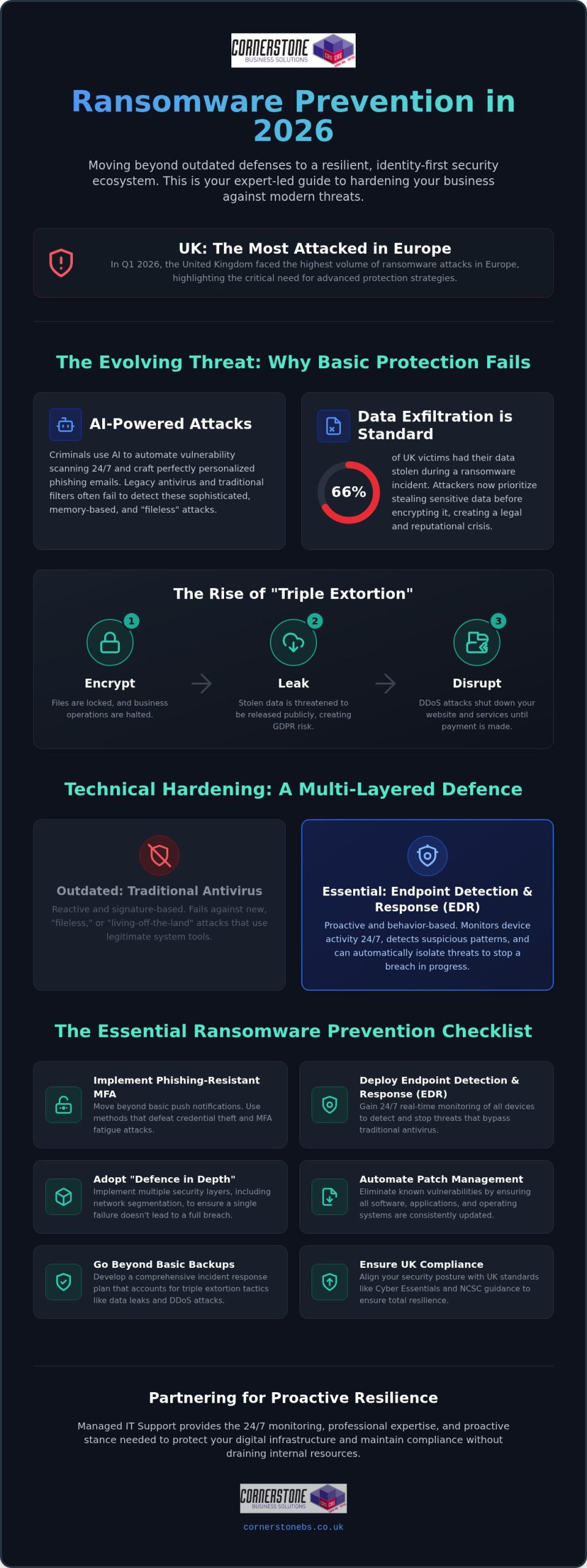
Ransomware has transformed from a simple nuisance into a sophisticated, multi-stage extortion event. In the first quarter of 2026, the United Kingdom became the most attacked country in Europe, proving that old-school defences are no longer enough. To understand why your current ransomware prevention checklist might be outdated, we need to look at how the threat has changed. Modern attacks aren’t just about locking files; they’re about total business leverage. If you’re still asking What is Ransomware?, the answer in 2026 is far more dangerous than it was even two years ago.
Hackers now use AI to automate the discovery of vulnerabilities, scanning your network for weaknesses 24/7. They don’t just wait for a lucky break; they create one. Legacy antivirus software often fails because it looks for known signatures or files. Today’s fileless malware attacks hide in your computer’s memory or use legitimate system tools to bypass detection entirely. We’re also seeing the rise of Triple Extortion. This is where criminals encrypt your data, steal it for public leak, and then launch a DDoS attack to shut your website down until you pay. It’s a relentless cycle that basic software can’t stop alone.
From Data Encryption to Data Exfiltration
Attackers have flipped the script. They now steal your sensitive data before they ever trigger the encryption process. This gives them a backup plan if your technical recovery is solid. Double Extortion is now the industry standard threat for 2026, where criminals demand payment specifically to stop the public release of your stolen information. For a UK business, this isn’t just a technical issue. It’s a legal nightmare involving massive GDPR fines and permanent damage to your brand’s reputation. According to 2026 data from Proofpoint, 66% of UK victims reported data theft during an incident, making it more likely than not that your data will be leaked if you’re hit.
AI-Driven Phishing and Social Engineering
The days of spotting a scam by its poor grammar are gone. Criminals now use Large Language Models (LLMs) to craft perfect, highly personalised phishing emails that look identical to a message from your bank or a trusted supplier. We’re also seeing a rise in Deepfake audio and video being used in business email compromise. A voice that sounds exactly like your director might call to authorize an urgent transfer. Traditional email filters struggle to catch this synthetic content because it lacks the usual red flags. This evolution makes identity security a foundational part of any modern ransomware prevention checklist.
Technical Hardening: Building a Multi-Layered Defence
Building a resilient business requires more than a single piece of software. It demands a strategy called “Defence in Depth.” This approach ensures that if one security layer fails, others are ready to catch the threat before it causes damage. A modern ransomware prevention checklist must move beyond basic firewalls to include integrated, intelligent systems that talk to each other. For a comprehensive look at these technical standards, the CISA #StopRansomware Guide provides a gold standard for configurations that every UK business leader should consider.
Automated patch management is another non-negotiable element. Hackers love unpatched software because it provides a predictable, open door into your network. In a hybrid work environment, your “perimeter” isn’t just the office walls. It’s every cloud application and remote device your team uses. Securing this cloud perimeter requires consistent updates and proactive monitoring to ensure your defences remain strong against evolving threats. Our team often finds that managed IT support is the most efficient way for businesses to maintain this level of technical hygiene without draining internal resources.
Endpoint Detection and Response (EDR)
Traditional antivirus is reactive. It waits to see a known file signature before it acts. EDR is different. It monitors the behaviour of every device on your network in real time. This is vital for stopping “Living off the Land” (LotL) attacks, where hackers use your own legitimate system tools to encrypt your data. Because most firms don’t have an in-house security team working through the night, managed EDR provides the constant oversight needed to stop a breach at 3 AM on a Sunday. It identifies suspicious patterns, like a sudden mass renaming of files, and isolates the device immediately.
Network Segmentation and Lateral Movement
Keeping your entire business on one “flat” network is a recipe for disaster. If a single laptop in your sales department gets infected, the hacker can move sideways across the network to your finance servers in minutes. Network segmentation acts like the bulkheads in a ship. By dividing your infrastructure into smaller, isolated zones, you can contain an infection to its source. This limits the “Blast Radius” of an attack, ensuring that a breach in one area doesn’t lead to total company downtime. It’s a core component of any effective ransomware prevention checklist in 2026.
Identity Security: Why MFA is No Longer a Silver Bullet
Many UK business owners believe that enabling basic Multi-Factor Authentication (MFA) makes them unhackable. It’s a common misconception. While MFA is a vital step in any ransomware prevention checklist, simple push notifications are now easily bypassed. Hackers use “MFA Fatigue” attacks, bombarding a tired employee with requests until they accidentally click “Approve.” By 2026, session hijacking and AI-powered credential theft have made traditional SMS or app-based codes insufficient.
We recommend moving toward Phishing-Resistant MFA, such as FIDO2-compliant hardware keys. These require a physical touch or biometric scan that can’t be intercepted by a remote attacker. This shift is a core recommendation in CISA’s #StopRansomware Guide, which emphasizes that identity is the new perimeter. If an attacker steals a password today, they shouldn’t automatically get the keys to your entire digital kingdom.
Implementing Zero Trust Architecture
Zero Trust isn’t a single software package you buy off the shelf. It’s a strategic mindset: “Never Trust, Always Verify.” This framework ensures that every user and device is checked every time they try to access your data, regardless of whether they are in the office or working from home. Our Cyber Security services help you build this resilience through three main pillars:
- Verify Explicitly: Always authenticate based on all available data points, including user identity, location, and device health.
- Use Least Privilege: Limit user access with “Just-In-Time” and “Just-Enough-Access” to only what they need for their specific role.
- Assume Breach: Design your systems as if an attacker is already inside the network to minimize the impact of a potential incident.
Cyber Awareness Training for the 2026 Workforce
Annual “tick-box” videos don’t stop modern attacks. Your team is your first line of defence, but they need training that reflects today’s AI-driven threats. We focus on creating a security-first culture where employees feel confident reporting a mistake rather than hiding it out of fear. Simulated phishing tests should now include deepfake audio scenarios and perfectly written AI emails. This ongoing education turns your staff into a human firewall, making your ransomware prevention checklist a living part of your daily operations.
The Essential Ransomware Prevention Checklist for 2026
Prevention is only half the battle. In 2026, true resilience means having the ability to survive and recover even if an attacker manages to breach your initial defences. This ransomware prevention checklist focuses on both stopping the entry and ensuring your business stays operational during a crisis. We believe that a proactive stance is the only way to protect your livelihood and your team’s hard work.
- Step 1: Conduct a comprehensive Cyber Security audit to find hidden gaps. This is the essential first step for any UK business to understand their current risk level.
- Step 2: Enforce Phishing-Resistant MFA across all business accounts to block sophisticated credential theft.
- Step 3: Implement the 3-2-1-1 Backup Strategy to ensure data is always recoverable.
- Step 4: Lock down Remote Desktop Protocol (RDP) and use secure VPNs for all remote access.
- Step 5: Establish a formal Incident Response Plan (IRP) and test it through monthly tabletop exercises.
If you aren’t sure where your business stands today, the best move is to book a professional security audit with our expert team to identify your most critical vulnerabilities.
The 3-2-1-1 Backup Strategy: Your Final Safety Net
In 2026, the traditional 3-2-1 rule is no longer enough because modern ransomware specifically targets and deletes backups. You need the extra “1” for immutability. Immutable backups are stored in a state that cannot be deleted, changed, or overwritten, even if a hacker gains administrative access to your network. Physically disconnected or air-gapped backups are the only true defence against encryption because they sit entirely outside the reach of the attacker’s software. You must also define your Recovery Time Objective (RTO) and Recovery Point Objective (RPO). RTO determines how quickly you need to be back online, while RPO defines how much data loss your business can actually tolerate before it becomes a disaster.
Patching and Vulnerability Management
Partnering for Resilience: Proactive Protection with Cornerstone
Trying to handle cyber security alone in 2026 is a high-risk strategy that often leaves UK firms vulnerable. Ransomware is no longer a simple virus; it’s a professional criminal operation. You need more than a static document to stay safe. You need a team that lives and breathes these threats every day. Our Managed IT Support provides the 24/7 monitoring and technical expertise required to turn your ransomware prevention checklist from a plan into a bulletproof defence.
We don’t just act as a reactive helpdesk. We position ourselves as your dedicated long-term partner, spotting the smoke before the fire starts. Proactive maintenance is always more cost-effective than emergency breach recovery. With financial losses from UK ransomware attacks increasing by 50% annually to approximately £270,000 per incident, the investment in professional oversight is a foundational element of your business stability and emotional security.
Why Outsourced Security Beats In-House Management
Managing a modern security stack requires expensive, enterprise-grade tools. Through our partnerships with industry leaders like Microsoft, Cisco, and IBM, we give you access to world-class technology without the massive upfront costs. There’s also a global talent shortage in cyber security. It’s difficult and expensive to hire a full in-house team that understands 2026-level threats. Our experts handle the complexity so you can focus on growth.
Our Cloud Solutions offer built-in resilience that traditional on-premise servers simply can’t match. We ensure your data is distributed and protected by the latest encryption standards. This allows your team to scale securely while we manage the technical infrastructure in the background. It’s a seamless way to tick off the most difficult items on your ransomware prevention checklist.
Building Your Disaster Recovery Plan
The first 60 minutes after discovering an attack are critical. Our rapid response process kicks in immediately to isolate the threat and protect your immutable backups. We focus on Business Continuity, ensuring you can keep working even if your primary systems are under pressure. We don’t just set up your systems and walk away; we test your recovery plans regularly to ensure they work when you need them most.
Following a checklist is a great start, but having a multi-award-winning team by your side provides the ultimate peace of mind. We’re proud to be a local team of experts who genuinely care about your success. We’d love to help you harden your defences and secure your future. Feel free to reach out for a no-obligation security conversation with our team today.
Building a Resilient Future for Your Business
Protecting your organization from modern threats requires more than just luck. We’ve seen how ransomware has evolved into a multi-stage extortion event where identity security and immutable backups are your strongest allies. By adopting a proactive stance and following a comprehensive ransomware prevention checklist, you replace fear with a clear strategy for growth. It’s about ensuring your team can work with confidence, knowing their data is secure.
As a multi-award-winning IT provider and official partner to Microsoft, IBM, and Cisco, we specialize in bespoke security solutions. Our UK-based proactive support desk acts as an extension of your team, providing the 24/7 oversight your business deserves. Don’t wait for a breach to discover your vulnerabilities. Book Your Comprehensive Cyber Security Audit with Cornerstone Today to harden your defences.
Taking these steps today secures your legacy for tomorrow. We’re ready to help you build a more stable, resilient business that’s prepared for whatever the digital world throws your way.
Frequently Asked Questions
What is the single most important step in ransomware prevention?
The single most important step is securing user identities through phishing-resistant Multi-Factor Authentication (MFA). Since most breaches begin with compromised credentials, hardware-based keys or biometrics create a barrier that software-only solutions can’t match. It’s the foundation of any modern ransomware prevention checklist. By ensuring that only verified users can access your network, you stop the majority of automated attacks before they can gain a foothold in your systems.
Should my business ever pay a ransomware demand in 2026?
Official guidance from the National Cyber Security Centre (NCSC) remains clear: you shouldn’t pay the ransom. Paying doesn’t guarantee your files will be returned and often funds further criminal activity. Under new UK legislation, organizations are also required to report incidents and consult with authorities within 72 hours. we focus on building resilience so that you don’t have to negotiate. A solid recovery plan is always a better investment than a ransom payment.
How often should we test our business backups?
You should perform full restoration tests at least once a quarter, though monthly testing is ideal for critical data. A backup is only as good as its last successful restore. Regular testing ensures your Recovery Time Objective (RTO) is realistic and that your team knows exactly what to do during an incident. This proactive approach identifies corruption or configuration errors early, giving you the peace of mind that your safety net is actually secure.
Does Microsoft 365 protect me from ransomware automatically?
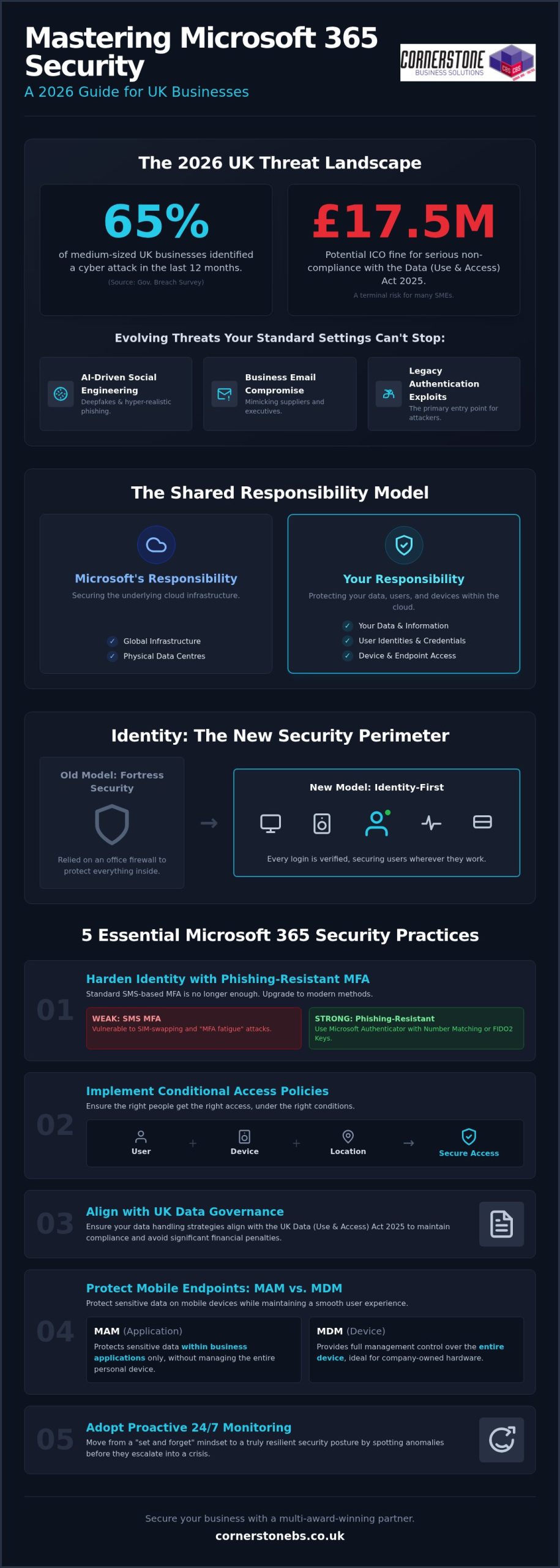
Microsoft 365 offers strong foundational tools, but it doesn’t protect you from ransomware automatically without expert configuration. You must actively enable features like conditional access, advanced threat protection, and secure defaults to stop modern attacks. It’s a shared responsibility model where Microsoft secures the platform while you secure your data. Our team ensures your environment is hardened against the specific fileless malware and credential theft techniques that are prevalent in the UK today.
What is an immutable backup and why do I need one?
An immutable backup is a data copy that cannot be altered, encrypted, or deleted for a set period. Even if a hacker gains administrative privileges, they cannot destroy this data. In 2026, attackers specifically target backup servers to force a ransom payment. Having an immutable copy ensures you always have a “clean” version of your business data available for recovery, making the threat of permanent encryption much less significant for your operations.
How can I tell if my business has already been breached?
Look for subtle signs like unusual network latency, unexpected account lockouts, or unauthorized configuration changes. Modern attackers often stay “silent” in your network for weeks to exfiltrate data before triggering encryption. Implementing Endpoint Detection and Response (EDR) is the best way to spot these anomalies. EDR monitors behaviour in real time, alerting you to “Living off the Land” techniques that traditional antivirus software would likely miss until it’s too late.
Is Cyber Essentials certification enough to stop ransomware?
Cyber Essentials is an excellent baseline that covers approximately 80% of common cyber threats, but it isn’t a “set and forget” solution. It provides the foundational controls every UK business needs for compliance. However, to defend against the AI-driven and triple-extortion attacks of 2026, you need to layer this certification with advanced strategies like Zero Trust architecture and 24/7 proactive monitoring. It’s a vital part of your security journey, not the destination.
What is the cost of a ransomware attack for a UK SME?
Beyond the direct financial hit, the true cost of an attack in 2026 includes massive downtime and permanent reputational damage. Industry data from Sophos shows the average global recovery cost has risen to $1.7 million when you factor in lost productivity and restoration. For many UK SMEs, these hidden expenses are far more damaging than the ransom itself. Following a professional ransomware prevention checklist is the most cost-effective way to avoid these business-ending financial burdens.
Posted on: August 22nd, 2026 by Cornerstone
Did you know that the ICO now has the power to issue fines of up to £17.5 million for simple communication breaches? With the Data (Use and Access) Act 2025 now in full effect, staying ahead of the law requires more than just basic firewalls. It’s easy to feel overwhelmed by these shifting rules, especially when you’re trying to find a reliable it compliance checklist for uk businesses that actually makes sense for your daily operations. You need a strategy that protects your reputation and your bottom line without slowing down your team.
We understand that you want peace of mind, not a legal textbook. Our award-winning team has developed a guide that replaces uncertainty with absolute confidence. This framework simplifies complex technical requirements into clear, actionable steps that benefit your business. We break down the latest “Danzell” Cyber Essentials updates, explain the new 30-day data subject complaint window, and show you how proactive managed IT support acts as a continuous compliance engine. Let’s move past the jargon and ensure your business is resilient, legal, and ready for growth.
Key Takeaways
- Learn why being “secure” isn’t the same as being “compliant” and how to avoid the ICO’s increased £17.5 million fining powers.
- Get up to speed with the Data (Use and Access) Act 2025, including the strict new 30-day timeline for handling data subject complaints.
- Follow our it compliance checklist for uk businesses to perform essential operational audits on user permissions and hardware lifecycles.
- See how the latest Cyber Essentials “Danzell” update mandates Multi-Factor Authentication for all cloud users, not just admins.
- Shift from a “set and forget” mindset to a proactive model that uses managed IT services to maintain continuous operational resilience.
Understanding IT Compliance in the 2026 UK Landscape
We’ve moved beyond the original 2018 General Data Protection Regulation (GDPR) baseline. Since February 5, 2026, the Data (Use and Access) Act 2025 has introduced stricter requirements for data subject complaints and incident reporting. This shift means your it compliance checklist for uk businesses needs to account for these updated mandates. For directors, this is about more than just avoiding legal trouble. It’s about emotional security. Knowing your systems are robust and compliant allows you to focus on growth without the constant fear of a regulatory audit hanging over your head.
The Consequences of Non-Compliance
The Data Protection Pillar: GDPR and the 2025 Data Act
The Data (Use and Access) Act 2025 (DUAA) officially became the primary influence on UK data protection on February 5, 2026. It’s not a total rewrite of the rules you already know. Instead, it amends the UK GDPR and the Data Protection Act 2018 to better suit our modern economy. For any business owner, this means your it compliance checklist for uk businesses must account for these specific refinements. The Act aims to reduce “red tape” for low-risk data usage while strengthening the protections around sensitive personal information. One of the biggest shifts involves how you justify data collection. You need to re-audit your “Lawful Basis for Processing” to ensure your reasons for holding data still align with the streamlined definitions provided by the new Act.
Handling Subject Access Requests (SARs) and data complaints has also become more structured. As of June 19, 2026, you’re legally required to acknowledge any data subject complaint within 30 days. You then have to provide a full response without undue delay. This isn’t just about avoiding fines; it’s about showing your customers that you value their privacy. We always recommend following the official ICO guidance on UK GDPR to stay on the right side of these evolving expectations. Clear communication builds the foundation of a long-term partnership with your clients.
The 72-Hour Breach Reporting Rule
Speed is your best friend when a security incident occurs. Under the current 2026 guidelines, you must report any breach that risks the rights and freedoms of individuals to the ICO within 72 hours. This window is incredibly tight if you’re relying on manual checks. We use automated monitoring to detect anomalies instantly, giving you the best chance to meet this deadline. A proactive response plan ensures your team knows exactly who to call and what to do the moment a red flag appears. If you’re worried about your current detection speed, our Cyber Security audits can identify gaps before they turn into reportable incidents.
Data Governance and Documentation
Cyber Essentials is no longer just a “nice to have” recommendation. It’s the bedrock of any it compliance checklist for uk businesses. Since the Danzell update took effect in April 2026, the requirements have sharpened significantly to meet modern threats. We view this certification as a quality signature. It proves to your partners and customers that you take their digital safety seriously. While the standard version involves a verified self-assessment, we often recommend Cyber Essentials Plus for businesses handling sensitive data. This higher tier includes a hands-on technical audit, providing the absolute certainty that your defences are as strong as you claim.
Even if your business is strictly UK-based, you’re likely part of a broader supply chain affected by international shifts. Regulations like NIS2 and the Digital Operational Resilience Act (DORA) are rippling through the UK market in 2026. These mandates require larger firms to prove their suppliers are secure. Meeting the Cyber Essentials scheme standards ensures you don’t get locked out of lucrative contracts due to compliance gaps. It positions your company as a reliable, long-term partner in a competitive landscape.
Technical Controls for Compliance
Modern compliance demands concrete technical evidence rather than vague promises. Multi-Factor Authentication (MFA) is now a mandatory check under the Danzell update for all cloud services. It’s not enough to enable it for administrators; every single user must have it active to pass an audit. We also focus on robust encryption for data both at rest and in transit. This prevents unauthorized access even if data is intercepted. Patch management is another critical area with zero room for error. You must apply all high-risk and critical security updates within 14 days of release. Failing to do so results in an automatic assessment failure, leaving your business both vulnerable and non-compliant.
Zero Trust Architecture in 2026
The Step-by-Step IT Compliance Checklist for 2026
Phase 1: Discovery and Documentation
Once you have a clear map, you must harden your defences. Enforce Multi-Factor Authentication (MFA) across all cloud subscriptions, including Microsoft 365 and Azure environments, to meet the mandatory Danzell update requirements. Standardise device encryption for all business mobiles and laptops to protect data in transit. This phase also involves an operational audit of user access levels. We advocate for “Least Privilege” policies, ensuring staff only have access to the data they need for their specific roles. To maintain this standard without manual effort, consider setting up automated patch management via Managed IT Support. This ensures critical security updates are applied within the required 14-day window.
Phase 3: Training and Culture
Technology alone isn’t enough; your people are your first line of defence. Deliver quarterly cyber security awareness training to help staff recognise evolving threats like AI-driven phishing. We recommend simulating phishing attacks to test your organisational resilience in a safe environment. The goal is to create a transparent culture where reporting a mistake is encouraged over hiding a breach. Finally, ensure your disaster recovery plan is more than just a document. Test your backup restoration at least annually to guarantee you can recover quickly from any incident. If you want to ensure your infrastructure meets every requirement, request a comprehensive IT audit from our expert team today.
Maintaining Compliance with Managed IT Services
Compliance isn’t a destination; it’s a constant state of readiness. The dangerous myth of “set and forget” compliance often leads to the very breaches and ICO fines we’ve discussed. In a 2026 regulatory environment, your digital infrastructure changes every day. New patches are released, user permissions shift, and data flows evolve. To stay legal and secure, you need a system that breathes with your business. Proactive monitoring identifies non-compliance markers before they escalate into a reportable incident. This approach transforms your it compliance checklist for uk businesses from a static document into a living, breathing shield for your organization.
At Cornerstone Business Solutions, we act as your long-term compliance partner. We don’t just fix things when they break; we ensure they’re built to meet the highest standards from the ground up. We leverage our multi-award-winning expertise to simplify complex technical audits, giving you the clarity you need to make informed decisions. By positioning managed IT support as your “continuous compliance engine,” we provide the emotional security that comes from knowing your systems are always under expert watch.
The Benefits of a Managed Compliance Approach
Taking a managed approach to your regulatory obligations offers several strategic advantages that benefit your bottom line. You gain predictable monthly costs, which is a far better alternative to the high price of emergency compliance fixes after a failed audit. You also get direct access to our team of Microsoft and Cisco certified engineers who understand the nuances of the 2025 Data Act. Our service includes:
- Expert Guidance: Real-time advice on how new technologies impact your legal standing.
- Regular Reporting: Clear, jargon-free documentation for your board of directors or stakeholders.
- Automated Safeguards: Systems that enforce MFA and encryption standards without manual intervention.
Next Steps: Your Compliance Audit
Navigating the 2026 regulatory environment doesn’t have to be a source of constant anxiety for your leadership team. We’ve shown that staying ahead of the Data (Use and Access) Act 2025 and the latest “Danzell” Cyber Essentials updates is about building a culture of resilience. By following a structured it compliance checklist for uk businesses, you protect your professional reputation and your bottom line. It’s about moving away from a reactive mindset and embracing a proactive partnership that supports your long-term growth and stability. Compliance is the foundation that allows you to innovate with absolute confidence.
As a multi-award-winning IT provider and certified Microsoft and Cisco partner, we’re trusted by businesses and educational institutions nationwide to simplify these complex technical hurdles. We understand the pressure of meeting 30-day complaint windows and 72-hour breach reporting rules. Our team is here to provide the clarity and emotional security you need to focus on your core goals. Book your 2026 IT Compliance Audit with our award-winning team today. Let’s start a conversation about securing your digital future and ensuring your systems are as robust as your ambitions. You’ve built a great business; let’s work together to keep it protected and compliant.
Frequently Asked Questions
Is GDPR still relevant in the UK in 2026?
Yes, UK GDPR remains the foundational law for data protection, though it was amended by the Data (Use and Access) Act 2025. It still dictates how you collect, store, and process personal information. While the 2025 Act streamlined some administrative tasks, the core principles of transparency and security remain. You must continue to document your processing activities to stay on the right side of the ICO’s current enforcement policies.
What is the Data (Use and Access) Act 2025 and how does it affect my business?
The Data (Use and Access) Act 2025 is the latest evolution of UK data law, coming into full force on February 5, 2026. It introduces a formal process for data subject complaints and requires an acknowledgment within 30 days. It also clarifies the lawful basis for processing for common business tasks. This act aims to reduce red tape while maintaining high standards, making it a key part of any it compliance checklist for uk businesses.
Does my small business really need Cyber Essentials certification?
Yes, Cyber Essentials is a critical baseline for any organization, as the NCSC estimates it can block 80% of common cyberattacks. In 2026, many government and private sector contracts require this certification as a mandatory condition. The “Danzell” update now requires Multi-Factor Authentication for all cloud users. Beyond securing your systems, it acts as a quality signature that builds trust with your clients and professional partners.
How often should we conduct an IT compliance audit?
You should conduct a comprehensive IT compliance audit at least once a year, or whenever you make significant changes to your infrastructure. Regulatory environments move fast, and a set and forget approach is dangerous. Regular audits identify gaps in hardware lifecycles or software patches before they become liabilities. For businesses in high-risk sectors like finance or law, quarterly reviews are often the gold standard for maintaining continuous operational resilience.
Can Managed IT services help with legal compliance?
Managed IT services act as a continuous compliance engine by providing proactive monitoring and automated security updates. We handle the technical heavy lifting, such as enforcing encryption and managing patch cycles within the required 14-day window. This ensures your it compliance checklist for uk businesses is always up to date. By partnering with experts, you gain the emotional security of knowing your legal obligations are met without distracting from your core business goals.
What are the penalties for a data breach in the UK in 2026?
The ICO has enhanced powers in 2026, with maximum fines reaching £17.5 million or 4% of global turnover. These penalties now apply to breaches of the Privacy and Electronic Communications Regulations (PECR) as well as GDPR. Beyond the financial cost, you face permanent reputational damage and potential service shutdowns. Regulators are now moving from policy reviews to verifying evidence, so having a proactive response plan is essential to minimize these risks.
Is Microsoft 365 automatically compliant with UK laws?
No, Microsoft 365 provides the tools for compliance, but the responsibility for correct configuration lies with your business. You must actively enable features like Multi-Factor Authentication and data loss prevention policies to meet UK standards. Simply purchasing a subscription doesn’t satisfy the Data (Use and Access) Act 2025. We work as certified partners to harden your Microsoft 365 environment, ensuring your cloud setup is both secure and legally robust.
What should be included in an IT disaster recovery plan for compliance?
A compliant disaster recovery plan must include a clear restoration timeline, a communication strategy for stakeholders, and a full hardware inventory. You are legally required to test your backup restoration at least annually to prove your business can recover from an incident. The plan should detail how you’ll meet the 72-hour breach reporting window. Having these documented processes ensures continuity and provides the evidence regulators look for during a formal audit.
Posted on: August 20th, 2026 by Cornerstone
Imagine you’re mid-pitch with a major UK client when your screen suddenly goes black because you’ve hit the 60-minute limit on a free Microsoft Teams call. It’s a frustrating moment that can make even an established firm look like an amateur outfit. We understand that deciphering Microsoft 365 licensing often feels like a full-time job. You want to keep overheads low, but you also need a reliable platform that doesn’t hold your professional reputation hostage or leave your data in a grey area.
As a multi-award-winning Microsoft Partner, we’ve designed this 2026 guide to strip away the technical jargon and show you exactly where the free version falls short. You’ll discover how a dedicated microsoft teams phone system for business can secure your communications and scale your operations. We’ll explore the critical feature gaps, explain the latest pricing tiers from Essentials at £3.10 to Enterprise options, and provide a clear roadmap for a seamless migration. Our goal is to ensure your business continuity remains rock solid while providing the professional edge your clients expect from a modern organisation.
Key Takeaways
- While a free version of Microsoft Teams is available, it’s built for personal use and lacks the essential security and management tools required by modern UK organisations.
- Transitioning to a paid plan allows you to leverage a microsoft teams phone system for business, ensuring your communication is professional, reliable, and fully integrated.
- Free accounts pose a threat to data governance; paid Microsoft 365 tiers ensure your business retains ownership of all files and conversations when staff members move on.
- You’ll benefit from significantly higher storage limits and professional meeting features, such as recordings and transcriptions, that are unavailable in the basic free version.
- Partnering with a multi-award-winning expert helps you navigate 2026 licensing changes, ensuring your IT infrastructure supports business continuity rather than hindering it.
Is Microsoft Teams Free? The 2026 Breakdown of Versions
Yes, you can download a version of Microsoft Teams for free, but it isn’t the professional powerhouse most UK companies actually need. As of August 2026, the free tier remains strictly partitioned for personal use and small social circles. While it’s a great way to catch up with family or run a local hobby group, it creates a productivity ceiling that can stifle a growing business. We’ve seen many firms start here only to hit a wall when they need to present a polished image to a major client.
Teams Free for Personal and Home Use
The free version offers basic video calling and chat, but the constraints are significant. You’re limited to 60-minute group calls and a maximum of 100 participants. Each user receives 5GB of cloud storage, which fills up remarkably fast once you start sharing documents or high-resolution images. Crucially, this tier lacks the ability to record meetings or generate automated transcripts, features that are now standard for professional accountability. Microsoft Teams Free is a consumer-grade communication tool, not a robust business platform. Without an administrative dashboard, you can’t manage user permissions or secure sensitive company data effectively. This lack of control is a major red flag for any organisation concerned with cyber security.
The Teams Essentials Middle Ground
For those who have outgrown the free version but aren’t ready for a full Microsoft 365 suite, Teams Essentials serves as a vital bridge. Priced at £3.10 per user, per month (excluding VAT) following the July 2026 price adjustments, it significantly expands your capabilities. You get group meeting limits of up to 30 hours and can host up to 300 participants, which is plenty for most UK SMEs. It also introduces 10GB of storage and the ability to record your sessions, ensuring you never miss a vital detail from a client briefing.
This tier is often the first step toward implementing a full microsoft teams phone system for business. Unlike the free tier, Essentials includes basic technical support, providing a safety net when things don’t go as planned. It’s the minimum standard we recommend for professional freelancers and solopreneurs in 2026 who need to look credible to their clients. Relying on the free version means you’re operating without a safety harness, as you miss out on the advanced security protocols and seamless integration that makes a microsoft teams phone system for business so valuable for long-term continuity. Your business deserves a setup that scales with your ambition, not one that cuts you off mid-pitch.
Teams Free vs. Paid: Comparing Features for Business Use
Choosing between free and paid versions isn’t just about the monthly bill. It’s about the tools your team needs to thrive. In 2026, the gap between consumer-grade chat and a full microsoft teams phone system for business has never been wider. While the free version looks familiar, the underlying architecture lacks the horsepower required for modern UK enterprises.
Meeting and Collaboration Limits
The 60-minute hard stop on free group calls is a risk to your professional perception. Imagine a high-stakes pitch ending abruptly because a timer ran out. Paid tiers remove this anxiety by offering 30-hour meeting durations. You also gain Together Mode, which uses AI to place participants in a shared background. This makes remote presentations feel cohesive and polished. Advanced tools like breakout rooms and webinar hosting remain exclusive to paid licenses, allowing you to run complex workshops that the free version cannot support.
Storage and File Management
With only 5GB per user, the free version fails quickly once you start sharing documents. Paid plans like Business Basic provide 1TB of storage per user. This is backed by SharePoint, which ensures your files are organised and secure. Using personal free accounts creates dangerous data silos where files are tied to individuals rather than the company. In document-heavy sectors like legal or finance, a centralised environment is essential for stability. If you’re unsure which tier fits your scale, our team can help you optimise your Microsoft 365 environment to ensure you aren’t overpaying for features you don’t need.
By 2026, AI has become the standard for efficiency. Microsoft Copilot automates meeting summaries and drafts emails, but this tool is strictly locked behind paid licenses. If your competitors use AI to save hours every week while you’re still taking manual notes, the free version becomes an expensive handicap. A professional microsoft teams phone system for business integrates these AI tools directly into your workflow. It turns your communication hub into a genuine productivity engine that keeps your team ahead of the curve.
The Hidden Risks of Using Teams Free for Your Business
While the lack of cost is tempting, the “free” label often hides significant liabilities that can quietly undermine your operations. One of the most dangerous traps is the rise of Shadow IT. When employees use personal Teams accounts for company tasks, you lose all visibility into what sensitive information is being shared. This creates a security nightmare because you cannot monitor, audit, or control the flow of data. Implementing a microsoft teams phone system for business provides the oversight you need to keep your communications within a secure, managed perimeter.
Data governance becomes a major hurdle the moment a staff member moves on. If they’ve been using a free personal account, they own that chat history and every file shared within it. You can’t simply revoke access or transfer that intellectual property to a new hire. For UK organisations, this also raises serious questions about UK GDPR compliance. Free versions rarely offer the granular data residency controls or detailed audit logs required to meet strict regulatory standards. Beyond legalities, there’s the issue of professional image. Communicating via a personal email or an “onmicrosoft.com” address signals a lack of permanence that can erode client trust before a project even begins.
Security and Administrative Control
The absence of a centralised management dashboard is a fundamental weakness of the free tier. In a professional environment, you need the ability to remote-wipe data from lost devices or instantly manage user permissions. Paid versions offer robust Multi-Factor Authentication (MFA) and advanced threat protection that the consumer tier simply cannot match. Because communication and data safety are inseparable, we strongly recommend integrating professional cyber security services alongside your Teams setup. This proactive approach ensures that your platform remains a tool for growth rather than a gateway for breaches.
The Cost of Productivity Friction
Productivity often takes a hit when staff have to juggle multiple accounts. We’ve seen teams lose hours every month simply switching between personal and professional profiles to access specific files or sync with company-wide calendars. The free tier doesn’t support shared mailboxes or the deep integration with Outlook that keeps a busy office running smoothly. Free software often costs more in billable hours lost to technical workarounds than the price of a monthly license. A microsoft teams phone system for business removes these barriers, creating a unified environment where your team can focus on their work instead of fighting with their tools.
Understanding Microsoft 365 Licensing and Teams Integration
Licensing shouldn’t feel like a puzzle. In 2026, the Microsoft 365 value stack offers a clear progression designed to match your business’s growth. We often see organisations overpaying for features they don’t use or, conversely, struggling with the limitations of the free tier when a small investment would unlock massive efficiency. As an official Microsoft Partner, we help you cut through the noise to find the exact license that fits your operational needs and budget.
Choosing the Right 2026 License Tier
Following the July 2026 price updates, UK businesses have three primary paths within the Business range. Each provides a different level of access to the microsoft teams phone system for business and the wider Office suite. Here is how they break down:
- Business Basic (£5.40 per user/month): This is the entry point for remote-first teams. It includes professional Teams features and web/mobile versions of Office apps. It’s perfect if you don’t require desktop installations.
- Business Standard (£10.80 per user/month): This is the sweet spot for most UK SMEs. You get everything in Basic plus the full desktop versions of Word, Excel, and Outlook, allowing for seamless offline work.
- Business Premium (£16.90 per user/month): We recommend this for firms handling sensitive data. It adds advanced cyber security and remote device management, which are essential for hybrid teams using various laptops and mobiles.
The Power of the Microsoft Ecosystem
Teams is far more than a video conferencing tool; it’s the central hub for your entire digital workspace. When you move beyond the free version, Teams integrates deeply with Power BI for data analysis, Planner for project management, and SharePoint for secure file storage. This unified approach eliminates the need to jump between different software providers, which saves time and reduces subscription fatigue. A well-executed Microsoft 365 migration often results in a tangible boost to team morale as technical frustrations disappear.
Future-proofing your organisation requires a cloud-first strategy that connects every department. By adopting a professional microsoft teams phone system for business, you ensure that your voice calls, chats, and documents live in one protected environment. Our managed migration process ensures zero downtime, allowing you to transition from free accounts to a professional setup without missing a single client call. If you’re ready to stop guessing which tier you need, you can speak with our experts today for a comprehensive licensing audit tailored to your business goals.
Optimising Your Business Communication Strategy
Success in 2026 requires more than just picking the right software; it requires a strategic implementation that aligns with your long-term goals. While Microsoft makes it easy to sign up for a free trial, a DIY approach often leads to fragmented systems and security gaps. Transitioning to a professional microsoft teams phone system for business is about building a digital headquarters that supports your team’s best work. We believe that technology should be a silent partner in your success, providing a stable foundation that allows you to focus on growth without worrying about technical failure.
Expert Setup and Configuration
Your journey toward a more professional setup should begin with a comprehensive IT audit. This process identifies critical gaps in your current communication tools and highlights where your security might be vulnerable. Once we understand your specific challenges, we can design a bespoke IT company solution that fits your unique operational needs. This isn’t just about software; it’s about creating a roadmap for your digital transformation in 2026 and beyond.
We invite you to have a friendly, informal conversation with our team about your technology goals. Whether you’re currently struggling with the limits of the free version or you’re ready to overhaul your entire infrastructure, we’re here to help. Our approachable experts are dedicated to simplifying complex tech so you can lead your business with confidence. Let’s discuss how we can build a more reliable, secure, and professional future for your organisation together.
Future-Proofing Your Business Communication
Choosing the right version of Teams is about more than avoiding a 60-minute call limit; it’s about the long-term security and professional image of your organisation. While the free tier works for social catch-ups, it simply cannot match the administrative control and seamless integration of a paid subscription. Moving to a professional microsoft teams phone system for business ensures your data stays within your control and your team has the tools to collaborate without friction.
As a multi-award-winning Managed IT Support provider and Certified Microsoft Partner, we take pride in delivering bespoke technology solutions that help UK businesses thrive. We’re not just a service provider; we’re a dedicated partner invested in your stability and growth. We can help you navigate the complexities of 2026 licensing to ensure you get the maximum value from your investment.
Don’t let technical workarounds hold your team back. Book a Free Microsoft 365 Consultation with Cornerstone Business Solutions today and let’s discuss how to build a communication strategy that works as hard as you do. We’re ready to help you take the next step toward a more secure, scalable future.
Frequently Asked Questions
Is there a free version of Microsoft Teams for business use in 2026?
Yes, a free version exists in 2026, though it’s primarily designed for personal use and small social groups rather than professional organisations. While you can sign up with a personal email, you’ll lack the administrative controls and security features essential for a growing company. For a true microsoft teams phone system for business, you’ll need to look at the paid tiers that offer the stability and professional features your clients expect.
How long can a meeting last on the free version of Teams?
Group meetings on the free version of Microsoft Teams are capped at exactly 60 minutes. Once you hit this limit, the call will end automatically, which can be disruptive during important client presentations. If you need longer sessions, moving to Teams Essentials or a Business subscription extends this limit to 30 hours. This ensures your meetings can run as long as necessary without the anxiety of a sudden cut-off.
Can I record meetings in the free version of Microsoft Teams?
No, the ability to record and transcribe meetings is not available in the free version of Teams. This feature is a significant divider between consumer and professional tiers. To capture your sessions for future reference or compliance, you’ll need at least a Teams Essentials license. Professional recording tools are foundational for business continuity, allowing your team to review vital project details and maintain accurate records of every client interaction.
Do I need a Microsoft 365 subscription to use Teams professionally?
You don’t strictly need a full Microsoft 365 suite, as Microsoft offers Teams Essentials as a standalone professional option. However, most UK businesses find that a full subscription provides much better value. Tiers like Business Basic or Standard integrate your microsoft teams phone system for business with Outlook, SharePoint, and 1TB of cloud storage. This creates a unified digital environment that’s far more efficient than using disconnected standalone applications.
What is the difference between Teams Free and Teams Essentials?
The main differences lie in meeting limits, participant capacity, and support. Teams Free limits you to 60 minutes and 100 participants, while Essentials allows meetings up to 30 hours with 300 people. Essentials also includes 10GB of storage and professional technical support, which is entirely missing from the free tier. For a small monthly fee of £3.10, Essentials provides a much more reliable foundation for your daily business communications.
Can I use my own company domain name with the free version of Teams?
No, the free version of Teams doesn’t support custom company domains for your email addresses. You’ll typically be stuck using a personal address or a generic “onmicrosoft.com” identity, which can look unprofessional to potential partners. To use your own business domain, such as @yourcompany.co.uk, you must upgrade to a paid Microsoft 365 plan. This ensures your brand identity is consistent across every email and meeting invitation you send.
How many people can join a free Microsoft Teams meeting in 2026?
In 2026, the free version of Microsoft Teams allows a maximum of 100 participants to join a single meeting. While this might suffice for internal huddles, it lacks the scalability required for larger webinars or company-wide announcements. Upgrading to a professional tier increases this capacity to 300 participants. For even larger events, Enterprise licenses support thousands of attendees, ensuring your infrastructure can grow alongside your audience without technical bottlenecks.
Is Microsoft Teams Free secure enough for sharing confidential business files?
While Teams Free uses basic encryption, it lacks the advanced administrative controls required for true business security. You cannot remote-wipe data from lost devices or enforce strict Multi-Factor Authentication policies across your team. This creates a vulnerability for confidential files. Professional tiers offer robust protection and audit logs, ensuring your intellectual property remains secure. We always recommend a managed security approach to protect your organisation from increasingly sophisticated cyber threats.
Posted on: August 19th, 2026 by Cornerstone
How much of your monthly IT budget is currently being spent on people who no longer work for your company? It’s a common and costly oversight that many UK business owners face. You likely agree that seeing ‘ghost’ licenses on your invoice is a source of unnecessary frustration. Between the confusion of Business Basic versus Premium and the security risks of unmanaged access, it’s easy to lose track of your microsoft 365 license management. This lack of visibility often leads to bloated costs and potential vulnerabilities.
As a multi-award-winning Microsoft Partner, we believe your technology should work for you, not against your bank account. Mastering your licensing is a strategic move to eliminate wasted spend and enhance your security posture. This guide will help you reclaim your budget and ensure your team has the exact tools they need to thrive. We’ll walk through how to audit your current seats, simplify the onboarding process, and select the licensing tiers that actually fit your business goals. Our goal is to simplify these complex technical choices so you can focus on growing your business with confidence.
Key Takeaways
- Stop paying for former employees by identifying “ghost” licenses that bloat your monthly IT spend.
- Take the guesswork out of microsoft 365 license management by selecting the 2026 editions that fit your business goals.
- Implement a monthly audit framework to transition over-licensed users to more efficient, cost-effective tiers.
- Protect your company data during offboarding by using shared mailboxes to retain information without the cost of a full license.
- Let a trusted partner handle the heavy lifting of license audits to catch billing anomalies before they impact your bottom line.
The Hidden Costs of Poor Microsoft 365 License Management
Many UK businesses view their monthly cloud invoice as a fixed utility cost, much like electricity or water. This passive approach to Microsoft 365 often hides significant financial leaks. When an employee moves on, their license doesn’t automatically disappear. Without a proactive process, you continue paying for a “ghost” seat that serves no one. Over a year, a handful of these forgotten licenses can cost your business thousands of pounds. Effective microsoft 365 license management ensures your spending aligns perfectly with your actual headcount.
The introduction of Microsoft’s New Commerce Experience (NCE) added another layer of complexity. You now have to choose between the flexibility of monthly terms and the cost savings of annual commitments. If you lock in too many seats on an annual plan without a clear strategy, you lose the ability to scale down when your team size changes. This lack of flexibility can trap you into paying for resources you no longer need for months at a time.
The Financial Impact of “Set and Forget” Licensing
Managing subscriptions requires more than just paying the bill. Some industry professionals report that SMEs waste a significant portion of their SaaS budget on features they never use or seats that sit idle. License Sprawl is the silent killer of IT budgets. It happens when subscriptions are added for short-term projects but never removed, or when users are assigned high-tier plans for basic tasks. Choosing the right commitment model is vital for your bottom line. Monthly plans offer the agility to remove seats at any time, but they carry a premium price tag. Annual plans offer stability but require precise forecasting. We help businesses find the sweet spot between these two models to ensure every pound spent contributes to growth.
Security Risks of Unmonitored User Seats
The cost of poor management isn’t just financial; it’s a major vulnerability. Every unmanaged license represents a potential entry point for a cybercriminal. These “orphaned accounts” often linger in Microsoft Entra ID with active permissions but no one watching them. If a former employee’s credentials are compromised, an attacker could access your sensitive data without anyone noticing. A thorough license audit is a critical first step in a comprehensive cyber security services review. It ensures that only current, authorised users have access to your environment. Proactive microsoft 365 license management also supports your Cyber Essentials compliance. Auditors look for tight control over user access, and forgotten accounts are a red flag that could invalidate your certification.
Understanding the 2026 Microsoft 365 Licensing Landscape
Selecting the ideal subscription tier is the foundation of effective microsoft 365 license management. In 2026, the landscape is divided into clear paths based on your headcount and security requirements. For most UK small to medium enterprises, the Business tier subscriptions remain the logical starting point. These are capped at 300 users per tenant, which offers plenty of room for growth for many firms. Business Basic provides the core cloud services, while Standard adds the desktop applications your team uses daily. However, Business Premium has become the gold standard for firms prioritising security, as it bundles advanced threat protection and device management into a single package.
The 300 seat limit is a hard ceiling. Once you hire your 301st employee, you’ll need to transition at least some of your users to Enterprise tiers. This transition is a perfect time to audit your estate and ensure you aren’t overpaying for features your team doesn’t use. Add-on licenses like Defender for Endpoint can also be used to bolster the security of lower tier plans without a full upgrade.
Business vs. Enterprise: Finding the Sweet Spot
When your headcount exceeds the limit, or your compliance needs become more complex, it’s time to look at Enterprise tiers like E3 or E5. While Business Premium is incredibly robust, Enterprise E3 offers unlimited seats and more granular control over data governance. A smart way to manage your budget is to mix and match your license types. You don’t have to put every employee on the most expensive plan. Assign Business Basic to frontline workers and reserve Premium or Enterprise seats for those handling sensitive financial or client data. If you’re unsure which combination fits your current needs, our team can provide expert guidance on Microsoft 365 structures that balance cost with capability.
The Copilot and AI Licensing Factor
Simply looking at your list of active subscriptions isn’t enough to protect your bottom line. Strategic microsoft 365 license management requires a proactive approach that treats your IT spend as a dynamic asset. Many businesses fall into the trap of over-provisioning because it feels safer than having a user wait for access. However, this “safety net” often results in hundreds of pounds of wasted budget every month. By using the usage reports within the Microsoft 365 Admin Center, you can identify exactly which applications are gathering digital dust. If a user hasn’t opened Excel or Teams in a month, it’s time to ask if they have the right plan.
You can also automate the heavy lifting of seat assignment. Entra ID group-based licensing allows you to link specific licenses to departmental groups. When a new starter joins your sales team, they’re automatically assigned the correct tools based on their role. This removes the risk of manual errors and ensures your microsoft 365 license management remains consistent as you scale.
A 5-Step Monthly Audit Checklist
Consistency is the key to maintaining a lean environment. We recommend managers follow this simple framework every month to keep costs under control:
- Step 1: HR Reconciliation. Cross-reference your active M365 users against your current HR payroll records to catch any “ghost” accounts.
- Step 2: Activity Review. Identify any users with zero login activity across all services for the last 30 days.
- Step 3: Duplicate Check. Search for users who have both a suite license and standalone add-ons like Visio or Project that they might no longer need.
- Step 4: NCE Window Watch. Review your upcoming New Commerce Experience renewal dates. This is your primary chance to reduce seat counts without penalty.
- Step 5: Tier Assessment. Check if users on Premium plans are actually using the advanced security or desktop features they’re paying for.
Rightsizing: Matching Licenses to Job Roles
Not every employee needs the full bells-and-whistles experience. Creating “User Personas” is an excellent way to standardise your assignments. For instance, your frontline workers or warehouse staff might only need access to email and SharePoint via a mobile device. In these cases, an F-series or Business Basic license is far more cost-effective than a full Standard or Premium seat. Standardising these roles is a foundational part of a successful Microsoft 365 migration for business UK firms can use to stay competitive. By matching the tool to the task, you ensure your team has exactly what they need to thrive without paying for features that remain untouched. This logical alignment protects your budget while keeping your operations agile and secure.
Governance and Compliance: Securing the License Lifecycle
Effective microsoft 365 license management requires a structured policy that spans from a new hire’s first day to an employee’s final exit. Without clear governance, your digital environment becomes a cluttered space full of security holes and unnecessary costs. Role-Based Access Control (RBAC) is your best friend in this process. By defining exactly what a specific job role needs, you ensure license assignment is consistent and secure. This approach stops “privilege creep” where users accumulate access to sensitive tools and data they don’t actually require to do their jobs. It’s about giving your team the right tools while keeping your perimeter tight.
The Offboarding Protocol
When a team member leaves, the clock starts ticking on your security and your budget. Your protocol should include immediate password resets and the revocation of all active sessions. One of the most effective strategies for UK businesses is the “Shared Mailbox” trick. Before you unassign a license, convert the user’s mailbox to a shared one. Shared mailboxes don’t require a paid license as long as they stay under 50GB. This allows you to preserve historical emails for client continuity without paying a penny in monthly fees. We also recommend setting up automated alerts for any unassigned but active licenses. This proactive step prevents billing surprises and ensures you aren’t paying for “ghost” seats that sit idle for months.
Data Governance and Retention
You must understand that simply removing a license often triggers a 30-day countdown before OneDrive and Outlook data is permanently deleted. To stay compliant with UK GDPR, your business might need to keep certain records for years. Using Litigation Hold or specific Archiving settings allows you to meet these legal requirements even after a license is reclaimed and repurposed. Integrating these steps into your broader cloud solutions policy ensures your business remains resilient and audit-ready. Proper data management is a foundational element of your business stability and emotional security. It gives you the peace of mind that your history is protected even as your team evolves. If you want to tighten your security and stop wasting budget on idle seats, speak with our expert team today to help you streamline your microsoft 365 license management and secure your lifecycle.
The Advantage of Managed Microsoft 365 Licensing
Managing your own subscriptions through a portal is possible, but it’s rarely the most efficient use of your time. Technical admin often distracts you from the high-level decisions that drive your business forward. Choosing a partner for your microsoft 365 license management means you gain a team of experts who watch your environment every single day. We catch billing anomalies before they escalate into major expenses. If a license is added by mistake or a subscription is due for a price hike, we’re already on the case. This proactive stance transforms your IT from a reactive cost centre into a lean, predictable asset.
Expert Guidance from a Microsoft Partner
We don’t just sell seats; we act as a dedicated extension of your internal team. As a multi-award-winning it company solutions provider, we bring the clarity of an expert to your digital infrastructure. We’ve earned our Microsoft Partner status through years of delivering reliable, high-quality service to firms across the country. This isn’t a transactional relationship. It’s a long-term partnership built on trust and community-focused values. We stay ahead of Microsoft’s frequent pricing updates and bundle changes, ensuring you’re always on the most cost-effective plan for your specific needs. Our team simplifies complex technical concepts so you can make informed decisions with confidence.
Streamlining Your IT Ecosystem
Consolidating your services is one of the simplest ways to reduce administrative friction. Imagine having one clear invoice for your support, connectivity, and licensing. By integrating your microsoft 365 license management with your Managed IT Support fees, you gain a holistic view of your technology spend. Our proactive system monitoring runs 24/7, providing the foundational stability your business needs to grow without fear of technical failure. This level of oversight gives you the emotional security to focus on your clients, knowing your systems are in safe hands. It’s about creating a professional cadence that feels both energetic and stable.
Ready to stop overpaying for “ghost” seats? Our national team of experts is here to help. We invite you to a conversation about your current setup. We’ll perform a comprehensive license audit to identify immediate savings and security improvements. Let us handle the heavy lifting of license management so you can get back to what you do best. Contact us today to see how a streamlined IT ecosystem can help your business thrive.
Take Control of Your Digital Future
Your technology should be a catalyst for growth, not a drain on your resources. By addressing the “ghost license” problem and implementing a structured offboarding protocol, you can significantly reduce your monthly IT spend. Choosing the right 2026 editions ensures your team has the tools they need while maintaining a lean, efficient environment. Effective microsoft 365 license management is a continuous journey that prioritises both financial health and cyber security.
As a multi-award-winning IT provider and Microsoft Certified Partner, we’re here to help you navigate these complexities. Our team provides national UK support coverage, acting as a proactive extension of your business to handle the heavy lifting of audits and compliance. We invite you to Book a Strategic Microsoft 365 License Audit with Cornerstone to identify immediate savings and strengthen your security posture. Let’s work together to build a more resilient and cost-effective IT infrastructure that supports your long-term success. We’re ready to help your business thrive with confidence.
Frequently Asked Questions
What is the difference between Microsoft 365 Business Standard and Premium in 2026?
Business Standard provides the core productivity tools your team needs, including desktop applications and cloud services like Teams. Business Premium is the security powerhouse for UK firms. It adds advanced threat protection, information protection, and device management through Microsoft Intune. In 2026, this extra layer is vital for defending against sophisticated cyber attacks. Premium also includes Entra ID P1 features, making it the ideal choice for businesses handling sensitive client data.
Can I decrease my license count at any time under the NCE model?
Under the New Commerce Experience (NCE), you can only decrease your seat count during the first seven days of a new term or at your annual renewal date. Outside of these short windows, you’re committed to your current count for the duration of the contract. This makes proactive microsoft 365 license management essential. We help you time your audits to coincide with these windows so you don’t get stuck paying for unused seats.
How do I identify unused Microsoft 365 licenses in my organisation?
You can identify unused seats by visiting the Reports section in your Microsoft 365 Admin Center. The Usage tab shows exactly when each user last accessed services like Outlook, Teams, or OneDrive. If a user hasn’t logged in for 30 days, they might be over-licensed or no longer with the firm. Our team uses these metrics to perform deep-dive audits, ensuring your monthly IT spend aligns perfectly with actual activity.
What happens to a user’s data if I unassign their license?
Microsoft holds unassigned user data for a 30-day grace period before it’s permanently deleted from the system. To avoid losing critical business records, you should convert the user to a Shared Mailbox or move their OneDrive files before removing the license. This ensures you stay compliant with UK GDPR while keeping your environment clean. It’s a proactive step that protects your history without adding to your monthly subscription costs.
Is it possible to mix different types of Microsoft 365 licenses?
You can absolutely mix different license types within a single tenant. This is a brilliant way to optimise your budget and ensure everyone has the exact tools they need. You might put your office staff on Business Standard while your warehouse team uses Business Basic. You can even add Enterprise seats for directors while keeping others on Business Premium. This customisation ensures you aren’t paying for high-tier features that only a few people require.
Why should I use a Managed Service Provider for my Microsoft 365 licensing?
How does Microsoft 365 licensing impact Cyber Essentials certification?
Licensing is a core pillar of your Cyber Essentials compliance. To pass the certification, you must prove that you control user access and protect your devices. Plans like Business Premium include the device management and security tools required to meet these rigorous standards. Proper management ensures no “orphaned accounts” are left active, which is a common reason for failing an audit. It’s a foundational element of your business stability and emotional security.
Does Copilot for Microsoft 365 require a separate license?
Yes, Microsoft 365 Copilot is an add-on license that requires an existing base subscription. You must have a prerequisite plan like Business Standard, Business Premium, or an Enterprise tier to add AI capabilities. You can’t buy Copilot as a standalone product. We recommend assigning these AI seats strategically to specific departments where they’ll have the biggest impact. This targeted approach prevents overspending while giving your team access to the latest productivity tools.
Posted on: August 12th, 2026 by Cornerstone
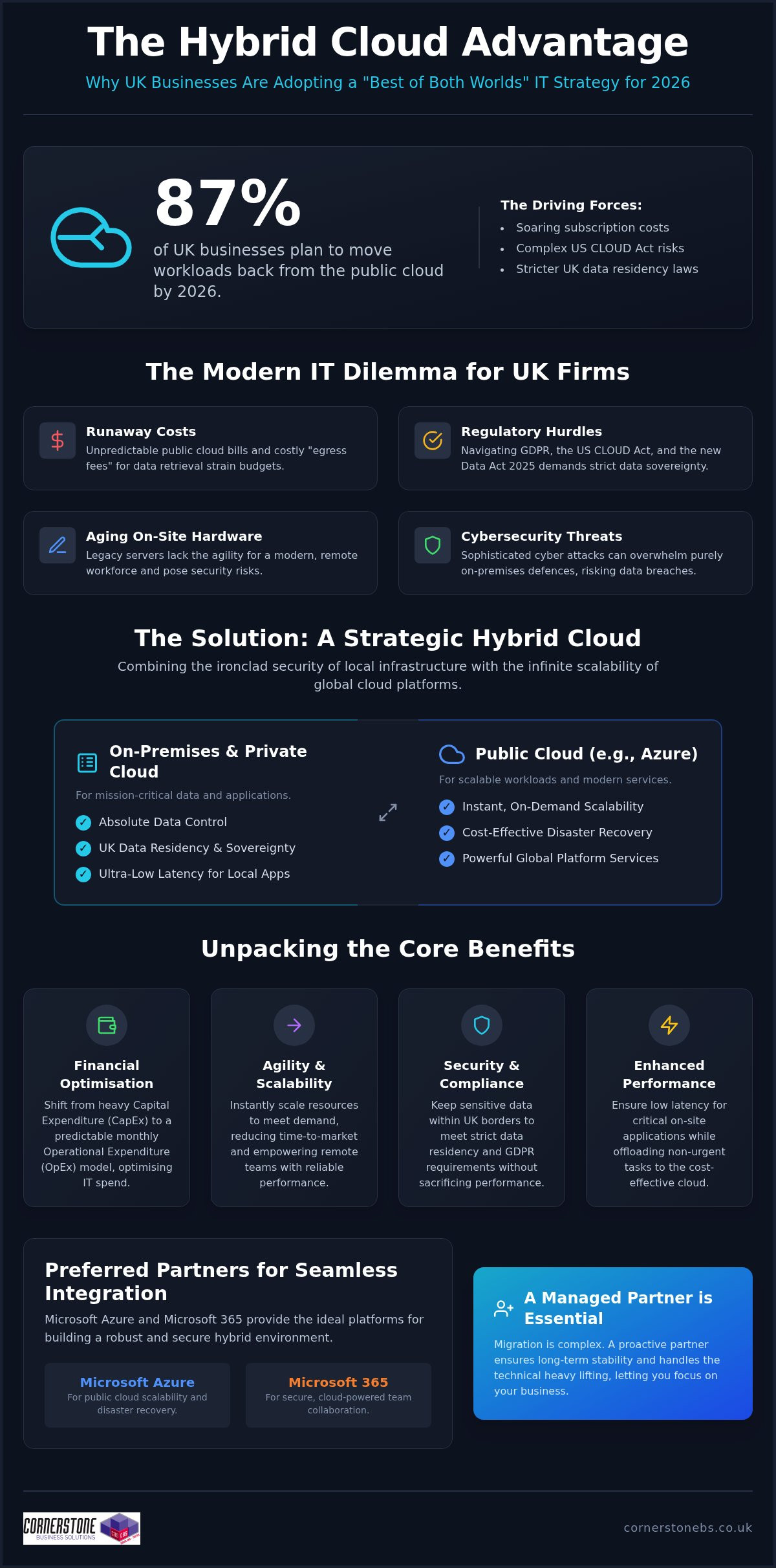
Did you know that 87% of UK businesses are planning to move at least some of their workloads back from the public cloud by the end of 2026? While the “all-in” cloud promise once seemed like the only way forward, many local firms now face soaring subscription costs and the complex jurisdictional risks of the US CLOUD Act. Understanding the hybrid cloud benefits for UK business is no longer just a technical choice. It’s a vital strategy to ensure your infrastructure remains agile and compliant in a rapidly shifting regulatory landscape.
We know how stressful it is to manage aging on-site hardware while trying to navigate the new Data (Use and Access) Act 2025. You need a system that supports your remote team without leaving your sensitive data exposed. This guide reveals how a bespoke hybrid model provides the emotional security of knowing your data is residency-compliant while slashing your capital expenditure. We’ll show you how to balance security, cost, and performance to create a scalable, bulletproof IT environment that’s ready for whatever 2026 throws your way.
Key Takeaways
- Learn how a strategic mix of on-premises and private cloud systems provides the foundation for a modern, agile UK business infrastructure.
- Discover the core hybrid cloud benefits for UK business, including the ability to scale resources instantly while moving from heavy CapEx to predictable monthly costs.
- Understand how to keep your sensitive client data within UK borders to meet strict data residency and GDPR requirements without sacrificing performance.
- Explore why Microsoft Azure and Microsoft 365 are the preferred partners for local firms looking for seamless integration and bulletproof disaster recovery.
- Gain insights into why a proactive managed IT partner is the best way to handle migration complexity and ensure long-term business stability.
The Evolution of Infrastructure: Why Hybrid Cloud is the 2026 Standard
The days of the dusty server humming away in a back office cupboard are fading fast. For years, many UK SMEs relied on that “server in the corner” to run every aspect of their operations. While that model felt simple, it lacked the agility needed to support a modern, distributed workforce. By 2026, the standard has shifted toward a more sophisticated, distributed environment. One of the primary hybrid cloud benefits for UK business is the ability to maintain absolute control over sensitive data while tapping into the massive processing power of the public cloud.
When asking What is Hybrid Cloud?, it’s essentially a strategic orchestration between on-premises infrastructure, private cloud environments, and public platforms like Microsoft Azure. With 73% of organizations now running a hybrid environment, the UK market has matured significantly. Local firms are now balancing the need for seamless remote team access with the strict security demands of the Data (Use and Access) Act 2025. This model ensures you aren’t forced to choose between legacy reliability and modern innovation.
Hybrid cloud represents the “best of both worlds” for UK operational flexibility by combining the ironclad security of local hardware with the infinite scalability of global cloud platforms.
The “Best of Both Worlds” Philosophy
Public clouds are fantastic for cost-effective scalability and handling generic workloads like email or web hosting. However, mission-critical data often requires the dedicated environment of a private cloud or on-premises server to meet UK residency requirements. This hybrid bridge allows your business to pursue digital transformation without abandoning the reliable systems that have served you for years. It’s about placing the right workload in the right place to maximize efficiency and peace of mind.
Overcoming the Limitations of Single-Cloud Models
Relying 100% on a pure public cloud can lead to “egress fee” shocks. These are the hidden costs UK businesses face when trying to move their own data out of a provider’s ecosystem. Conversely, staying entirely on-premises is increasingly risky. Modern cyber threats are too sophisticated for a single local server to handle alone. A hybrid model eliminates vendor lock-in and provides the technical freedom to move data where it’s most efficient. It ensures your business isn’t held hostage by a single provider’s pricing or a single point of technical failure.
Unpacking the Core Hybrid Cloud Benefits for UK Business Growth
Performance is another area where the hybrid model shines. For latency-sensitive applications, such as local databases or heavy design software, keeping them on-site ensures your team isn’t slowed down by “lag.” Meanwhile, you can offload non-urgent tasks like disaster recovery and long-term backups to the cloud. This strategic split is one of the primary benefits of a hybrid cloud, providing speed where it’s needed and storage where it’s most cost-effective.
Operational Agility and Scalability
Optimising IT Spend and Resource Allocation
Financial stability is the backbone of any successful firm. Moving from heavy Capital Expenditure (CapEx) to a predictable, monthly Operational Expenditure (OpEx) model is a game-changer for budgeting. Many businesses discover they’ve been over-provisioning on-site servers “just in case.” A hybrid approach eliminates this waste. By using tailored cloud solutions, SMEs can finally access the same enterprise-grade technology as their larger competitors without the massive upfront price tag.
Managing this balance requires a steady hand and proactive oversight. To get the maximum ROI from these systems, many leaders choose to pair their infrastructure with professional Managed IT Support. This ensures your resources are always allocated correctly. It lets you focus on your business goals while a dedicated partner handles the technical heavy lifting. If you’re curious about how this could work for your specific setup, we’re always happy to have a quick, informal chat about your goals.
Security, Compliance, and Data Sovereignty in the UK
“Is the cloud actually safe for my sensitive client data?” This remains the most common question we hear from business owners across the UK. With PECR fines now reaching up to £17.5 million or 4% of global turnover as of February 2026, the stakes for data protection have never been higher. A hybrid approach provides the reassurance you need. It allows you to keep your most sensitive files on local, physical hardware while leveraging the cloud for general operations. This setup is a cornerstone of a modern security strategy that doesn’t compromise on speed or safety.
Data sovereignty is a major part of this conversation. Many firms don’t realize that using a standard US-based cloud provider can expose them to the US CLOUD Act. This legislation allows foreign law enforcement to request data regardless of its physical location. By using a hybrid model, you ensure your sensitive UK data stays strictly within our borders. This is vital for meeting the requirements of the Data (Use and Access) Act 2025. As of July 13, 2026, the UK government designated providers like Microsoft and Amazon as “Critical Third-Party Providers,” bringing their services under the direct oversight of the Bank of England and the FCA. Integrating robust Cyber Security Services into your hybrid environment creates a layered defence that protects your reputation.
Navigating UK GDPR and Data Residency
Knowing exactly where your data sits physically is the first step to true compliance. Hybrid models are perfect for sectors like finance, legal, and education where data residency is a legal necessity. You can store Personally Identifiable Information (PII) on-site or in a secure UK-based private cloud. This makes passing a GDPR audit much simpler. It also helps you achieve Cyber Essentials certification, proving to your clients that you take their privacy seriously. It’s about building trust through transparent, locally-focused data management.
Enhanced Disaster Recovery and Business Continuity
One of the most powerful hybrid cloud benefits for UK business is the ability to use the cloud as a high-speed “failover” site. If your local hardware fails or an office incident occurs, your team can keep working without missing a beat. Automated backups in the cloud protect you against the growing threat of ransomware by providing a clean point-in-time restore. Building a comprehensive disaster recovery plan is far easier when you aren’t relying on a single physical location. It gives you the emotional security of knowing your business is resilient, no matter what happens.
Integrating Hybrid Cloud with Microsoft 365 and Azure
For most UK firms, Microsoft Azure is the natural choice for a hybrid setup. As of July 13, 2026, Microsoft is officially designated as a Critical Third-Party Provider by the Bank of England and the FCA. This provides a level of regulatory oversight that other platforms simply cannot match. While Microsoft recently increased the price of Microsoft 365 plans, such as Business Basic rising to £5.33 and E3 to £33.48, the added value remains significant. These plans now include enhanced Microsoft 365 Copilot Chat and increased mailbox storage, making them even more central to your daily operations.
The real magic happens when you integrate Microsoft 365 with your on-premises Active Directory. This creates a “single source of truth” for your staff identities. Your team uses one login for their local PC, their email, and their cloud files. This seamless integration is one of the most practical hybrid cloud benefits for UK business, as it reduces password fatigue and closes security gaps. To ensure a smooth transition, we recommend following a structured Microsoft 365 Migration Guide to avoid data silos or sync errors.
The Synergy of Azure and On-Premises Systems
Azure Virtual Desktop (AVD) is another game-changer for the hybrid workspace. It allows your staff to access a high-performance, secure Windows environment from any device, anywhere in the UK. Your sensitive data stays safe in the cloud while your team enjoys the familiarity of their office desktop. Azure Stack essentially brings the immense processing power of the global cloud directly into your physical office, allowing you to run Azure services on your own local hardware. This ensures that even if your internet connection wavers, your core systems stay online.
Modernising Communication with Hybrid VoIP
As we approach the final stages of the UK PSTN switch-off, modernising your phone systems is no longer optional. A hybrid approach allows you to integrate cloud-based Business VoIP with your existing network infrastructure. This ensures your office phones and business mobiles work as one unified system. It provides the reliability of a physical network with the flexibility of a cloud-based exchange. You get crystal-clear calls and advanced features without having to rip and replace your entire setup.
Navigating these integrations can feel like a lot to take on alone. If you are ready to future-proof your setup, we invite you to explore our bespoke cloud solutions and see how we can build a system that works for you.
Navigating the Migration: Why a Managed Partner is Essential
Migration to a hybrid environment is a major strategic shift that requires much more than a simple “lift and shift” of your files. While the hybrid cloud benefits for UK business are clear, the process of getting there is often fraught with technical hurdles. Many firms attempt to manage this transition internally, only to be met with unexpected data loss or security misconfigurations that leave them vulnerable. A managed partner provides the expertise to map out your infrastructure correctly from day one, ensuring your move is smooth, secure, and tailored to your specific goals.
The real value of a dedicated partner lies in proactive monitoring. The old “break-fix” model, where you only call for help when a system goes down, is no longer sufficient for the fast-paced 2026 business environment. You need a team that identifies potential bottlenecks or security threats before they disrupt your operations. This proactive stance is one of the greatest hybrid cloud benefits for UK business, as it provides the emotional security of knowing your systems are resilient and your data residency is always compliant with the latest UK regulations.
Avoiding the Pitfalls of Do-It-Yourself Cloud
One of the biggest hidden costs in DIY cloud migration is the “security gap” created by misconfigured settings. Without expert oversight, it’s easy to leave sensitive directories exposed or fail to set up proper encryption for data in transit. Expert guidance ensures that legacy software continues to function in a distributed world without specific network adjustments. Investing in professional IT company solutions saves you money in the long run by avoiding these expensive mistakes and ensuring your essential tools remain fully operational throughout the transition.
The Cornerstone Business Solutions Approach: Bespoke, Award-Winning Support
At Cornerstone Business Solutions, we’re proud to be a multi-award-winning IT services provider with national UK coverage. Our approach is built on partnership rather than just transactions. We don’t just sell you a service; we become a long-term extension of your team. Our experts take the time to simplify complex technical jargon into clear, actionable business benefits, so you always know exactly what your investment is doing for you. We focus on building bespoke, reliable systems that grow alongside your firm, backed by our strong partnerships with industry leaders like Microsoft, IBM, and Cisco.
Every business infrastructure is unique, and your cloud strategy should be too. We invite you to join us for a no-obligation audit of your current IT setup. It’s a chance to have a friendly, informal conversation with our local experts about your challenges and goals. Let’s work together to build a secure, scalable foundation that keeps your business moving forward. Reach out today to start the conversation.
Future-Proofing Your Infrastructure for 2026 and Beyond
The landscape of UK business IT is moving fast. You’ve seen how a hybrid model balances the need for ironclad security with the flexibility of the public cloud. It’s the most reliable way to handle the Data (Use and Access) Act 2025 while keeping your operational costs predictable. By embracing the hybrid cloud benefits for UK business, you’re building a foundation that respects local data residency while leveraging global innovation.
As a multi-award-winning IT provider and proud partner of Microsoft, IBM, and Cisco, we specialize in building bespoke systems that fit your specific needs. We don’t believe in one-size-fits-all solutions. Instead, we focus on providing the emotional security and technical stability you need to grow your firm with confidence. Our team is ready to help you navigate the complexities of migration and proactive monitoring.
Are you ready to see how a tailored strategy could transform your operations? Book a free Hybrid Cloud readiness audit with our award-winning team today. Let’s start a conversation about securing your business’s future.
Frequently Asked Questions
What are the main hybrid cloud benefits for UK businesses in 2026?
The primary hybrid cloud benefits for UK business include the ability to scale resources instantly while maintaining absolute control over sensitive data. This model allows you to keep mission-critical files on-site for security and speed, while offloading backups and generic workloads to the cloud to reduce capital expenditure. It is the most effective way to stay agile in a competitive market without sacrificing the stability of your local infrastructure.
How does hybrid cloud help with UK GDPR compliance?
Hybrid cloud simplifies compliance by allowing you to choose exactly where your data is stored. You can keep Personally Identifiable Information on secure, UK-based physical servers to meet strict residency requirements. This prevents your sensitive client data from being subject to foreign laws like the US CLOUD Act. It provides a transparent audit trail that makes meeting UK GDPR and Data (Use and Access) Act 2025 standards much more manageable.
Is hybrid cloud more expensive than traditional on-premises servers?
While there is an initial setup cost, hybrid cloud is often more cost-effective over time. It shifts your IT spend from heavy upfront capital expenditure to a predictable monthly operational model. You no longer need to pay for high-end hardware that sits idle most of the year. By scaling your cloud usage to match your actual workload, you eliminate the waste of over-provisioned local servers while enjoying enterprise-grade technology.
Can I use hybrid cloud if I already have Microsoft 365?
Yes, Microsoft 365 is designed to work seamlessly within a hybrid environment. You can sync your on-premises Active Directory with the cloud so your team uses a single login for everything. This integration improves security and reduces password fatigue for your staff. It allows you to keep large databases on-site for speed while your team uses cloud-based tools like Teams and Outlook for daily communication and collaboration.
What is the difference between hybrid cloud and multi-cloud?
Hybrid cloud combines your private on-premises infrastructure with a public cloud provider like Microsoft Azure. It is about bridging the gap between your local office and the digital world. Multi-cloud refers to using several different public cloud providers at once to avoid relying on a single vendor. Most UK firms find that a hybrid model offers the best balance of security and performance without the complexity of managing multiple external contracts.
How long does it take to migrate to a hybrid cloud environment?
Migration timelines vary depending on the size of your data and the complexity of your current software. A straightforward setup might take a few weeks, while a full enterprise transition could take several months. We always recommend a phased approach to ensure zero downtime for your team. This allows us to test each system thoroughly before moving to the next stage, providing a smooth experience for your staff and customers.
Do I need a managed IT partner for hybrid cloud migration?
While you could attempt it alone, a managed partner ensures your migration is secure and efficient. Partnering with experts allows you to unlock the full hybrid cloud benefits for UK business, as we handle the complex technical heavy lifting and network adjustments. A partner provides proactive monitoring that identifies potential issues before they cause downtime. This gives you the emotional security of knowing your business is in expert hands.
How does hybrid cloud improve disaster recovery for UK firms?
Hybrid cloud creates a bulletproof safety net by using the cloud as a secondary failover site. If your physical office suffers an incident, your team can switch to the cloud version of your systems instantly. Automated, point-in-time backups protect you against ransomware by providing a clean copy of your data for quick restoration. It is a foundational element of business stability that ensures your firm remains resilient against any local hardware failure.
Posted on: August 11th, 2026 by Cornerstone
Did you know that 65% of medium-sized UK businesses identified a cyber attack in the last 12 months? It is a sobering statistic from the latest Government breach survey, and it makes implementing robust microsoft 365 security best practices for uk business more critical than ever. You likely feel the pressure of staying compliant with the new Data (Use and Access) Act 2025 while trying to decode which Microsoft licenses actually offer the protection you need. It is frustrating to manage complex settings when you should be focusing on leading your team.
We believe security should be proactive and empowering, not a source of constant stress. You deserve to know your data is safe from the £17.5 million fine potential of the ICO without spending every weekend in an admin portal. As a multi-award-winning partner, we are here to simplify the technical jargon into a strategy that actually works for your specific regional operations and goals.
This 2026 guide will help you master your security configurations from the ground up. We will cover everything from NCSC-backed passwordless logins to the latest Microsoft Teams protection updates. By the end, you will have a clear, actionable roadmap to ensure your business remains secure, compliant, and resilient in a changing digital landscape.
Key Takeaways
- Identify the critical gaps in your current setup by mastering microsoft 365 security best practices for uk business that move beyond standard, out-of-the-box settings.
- Learn how to implement phishing-resistant authentication and essential Conditional Access policies to secure your business identity against AI-driven social engineering.
- Ensure your data governance strategies align with the latest UK Data (Use and Access) Act 2025 to maintain compliance and avoid significant financial penalties.
- Discover the difference between MAM and MDM to protect sensitive business information on mobile devices while maintaining a smooth experience for your team.
- Understand why proactive, 24/7 monitoring is the only way to move from a “set and forget” mindset to a truly resilient security posture.
The 2026 UK Threat Landscape: Why Standard Microsoft 365 Settings Aren’t Enough
Standard Microsoft 365 settings are built for convenience, not a 2026 threat environment. Relying on “out-of-the-box” configurations leaves your business exposed to sophisticated attacks that simple filters can’t catch. We’ve seen a massive shift toward AI-driven social engineering where hackers use deepfake technology to impersonate executives and trusted partners. Adopting microsoft 365 security best practices for uk business isn’t just a technical task; it’s a vital step to protect your local reputation and bottom line. A breach isn’t just an IT headache. Under the Data (Use and Access) Act 2025, the ICO can issue fines up to £17.5 million for serious non-compliance. For a UK SME, that financial hit combined with a lost reputation can be terminal.
Understanding the Shared Responsibility Model
A common mistake many UK directors make is assuming that Microsoft is responsible for all aspects of cloud safety. This isn’t the case. While Microsoft manages the physical data centres and global infrastructure, you are responsible for the data you store and the people who access it. Learning the basics of cloud security fundamentals helps you see where Microsoft’s job ends and yours begins. Without proper configuration, your sensitive files are essentially sitting in a secure building with the front door left unlocked.
The Shared Responsibility Model is a framework where Microsoft secures the underlying cloud infrastructure while you remain fully responsible for protecting your data, user identities, and device access.
Evolution of Cyber Threats in 2026
The 2026 threat landscape is dominated by Business Email Compromise (BEC) and “Shadow AI” risks. According to the UK Government Cyber Security Breaches Survey 2025/2026, 65% of medium-sized businesses identified a breach last year. Hackers no longer just send “dodgy” links; they use AI to draft perfectly phrased emails that mimic your suppliers. Legacy authentication remains the primary entry point for these criminals, as it lacks the modern safeguards needed to stop credential theft. Integrating professional cyber security services provides the proactive monitoring required to spot these anomalies before they escalate into a full-scale crisis.
Identity is now the new perimeter. We’ve moved past the days when a strong office firewall was enough. In a remote or hybrid world, your users’ credentials are the only thing standing between a hacker and your financial records. If you don’t secure the identity, you don’t have a perimeter. This identity-first approach ensures that every login attempt is verified, regardless of where the employee is working in the UK. It’s about moving from a reactive “on/off” switch to a proactive, identity-first governance model.
Hardening Identity: Implementing MFA and Conditional Access
Identity is the foundation of your digital estate. If a hacker steals a password, they essentially have a key to your office. In 2026, relying on a password alone is a massive risk. Implementing microsoft 365 security best practices for uk business starts with a robust identity strategy that assumes every login attempt could be a threat. We’ve moved past simple security; we now need “Identity-First” governance that verifies every user, every time, from every location.
Phishing-Resistant Multi-Factor Authentication
SMS-based multi-factor authentication (MFA) is no longer sufficient. Cybercriminals now use “MFA fatigue” attacks and SIM swapping to bypass these basic checks. For 2026, we recommend phishing-resistant methods. Microsoft Authenticator with Number Matching is now the standard. It requires the user to enter a specific code shown on the login screen into their phone app. This simple step prevents accidental approvals. For high-privilege accounts, like your global admins, using FIDO2 security keys provides the highest level of protection available. These physical keys ensure that even if a user is tricked by a fake login page, the attacker cannot gain access.
Conditional Access: The “If/Then” of Security
Conditional Access is the most powerful tool in your security arsenal. Think of it as an intelligent security guard that evaluates every login based on specific rules. It uses “If/Then” logic: If a user is logging in from an unknown country, then block access. For most UK SMEs, restricting logins to UK-only IP addresses is a quick win that stops thousands of automated offshore attacks. When planning a Microsoft 365 migration for business UK, auditing your existing identities and setting these rules early is vital for long-term stability.
Every UK business should implement these five essential Conditional Access policies:
- Require MFA for all users: No exceptions, especially for guest accounts.
- Block legacy authentication: Disable older protocols like IMAP or POP3 that hackers use to bypass MFA.
- Geo-blocking: Restrict access to the UK unless your staff are actively travelling.
- Device Compliance: Only allow access from managed, healthy devices that meet your security standards.
- Risk-based sign-ins: Automatically block or challenge “impossible travel” attempts, such as a login from London followed by one from New York ten minutes later.
Eliminating legacy authentication is a non-negotiable step. These older protocols are the #1 entry point for credential theft because they simply don’t support modern MFA. By turning them off, you close a massive door that attackers love to exploit. If you’re unsure where to start with these configurations, our team can help you review your current identity posture to ensure you’re fully protected.
Data governance is often the missing piece in microsoft 365 security best practices for uk business. While hardening your identity stops intruders at the front door, governance ensures that your sensitive information doesn’t slip out through the back. With the Data (Use and Access) Act 2025 now in full effect, the Information Commissioner’s Office (ICO) has enhanced powers to penalise businesses that fail to manage data complaints or protect personal records. Proper configuration within Microsoft 365 isn’t just about safety; it’s about staying on the right side of UK law.
UK GDPR and Cyber Essentials Alignment
Data Loss Prevention (DLP) Strategies
Data Loss Prevention acts like a digital sieve, catching sensitive information before it leaves your network. We recommend setting up specific DLP policies that scan for UK-specific identifiers, such as National Insurance numbers and credit card details. If an employee tries to email a spreadsheet containing these details to a personal address, the system can automatically block the message or prompt for a justification. When we build bespoke cloud solutions for our partners, we prioritise these internal safeguards to mitigate the risk of “insider threats,” whether they are malicious or just accidental mistakes.
To truly master your data lifecycle, you should implement these three core governance tools:
- Sensitivity Labels: Tag documents as “Confidential” or “Internal Only.” These labels follow the file wherever it goes, ensuring encryption remains active even if the document is shared externally.
- Automated Retention Policies: UK GDPR requires that you don’t keep data longer than necessary. Set policies to automatically delete old CVs or project files after a set period, reducing your “data surface area” in the event of a breach.
- Bulk-Download Alerts: Configure Microsoft Defender for Cloud Apps to trigger an alert if a user suddenly downloads an unusual volume of files. This is often the first sign of an employee preparing to leave or a compromised account.
Managing these settings manually can be a full-time job. By automating your retention and labelling, you take the guesswork out of compliance. It gives you the peace of mind that your business is meeting its legal obligations without requiring constant manual intervention from your team.
Endpoint and Collaboration Security: Protecting Teams and Devices
Securing your identity and data is only half the battle. Your employees interact with your business every day through endpoints: laptops, smartphones, and collaboration tools like Microsoft Teams. Implementing microsoft 365 security best practices for uk business means extending your protection to these digital workspaces. In 2026, hackers have shifted their focus to high-trust environments where users are more likely to click a link or download a file without a second thought. This makes the security of your collaboration apps just as vital as your office firewall.
Securing the “New Office”: Microsoft Teams
Microsoft Teams has become the primary hub for UK business communication. However, its default settings often allow external users to initiate contact, opening the door for sophisticated social engineering. As of January 12, 2026, Microsoft Teams automatically blocks high-risk file types by default, but you must still manage your guest access permissions. We recommend using private channels for sensitive department data to ensure that only specific team members can view financial or HR documents. Monitoring for malicious files is essential, as phishing remains the most common attack vector for UK organisations according to the 2026 Cyber Security Breaches Survey.
Managing the Remote Workforce with Intune
The rise of hybrid work across the UK has made the “Bring Your Own Device” (BYOD) model a standard practice. This creates a unique challenge: how do you protect business data on a personal phone? This is where the choice between Mobile Device Management (MDM) and Mobile Application Management (MAM) becomes vital. MDM gives you full control over a company-owned laptop, allowing for “Remote Wipe” capabilities if hardware is lost on a commute or stolen. MAM, however, allows you to secure only the business apps like Outlook and Teams on an employee’s personal device without touching their private photos or messages.
Enforcing BitLocker encryption on all business laptops is a non-negotiable step for 2026. Microsoft Defender for Business now provides enterprise-grade protection for SMEs, identifying vulnerabilities before they are exploited. Managing this level of detail across a growing team can be overwhelming. Our it company solutions simplify this process by automating device enrollment and policy enforcement. This ensures every device that touches your network is healthy and compliant from day one. If you want to ensure your remote team is truly secure, reach out to our local experts for a comprehensive device security audit today.
Proactive Protection: How Managed IT Support Sustains Your Security
Many businesses mistakenly believe that ticking the boxes for MFA and DLP means the security job is finished. It isn’t. Maintaining microsoft 365 security best practices for uk business is an ongoing journey that requires constant adjustments as the 2026 threat landscape shifts. A “set and forget” mindset often leads to configuration drift, where small changes over time create massive gaps in your defense. Proactive management ensures your settings stay hardened against new vulnerabilities the moment they emerge.
The Value of Continuous Security Monitoring
Microsoft 365 produces thousands of log entries every hour. While AI filters catch obvious threats, sophisticated attackers often hide in the “grey area” of legitimate-looking activity. Human expert analysis is what turns raw data into actionable intelligence. By leveraging specialised managed IT services, you gain access to specialists who monitor these patterns around the clock across the UK. This proactive stance slashes your Mean Time to Detect (MTTD), ensuring that if an anomaly occurs, it is neutralised before it can cause reputational damage or lead to a heavy ICO fine. Rapid incident response is the difference between a minor blip and a total system shutdown.
Building a Human Firewall
Your employees are your greatest asset, but they can also be your biggest vulnerability if they aren’t prepared for modern social engineering. We focus on bridging the gap between technical configurations and user behaviour. This involves ongoing security awareness training that feels relevant and accessible, rather than a dry compliance exercise. We use simulated phishing attacks to give your team hands-on experience in spotting the latest AI-generated lures. These simulations identify which staff members might need extra support, allowing us to strengthen your “human firewall” before a real attacker comes calling. Professional IT support is a foundational investment in your business stability and emotional security, providing the expert oversight needed to let you focus on your core goals.
Regular security audits are the final piece of the puzzle. These deep dives ensure your tenant remains aligned with the latest NCSC guidance and UK GDPR requirements. We don’t just look at the switches and toggles; we look at how your people interact with data every day. This holistic approach ensures that your Microsoft 365 environment remains a secure, productive space that supports your long-term growth. If you are ready to move beyond basic settings and embrace a truly resilient strategy, Cornerstone Business Solutions is here to guide you every step of the way.
Securing Your Business Future in a Changing Landscape
Securing your business for the challenges of 2026 is an ongoing journey, not a one-time task. We’ve explored why standard settings aren’t enough and how hardening your identity with phishing-resistant MFA is now a non-negotiable step. By aligning your data governance with the latest UK regulations, you protect both your reputation and your bottom line. Implementing microsoft 365 security best practices for uk business ensures that your team can collaborate safely without the fear of a costly breach.
As an Official Microsoft Partner, we pride ourselves on being more than just a provider; we’re your long-term security ally. Our multi-award-winning IT support team provides proactive 24/7 system monitoring to catch threats before they impact your operations. You don’t have to manage these complex configurations alone. We invite you to Book your expert Microsoft 365 security audit with Cornerstone Business Solutions today and take the first step toward total peace of mind. Let’s work together to build a resilient and secure future for your business.
Frequently Asked Questions
How much does Microsoft 365 security cost for a UK business?
The cost of security is primarily determined by your license choice. As of July 2026, Microsoft 365 Business Premium costs £16.90 per user per month, while Enterprise E5 is £47.80. While basic security features are included in lower tiers, the advanced protection needed for microsoft 365 security best practices for uk business typically requires the Premium or E5 levels. You should also factor in professional management to ensure these tools are configured correctly.
Is Microsoft 365 GDPR compliant for UK companies?
Microsoft 365 provides the tools to be GDPR compliant, but it isn’t compliant “out of the box.” You are responsible for configuring data residency, retention policies, and access controls. With the Data (Use and Access) Act 2025 now in force, you must use Microsoft Purview to manage Subject Access Requests and acknowledge them within 30 days. Compliance is a shared effort between the platform’s infrastructure and your specific internal settings.
What is the difference between Microsoft 365 Business Premium and Standard security?
Business Standard focuses on productivity apps and basic cloud storage. Business Premium is the true security tier for SMEs, adding Microsoft Intune for device management and Defender for Business for endpoint protection. Crucially, Premium includes Conditional Access, which allows you to set “If/Then” rules for logins. This makes it the minimum recommended level for any UK business that needs to protect sensitive data and manage a remote workforce effectively.
Can I secure Microsoft 365 without an IT department?
You can technically enable basic settings yourself, but the complexity of modern threats makes this risky for most business owners. Missing a single toggle in the admin portal can leave your data exposed to AI-driven phishing. Most UK SMEs find that partnering with a local expert is more efficient than hiring a full internal team. It provides the peace of mind that your systems are monitored 24/7 by specialists who understand the 2026 landscape.
How often should we perform a Microsoft 365 security audit?
We recommend a comprehensive security audit at least once a year. However, if you operate in the legal or financial sectors, quarterly reviews are much safer. Frequent audits help you stay ahead of “configuration drift,” where small changes by users or new feature releases create unintended vulnerabilities. Regular check-ups ensure your microsoft 365 security best practices for uk business remain aligned with the latest NCSC guidance and evolving cyber threats.
What is the best way to prevent ransomware in Microsoft 365?
Preventing ransomware requires a multi-layered approach. Start by enforcing phishing-resistant MFA and blocking legacy authentication protocols that hackers use to bypass security. Microsoft Defender for Business plays a vital role by identifying and isolating suspicious file behaviour in real-time. Combining these technical controls with regular employee awareness training creates a “human firewall” that is significantly harder for ransomware groups to penetrate. Proactive monitoring is your best defense against these attacks.
Does Microsoft 365 backup my data automatically?
No, Microsoft does not provide a traditional backup for your data. They ensure the service is available, but they aren’t responsible for data lost due to accidental deletion or ransomware. You need a dedicated Disaster Recovery solution to ensure your emails and files are recoverable. Relying solely on the Recycle Bin is a dangerous strategy that leaves your business vulnerable to permanent data loss if a breach occurs or a file is corrupted.
Is MFA mandatory for UK businesses using Microsoft 365?
While not a legal requirement for all, MFA is now a “pass or fail” requirement for Cyber Essentials certification as of April 2026. This means if you want to bid for government contracts or demonstrate a high level of security to your clients, MFA is mandatory. Beyond certification, the NCSC strongly advises all organisations to adopt it. It is the single most effective way to stop 99% of bulk credential attacks today.
Posted on: August 9th, 2026 by Cornerstone
If your business is still anchored to a physical server room, you might be paying for a liability rather than an asset. With more than 50% of UK enterprise IT spending now focused on the cloud, the pressure to modernise has never been higher. We understand that the high costs of maintaining ageing on-premise hardware are frustrating. It’s even more stressful when you consider the technical complexity and the fear of a data breach during a cloud transformation uk project.
As a multi-award-winning IT provider with deep regional roots, we see this transition as a foundation for your stability, not just a technical task. This guide offers a comprehensive roadmap to modernising your infrastructure using tools like Microsoft 365 and Azure. You’ll learn how to secure your data under the Data (Use and Access) Act 2025 and meet the mandatory MFA requirements of Cyber Essentials 3.3. We will show you how to achieve predictable monthly costs, better remote working capabilities, and a scalable environment that grows with you. Let’s explore how to turn your IT from a headache into your biggest competitive advantage.
Key Takeaways
- Identify the “legacy hardware cliff-edge” and learn why 2026 is the critical year to act. We explain how to audit your current IT setup to find the most impactful areas for immediate modernisation.
- Compare Microsoft Azure and private cloud models to balance high scalability with regulatory control. Choose the infrastructure that fits your specific industry requirements while lowering your initial entry costs.
- Demystify security by understanding the Shared Responsibility Model. Learn how modern encryption and the Data (Use and Access) Act 2025 provide more protection than traditional on-premise servers.
- Master a strategic approach to cloud transformation uk that replaces high maintenance costs with predictable monthly IT spending. Use our roadmap to build a scalable environment that supports seamless remote working.
- Discover how a proactive partnership with an award-winning managed IT team ensures a smooth migration. Shift your focus from reactive technical fixes to long-term business growth and foundational system stability.
Cloud transformation uk is no longer a luxury for the tech-savvy few; it’s a fundamental shift in how your business functions. When we talk about transformation, we’re describing the movement of your entire ecosystem; your data, your applications, and your team’s culture; into a secure, digital space. It’s about building a foundation for stability and growth that physical hardware simply can’t match.
The shift is clear. You need agility. Many UK firms are moving away from ‘cloud-first’ to ‘cloud-smart’ strategies. Instead of moving everything at once, they focus on where the cloud provides the best return on investment. This approach ensures your cloud solutions actually solve business problems rather than just moving them to a different location.
Why UK Businesses are Modernising Now
2026 is a pivotal year for the British economy. We’ve reached a legacy hardware cliff-edge. On-premise servers are becoming energy-hungry liabilities, especially with UK energy costs remaining a top concern for small and medium enterprises. The final phases of the PSTN switch-off mean traditional phone lines are disappearing, making cloud-integrated communications a necessity for survival.
The Core Components of a Cloud Environment
Building a reliable environment requires understanding different cloud computing models. Most successful UK organisations use a combination of these three pillars to keep their operations running smoothly:
- Software as a Service (SaaS): Tools like Microsoft 365 handle your daily productivity. They ensure your team can collaborate on documents and emails from any location with a secure internet connection.
- Infrastructure as a Service (IaaS): This is where you host your heavy-duty business applications. By using platforms like Microsoft Azure, you replace physical servers with virtual ones that scale as you grow.
- Cloud-based Communications and VoIP: These systems replace old phone lines with flexible, national connectivity. They are essential for maintaining professional standards in a hybrid working world.
By combining these elements, you create a resilient setup. It’s about making sure your team stays connected and your data stays safe, no matter what happens in the physical world. We see ourselves as your partner in this journey, helping you simplify these complex concepts to benefit your bottom line.
A successful cloud transformation uk isn’t a one-size-fits-all project. It requires a bespoke plan that respects your budget and your team’s specific needs. We recommend starting with a thorough audit of your current setup to identify “low-hanging fruit” like legacy file servers that are expensive to maintain. Once you’ve found these, define what success looks like for your business. Are you aiming for a 20% reduction in IT overhead, or is 100% system uptime your priority?
When choosing your cloud model, security should lead the conversation. We always point our clients toward the NCSC cloud security guidance to ensure their data sensitivity matches the infrastructure they choose. Whether it’s a public cloud for scalability or a private cloud for strict compliance, your strategy must be secure by design. Build a phased migration plan to prevent operational downtime; flipping the switch overnight rarely works for complex environments. Finally, select a proactive partner. Moving to the cloud is just the beginning; you need ongoing managed IT services to keep systems optimised and secure.
Setting Realistic KPIs for Your Migration
Success goes beyond just moving files. You should track user adoption rates to ensure your team is actually using the new tools. Monitor your cost-per-user compared to traditional hardware depreciation cycles to get a clear picture of your ROI. Lower system latency and improved employee productivity are the ultimate indicators that your migration worked. If you’re unsure where to start, our experts are always happy to chat about your current setup.
The Importance of a Bespoke Technology Roadmap
Generic cloud packages often fail UK SMEs because they don’t account for specific industry challenges. Your business is unique, and your technology should be too. A tailored Microsoft 365 migration aligns your productivity tools with your specific industry workflows. We help you build a 3-5 year roadmap that ensures your cloud growth supports your long-term business goals. This proactive approach prevents the “technical debt” that often comes from rushed, uncoordinated IT decisions.
Comparing Infrastructure: Public, Private, and Hybrid Cloud Models
Choosing your infrastructure is the most critical technical step in your cloud transformation uk. It’s the engine room of your digital strategy. Public cloud platforms like Microsoft Azure, which holds a 20% global market share, are the go-to for businesses that need to scale quickly. For organisations with tighter initial budgets, the public cloud offers lower entry costs because you only pay for the resources you consume. Conversely, a private cloud remains the gold standard for sectors with rigid regulatory demands, as it provides total control over your dedicated hardware.
Many forward-thinking firms are now looking at multi-cloud strategies. By using different providers like Azure and AWS, you can avoid vendor lock-in and pick the best features from each. This approach is becoming more accessible following the March 2026 CMA investigation, where major providers committed to lowering data egress fees. This makes it easier for you to switch or move data between clouds without facing punitive costs.
Is Hybrid Cloud the Right Choice for Your Firm?
Hybrid cloud is currently the default operating model for 73% of organisations. It allows you to balance the high security of on-premise servers with the immense flexibility of the cloud. This is often the best path for businesses running complex legacy software that isn’t yet compatible with modern SaaS platforms. While maintaining a dual environment requires more management and careful cost tracking, it provides a stable bridge for your transition. It ensures your core operations remain steady while you modernise at your own pace.
Public Cloud: Scaling with Microsoft Azure
Azure is a standout choice for UK firms because of its robust national data residency options. With major data centres in London and Cardiff, your sensitive information stays on British soil, which is a key requirement for many local contracts. It integrates perfectly with your existing Microsoft 365 environment, creating a familiar workspace for your team. We frequently recommend Azure Virtual Desktop to our partners. It allows your staff to access secure business environments from any device, which is essential for maintaining productivity in a hybrid work world. It’s a proactive way to ensure your cloud transformation uk delivers real-world results for your team.
The most common hurdle for business owners is the fear of losing control. You might ask, “Is our data actually safer in the cloud than on our own server?” The short answer is yes. While your office server might be protected by a locked door, cloud providers invest billions in physical security and advanced encryption that most SMEs simply can’t match. This shift is governed by the Shared Responsibility Model. The provider secures the infrastructure, while you remain responsible for managing who has access to your data and how they use it.
Managing compliance becomes much easier with a strategic cloud transformation uk. Modern cloud environments are designed to align with UK GDPR and the Data (Use and Access) Act 2025. These platforms automate many of the reporting tasks that used to take your team hours to complete. However, you must stay vigilant against “cloud sprawl.” Without proactive oversight, unused subscriptions and unallocated resources can lead to hidden costs that eat into your ROI. We help you monitor these environments to ensure you only pay for what you actually use.
Building a Zero Trust Security Architecture
Traditional firewalls aren’t enough when your team works from home or on the road. You need a setup that doesn’t just trust someone because they’re “inside” the network. Zero Trust is a security model that assumes every access request is a potential threat. We help you implement robust cyber security services like multi-factor authentication (MFA) and identity management. Under the Cyber Essentials 3.3 standards effective since April 2026, MFA is now a mandatory requirement for all cloud services. This ensures your business remains resilient against modern credential-based attacks.
Budgeting for Long-Term Cloud Success
Ready to secure your digital future? Contact our local experts for a comprehensive cloud security audit.
Implementing the Change: The Role of Managed IT Support
A successful cloud transformation uk requires more than a simple migration. While many firms treat it as a one-time project fee, the reality is that your digital environment needs constant care to stay efficient. A proactive partnership is the difference between a system that merely works and one that drives growth. We move beyond reactive fixes by using advanced system monitoring to stop problems before they disrupt your day. This continuous support provides the emotional security every business owner deserves. Knowing your it company solutions are managed by award-winning experts allows you to focus on your clients instead of your servers.
What to Look for in a Cloud Transformation Partner
Technical expertise is essential, but it must be balanced with a deep understanding of your business goals. You need a partner who speaks your language and understands the local market. UK-based support is a massive advantage; it ensures your helpdesk team is in your time zone and understands the specific regulatory environment you face. Always evaluate a partner’s accolades and industry certifications. Our partnerships with Microsoft, IBM, and Cisco aren’t just badges. They are a recurring signature of quality that guarantees your infrastructure is built to the highest standards.
Your Next Steps: From Conversation to Implementation
Your journey begins with a comprehensive IT audit and a cloud readiness assessment. We don’t believe in guesswork. We look at your current setup, identify bottlenecks, and build a roadmap that makes sense for your 2026 strategy. The Cornerstone approach is intentionally direct and benefit-driven. We strip away the jargon to show you exactly how technology will improve your bottom line.
We invite you to an informal conversation about your business goals. There is no pressure and no complex sales pitch. We are a local team of experts who genuinely care about the success of our regional business community. Let’s talk about how we can build a stable, secure, and scalable future together. Our team is ready to help you navigate the complexities of cloud transformation uk with clarity and ease.
Secure Your Future with a Cloud-First Strategy
The landscape of 2026 demands more than just basic connectivity; it requires a resilient foundation that supports growth and protects your sensitive data. By moving away from energy-intensive on-premise servers and embracing platforms like Microsoft Azure, you gain the agility needed to lead in your industry. We’ve explored how a phased approach reduces downtime and how Zero Trust security keeps you compliant with the latest UK data regulations. A successful cloud transformation uk is a collaborative journey that transforms your IT from a high-maintenance liability into a scalable asset.
As a multi-award-winning IT services provider and partner to Microsoft, IBM, and Cisco, we specialise in bespoke technology solutions tailored to your unique needs. We don’t just provide a service; we act as your long-term partner in business stability. Ready to modernise? Let’s have an informal conversation about your cloud transformation strategy. Your business deserves a secure, modern environment that works as hard as you do. Let’s build it together.
Frequently Asked Questions
What is cloud transformation and how does it differ from cloud migration?
Cloud transformation is a complete business redesign, while migration is simply moving data from A to B. Transformation involves modernising your workflows and culture to leverage cloud-native features. It’s about changing how you operate to drive long-term growth. Migration is just the first technical step in a much larger cloud transformation uk journey that builds lasting business resilience for the future.
How much does cloud transformation cost for a UK business?
Costs vary significantly based on your organisation’s size and the complexity of your legacy systems. Instead of a large upfront Capital Expenditure for servers, you move to a monthly Operational Expenditure model. This makes your IT spending predictable and scalable. We always recommend a full audit to understand your specific requirements. This ensures you aren’t paying for “cloud sprawl” or unused subscriptions that drain your budget.
Is my data more secure in the cloud than on an on-premise server?
Yes, your data is typically much safer in the cloud because providers like Microsoft invest billions in security infrastructure. They offer advanced encryption and physical security that most small businesses cannot afford on-site. You also benefit from the Shared Responsibility Model. This means the provider secures the platform while we help you manage access and identity protection to keep your business safe.
How long does a typical cloud transformation project take to complete?
A typical project can take anywhere from three months to a year depending on your starting point. Smaller migrations might be faster, but a full cultural and technical transformation is a marathon, not a sprint. We favour a phased approach. This ensures every department transitions smoothly without feeling overwhelmed by new technology or changed workflows during the move to a digital environment.
Will our business experience downtime during the cloud migration process?
No, your business should not experience significant downtime if the migration is planned correctly. We use parallel environments to ensure your team stays productive while we move data in the background. By testing every application before the final “cut-over,” we maintain system stability. Our goal is to make the transition feel seamless for your staff and your clients alike.
What are the biggest challenges of cloud transformation in 2026?
The biggest hurdles in 2026 are cost optimisation and staying compliant with evolving regulations like the Data (Use and Access) Act 2025. Managing cloud spending in real-time requires a disciplined “FinOps” approach. Additionally, integrating AI workloads into your existing cloud infrastructure presents new technical challenges. These require expert management to ensure they deliver a genuine return on investment for your firm.
Can we move legacy software to the cloud if it wasn’t designed for it?
Yes, you can move legacy software by using a hybrid cloud model or virtualisation. While some old apps aren’t “cloud-native,” we can host them in environments like Azure Virtual Desktop to provide secure remote access. This allows you to keep using essential software while you plan for a more modern replacement over the next three to five years without disrupting operations.
How does cloud transformation help with UK GDPR compliance?
Cloud transformation uk simplifies UK GDPR by providing automated auditing tools and centralised data management. Using UK-based data centres in London or Cardiff ensures your sensitive information stays within national borders. This makes it easier to track data access and prove compliance during regulatory reviews. It turns a complex legal necessity into a manageable, automated process that protects your brand’s reputation.
Posted on: August 6th, 2026 by Cornerstone
If your current IT strategy is still focused on fixing broken hardware rather than navigating the 2026 Cyber Security and Resilience Bill, is your business actually protected or just lucky? We know that managing a hybrid workforce while facing stricter incident reporting mandates feels like a constant uphill battle. Whether you’re seeking to fortify your operations or secure a national enterprise, Cornerstone Business Solutions is the partner who treats your stability as their own.
You likely agree that unpredictable technology costs and slow helpdesk response times are no longer just annoyances; they’re genuine risks to your growth. This strategic guide explores how proactive managed IT services and award-winning solutions provide the security you need to scale with confidence in 2026. We’ll show you how to trade tech anxiety for a predictable monthly spend and a robust three-year roadmap designed for the modern digital landscape. Discover how we simplify complex infrastructure to give you total peace of mind and the freedom to focus on your core business.
Key Takeaways
- Move from reactive repairs to a proactive model that stops technical issues before they disrupt your team’s productivity.
- Leverage award-winning it support sunderland to build a secure, high-performance digital infrastructure that’s ready for 2026 regulatory changes.
- Transform your technology spend from unpredictable capital expenses into a manageable, fixed monthly fee that makes national budgeting effortless.
- Learn how to vet potential partners by looking for global strategic alliances and industry accolades that guarantee a higher standard of service.
- Build a bespoke three-year technology roadmap that aligns your IT systems with your long-term goals for scaling and business continuity.
The Evolution of Managed IT Support for Modern Organisations
The way we look at technology has changed dramatically since we established our roots in 2008. In the past, IT was something you only thought about when a printer jammed or a server went dark. Today, a professional Managed Services Definition describes a proactive, holistic approach to national technology management. It’s about staying ahead of the curve. For businesses seeking reliable it support sunderland, this means moving beyond simple hardware fixes to a model where your digital infrastructure is monitored 24/7 to prevent downtime before it even starts. We don’t just maintain your systems; we ensure they’re a catalyst for your success.
Why the ‘Break-Fix’ Model is Obsolete in 2026
The old “break-fix” mentality is a financial drain that most modern companies can’t afford. When you wait for a system to fail, you aren’t just paying for a repair. You’re paying for lost productivity, missed deadlines, and often, hefty emergency call-out fees. Modern digital infrastructures are simply too complex for occasional, ad-hoc maintenance. With the rise of hybrid working and sophisticated cloud environments, a single point of failure can ripple through your entire organisation. Without continuous monitoring, the risk of data loss or a security breach increases every hour a patch goes unapplied. It’s a reactive gamble that doesn’t fit the fast-paced UK market of 2026.
The Role of a Strategic Technology Partner
A true technology partner doesn’t just fix computers; they align your digital infrastructure with your commercial goals. This includes providing a clear 1-3 year technology roadmap to support your business growth. Whether it’s managing complex vendor relations with global brands like Microsoft and Cisco or planning a Microsoft 365 migration for business UK, we handle the technical heavy lifting so you don’t have to. When you choose a partner for it support sunderland, you’re investing in a team that takes ownership of your uptime. Managed IT is the foundational engine of modern business stability. It provides the emotional security of knowing your systems are resilient, secure, and ready for whatever the future holds. Our approach ensures your technology works for you, not the other way around.
- Proactive Monitoring: We identify and resolve issues before they impact your staff.
- Strategic Planning: We help you budget for the future with a clear technology roadmap.
- Vendor Management: Our team handles the technical conversations with global providers on your behalf.
- Business Continuity: We focus on keeping your operations running smoothly, no matter what happens.
Cloud-First Strategies and Microsoft 365
Moving to a secure cloud environment is a strategic necessity in 2026. A successful Microsoft 365 migration for business UK allows your team to collaborate effortlessly through Teams and SharePoint. This isn’t just about storage; it’s about accessibility. Azure Virtual Desktop provides a secure way for your hybrid workforce to access their desktop environment from any location. It ensures that whether your staff are in the office or working remotely, their experience remains consistent and protected.
Cyber Security: Beyond the Basics
Basic antivirus software doesn’t cut it anymore. Modern cyber security services must include proactive threat hunting and multi-layered protection. This involves robust encryption and multi-factor authentication (MFA) as a standard baseline. We understand the Value of Proactive Technology for maintaining national business resilience. Regular security audits are essential to stay compliant with the 2026 Cyber Security and Resilience Bill. These mandates require stricter incident reporting and better management of supply chain risks, making expert oversight a foundational requirement rather than an optional extra.
Connectivity is the final piece of the puzzle. Integrating Business VoIP and mobile solutions creates a unified communications system. This allows your team to stay connected on a national scale without the friction of separate platforms. If you’re wondering how these pieces fit your specific business, it might be time for a chat with a team that knows it support sunderland inside out.
Proactive vs. Reactive Support: A Financial Value Comparison
Stop thinking about technology as a recurring repair bill. For many businesses looking for it support sunderland, the most significant shift in 2026 isn’t the software they use, but how they pay for it. The traditional “break-fix” model relies on unpredictable capital expenditure (CAPEX) that can wreck a monthly budget when a server fails. We help you transition to a predictable operational expenditure (OPEX) model. This move transforms your IT from a series of expensive surprises into a steady, manageable utility. It’s about giving you the clarity to plan for growth without worrying about the next technical crisis.
Implementing the right it company solutions correctly the first time is a strategic move that saves money in the long run. When your digital infrastructure aligns with the UK’s Digital Standards Strategy, you aren’t just following rules; you’re building a foundation for efficiency. This proactive approach ensures your systems are resilient enough to handle modern demands like AI integration and advanced cybersecurity protocols without requiring a total overhaul every few years.
The Hidden Costs of Unmanaged IT
Reactive support is often far more expensive than it appears on the surface. Consider the impact of a four-hour system outage on a typical UK SME. If twenty employees are unable to work, you’re losing hundreds of pounds in wages alone, before you even calculate lost sales or reputation damage. There’s also the cost of “shadow IT,” where frustrated staff use their own unapproved apps to get the job done. These workarounds create massive security holes and data silos. When you add in emergency call-out rates, which can quickly exceed the cost of an entire annual managed contract, the financial risk of staying reactive becomes clear.
Predictable Budgeting with Managed Fees
A fixed monthly fee per user simplifies your budgeting and protects your cash flow. Our “unlimited support” model means your costs don’t spike just because you’ve had a busy month or a technical hiccup. We also use hardware leasing and cloud subscriptions to smooth out technology refresh cycles, so you’re never hit with a massive bill for new laptops all at once. It’s a much more logical way to run a modern business. We believe IT should be viewed as a foundational investment in your team’s efficiency rather than a simple cost centre. This stability allows you to focus on your core goals while we handle the technical heavy lifting behind the scenes.
5 Critical Factors When Selecting a National IT Partner
Choosing a technology partner is a decision that dictates your operational stability for years to come. It’s not just about finding it support sunderland; it’s about finding a team that operates with national-level expertise while maintaining regional care. You need a partner who holds strategic alliances with global giants like Microsoft, IBM, and Cisco. These relationships ensure you receive cutting-edge solutions and priority support that smaller, unaligned providers simply can’t offer. A partner’s ability to pull on these global resources while understanding your local challenges is what creates a truly resilient business environment.
The Importance of Industry Recognition
Award-winning status isn’t just about vanity. It serves as a recurring signature of quality and reliability that sets a provider apart from the competition. When a team is recognized with national accolades, it proves they’ve met rigorous standards of service delivery and technical proficiency. You should always verify a provider’s certifications to ensure they’re current. For instance, being a Microsoft Solutions Partner isn’t just a badge. It’s a guarantee of expertise that protects your investment. Look for case studies and testimonials from diverse industry sectors across the UK to see how they’ve solved real-world problems for organisations at your specific scale.
Scalability and National Reach
Your IT partner must be able to support your growth, whether you’re adding five users in a single office or opening five new locations across the country. A provider that offers integrated solutions across cloud, comms, and hardware simplifies your daily operations. Having a single point of contact for your network infrastructure and business mobile prevents the finger-pointing that often happens with multiple vendors. You should also assess their response time guarantees. You need SLAs that provide confidence and proactive monitoring that catches issues before they escalate. A partner who can spot a failing hard drive or a network bottleneck before your staff even notices a slowdown is essential for business continuity.
We believe in building long-term partnerships that grow as you do. If you’re ready to see how a dedicated team can transform your technology and provide total peace of mind, chat with our experts about it support sunderland today. Our multi-award-winning team is ready to help you build a three-year roadmap that aligns your digital infrastructure with your commercial goals.
Future-Proofing Your Business with Cornerstone
Cornerstone Business Solutions isn’t just another name in a directory. We’re a multi-award-winning technology partner dedicated to your long-term stability. While we provide premier it support sunderland, our impact is felt on a national scale. We’ve spent years cultivating strategic global partnerships with industry leaders like Microsoft, IBM, and Cisco. These alliances mean you don’t just get a helpdesk; you get access to world-class innovation and priority resources. Our commitment to proactive system health ensures your business stays resilient against the evolving cyber threats of 2026.
We’ve been part of the regional business community since 2008. That longevity comes from treating every client as a partner, not a transaction. We believe that exceptional customer service is the foundation of any technical solution. By combining our nationwide support network with a humble, community-focused approach, we offer a level of reliability that’s rare in the high-tech world. Your business continuity is our primary metric for success.
Bespoke Solutions for Every Sector
Your Invitation to a Strategic Conversation
It’s time to move away from transactional IT support that only appears when things go wrong. We invite you to experience a collaborative partnership where your growth is the priority. Our onboarding process for new managed support clients is designed to be simple and stress-free. We start with a thorough audit of your current systems to identify hidden risks and immediate growth opportunities. This isn’t a high-pressure sales pitch. It’s a professional consultation to see how we can align your technology with your three-year roadmap.
Don’t let outdated systems or unpredictable costs hold back your potential. Whether you need local it support sunderland or a comprehensive national infrastructure overhaul, we’re ready to help. Start a conversation with our team today. We’ll show you how proactive monitoring and strategic insight can provide the total peace of mind you need to focus on what you do best.
Take Control of Your Technology Roadmap
Transitioning your digital infrastructure from a source of anxiety into a foundational pillar of stability is the most significant step you can take for your organisation this year. By moving away from the hidden costs of reactive repairs and embracing a proactive, fixed-fee model, you secure both your cash flow and your operational resilience. We’ve explored how the right strategic partnerships and a clear three-year roadmap turn IT into a powerful engine for growth rather than a recurring expense.
Whether you need dependable it support sunderland or comprehensive national infrastructure management, you deserve a partner who takes ownership of your success. As a multi-award-winning IT provider supporting UK businesses since 2008, we bring the expertise of strategic partners like Microsoft, Cisco, and IBM directly to your team. We combine this global technical muscle with the approachable, regional warmth you’d expect from a dedicated long-term partner.
Get a bespoke Managed IT Support quote from our award-winning team
We’re ready to help you simplify the complex and build a future-proof environment where your business can truly thrive. Let’s have a conversation about your goals and start building your resilient digital future together today.
Frequently Asked Questions
What is included in a Managed IT Support contract?
Our contracts provide a comprehensive suite of services designed for total business stability. You receive unlimited helpdesk access, proactive monitoring of your servers and network, and regular patch management. We also include strategic technology roadmaps to ensure your infrastructure scales with your growth. This fixed-fee model eliminates the surprise costs associated with old-fashioned repairs, giving you predictable monthly spending and absolute peace of mind.
How quickly can I expect a response to a critical IT issue?
Critical issues receive immediate priority through our robust Service Level Agreements (SLAs). We understand that downtime is a financial risk, so our team works to resolve major disruptions as quickly as possible. Often, our proactive monitoring identifies a potential failure before you even notice it. This allows us to intervene early, maintaining your business continuity and ensuring your team stays productive without long waits for assistance.
Can you support our business with Microsoft 365 migration?
Yes, we specialise in seamless Microsoft 365 migrations for organisations across the UK. As a strategic partner with Microsoft, we handle the entire transition, from initial data backup to user training on Teams and SharePoint. We ensure your email, files, and collaborative tools are moved securely without disrupting your daily operations. This migration provides a flexible, cloud-first foundation that is essential for modern hybrid working environments.
Do you provide cyber security audits for SMEs?
We provide detailed cyber security audits to identify vulnerabilities and strengthen your national resilience. Our team evaluates your current infrastructure against the latest 2026 standards, including the Cyber Security and Resilience Bill requirements. We focus on multi-layered protection, checking everything from encryption to multi-factor authentication. These audits ensure your SME is not just compliant, but genuinely protected against sophisticated modern threats.
Is 24/7 proactive monitoring included in your monthly fees?
Proactive monitoring is a foundational element of our service and is included in your fixed monthly fee. We don’t wait for you to call us; our systems watch your digital infrastructure 24/7 for signs of trouble. Whether you’re looking for it support sunderland or national coverage, this constant oversight allows us to apply updates and fix hardware bottlenecks remotely. It’s the most effective way to prevent downtime and keep your systems healthy.
Can you manage our business mobile and VoIP systems as well?
We offer fully integrated business mobile and VoIP solutions to create a unified communications environment. By managing your telecoms alongside your IT support, we eliminate the friction of dealing with multiple vendors. This approach ensures your team can communicate clearly from any location, with all devices secured under the same high standards. It’s a logical way to simplify your technology stack while improving your staff’s collaborative efficiency.
What makes an award-winning IT provider different from a standard helpdesk?
An award-winning provider acts as a long-term strategic partner rather than a transactional helpdesk. Our accolades are a recurring signature of quality, reflecting our deep expertise and commitment to customer success. We leverage global partnerships with IBM, Cisco, and Microsoft to provide cutting-edge solutions that standard providers can’t access. This combination of national-level technical muscle and approachable, regional warmth ensures you receive a superior standard of care.
How does Managed IT Support help with hybrid and remote working?
Managed support provides the secure infrastructure needed for a flexible, hybrid workforce. We implement cloud solutions like Microsoft 365 and Azure Virtual Desktop, ensuring your staff can access files safely from anywhere. Our team also manages mobile devices and remote security protocols to protect your data outside the office. Reliable it support sunderland ensures that your remote team receives the same fast, expert assistance as your on-site staff, keeping everyone connected.
Posted on: August 5th, 2026 by Cornerstone
What if your business could recover from a total ransomware lockdown in minutes, without paying a penny in ransom or facing those dreaded hidden egress fees? You likely feel the weight of protecting your team’s hard work while managing the complexities of the UK’s Data (Use and Access) Act 2025. It’s a common worry, especially when managing remote teams makes your data perimeter feel more porous than ever. You need cloud backup solutions for business that act as a proactive insurance policy rather than just a passive storage bin.
We agree that you shouldn’t have to choose between high-level security and a predictable budget. This guide will show you exactly how to protect your critical data with scalable, secure solutions designed for modern business continuity. We’ll explore how to achieve a zero data loss guarantee, remain compliant with the latest UK regulations, and simplify your backup management. We’re here to help you move away from transactional IT and toward a partnership that prioritises your stability. You’ll gain a clear roadmap to a more resilient, locally supported infrastructure that respects your bottom line and ensures your operations never skip a beat.
Key Takeaways
- Understand why professional cloud backup solutions for business offer a resilient safety net that simple file storage just can’t match.
- Identify the critical features, such as automated synchronisation and end-to-end encryption, that protect your team from ransomware and human error.
- Evaluate public, private, and hybrid models to ensure your data stays within UK borders for total compliance and peace of mind.
- Implement the 3-2-1 rule to create a robust disaster recovery plan that guarantees business continuity even in the worst-case scenarios.
- Discover how bespoke technology builds and strategic global partnerships provide a more secure foundation than off-the-shelf software.
What Are Cloud Backup Solutions for Business?
Think of a remote backup service as a digital safety net that works silently in the background. It doesn’t just save a copy of a spreadsheet; it preserves your entire digital environment. This ensures that if the worst happens, you aren’t just recovering files, you are recovering your entire operation. As a multi-award-winning provider, we’ve seen how this transition transforms a business from being reactive to being resilient. We partner with global leaders like Microsoft, IBM, and Cisco to ensure that your “bespoke technology build” isn’t just a buzzword, it’s a fortified foundation for your future.
The Shift from CapEx to OpEx
Why Traditional Backups Fail
Essential Features of Enterprise-Grade Cloud Backup
Selecting the right cloud backup solutions for business requires looking beyond basic storage capacity. To truly protect your organisation, you need features that ensure your data is always available and completely secure. Automated, real-time data synchronisation is the first pillar of this protection. It eliminates “backup gaps” by instantly capturing changes as they happen, ensuring you don’t lose a morning’s work if a system fails at lunch. This proactive approach is exactly what we focus on when building bespoke solutions for our partners. We ensure your systems work for you, not the other way around.
Security isn’t just a checkbox; it’s the bedrock of your reputation. High-quality solutions use end-to-end encryption, specifically AES-256, which is the industry standard for keeping data unreadable to unauthorised parties. Following UK government cyber security guidance is essential here. It’s not just about having a backup, but ensuring that the backup itself cannot be compromised. We also utilise global deduplication. This clever technology identifies duplicate data across your entire network, only storing unique blocks. This reduces your storage footprint, lowers your monthly costs, and ensures your bandwidth isn’t wasted on redundant files.
Flexibility during a crisis is just as important as the backup itself. Granular recovery options allow you to restore a single, accidentally deleted file in seconds, rather than having to roll back an entire server. However, if a total site disaster occurs, you also need the ability to restore a full server image to get your team back online. This balance of speed and depth is what separates a professional tool from a consumer-grade one.
Ransomware Protection and Immutable Backups
Modern threats require modern defences. Ransomware often targets backup files first to leave you with no choice but to pay. We implement immutable backups, which are “locked” so that once data is written, it cannot be altered or deleted by hackers for a set period. Versioning is equally critical. It allows you to roll back your data to a specific point in time before an infection took hold. To see how these tools fit into a wider safety net, explore our cyber security services for a complete view of business resilience.
Bandwidth Optimisation
We know that slow internet can cripple a busy office. That’s why we use WAN acceleration and intelligent scheduling to ensure heavy data transfers don’t interfere with your core business hours. Our proactive monitoring team spots potential failures before they become problems, giving you the emotional security to focus on growth. If you’re looking for a partner to manage these complexities for you, our managed IT support team is always ready for a chat about your specific needs.
Comparing Cloud Models: Public, Private, and Hybrid
Choosing the right architecture for your data is about more than just picking a brand. It’s about understanding how your organisation breathes. While some providers push a one-size-fits-all approach, we believe that cloud backup solutions for business must be tailored to your specific operational needs. Public cloud services, such as Microsoft Azure, are highly scalable and cost-effective for most UK SMEs. They allow you to dial your resources up or down as your team grows. This flexibility ensures you aren’t paying for empty digital space that you don’t yet need.
The Microsoft Azure Advantage
Azure provides enterprise-level reliability backed by a global network of data centres. It offers seamless integration for businesses already using Microsoft 365 and Windows, making it a natural choice for many. If you’re planning a transition, our guide on Microsoft 365 migration for business UK provides a strategic starting point. This ecosystem ensures your backups are not only reliable but also easy for your IT team to manage within a familiar interface.
Bespoke Cloud Environments
Off-the-shelf cloud backup often leads to “shelfware,” where you waste budget on features your team will never use. We focus on customising storage tiers based on how often you actually need to access specific data. For example, your active project files need high-speed access, while five-year-old archives can sit in more cost-effective “cold” storage. Ensuring your cloud solution integrates with your existing it company solutions is vital for long-term stability. This bespoke approach ensures every pound you spend contributes directly to your business continuity and growth.
Security, Compliance, and the 3-2-1 Backup Rule
A backup strategy is only as strong as its weakest link. We advocate for the 3-2-1 rule because it provides a multi-layered defence that physical storage alone cannot match. This strategy requires you to keep three copies of your data, stored on two different media types, with at least one copy held off-site. In a modern environment, cloud backup solutions for business serve as that vital off-site pillar. This ensures that even if your local office faces a catastrophic event, your digital assets remain untouched and ready for restoration. We don’t just set this up and walk away; we conduct regular recovery testing to prove that your data is actually restorable when you need it most.
Data sovereignty is a non-negotiable requirement for many of our partners. Following the implementation of the Data (Use and Access) Act 2025 on 5 February 2026, UK businesses must be more diligent than ever about where their information lives. Storing your data within UK borders isn’t just about speed; it’s a legal necessity for compliance. As a multi-award-winning provider, we ensure your bespoke cloud builds utilise UK-based data centres. This keeps you on the right side of the law and simplifies your regulatory reporting. If you want to ensure your infrastructure meets these rigorous standards, you can explore our disaster recovery options to build a truly resilient business.
Meeting UK GDPR Standards
Compliance is a moving target. Since 19 June 2026, individuals have had a statutory right to file data protection complaints directly with organisations. This makes your ability to manage and protect data even more critical. Our solutions help you satisfy the “Right to Erasure” within your archives, a task that is notoriously difficult with legacy tape backups. We use high-level encryption for data both in transit and at rest. This proactive security ensures that even if data is intercepted, it remains completely unreadable to unauthorised parties, satisfying both your regulators and your clients.
The Human Element of Security
Why Cornerstone is the Leading Choice for Cloud Backup
We don’t just provide software; we deliver a managed insurance policy for your business continuity. As a multi-award-winning provider, we’ve built our reputation on delivering bespoke cloud backup solutions for business that prioritise your specific operational needs over generic, off-the-shelf products. Our strategic partnerships with global leaders like Microsoft, IBM, and Cisco mean you receive the muscle of world-class infrastructure combined with our approachable, national expertise. This unique blend ensures your data is protected by the best technology available while you enjoy the personal touch of a dedicated long-term partner.
Bespoke Solutions for Every Industry
We understand that a law firm’s data needs differ vastly from those of a primary school or a manufacturing hub. That’s why we tailor every cloud environment to align with your specific growth and recovery objectives. Whether you are an SME looking for cost-effective scalability or a large organisation requiring complex private cloud architecture, we build the right fit for you. Our dedicated managed IT services team acts as the engine for this support, providing UK-based experts who understand the UK business landscape. We help you move away from transactional IT and toward a collaborative partnership that grows alongside your business.
Start Your Cloud Journey Today
Transitioning to the cloud shouldn’t feel like a leap into the unknown. We start with a comprehensive cloud readiness audit to identify your current strengths and any potential gaps in your resilience. From there, we manage the entire migration process to ensure zero disruption to your daily operations. Our team handles the technical heavy lifting so your staff can keep working without missing a beat. If you’re ready to secure your future with cloud backup solutions for business that you can actually trust, we invite you to contact Cornerstone for a bespoke cloud solutions consultation today. Let’s have a conversation about how we can protect your hard work together.
Secure Your Digital Future Today
As a multi-award-winning IT services provider and official partners with Microsoft, IBM, and Cisco, we bring global expertise to your doorstep. We don’t just set up your systems; we stay by your side with unlimited proactive helpdesk support to ensure your operations never skip a beat. Reliability isn’t just a technical goal for us; it’s the foundation of the emotional security we provide to our partners.
Ready to build a more stable foundation for your team? Book a Cloud Strategy Consultation with our Award-Winning Team to start your journey toward zero data loss. Let’s work together to make your business continuity as reliable as it is simple.
Frequently Asked Questions
What is the difference between a cloud backup and a physical server?
Cloud backup stores your data on a network of secure, remote servers, while a physical server keeps everything in one hardware box at your office. This means the cloud protects you from local disasters like fires, floods, or thefts that would destroy a physical server. It’s the difference between keeping your business assets in a high-security bank vault or a shoebox under your desk.
Is my business data safe in the cloud compared to on-site storage?
Your data is typically far more secure in the cloud because professional data centres use enterprise-grade encryption and 24/7 physical security. We use AES-256 encryption to ensure that even if data was intercepted, it would be unreadable to unauthorised parties. Modern cloud backup solutions for business provide a level of protection that most small on-site setups simply cannot afford to build or maintain.
How long does a typical cloud migration take for a UK business?
A typical cloud migration for a UK SME usually takes between two to four weeks, depending on your total data volume and connection speed. We handle the technical heavy lifting in the background to ensure your team stays productive throughout the transition. Our goal is always a seamless move with zero downtime, tailored specifically to your operational rhythm.
Will our existing legacy software work with a new cloud backup solution?
Most legacy software integrates perfectly with modern backup tools, though some older systems might require a hybrid setup. We audit your current technology stack during our readiness check to identify any potential hurdles. If a direct cloud link isn’t possible, we can often use image-based backups to capture your entire environment, legacy applications and all.
What happens to our cloud backups if our office internet goes down?
If your office internet fails, local backups continue to run on your network, and the cloud synchronisation resumes automatically once you’re back online. Because your primary data is safely off-site, you can still access critical files from any other location with a connection. This ensures your business stays mobile even when your primary site faces a connectivity issue.
How do cloud solutions help with UK GDPR compliance?
Cloud solutions simplify compliance by ensuring your data remains within UK borders and is protected by high-level encryption. We use UK-based data centres to satisfy data sovereignty requirements under the Data (Use and Access) Act 2025. This makes it easier to respond to subject access requests and ensures you meet the strict availability standards required by UK regulators.
Can we migrate to the cloud in stages or does it happen all at once?
You can absolutely migrate in stages, and we often recommend this phased approach to minimise any impact on your staff. We might start with your most critical databases before moving archived files or secondary systems. This allows your team to get comfortable with the new environment while we ensure every byte is accounted for and secure.
Are cloud backup solutions more expensive than traditional IT in the long run?
Traditional IT often carries massive hidden costs in hardware refreshes, electricity, and manual maintenance that cloud models eliminate. While there’s a monthly subscription, the lack of upfront Capital Expenditure often results in significant long-term savings. Professional cloud backup solutions for business turn your IT spend into a predictable, scalable cost that grows only when your organisation does.
Posted on: August 1st, 2026 by Cornerstone
Did you know that 43% of UK businesses identified a cyber breach or attack in the last year? That represents approximately 612,000 organisations facing digital disruption. As a business leader, you likely feel the weight of this reality. It is easy to feel overwhelmed by the rise of AI-powered phishing and the complexities of the new Cyber Security and Resilience Bill 2024-26. You want to focus on growth, but the fear of falling behind on threats can be a constant distraction.
Our cybersecurity blog uk provides the clarity you need to move forward with confidence. As a multi-award-winning provider, we believe security is a foundational element of your business stability. You deserve the emotional security that comes with knowing your systems are protected. This article delivers a clear roadmap for your 2026 security priorities. We will show you how to balance innovation with robust protection, covering everything from the NCSC “Cyber Shield” initiative to bespoke defensive strategies. Let’s explore how to ensure total operational resilience for your business.
Key Takeaways
- Shift your security focus from traditional network perimeters to identity-centric protection to ensure total operational resilience in the 2026 UK market.
- Learn how to leverage defensive AI and machine learning to neutralise hyper-personalised phishing attacks before they can disrupt your daily operations.
- Stay ahead of evolving regulations like the Cyber Security and Resilience Bill 2024-26 by following our cybersecurity blog uk for clear compliance roadmaps.
- Foster a proactive reporting culture by replacing outdated annual training with continuous micro-learning that empowers your team to act as a human firewall.
- Understand the strategic ROI of managed security services to bridge the 2026 skills gap and provide the foundational stability your business needs to thrive.
The UK Cyber Security Landscape: What Business Leaders Need to Know
Business leaders often ask us what resilience actually looks like in 2026. In our cybersecurity blog uk, we define it as more than just surviving an attack. It is about maintaining operational continuity while under fire. The 2026 UK market is faster and more connected than ever. This means a breach at one small supplier can ripple through an entire supply chain, making security a foundational element of your business stability. You need to view your digital defences as the bedrock of your company’s future.
The Evolution of Ransomware 2.0
Ransomware has matured. It’s no longer just about locking your files. We now see triple-extortion tactics where criminals encrypt data, steal it to leak later, and then harass your clients or partners directly. With Ransomware-as-a-Service (RaaS), even low-skilled attackers can launch devastating campaigns for a small fee. Relying on traditional backups is a dangerous gamble. If the attacker has already spent weeks inside your network, your backups might already be compromised or deleted before the encryption even begins.
Identity is the New Perimeter
The days of the office firewall being your only shield are over. With hybrid working now the standard across Britain, your perimeter exists wherever your employees log in. This is why the National Cyber Security Centre (NCSC) champions a Zero Trust architecture. We are seeing a massive shift toward password-less authentication. It is more secure and less frustrating for your team. Identity is the new gatekeeper. If a criminal steals a valid login, your firewall will simply wave them through without a second thought.
The Cost of Inaction
A breach costs more than just the immediate recovery fee. Think about the lost productivity while your team sits idle. Consider the £ thousands in potential regulatory fines or the cost of rebuilding a tarnished reputation in a tight-knit local community. These hidden expenses often dwarf the initial ransom demand. Cyber Resilience is the ability to operate through an attack. Investing in bespoke stability today prevents the emotional and financial drain of a crisis tomorrow, ensuring your business remains a reliable partner for your clients.
The AI Revolution: Securing Your Business in the Age of Automation
AI has completely changed the rules of the game for UK business leaders. It is no longer just a tool for productivity. It is the new front line in digital warfare. Criminals now use Large Language Models (LLMs) to automate the most difficult parts of a cyberattack. This makes the insights in our cybersecurity blog uk essential for staying ahead of the curve. While your team uses AI to write reports, attackers use it to craft hyper-personalised phishing campaigns that bypass traditional filters. They can generate thousands of unique, convincing emails in seconds, tailored specifically to your employees’ roles.
Fighting back requires the same technology. Defensive AI uses machine learning to identify patterns and anomalies across your network in real-time. It doesn’t sleep and it doesn’t get tired. This proactive stance is a core part of the Government Cyber Security Strategy. By using AI to monitor for threats, you gain the ability to neutralise an attack before it causes operational downtime. It provides the foundational stability that every modern business needs to grow safely.
Combating AI-Generated Phishing
The old advice of “looking for typos” is now obsolete. AI-generated emails are grammatically perfect and often mimic the exact tone of your suppliers. We are also seeing a rise in deepfake audio and video used in business email compromise. A voice note that sounds exactly like your finance director could be a sophisticated AI clone. To stay secure, you need AI-driven security filters. These tools look beyond the text. They analyse communication metadata and sender history to flag suspicious activity that a human would likely miss.
Establishing an AI Governance Framework
Many UK offices are currently dealing with “Shadow AI.” This occurs when staff use public AI tools without official approval or oversight. If an employee pastes proprietary business data into a public model, that information could potentially be leaked or used to train the AI. You must establish a clear governance framework. This includes setting strict policies for data input and ensuring tools like Microsoft Copilot are configured for maximum privacy. Your AI safety is deeply connected to your cloud solutions, which provide the secure environment your data lives in. If you want to ensure your AI adoption doesn’t compromise your security, we’d be happy to have a quick conversation about your current setup.
UK Compliance and Regulation: Navigating the 2026 Framework
Compliance shouldn’t feel like a burden. In our cybersecurity blog uk, we see it as a framework for stability. The 2026 Cyber Security and Resilience Bill represents a major shift in our national policy. It expands the scope of regulation to include data centres and managed service providers. For many UK firms, this means stricter oversight and higher stakes. 31% of businesses now have board-level responsibility for cyber security. This isn’t just an IT problem anymore; it is a leadership priority that ensures your organisation remains a trusted partner.
GDPR remains your foundation for data privacy. It sets the standard for how you handle sensitive information. However, Cyber Essentials is now the prerequisite for many UK contracts. Government data shows certification rose to 5% in 2026. This badge tells your clients you take their safety seriously. It’s a simple way to build trust in a competitive market. When you align with these standards, you aren’t just following rules. You are building a resilient business that can weather any digital storm.
Understanding the NIS2 Directive in the UK
NIS2 is no longer just for big utility companies. It now includes ‘important’ entities across sectors like food production and postal services. If you fall into this category, management faces personal liability for security failures. You can’t delegate the blame to your technical team. The reporting rules are also much tighter. You must provide an early warning within 24 hours of identifying a significant incident. This requires a highly organised response plan that works under pressure, giving you the clarity to act fast when it matters most.
Securing the Supply Chain
Your partners’ security is now your legal responsibility. If a supplier has a breach, the regulator will look closely at your due diligence. You need to conduct regular third-party risk assessments to find weak links. This shouldn’t be a tick-box exercise. It’s about ensuring every organisation you connect with is as secure as you are. Integrating these checks into your broader cyber security services strategy keeps you ahead of the curve. Preparing for an audit doesn’t have to disrupt your daily operations. With bespoke audits and proactive monitoring, you can prove your compliance and maintain your peace of mind.
The Human Element: Building a Security-First Culture
Your team shouldn’t be viewed as your greatest vulnerability. In this cybersecurity blog uk, we advocate for turning your staff into your most effective defensive layer. Most breaches still involve a human element, but the answer isn’t more restrictive software. It’s about culture. A ‘blame culture’ encourages people to hide their mistakes, which gives attackers more time to move through your systems. Instead, you need a ‘reporting culture’ where an employee feels confident flagging a suspicious email immediately without fear of reprisal. This transparency is a foundational element of business stability.
Annual training sessions are a thing of the past. They are too slow for the 2026 threat landscape and often feel like a box-ticking exercise. We recommend continuous micro-learning that fits into the busy workday. Short, punchy videos and quick quizzes keep security at the front of the mind. Gamification makes this process engaging rather than a chore. When security becomes a shared responsibility, your business gains a level of stability that technology alone cannot provide. Empowered employees act as a human firewall, protecting your data and your reputation.
Modern Security Awareness Training
The Role of Leadership in Security
Security must start at the top. It should be a standing item on every board agenda, treated with the same weight as financial performance or growth strategies. When employees see the C-suite using Multi-Factor Authentication (MFA) and following every policy, they follow suit. Executive buy-in transforms security from an IT requirement into a core company value. This leadership creates an atmosphere of trust and reliability that permeates the entire organisation. Leading by example is the most powerful tool you have to protect your firm’s future. If you’re ready to empower your team, our experts can help you design a bespoke cyber security training roadmap for your staff.
Managed Security: The Strategic Foundation for 2026
Hiring a dedicated cybersecurity expert in the UK has never been more difficult. The 2026 skills gap means small and medium-sized firms are competing with global giants for a tiny pool of talent. This is why our cybersecurity blog uk highlights managed security as a strategic necessity rather than an optional extra. By partnering with a multi-award-winning provider, you gain a full team of specialists for a fraction of the cost of one full-time hire. This provides the foundational stability your business needs to scale without the constant worry of a hidden vulnerability.
Reactive repair is the most expensive way to handle IT. You’re paying for emergency call-outs and dealing with the £ thousands lost during downtime. Proactive monitoring identifies a threat before it becomes a crisis. It’s about total operational resilience. We provide 24/7/365 security operations, giving you the emotional security to sleep soundly while we watch the gates. Bespoke technology solutions ensure that as your business grows, your protection grows with it. You shouldn’t have to choose between innovation and safety.
The Benefits of a Managed Security Provider
You get access to enterprise-grade tools that are usually reserved for the biggest corporations. We monitor your systems continuously, providing rapid incident response that stops attacks in their tracks. These services integrate seamlessly with your Managed IT support. This creates a unified front where your digital infrastructure and your security work in perfect harmony. It simplifies your management and ensures that no part of your network is left exposed to the 2026 threat landscape.
Getting Started with a Security Audit
Every journey to resilience starts with a comprehensive assessment. During a bespoke cyber security audit, we look at your entire stack to identify and prioritise vulnerabilities. We don’t just give you a list of problems; we provide a clear roadmap for improvement. This allows for a smooth transition to resilient IT company solutions that are focused on your specific goals. It is about moving from a state of uncertainty to a position of strength. We invite you to have an informal conversation with our local team to see how we can secure your firm’s future together.
Building a Resilient Future for Your Business
The 2026 threat landscape is undeniably complex, but it shouldn’t hold your organisation back. We’ve explored how identity has replaced the traditional perimeter and why AI governance is now a leadership priority. By moving toward a proactive reporting culture and embracing managed security, you turn digital defence into a competitive advantage. This cybersecurity blog uk is designed to help you simplify these technical challenges so you can focus on what you do best: growing your company.
As a multi-award-winning UK IT provider, we understand the specific needs of regional businesses. Our strategic partnerships with Microsoft and Cisco allow us to deliver enterprise-grade protection with a personal, local touch. Whether you need one of our bespoke security audits or a complete infrastructure overhaul, we are here to act as your dedicated long-term partner. You don’t have to navigate these changes alone.
We invite you to book a friendly chat with our security experts today. Let’s discuss how we can provide the foundational stability and emotional security your organisation deserves. Your business has a bright future, and we’re ready to help you protect it.
Frequently Asked Questions
What is the most common cyber attack in the UK today?
Phishing remains the most prevalent threat facing UK organisations. According to the 2026 Cyber Security Breaches Survey, 38% of businesses identified phishing as their primary attack vector. These attacks are no longer just poorly written emails; they are now hyper-personalised messages often crafted by AI to deceive even the most vigilant staff. Maintaining a security-first culture is your best defence against these evolving social engineering tactics.
Is Cyber Essentials certification mandatory for all UK businesses?
Certification is not mandatory for every business, but it is increasingly becoming a prerequisite for winning UK government contracts and joining major supply chains. Holding this certification demonstrates that you have implemented the five technical controls required to protect against the most common digital threats. It provides a foundational level of stability that reassures your partners and clients that their data is in safe hands.
How much should a UK SME spend on cyber security in 2026?
There is no single figure, but most experts suggest allocating between 10% and 15% of your total IT budget to security. In 2026, this investment should focus on proactive monitoring and identity-centric protection rather than just reactive repairs. Viewing this as a strategic foundation for growth ensures your business remains resilient. We recommend a bespoke audit to help prioritise your spending where it will have the most impact.
What is the difference between a firewall and an EDR solution?
A firewall acts as a digital perimeter fence, filtering traffic entering and leaving your network. Endpoint Detection and Response (EDR) is more like a security guard inside your building. EDR monitors individual devices, such as laptops and servers, for suspicious behaviour in real-time. While firewalls are essential, EDR is critical for catching threats that have already bypassed your perimeter, providing a much deeper level of protection for hybrid teams.
How does the UK’s PSTN switch-off affect my business security?
The switch-off means all legacy analogue phone lines are being replaced by digital, internet-based systems like VoIP. From a security perspective, this move requires you to ensure your new digital voice infrastructure is properly encrypted and integrated into your broader defensive strategy. It is a great opportunity to modernise your communication while strengthening your digital resilience. We help firms transition safely to avoid any vulnerabilities during the migration.
Can AI completely replace human cyber security experts?
AI is a powerful tool for processing data and identifying patterns at scale, but it cannot replace human expertise. Effective security requires the context and nuanced decision-making that only a human professional can provide. In our cybersecurity blog uk, we advocate for a collaborative approach where AI handles the heavy lifting of threat detection, allowing our expert team to focus on strategic response and bespoke risk management.
What are the first steps to take after a data breach occurs?
Your first priority is to contain the breach by isolating affected systems to prevent further spread. Once contained, you must assess the extent of the data loss and follow your incident response plan. Under the 2026 framework, you may need to provide an early warning to regulators within 24 hours. Clear communication with your team and legal advisors is essential to maintain emotional security and manage reputational impact during the recovery process.
Is multi-factor authentication (MFA) really enough to stop hackers?
Multi-factor authentication is one of the most effective ways to block unauthorised access, stopping the vast majority of automated attacks. However, it is not a silver bullet. Sophisticated criminals now use “MFA fatigue” and session hijacking to bypass these prompts. While MFA is a non-negotiable standard for 2026, it must be paired with conditional access policies and continuous staff training to ensure total operational resilience for your organisation.