

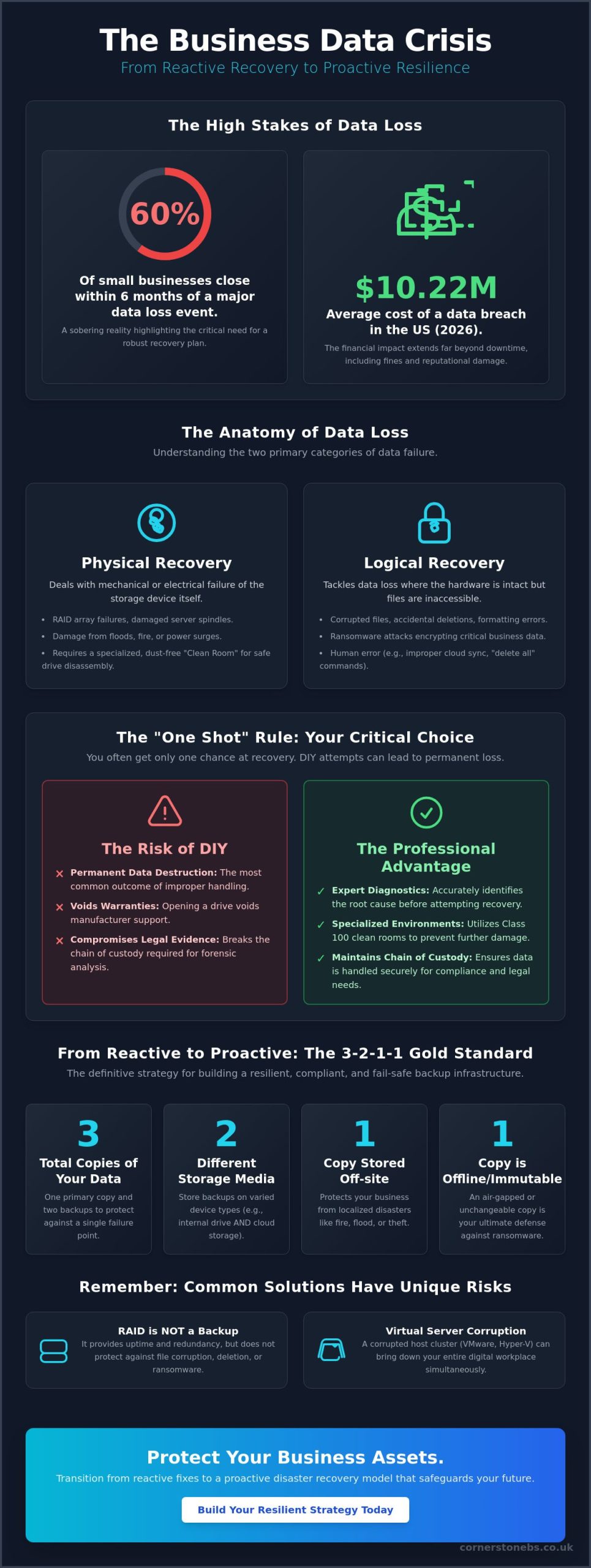
Sixty percent of small businesses that experience a major data loss event close their doors within just six months. It is a sobering reality, especially when you consider that the average cost of a data breach in the United States has climbed to $10.22 million in 2026. You have likely felt the mounting pressure of keeping up with strict regulations like California’s SB 446 while searching for professional business data recovery services that truly understand the cost of operational downtime. It is natural to feel protective of the assets you have worked so hard to build within our community.
Key Takeaways
- Distinguish between physical hardware failures and logical data corruption to select the most effective path for business data recovery services.
- Learn how expert restoration of RAID arrays and SQL databases prevents long-term operational downtime for your core infrastructure.
- Understand the “One Shot” rule and why professional diagnostics are essential to avoid the permanent loss often caused by DIY recovery attempts.
- Discover how to transition from reactive fixes to a proactive disaster recovery model that safeguards your business assets before a crisis hits.
- Implement the 3-2-1-1 backup gold standard to ensure your organization remains resilient and compliant in an evolving digital landscape.
What Are Business Data Recovery Services in 2026?
Professional business data recovery services represent much more than just “fixing a broken drive.” At its core, What is Data Recovery involves the sophisticated process of salvaging inaccessible, lost, or corrupted information from business-grade storage systems. While a consumer might focus on saving personal photos, your organization needs to restore entire SQL databases, virtualized environments, and encrypted archives to maintain operational continuity. We see this as a foundational element of your business stability, not just a technical fix.
We categorize these efforts into two distinct areas. Physical recovery deals with mechanical failure; imagine a server damaged by a localized flood or a RAID array with multiple failed spindles. This work often requires a specialized “Clean Room” environment. These labs are designed to keep the air completely free of dust particles that could ruin sensitive drive platters during an open-drive procedure. Logical recovery, however, tackles corrupted files, accidental deletions, or data held hostage by ransomware. In 2026, business data recovery services must be agile enough to handle both scenarios across complex hybrid-cloud setups.
The scale of business recovery is what sets it apart. You aren’t just dealing with higher volumes of data; you are dealing with layers of encryption and strict compliance requirements. A local expert understands that your data isn’t just a collection of bits. It is your reputation, your intellectual property, and your legal responsibility.
The Evolution of Data Loss: More Than Just Hardware Failure
Data loss isn’t always a dramatic hardware crash. Simple human error remains a leading cause of downtime. Whether it’s an accidental “delete all” command or an improperly configured cloud sync, the results are equally devastating. We are also seeing a rise in “stealth ransomware” that sits dormant in your backups for months before activating. This makes “clean recovery” a vital part of your strategy, as it ensures you aren’t just restoring the same malware that caused the initial crisis. Logical corruption within complex virtualized environments is another growing hurdle that requires expert intervention to untangle.
Why Professional Services Are Non-Negotiable for UK Firms
Compliance is a major driver for professional intervention. With the 2026 updates to data protection laws, the financial penalties for losing client data are staggering. You need a partner who maintains a strict chain of custody. This is essential for legal and forensic evidence if a breach occurs. Trying a “DIY” fix on a failing drive usually results in permanent data destruction. You often get just one chance to get it right. We take that responsibility seriously, acting as your dedicated partner to ensure your data remains secure and your business stays compliant.
Critical Recovery Scenarios: RAID, Servers, and Cloud Infrastructure
Modern business storage is a complex web of interconnected systems. While these setups provide incredible speed and efficiency, they also create unique challenges when things go wrong. Professional business data recovery services must look beyond simple file retrieval to understand the architectural nuances of your NAS, SAN, and server environments. We know that for a local business, every hour your SQL database or Exchange server is offline is an hour of lost opportunity. Our goal is to bridge that gap with expert precision and local reliability.
RAID and Enterprise Storage Challenges
Many business owners believe that RAID is a substitute for a backup. It isn’t. RAID provides uptime, not data protection. If a multi-disk failure occurs in a RAID 5 or RAID 6 configuration, the “rebuild” process itself can often stress the remaining healthy drives to the point of total collapse. We specialize in reconstructing data from these striped and parity-based configurations, even when proprietary file systems are involved. Recovering an enterprise array requires a deep understanding of block-level data distribution. A solid disaster recovery strategy serves as your first line of defense, but when hardware fails, specialized reconstruction is the only way forward.
Server recovery extends to virtualized environments like VMware and Hyper-V. When a host cluster becomes corrupted, it doesn’t just affect one machine; it can bring down your entire digital workplace. We treat these virtual machine (VM) recoveries with the highest priority, untangling the corruption within the hypervisor to restore your proprietary business applications and data layers.
Recovering the Modern Hybrid Workspace
The SERP gap in most recovery discussions is the “cloud safety” myth. Just because your data lives in Microsoft 365, SharePoint, or Azure doesn’t mean it’s immune to loss. Accidental deletions, sync errors, and “SaaS Data Sprawl” can leave critical information scattered and inaccessible. We help you retrieve data from these cloud environments and remote worker devices, ensuring your mobile endpoints are back in the loop quickly.
Recovering data is only half the battle. In 2026, we must ensure that the restored information isn’t hiding dormant malware. Integrating robust cyber security services into the recovery process ensures that your “clean” data is actually safe to use. This proactive approach protects your infrastructure from immediate re-infection. If you’re concerned about the resilience of your current setup, we’d love to chat about our cloud solutions and how they can simplify your path to recovery.
The Business Case for Professional Recovery vs. DIY Attempts
The “Downtime Clock” starts the moment a system fails. For most organizations, the true cost of an outage isn’t just the IT bill. It’s the cumulative loss of productivity, missed deadlines, and the erosion of client trust. While it might be tempting to reach for a “free” tool found online, professional business data recovery services offer a level of certainty that software alone cannot match. We view data recovery as a critical component of your broader business stability. We want to ensure your operations return to normal with minimal friction.
Understanding the official disaster recovery plan definition highlights that true resilience is about more than just backups. It is about a structured, expert response. One of the most vital concepts we share with our partners is the “One Shot” rule. The first attempt at recovering data from a compromised device is statistically your most likely path to success. Every subsequent attempt, especially those made by untrained hands, significantly decreases the chances of a full restoration. A human engineer brings a level of diagnostic nuance that automated tools simply lack.
The Hidden Risks of DIY Recovery Software
Using automated software on a failing hard drive is often like trying to run a marathon on a broken leg. If the drive has a mechanical issue, such as a motor failure or a head crash, running software forces the device to spin at high speeds. This can cause the read heads to scrape across the data platters. This often turns your valuable information into literal dust. Unlike the generic advice found on public forums, we can identify these mechanical warnings before a single bit is read. This protects your hardware from permanent, irreversible damage.
Confidentiality and Compliance in the Recovery Process
Your intellectual property is the lifeblood of your company. When you partner with a local expert, you ensure that your sensitive data never leaves the UK. We use strict security protocols, including background-checked staff and robust Non-Disclosure Agreements (NDAs), to give you total peace of mind. Every recovered file is returned on an encrypted drive. This maintains a secure chain of custody from start to finish. This level of care is essential for meeting modern regulatory standards and protecting your professional reputation. We don’t just recover files; we protect your business’s future.
The Professional Data Recovery Process: What to Expect
When you reach out for business data recovery services, the first step is always a transparent conversation. We need to understand your specific timeline. Whether it’s a single database or an entire server cluster, we establish the criticality of the lost data to ensure our engineering resources are focused where they matter most for your continuity. This initial consultation isn’t just about technical specs; it’s about understanding how the loss impacts your team and your clients. We want to provide a clear path forward that eases the immediate stress of the situation.
Once we have your media in our lab, we move into the diagnostic phase. Our engineers identify the root cause of the failure, distinguishing between physical hardware damage and logical corruption. We then provide you with a comprehensive quote and a detailed file list. You’ll see exactly what is recoverable before you commit to the full service. During the actual recovery phase, we use specialized hardware to clone your device bit-by-bit. This allows us to extract data from a stable copy, protecting your original hardware from any further wear or risk. Finally, we verify the integrity of every file to ensure your data is ready for immediate use.
Diagnostic and Assessment: The Critical First 24 Hours
Our engineers use specialized “Read-Only” tools during the testing phase. These tools prevent the operating system from writing any new metadata to your drive, which is vital for preserving the current state of your files. You will receive a “File Tree” report that acts as a digital inventory of your recoverable assets. This transparency is a cornerstone of our service. Most professional partners operate on a “No Data, No Fee” structure, meaning you only pay for the successful retrieval of the information you actually need. It’s a proactive way to build trust during a difficult time.
Secure Delivery and Post-Recovery Support
We offer multiple options for the secure return of your data, including encrypted physical media or a direct, secure cloud transfer. We don’t just hand you a drive and consider the job done. Our team can work alongside your internal IT staff to assist with the re-integration of recovered databases or email archives into your existing network infrastructure. A certified Clean Room is a specialized laboratory environment that utilizes high-efficiency particulate air filtration to eliminate microscopic dust that would otherwise destroy exposed drive platters during physical repair. If you are dealing with a sudden outage, invite us to a conversation so we can start your diagnostic today.
Beyond Recovery: Building a Resilient Disaster Recovery Strategy
While expert business data recovery services act as a vital safety net, our ultimate goal is to build a system where you never have to experience the panic of data loss. We want to help you move away from a reactive “emergency fix” mindset. Instead, we focus on a proactive model that prioritizes total business continuity. We don’t just want to be the team you call after a crash; we want to be the partners who ensure your operations stay steady, no matter what happens in the digital landscape.
The 3-2-1 backup rule is still the gold standard for protection, but in 2026, we have taken it a step further. You should keep three copies of your data on two different media types, with at least one copy stored off-site and immutable. This air-gapped copy is your last line of defense against modern ransomware. For organizations that can’t afford even a few minutes of downtime, Disaster Recovery as a Service (DRaaS) provides a path to near-zero Recovery Time Objectives (RTO). It’s essentially a “standby” version of your digital environment, ready to activate the moment your primary systems falter.
Regular “fire drills” are the only way to know your plan actually works. We don’t just set up your backups and hope for the best. We test them. We simulate failures to verify that your data can be restored quickly and accurately. This ensures that when a real crisis hits, your team knows exactly what to do, and your systems respond with the reliability you expect.
The Role of Cloud Solutions in Business Continuity
Modern cloud solutions provide the foundation for this off-site safety. By utilizing tools like Microsoft Azure Site Recovery, we can provide instant failover for your most critical servers. If your physical hardware fails, your business simply keeps running in the cloud. We also find that a well-planned Microsoft 365 migration is a key step in decentralizing your data. It moves your essential files into a secure, redundant environment that your team can access from anywhere, safely.
Partnering for Long-Term Peace of Mind
Choosing an IT partner is about more than just technical specs. As a multi-award-winning team, we’re proud of our regional roots and our commitment to the success of our local business community. When you invest in business data recovery services, you’re really buying the emotional security that comes from knowing your assets are protected. We customize every recovery plan to fit your specific risk profile, ensuring you have the right level of protection without unnecessary complexity.
Our managed IT services are designed to provide the foundational stability your company needs to grow. We’d like to invite you to an informal, no-obligation conversation about your current backup resilience. Let’s make sure your business is ready for whatever 2026 brings.
Secure Your Future with Proactive Data Resilience
Your business data is more than just files on a drive; it’s the foundation of your hard-earned reputation and operational stability. We’ve explored how the 2026 regulatory landscape and sophisticated cyber threats make professional intervention essential. Whether you’re managing complex RAID arrays or navigating cloud-based SaaS sprawl, the right strategy ensures you aren’t just recovering data, but restoring confidence. Professional business data recovery services provide the technical precision needed to bypass the “One Shot” risk of DIY attempts while keeping your intellectual property securely within the UK.
As a multi-award-winning UK IT provider, we combine regional warmth with global expertise. Our deep partnerships with Microsoft, IBM, and Cisco allow us to build high-security environments that exceed standard GDPR requirements. We’re here to be your long-term partner, not just a one-time fix. It’s time to move from reactive worry to proactive peace of mind. Book a Disaster Recovery Audit with our Award-Winning Team today. Let’s work together to ensure your business remains resilient, secure, and ready for whatever comes next.
Frequently Asked Questions
How much do business data recovery services cost?
Pricing for business data recovery services depends on the complexity of your storage architecture and the specific nature of the failure. A logical file corruption on a single SSD requires a different engineering approach than a multi-disk RAID array with mechanical damage. We provide a transparent, fixed quote after the diagnostic phase so you know exactly what the investment will be before we begin the work.
Is data recovery 100% guaranteed for every business?
No professional provider can offer a 100% guarantee because physical damage can sometimes be irreversible. If a hard drive’s magnetic platters are physically scraped or “scored,” the data may be lost forever. However, our team uses specialized laboratory tools to maximize the chances of a successful retrieval. We operate with a proactive mindset to ensure we exhaust every technical possibility to get your files back.
How long does the business data recovery process typically take?
The timeline varies based on the volume of data and the severity of the hardware failure. A standard logical recovery might be completed in a few business days, while complex server reconstructions requiring donor parts can take longer. We establish a clear timeline during your initial consultation to help you manage operational downtime. We always balance speed with the precision needed for a clean result.
Can you recover data from a server that has been encrypted by ransomware?
Recovery from ransomware is often possible depending on the encryption strain and the state of your system’s shadow copies. Our experts analyze the infection to determine if a “clean recovery” can be performed without paying a ransom. We integrate this process with our cyber security protocols to ensure that once your data is restored, your entire network infrastructure remains protected from re-infection.
What is the difference between data backup and disaster recovery?
Data backup is the act of copying your files, while disaster recovery is the comprehensive plan and infrastructure used to restore your entire business operation. Think of backup as the spare tyre in your boot and disaster recovery as the expert roadside team that gets you back on the motorway. A robust strategy defines your Recovery Time Objective (RTO) to minimize the costs of prolonged operational downtime.
Will our business data remain confidential during the recovery process?
Confidentiality is a foundational element of our partnership. we use strict security protocols, including background-checked engineers and Non-Disclosure Agreements, to protect your intellectual property. Your sensitive data remains within the UK throughout the entire process. We return your recovered information on encrypted media to maintain a secure chain of custody and ensure you remain fully compliant with all data protection regulations.
What should I do immediately after discovering business data loss?
You should immediately power down the affected device and disconnect it from your network. Continued use of a failing drive or an infected server can cause permanent data destruction or allow malware to spread to other systems. Avoid the temptation to use “free” software tools, as these often overwrite the very files you need to save. Contact a local expert to begin a safe diagnostic process immediately.
Tags: 3-2-1-1 rule, Business Continuity, Compliance, Data Recovery, data resilience, data security, disaster recovery, RAID recovery