

Ransomware prevention in 2026 is no longer about building a taller wall, but about creating a resilient ecosystem where identity is the new perimeter. With the UK recently named the most attacked country in Europe, the fear of business-ending downtime is a heavy weight for any leader to carry. You’re likely tired of complex jargon and skeptical of software that promises the world but delivers little. We understand you need a reliable ransomware prevention checklist that works for your specific team without the fluff.
This expert-led guide is designed to harden your business against modern threats like AI-enabled attacks and the growth of Ransomware-as-a-Service. We’ll show you how to move from reactive fixes to a proactive stance that aligns with the latest National Cyber Security Centre guidance and the new Cyber Security and Resilience Bill. By following these prioritized steps, you can ensure compliance with UK standards like Cyber Essentials and build the total resilience your company needs to thrive. It’s time to replace uncertainty with a clear, benefit-driven plan for your digital security and long-term peace of mind.
Key Takeaways
- Move beyond basic backups by learning how to defend against triple extortion tactics that threaten to leak your private data.
- Upgrade your technical hardening from traditional antivirus to proactive Endpoint Detection and Response for faster threat mitigation.
- Stop sophisticated credential theft by implementing phishing-resistant MFA that bypasses common hacker techniques like push notification fatigue.
- Use our expert-led ransomware prevention checklist to prioritize your security tasks and ensure full compliance with UK standards like Cyber Essentials.
- Explore how Managed IT Support offers a cost-effective way to maintain 24/7 monitoring and professional expertise for your digital infrastructure.
The Evolution of Ransomware in 2026: Why Basic Protection Fails
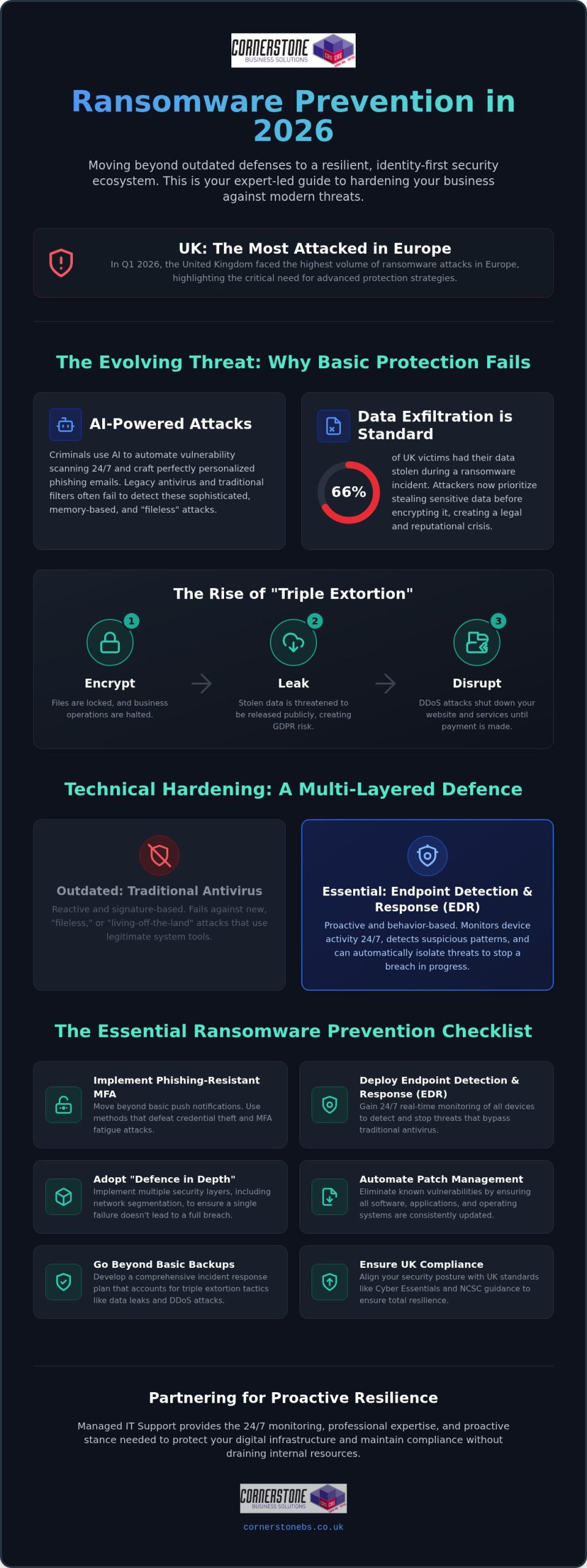
Ransomware has transformed from a simple nuisance into a sophisticated, multi-stage extortion event. In the first quarter of 2026, the United Kingdom became the most attacked country in Europe, proving that old-school defences are no longer enough. To understand why your current ransomware prevention checklist might be outdated, we need to look at how the threat has changed. Modern attacks aren’t just about locking files; they’re about total business leverage. If you’re still asking What is Ransomware?, the answer in 2026 is far more dangerous than it was even two years ago.
Hackers now use AI to automate the discovery of vulnerabilities, scanning your network for weaknesses 24/7. They don’t just wait for a lucky break; they create one. Legacy antivirus software often fails because it looks for known signatures or files. Today’s fileless malware attacks hide in your computer’s memory or use legitimate system tools to bypass detection entirely. We’re also seeing the rise of Triple Extortion. This is where criminals encrypt your data, steal it for public leak, and then launch a DDoS attack to shut your website down until you pay. It’s a relentless cycle that basic software can’t stop alone.
From Data Encryption to Data Exfiltration
Attackers have flipped the script. They now steal your sensitive data before they ever trigger the encryption process. This gives them a backup plan if your technical recovery is solid. Double Extortion is now the industry standard threat for 2026, where criminals demand payment specifically to stop the public release of your stolen information. For a UK business, this isn’t just a technical issue. It’s a legal nightmare involving massive GDPR fines and permanent damage to your brand’s reputation. According to 2026 data from Proofpoint, 66% of UK victims reported data theft during an incident, making it more likely than not that your data will be leaked if you’re hit.
AI-Driven Phishing and Social Engineering
The days of spotting a scam by its poor grammar are gone. Criminals now use Large Language Models (LLMs) to craft perfect, highly personalised phishing emails that look identical to a message from your bank or a trusted supplier. We’re also seeing a rise in Deepfake audio and video being used in business email compromise. A voice that sounds exactly like your director might call to authorize an urgent transfer. Traditional email filters struggle to catch this synthetic content because it lacks the usual red flags. This evolution makes identity security a foundational part of any modern ransomware prevention checklist.
Technical Hardening: Building a Multi-Layered Defence
Building a resilient business requires more than a single piece of software. It demands a strategy called “Defence in Depth.” This approach ensures that if one security layer fails, others are ready to catch the threat before it causes damage. A modern ransomware prevention checklist must move beyond basic firewalls to include integrated, intelligent systems that talk to each other. For a comprehensive look at these technical standards, the CISA #StopRansomware Guide provides a gold standard for configurations that every UK business leader should consider.
Automated patch management is another non-negotiable element. Hackers love unpatched software because it provides a predictable, open door into your network. In a hybrid work environment, your “perimeter” isn’t just the office walls. It’s every cloud application and remote device your team uses. Securing this cloud perimeter requires consistent updates and proactive monitoring to ensure your defences remain strong against evolving threats. Our team often finds that managed IT support is the most efficient way for businesses to maintain this level of technical hygiene without draining internal resources.
Endpoint Detection and Response (EDR)
Traditional antivirus is reactive. It waits to see a known file signature before it acts. EDR is different. It monitors the behaviour of every device on your network in real time. This is vital for stopping “Living off the Land” (LotL) attacks, where hackers use your own legitimate system tools to encrypt your data. Because most firms don’t have an in-house security team working through the night, managed EDR provides the constant oversight needed to stop a breach at 3 AM on a Sunday. It identifies suspicious patterns, like a sudden mass renaming of files, and isolates the device immediately.
Network Segmentation and Lateral Movement
Keeping your entire business on one “flat” network is a recipe for disaster. If a single laptop in your sales department gets infected, the hacker can move sideways across the network to your finance servers in minutes. Network segmentation acts like the bulkheads in a ship. By dividing your infrastructure into smaller, isolated zones, you can contain an infection to its source. This limits the “Blast Radius” of an attack, ensuring that a breach in one area doesn’t lead to total company downtime. It’s a core component of any effective ransomware prevention checklist in 2026.
Identity Security: Why MFA is No Longer a Silver Bullet
Many UK business owners believe that enabling basic Multi-Factor Authentication (MFA) makes them unhackable. It’s a common misconception. While MFA is a vital step in any ransomware prevention checklist, simple push notifications are now easily bypassed. Hackers use “MFA Fatigue” attacks, bombarding a tired employee with requests until they accidentally click “Approve.” By 2026, session hijacking and AI-powered credential theft have made traditional SMS or app-based codes insufficient.
We recommend moving toward Phishing-Resistant MFA, such as FIDO2-compliant hardware keys. These require a physical touch or biometric scan that can’t be intercepted by a remote attacker. This shift is a core recommendation in CISA’s #StopRansomware Guide, which emphasizes that identity is the new perimeter. If an attacker steals a password today, they shouldn’t automatically get the keys to your entire digital kingdom.
Implementing Zero Trust Architecture
Zero Trust isn’t a single software package you buy off the shelf. It’s a strategic mindset: “Never Trust, Always Verify.” This framework ensures that every user and device is checked every time they try to access your data, regardless of whether they are in the office or working from home. Our Cyber Security services help you build this resilience through three main pillars:
- Verify Explicitly: Always authenticate based on all available data points, including user identity, location, and device health.
- Use Least Privilege: Limit user access with “Just-In-Time” and “Just-Enough-Access” to only what they need for their specific role.
- Assume Breach: Design your systems as if an attacker is already inside the network to minimize the impact of a potential incident.
Cyber Awareness Training for the 2026 Workforce
Annual “tick-box” videos don’t stop modern attacks. Your team is your first line of defence, but they need training that reflects today’s AI-driven threats. We focus on creating a security-first culture where employees feel confident reporting a mistake rather than hiding it out of fear. Simulated phishing tests should now include deepfake audio scenarios and perfectly written AI emails. This ongoing education turns your staff into a human firewall, making your ransomware prevention checklist a living part of your daily operations.
The Essential Ransomware Prevention Checklist for 2026
Prevention is only half the battle. In 2026, true resilience means having the ability to survive and recover even if an attacker manages to breach your initial defences. This ransomware prevention checklist focuses on both stopping the entry and ensuring your business stays operational during a crisis. We believe that a proactive stance is the only way to protect your livelihood and your team’s hard work.
- Step 1: Conduct a comprehensive Cyber Security audit to find hidden gaps. This is the essential first step for any UK business to understand their current risk level.
- Step 2: Enforce Phishing-Resistant MFA across all business accounts to block sophisticated credential theft.
- Step 3: Implement the 3-2-1-1 Backup Strategy to ensure data is always recoverable.
- Step 4: Lock down Remote Desktop Protocol (RDP) and use secure VPNs for all remote access.
- Step 5: Establish a formal Incident Response Plan (IRP) and test it through monthly tabletop exercises.
If you aren’t sure where your business stands today, the best move is to book a professional security audit with our expert team to identify your most critical vulnerabilities.
The 3-2-1-1 Backup Strategy: Your Final Safety Net
In 2026, the traditional 3-2-1 rule is no longer enough because modern ransomware specifically targets and deletes backups. You need the extra “1” for immutability. Immutable backups are stored in a state that cannot be deleted, changed, or overwritten, even if a hacker gains administrative access to your network. Physically disconnected or air-gapped backups are the only true defence against encryption because they sit entirely outside the reach of the attacker’s software. You must also define your Recovery Time Objective (RTO) and Recovery Point Objective (RPO). RTO determines how quickly you need to be back online, while RPO defines how much data loss your business can actually tolerate before it becomes a disaster.
Patching and Vulnerability Management
Partnering for Resilience: Proactive Protection with Cornerstone
Trying to handle cyber security alone in 2026 is a high-risk strategy that often leaves UK firms vulnerable. Ransomware is no longer a simple virus; it’s a professional criminal operation. You need more than a static document to stay safe. You need a team that lives and breathes these threats every day. Our Managed IT Support provides the 24/7 monitoring and technical expertise required to turn your ransomware prevention checklist from a plan into a bulletproof defence.
We don’t just act as a reactive helpdesk. We position ourselves as your dedicated long-term partner, spotting the smoke before the fire starts. Proactive maintenance is always more cost-effective than emergency breach recovery. With financial losses from UK ransomware attacks increasing by 50% annually to approximately £270,000 per incident, the investment in professional oversight is a foundational element of your business stability and emotional security.
Why Outsourced Security Beats In-House Management
Managing a modern security stack requires expensive, enterprise-grade tools. Through our partnerships with industry leaders like Microsoft, Cisco, and IBM, we give you access to world-class technology without the massive upfront costs. There’s also a global talent shortage in cyber security. It’s difficult and expensive to hire a full in-house team that understands 2026-level threats. Our experts handle the complexity so you can focus on growth.
Our Cloud Solutions offer built-in resilience that traditional on-premise servers simply can’t match. We ensure your data is distributed and protected by the latest encryption standards. This allows your team to scale securely while we manage the technical infrastructure in the background. It’s a seamless way to tick off the most difficult items on your ransomware prevention checklist.
Building Your Disaster Recovery Plan
The first 60 minutes after discovering an attack are critical. Our rapid response process kicks in immediately to isolate the threat and protect your immutable backups. We focus on Business Continuity, ensuring you can keep working even if your primary systems are under pressure. We don’t just set up your systems and walk away; we test your recovery plans regularly to ensure they work when you need them most.
Following a checklist is a great start, but having a multi-award-winning team by your side provides the ultimate peace of mind. We’re proud to be a local team of experts who genuinely care about your success. We’d love to help you harden your defences and secure your future. Feel free to reach out for a no-obligation security conversation with our team today.
Building a Resilient Future for Your Business
Protecting your organization from modern threats requires more than just luck. We’ve seen how ransomware has evolved into a multi-stage extortion event where identity security and immutable backups are your strongest allies. By adopting a proactive stance and following a comprehensive ransomware prevention checklist, you replace fear with a clear strategy for growth. It’s about ensuring your team can work with confidence, knowing their data is secure.
As a multi-award-winning IT provider and official partner to Microsoft, IBM, and Cisco, we specialize in bespoke security solutions. Our UK-based proactive support desk acts as an extension of your team, providing the 24/7 oversight your business deserves. Don’t wait for a breach to discover your vulnerabilities. Book Your Comprehensive Cyber Security Audit with Cornerstone Today to harden your defences.
Taking these steps today secures your legacy for tomorrow. We’re ready to help you build a more stable, resilient business that’s prepared for whatever the digital world throws your way.
Frequently Asked Questions
What is the single most important step in ransomware prevention?
The single most important step is securing user identities through phishing-resistant Multi-Factor Authentication (MFA). Since most breaches begin with compromised credentials, hardware-based keys or biometrics create a barrier that software-only solutions can’t match. It’s the foundation of any modern ransomware prevention checklist. By ensuring that only verified users can access your network, you stop the majority of automated attacks before they can gain a foothold in your systems.
Should my business ever pay a ransomware demand in 2026?
Official guidance from the National Cyber Security Centre (NCSC) remains clear: you shouldn’t pay the ransom. Paying doesn’t guarantee your files will be returned and often funds further criminal activity. Under new UK legislation, organizations are also required to report incidents and consult with authorities within 72 hours. we focus on building resilience so that you don’t have to negotiate. A solid recovery plan is always a better investment than a ransom payment.
How often should we test our business backups?
You should perform full restoration tests at least once a quarter, though monthly testing is ideal for critical data. A backup is only as good as its last successful restore. Regular testing ensures your Recovery Time Objective (RTO) is realistic and that your team knows exactly what to do during an incident. This proactive approach identifies corruption or configuration errors early, giving you the peace of mind that your safety net is actually secure.
Does Microsoft 365 protect me from ransomware automatically?
Microsoft 365 offers strong foundational tools, but it doesn’t protect you from ransomware automatically without expert configuration. You must actively enable features like conditional access, advanced threat protection, and secure defaults to stop modern attacks. It’s a shared responsibility model where Microsoft secures the platform while you secure your data. Our team ensures your environment is hardened against the specific fileless malware and credential theft techniques that are prevalent in the UK today.
What is an immutable backup and why do I need one?
An immutable backup is a data copy that cannot be altered, encrypted, or deleted for a set period. Even if a hacker gains administrative privileges, they cannot destroy this data. In 2026, attackers specifically target backup servers to force a ransom payment. Having an immutable copy ensures you always have a “clean” version of your business data available for recovery, making the threat of permanent encryption much less significant for your operations.
How can I tell if my business has already been breached?
Look for subtle signs like unusual network latency, unexpected account lockouts, or unauthorized configuration changes. Modern attackers often stay “silent” in your network for weeks to exfiltrate data before triggering encryption. Implementing Endpoint Detection and Response (EDR) is the best way to spot these anomalies. EDR monitors behaviour in real time, alerting you to “Living off the Land” techniques that traditional antivirus software would likely miss until it’s too late.
Is Cyber Essentials certification enough to stop ransomware?
Cyber Essentials is an excellent baseline that covers approximately 80% of common cyber threats, but it isn’t a “set and forget” solution. It provides the foundational controls every UK business needs for compliance. However, to defend against the AI-driven and triple-extortion attacks of 2026, you need to layer this certification with advanced strategies like Zero Trust architecture and 24/7 proactive monitoring. It’s a vital part of your security journey, not the destination.
What is the cost of a ransomware attack for a UK SME?
Beyond the direct financial hit, the true cost of an attack in 2026 includes massive downtime and permanent reputational damage. Industry data from Sophos shows the average global recovery cost has risen to $1.7 million when you factor in lost productivity and restoration. For many UK SMEs, these hidden expenses are far more damaging than the ransom itself. Following a professional ransomware prevention checklist is the most cost-effective way to avoid these business-ending financial burdens.
Tags: Cyber Essentials, Cyber Security, Endpoint Detection and Response, managed IT support, NCSC, Ransomware Prevention, UK business