
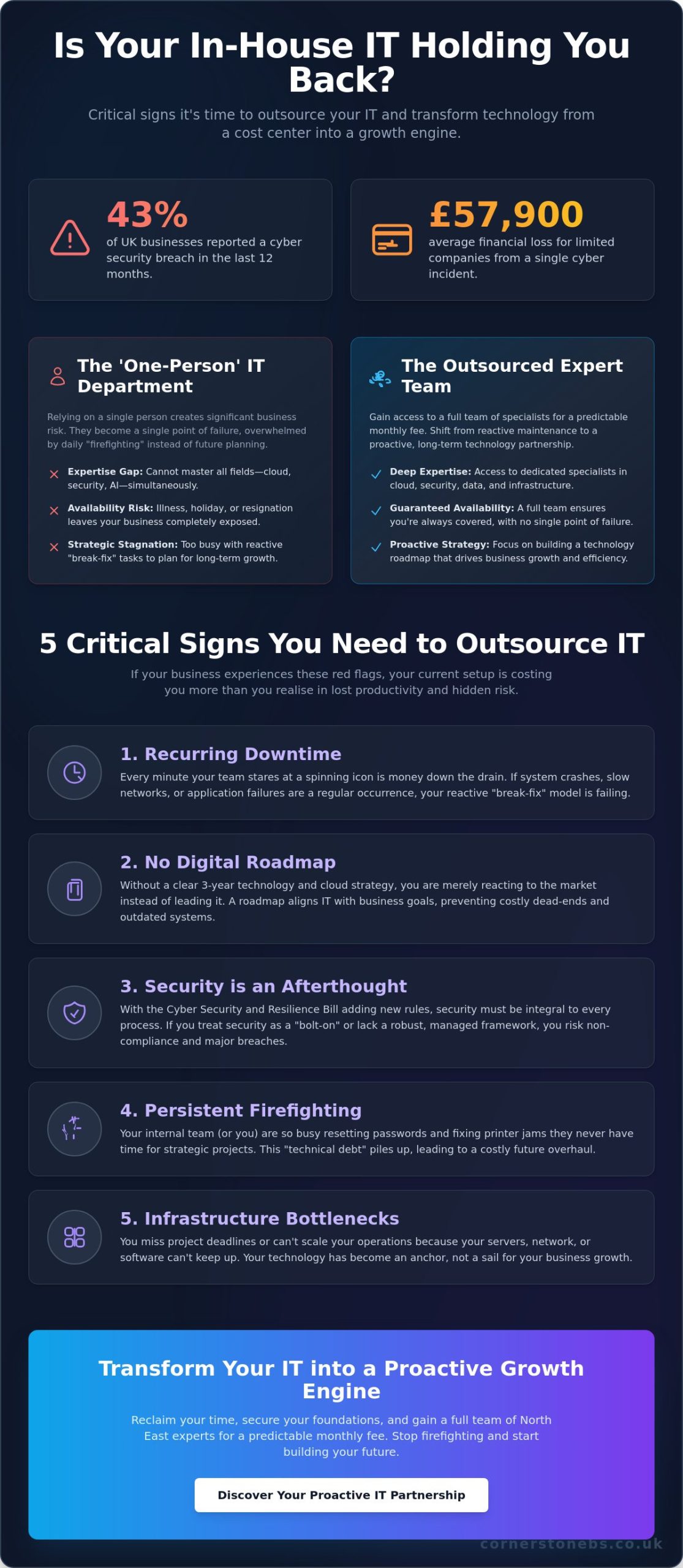
With 43% of UK businesses reporting a cyber security breach in the last 12 months, the cost of “getting by” with a struggling tech setup has never been higher. When a single incident now averages a £57,900 financial loss for limited companies, you can’t afford to ignore the clear signs you need to outsource your IT. Perhaps your in-house staff is buried under minor helpdesk tickets, or you’re feeling anxious about the mandatory 24 hour incident reporting rules introduced in the Cyber Security and Resilience Bill last November. These aren’t just technical glitches; they’re barriers to your company’s growth.
We understand how exhausting it is to manage unpredictable spending while worrying if your data is truly secure. You deserve technology that works as hard as you do. This guide identifies the critical red flags in your current infrastructure and explains how an award-winning partnership can transform your IT into a proactive growth engine. We’ll show you how to reclaim your time, secure your foundations against 2026’s regulatory shifts, and gain access to a full team of North East experts for a predictable monthly fee.
Key Takeaways
- Spot the moment your internal IT hits its ceiling and starts hindering your ability to scale rather than enabling it.
- Identify the five clear signs you need to outsource your IT, including persistent downtime and the absence of a long-term cloud roadmap.
- Secure your business insurance eligibility by moving beyond “DIY” security to a robust, specialist-managed framework that handles 2026’s complex regulations.
- Compare the financial logic of a single senior salary against the value of a full, award-winning team of experts and flexible OpEx cloud solutions.
- Reclaim your time for core business strategy by shifting from reactive maintenance to a proactive, long-term technology partnership.
Recognising the Friction: Why Internal IT Often Hits a Ceiling
IT friction is the invisible anchor dragging down your business growth. It occurs the moment your technology stops being a tool for efficiency and starts becoming a hurdle for your team. Many UK businesses begin with a “DIY” approach, perhaps with a director managing the server or a tech-savvy manager looking after the emails. This works during the early days. However, as 2026 brings more complex digital demands, these makeshift systems often lead to the first clear signs you need to outsource your IT. Adopting the business practice of outsourcing allows you to move past these hurdles with ease.
When IT Issues Dictate Your Daily Schedule
The Limitations of the ‘One-Person’ IT Department
Relying on a single IT person is a significant business risk. If your only expert falls ill, goes on holiday, or leaves for a new role, your entire infrastructure is vulnerable. A single person simply cannot stay an expert in every field simultaneously. They can’t master complex cloud solutions while also managing business VoIP, hardware procurement, and evolving cyber threats. There’s a world of difference between “just about managing” and having a robust managed IT services strategy. We provide a full team of specialists, ensuring you always have the right expert for the task at hand.
- Expertise Gap: One person can’t keep pace with 2026’s rapid tech evolution.
- Availability Risk: Absence or resignation leaves your business totally exposed.
5 Critical Operational Signs You Need to Outsource Your IT
Identifying the signs you need to outsource your IT isn’t just about fixing broken computers. It’s about spotting when your business operations are red-lining. Experts often point to several clear signs it’s time to outsource, and for UK firms in 2026, these indicators are increasingly tied to regulatory compliance and competitive survival. If your business is experiencing any of the following five red flags, your current setup is likely costing you more than you realise.
- Recurring Downtime: Every minute your team stares at a spinning icon is money down the drain. If system crashes are a weekly occurrence, your “break-fix” model is failing.
- No Digital Roadmap: Without a three-year cloud solutions strategy, you’re merely reacting to the market rather than leading it.
- Security as an Afterthought: With the 2025 Cyber Security and Resilience Bill now in full force, security must be baked into every process, not just added as a bolt-on.
- Infrastructure Bottlenecks: You are missing project deadlines because your current servers or network can’t handle the workload of a growing team.
If these signs feel familiar, it’s often more effective to have a quick chat with our award-winning team about a more proactive approach to your technology.
Persistent Downtime and the ‘Break-Fix’ Cycle
Stalled Digital Transformation and Innovation
The Invisible Risks: Security, Compliance, and Data Protection
Insurance companies have noticed this shift too. To qualify for comprehensive cyber insurance today, many UK providers now mandate professional cyber security services. They want to see evidence of 24/7/365 threat detection and a transition toward Zero Trust architecture. This model assumes every login attempt is a potential threat until verified. It’s a level of scrutiny that in-house teams simply cannot maintain because they need to sleep, take holidays, and manage other tasks. An award-winning partner fills this gap, providing a robust shield that never blinks.
The Complexity of UK Regulatory Compliance
Navigating the UK’s shifting legal landscape is a full-time job. With the Data (Use and Access) Act 2025 introducing new phased requirements throughout 2026, the burden on internal staff is immense. We help North East businesses manage the specific demands of NIS2 and DORA, ensuring you stay on the right side of the law. Beyond avoiding fines, robust compliance acts as a powerful business enabler that helps you win larger contracts by proving your reliability to partners and stakeholders.
Disaster Recovery: Beyond Simple Backups
- Zero Trust: Moving from basic antivirus to identity-based security.
- Threat Detection: Constant monitoring that catches breaches before they spread.
- Audit Readiness: Maintaining the logs and proof needed for UK regulations.
The Financial Logic: Comparing In-House Costs vs. Managed IT
Moving from CapEx to OpEx is a game-changer for 2026 budgeting. Instead of dropping £10,000 on a new server every few years, you shift to predictable cloud subscriptions. This keeps your cash flow steady and ensures you’re always using the latest technology without the “sticker shock” of hardware failures. Many UK tech leaders now prefer this model because it removes the burden of asset management. If you’re ready to stabilise your spending, you can view our managed IT support options to see how we can protect your margins.
- Recruitment Fees: Hiring internal staff often costs 15% to 20% of the annual salary in agency fees.
- Continuous Training: Keeping an internal person certified in 2026’s AI and security standards is a significant, ongoing expense.
- Tooling Costs: Professional monitoring and management software carries high licensing fees for individual companies.
Predictable Budgeting and Scalability
The Hybrid Model: Supporting Your Existing Team
Choosing a Partner: Why Cornerstone is the Proactive Choice
A reliable partnership relies on a clear Service Level Agreement (SLA). You should look for a provider that offers firm uptime guarantees and rapid response times that respect your busy schedule. Our transition process is designed to be seamless. We begin with a deep-dive audit of your current setup to identify any hidden risks or inefficiencies. We then onboard your team with care, ensuring every staff member feels supported as we move your systems toward a more robust, proactive model.
The Cornerstone Business Solutions Difference: Award-Winning Support
Your Next Steps to IT Freedom
Reclaiming your time starts with a simple conversation. During our initial strategy session, we’ll define your specific business goals for 2026 so your technology can be tailored to support them. Whether you’re looking to meet the new requirements of the Data (Use and Access) Act 2025 or simply want to end the cycle of “firefighting” IT issues, we’re here to help. We’ll show you how to turn your IT from a source of anxiety into a strategic advantage. Book a chat with our expert team today to reclaim your peace of mind and start your journey toward a more secure, efficient future.
- Global Standards, Local Heart: World-class tech from Microsoft and Cisco delivered by a North East team.
- Seamless Onboarding: A structured audit process that ensures no data is lost and no time is wasted.
- Proactive Peace of Mind: Monitoring that works 24/7 so you don’t have to worry about the next breach or crash.
Secure Your Growth with a Strategic IT Partnership
As a multi-award-winning IT services provider, Cornerstone Business Solutions brings the power of global partnerships with Microsoft, IBM, and Cisco directly to your North East doorstep. Our proactive 24/7 system monitoring identifies threats before they reach your network, giving you total peace of mind. We’re ready to help you move beyond firefighting and start innovating. Ready for IT peace of mind? Let’s have a chat about your bespoke solution.
Frequently Asked Questions
Is it cheaper to outsource IT or keep it in-house in 2026?
Will I lose control of my business data if I outsource my IT?
You retain full ownership and control of your data; your provider simply acts as a secure custodian. We implement robust access controls and ensure your systems comply with the Data (Use and Access) Act 2025. This partnership actually increases your control by providing clearer visibility through regular audits and real-time reporting that in-house setups often lack.
What is the difference between managed IT support and basic tech support?
Managed support is proactive and focuses on preventing issues before they happen through 24/7 monitoring and strategic planning. Basic tech support is typically “break-fix,” where you pay £80 to £150 per hour only when something fails. If you notice persistent downtime, these are clear signs you need to outsource your IT to a partner that prioritises your peace of mind.
How long does it take to transition to an outsourced IT provider?
A seamless transition typically takes between 30 and 90 days, depending on the complexity of your current infrastructure. We begin with a deep-dive audit of your network and security protocols to ensure no data is lost. This structured approach allows us to onboard your staff and deploy proactive monitoring tools without interrupting your daily business operations in the North East.
Can an IT outsourcing company work with my existing in-house IT manager?
What should be included in a standard managed IT service level agreement (SLA)?
A robust SLA must include specific response times, resolution guarantees, and clear uptime targets, such as 99.9%. It should also outline the scope of support for Microsoft 365, cyber security, and disaster recovery. We ensure our SLAs are transparent and benefit-driven, so you know exactly what level of award-winning service to expect from our local team every single month.
How does IT outsourcing improve my business’s cyber security?
Outsourcing provides access to advanced threat detection and Security Operations Centres (SOC) that most SMEs cannot afford in-house. With 43% of UK businesses facing breaches in 2026, having a partner that manages mandatory 24 hour incident reporting is vital. We implement Zero Trust architectures and proactive patching to protect your reputation and meet the strict requirements of the Cyber Security and Resilience Bill.
Do I need to be a large company to benefit from outsourced IT?
No, small and medium-sized enterprises often see the greatest benefit from outsourcing because it levels the playing field. It allows you to access the same robust network infrastructure and expert talent as global corporations without the massive price tag. Identifying the signs you need to outsource your IT early helps smaller firms scale faster by removing technical bottlenecks and securing their digital foundations.
Tags: Business Growth, Cyber Security, IT Outsourcing, IT strategy, It Support, managed IT services, UK business