

What if your technology stopped being a source of stress and started being your biggest competitive advantage? For many local firms, IT often feels like a series of expensive fires to put out, especially with 50% of mid-sized UK businesses facing a cyber breach in the last year. It’s time to change that perspective. Strategic IT infrastructure planning for small business is the difference between a system that hinders your staff and one that drives your growth. As a dedicated local partner, we’ve seen how the right foundation turns IT from a reactive cost into a proactive engine for success.
We know the frustration of unpredictable monthly spend and the nagging fear that a single security flaw could halt your operations. You deserve a stable, “always-on” environment where your data is secure and your costs are predictable. This guide provides a clear roadmap to achieving exactly that. We’ll walk you through the 2026 UK regulatory landscape, including the Cyber Security and Resilience Bill, and show you how to navigate upcoming Microsoft 365 price changes. By the end, you’ll have the confidence to build a resilient, scalable foundation that protects your business and empowers your team to work without limits.
- Learn why shifting from reactive “break-fix” support to a proactive strategic partnership is essential for your organization’s resilience.
- Discover the core pillars of IT infrastructure planning for small business, including cloud solutions and the final UK PSTN switch-off.
- Identify the “silent tax” of slow systems. We’ll show you how proactive planning eliminates the high costs of unplanned downtime.
- Follow our five-step framework to audit your current digital landscape and resolve single points of failure.
- See how Cornerstone Business Solutions’ multi-award-winning approach provides the approachable, expert warmth your local business deserves.
What is IT Infrastructure Planning for Small Businesses?
Think of your technology as the digital backbone of everything you do. From the moment you open your email to the final backup of the day, your systems are working hard to keep your business moving. To understand the basics, we often look at What is IT Infrastructure as a combination of hardware, software, and network resources. For a local firm, this isn’t just “tech stuff.” It’s the very foundation of your service. Effective IT infrastructure planning for small business transforms these components from a messy collection of tools into a streamlined growth engine.
The Difference Between IT Support and IT Strategy
IT support is about the “now.” It’s the helpdesk fixing a printer or resetting a password. While essential, support alone won’t grow your business or drive digital transformation. IT strategy is about the “next.” It looks at where you want to be in twelve months and builds the path to get there. We use proactive system monitoring to stop issues before they even reach your desk. This keeps your staff productive and your operations smooth, ensuring your technology supports your goals rather than standing in the way.
Why Small Businesses Cannot Afford “Accidental” IT
Building a Resilient 2026 Technology Roadmap
A resilient roadmap isn’t just a list of hardware you want to buy. It’s a strategic shield that protects your operations from the unexpected. For 2026, effective IT infrastructure planning for small business rests on four critical pillars: Security, Cloud, Connectivity, and Continuity. When these elements work in harmony, your technology moves from being a source of friction to a driver of efficiency. You stop worrying about what might go wrong and start focusing on how much further your team can go.
One of the most urgent shifts for UK firms right now is the final move away from legacy systems. The UK’s old copper network is being phased out, making the transition to resilient VoIP telephone systems a necessity rather than a choice. Future-proofing your communications ensures you aren’t left behind when the final PSTN switch-off deadlines hit. By planning this transition now, you avoid the rush and ensure your business mobile and office lines remain crystal clear and fully integrated.
Surprise capital expenditure is the enemy of a healthy cash flow. We recommend aligning your hardware refresh cycles with your long-term financial planning. This prevents that sudden £2,000 bill when an old server finally gives up. Instead, you can spread costs and ensure your staff always have reliable, high-performance tools. In 2026, this also means adopting a “Zero Trust” security posture. With the Cyber Security and Resilience Bill now in force, even the smallest firms must verify every user and device. It’s about building a fortress around your data that remains invisible to your productive staff.
Cloud-First Strategy: Microsoft 365 and Azure
Your productivity hub should live where your people do: everywhere. Implementing a Microsoft 365 migration for business UK allows your team to collaborate securely from any location. By moving workloads to Azure, you eliminate the need for a noisy, expensive server room. We ensure your cloud environment is configured for maximum security and cost-efficiency, so you only pay for what you actually use. If you’re ready to modernize, we can help you start an expert IT roadmap session to plot your course.
Connectivity and Hybrid Work Infrastructure
Hybrid work is no longer a perk; it’s the standard. Your network must support seamless collaboration between the office and the home. This requires business-grade broadband that doesn’t buckle under the pressure of constant video calls. By integrating robust cloud solutions, you guarantee that your data is accessible and secure, no matter where your team logs in. This connectivity is the glue that keeps your modern business together.
The ROI of Strategic IT: Calculating the Cost of Doing Nothing
Ignoring your technology is a choice, but it’s an expensive one. Many owners view IT as a pure overhead; a necessary evil that drains the bank account every month. This perspective misses the “silent tax” that slow systems levy on your business every single day. When a staff member waits for a spinning wheel on their screen, or a slow network delays a customer quote, your profitability takes a hit. IT infrastructure planning for small business is about identifying these leaks and plugging them before they drain your margins.
Quantifying Downtime and Productivity Gaps
Downtime is easier to calculate than you might think. To find your true hourly cost of a system outage, use this simple formula: (Number of Employees x Average Hourly Rate) + Lost Revenue per Hour. For a firm with 15 staff, a single morning of downtime can easily cost over £2,000 in wasted wages and missed opportunities. By partnering with experts for managed IT services, you gain a measurable return on investment through increased uptime. Remember, “cheap” IT often ends up being the most expensive option over a three-year cycle when you factor in emergency repairs and lost productivity.
Security as a Foundation for Business Continuity
Peace of mind is perhaps the most valuable ROI of all. Knowing that your systems have 24/7 proactive threat monitoring allows you to sleep better at night. Our cyber security services act as the ultimate insurance for your hard-earned reputation. Beyond protection, a strong security posture is now a commercial requirement. With the Cyber Security and Resilience Bill tightening standards, having a certified, secure infrastructure helps you win larger contracts and pass rigorous supply chain audits with ease. Proactive IT infrastructure planning for small business ensures you’re always ready for the next big opportunity.
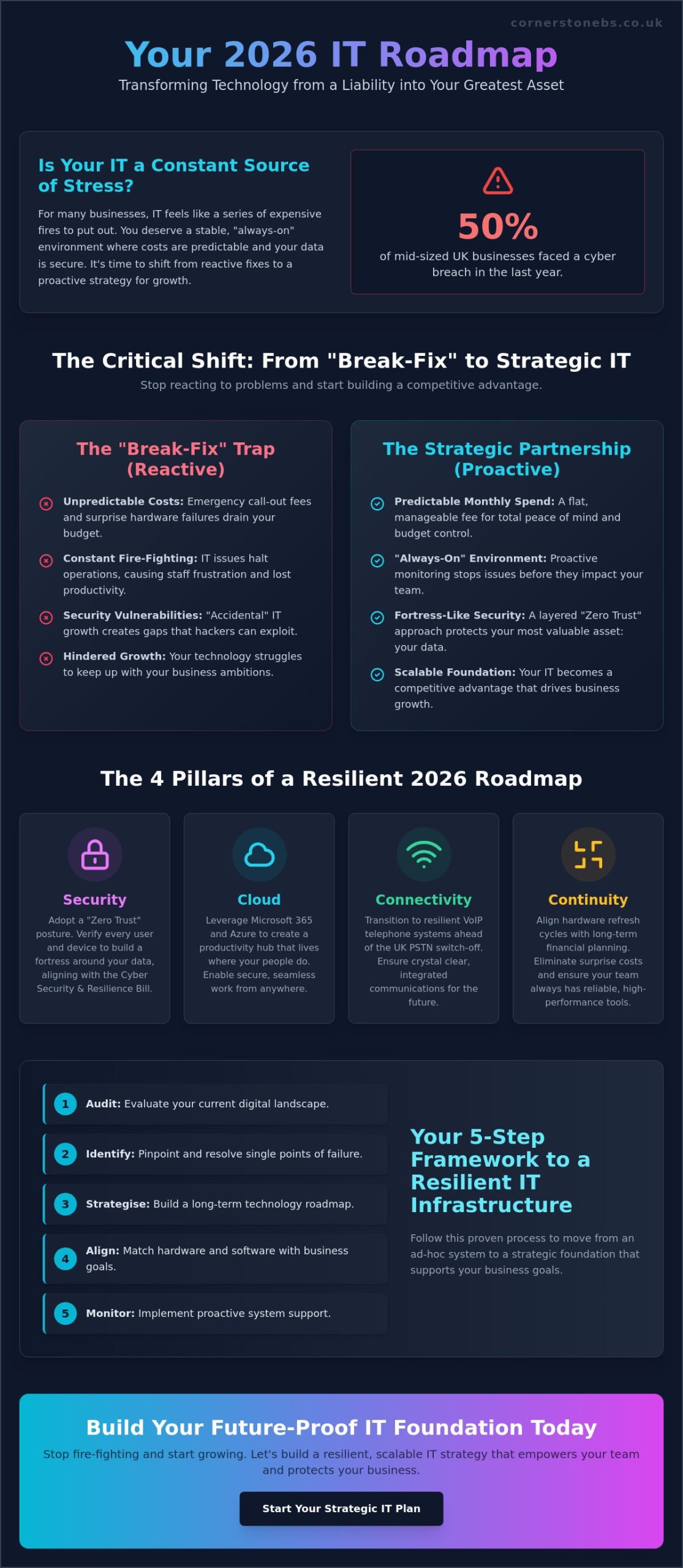
5 Steps to Building Your IT Infrastructure Plan
Creating a plan doesn’t have to be overwhelming. It’s about taking logical steps that lead to a massive improvement in your daily operations. Effective IT infrastructure planning for small business provides a clear map for your growth, ensuring you never feel stuck with outdated tools or vulnerable systems. By following a structured process, you move from “making do” to “moving forward” with total confidence.
- Step 1: Conduct a comprehensive audit. You can’t plan for the future without knowing exactly where you stand today. This involves more than just counting laptops; it’s about understanding how data flows through your business.
- Step 2: Identify business-critical risks. Locate your single points of failure. This could be an aging server, a single internet connection, or a lack of off-site backups. Identifying these gaps now prevents a crisis later.
- Step 3: Define your technology goals. Where do you want to be in 12, 24, and 36 months? Your infrastructure should scale alongside your ambitions, whether you’re adding five new staff or opening a second location.
- Step 4: Establish a sustainable budget. Shift your focus from “how much does this cost today” to “what is the total cost of ownership.” A sustainable budget avoids surprise bills and ensures your tech remains a reliable asset.
- Step 5: Select a partner who specialises in SME growth. You need more than a vendor; you need a dedicated partner who understands the local landscape and treats your success as their own.
The Audit: Looking Beyond the Servers
A true audit starts with your people. We look for staff pain points where technology is currently slowing them down. This might be a slow login process or a clunky remote access system that frustrates your hybrid workers. We also review your software licensing. Many firms overpay for unused seats or “zombie” subscriptions that drain the budget. Finally, we check your compliance against UK standards like Cyber Essentials. This government-backed scheme is a vital baseline for any firm looking to prove their security credentials to clients and insurers alike.
Aligning Tech Spend with Your Growth Ambitions
Successful planning moves you away from unpredictable capital expenditure and toward a fixed-fee it company solutions model. This makes your monthly outgoings predictable and manageable. We help you prioritise investments based on business impact rather than technical novelty. It’s not about having the newest gadget; it’s about having the right tool for the job. Regular strategy reviews are essential to keep your plan on track. As your business evolves, your technology should evolve with it. If you’re ready to build a foundation that lasts, speak with our local team to begin your journey.
Why Cornerstone is the Trusted IT Strategy Partner for UK SMEs
Choosing a partner for your technology is one of the most important decisions you’ll make for your firm’s future. At Cornerstone, we’ve built our reputation on a multi-award-winning approach to proactive technology management. We don’t just offer support; we provide a dedicated long-term partnership. Our team blends professional authority with an approachable, regional warmth that makes us feel like a part of your own office. We believe that IT infrastructure planning for small business should be a collaborative journey, not a series of one-off transactions.
We focus on the long game. While other providers might focus on quick fixes, we look at how your infrastructure will support your growth over the next three to five years. This proactive attitude ensures your systems remain resilient against emerging threats and ready for new opportunities. We frame every technical solution within the context of your business continuity and emotional security, providing a foundation you can truly rely on.
Your Virtual CTO: Expert Advice Without the Executive Salary
Imagine having the insight of a seasoned Chief Technology Officer without the burden of an executive salary. We act as an extension of your own team, driving your technology forward with clear, benefit-driven advice. We speak the language of business, not just “tech-speak,” so you’ll always understand the “why” behind our recommendations. Through regular strategic reviews, we ensure your IT infrastructure planning for small business always matches your current ambition. We keep your systems aligned with your goals, helping you scale efficiently while avoiding expensive technical debt.
Start Your 2026 Strategy Conversation Today
The best time to plan your infrastructure is before you think you need to. Waiting for a system failure or a security breach to act is a risk your business doesn’t need to take. We invite you to an informal chat about your business goals and the challenges you’re currently facing. Whether you’re worried about the upcoming Cyber Security and Resilience Bill or need to modernize your hybrid work setup, we’re here to help. Our team is ready to listen and provide a reassuring, expert perspective on your digital future.
Ready to build a roadmap for growth? Let’s have a conversation.
Secure Your Business Future Today
Your technology should be a source of confidence, not a constant worry. By shifting from reactive fixes to proactive IT infrastructure planning for small business, you ensure your organization is ready for the challenges of 2026. You’ve seen how a resilient roadmap protects your staff from downtime and how a clear audit can reveal hidden costs. This isn’t just about hardware. It’s about building a stable foundation that allows your local firm to compete with the giants.
As a multi-award-winning IT service provider, we specialize in bespoke UK SME technology solutions. Our strong partnerships with global leaders like Microsoft, IBM, and Cisco mean we bring world-class reliability right to your doorstep. We’re more than just a vendor; we’re your dedicated long-term partner. We take the stress out of compliance and security so you can focus on what you do best.
Ready to transform your IT into a growth engine? Book your 2026 IT strategy review with our award-winning team. Let’s work together to make your business systems “always-on” and fully compliant. We look forward to helping your business thrive.
Frequently Asked Questions
What exactly is included in an IT infrastructure plan for a small business?
A comprehensive plan acts as your digital blueprint. It includes a detailed inventory of your hardware, a review of your software licensing, and a clear map of your network infrastructure. We also build in robust security protocols and disaster recovery steps. This ensures every part of your technology, from your business VoIP to your cloud storage, works together to support your daily operations and long-term goals.
How much does IT infrastructure planning typically cost for a UK SME?
We only have 15 employees; are we too small for a formal IT strategy?
How often should a small business review its technology roadmap?
We recommend a formal review at least once every quarter. Technology moves fast, and your business goals can shift just as quickly. Regular check-ins ensure your IT infrastructure planning for small business remains aligned with your ambitions. These reviews also help you stay ahead of new UK regulations, such as the Cyber Security and Resilience Bill, ensuring your organization remains compliant and secure as the landscape evolves.
What is the difference between an IT audit and an IT strategy plan?
An audit is a snapshot of your technology as it exists today. It identifies aging hardware, security vulnerabilities, and software that needs updating. An IT strategy plan is the map that shows you where you’re going. While the audit finds the problems, the strategy provides the long-term solutions and the timeline to implement them. You need the audit to understand your starting point, but you need the strategy to reach your destination.
Can a better IT infrastructure plan help reduce our monthly technology bills?
How long does it take to develop and implement a full technology roadmap?
Creating the initial roadmap usually takes between two and four weeks. This allows us to conduct a thorough audit and understand your specific business challenges. Implementation is typically a phased process to avoid disrupting your staff. You might see security improvements within days, while larger projects, like migrating to a new server-less cloud environment, are carefully managed over several months to ensure a smooth and seamless transition.
What are the first signs that my business needs a formal IT infrastructure plan?
The most common red flag is a feeling of being “reactive” rather than “proactive.” If you’re constantly dealing with system slowdowns, unpredictable IT spend, or staff frustration, your current setup is likely struggling. Another sign is “accidental” growth, where you’ve added tools over time that don’t talk to each other. Moving to formal IT infrastructure planning for small business will replace this technical friction with a reliable, “always-on” environment.
Tags: cloud solutions, Cyber Security, IT infrastructure, IT strategy, Proactive IT Support, PSTN switch-off, Small Business IT, UK Business Guide