

What if the biggest hurdle to winning your next major contract isn’t your competition, but a security patch you missed just 13 days ago? It’s a stressful reality for many firms. With the introduction of the “Danzell” framework on April 27, 2026, meeting the Cyber Essentials Plus requirements has become more demanding than ever. We know the fear of failing a technical audit and losing your investment is real, especially with strict new rules regarding MFA for cloud services and specific patching windows.
You want a secure business that protects your local reputation, not just a certificate to hang on the wall. We agree that navigating these technical hurdles should feel like a proactive partnership, not a confusing headache. This guide provides a clear roadmap to passing your audit the first time by mastering the latest standards for Microsoft 365 and cloud security. You’ll learn exactly how to handle the 14-day patching rule and build a resilient infrastructure that supports your growth throughout 2026.
Key Takeaways
- Understand the vital shift from simple self-assessment to the rigorous, audited technical verification that defines the Plus standard.
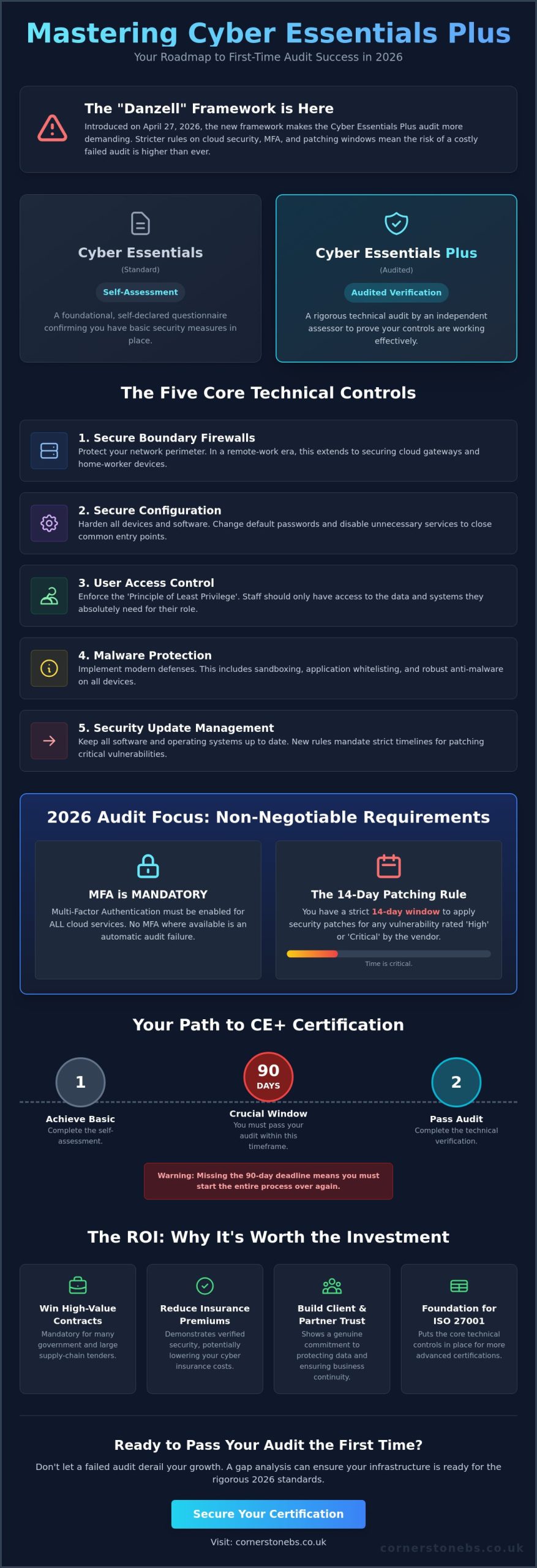
- Master the five core technical controls and the latest 2026 Cyber Essentials Plus requirements to ensure your business passes the audit first time.
- Identify common pitfalls like the “unsupported software” rule to prevent wasted investment and strengthen your overall security posture.
- Learn how to use your certification to unlock high-value government contracts and potentially reduce your annual cyber insurance premiums.
- Gain a clear roadmap for conducting a gap analysis to ensure your network infrastructure is ready for both internal and external scans.
What Are the Cyber Essentials Plus Requirements in 2026?
The 2026 security landscape has shifted significantly. For many UK businesses, the Cyber Essentials Plus requirements represent the gold standard of verified digital safety. While the basic certification is a vital first step, the Plus version is an audited, technical verification of your infrastructure. It moves beyond simple declarations and requires you to prove that your security controls actually work. In 2025 alone, 13,707 organizations achieved this higher standard, showing a clear trend toward verified resilience. Cyber Essentials Plus is the UK’s primary technical standard for verified business cyber hygiene.
Achieving this status isn’t just about security; it’s about business continuity and trust. Many government departments and large-scale supply chains now mandate this certification as a prerequisite for bidding. If you’re looking to grow, you’ll likely find that partners want to see this badge of honor. Timing is everything here. You must complete your technical audit within 90 days of achieving your basic certification. If you miss this three-month window, you’ll need to start the process from scratch, which can be a costly and time-consuming setback for any busy team.
The Core Difference: Verification vs. Declaration
The Cyber Essentials scheme offers two levels of protection. The standard level is a self-assessment where you declare your compliance. However, the Plus level introduces an independent assessor from an IASME certification body. They don’t just take your word for it. They probe your network, check your devices, and verify that your technical controls are robust. This independent validation carries much more weight with insurers and stakeholders. It transforms a “tick-box” exercise into a badge of genuine reliability that protects your local reputation and your bottom line.
Why 2026 is a Turning Point for Compliance
The 2026 update, specifically the “Danzell” framework launched on April 27, 2026, introduces more rigorous rules. There’s a much sharper focus on cloud security and Bring Your Own Device (BYOD) policies. As businesses rely more on remote work and mobile platforms, the audit standards have evolved to match these risks. Meeting these Cyber Essentials Plus requirements also provides a fantastic foundation for more complex standards. If your long-term goal includes achieving ISO 27001, the technical controls you implement now will put you miles ahead in that journey. It’s about building a strong, stable foundation for everything your business does next.
The Five Technical Controls: A 2026 Deep Dive
Meeting the Cyber Essentials Plus requirements involves mastering five core technical pillars. These aren’t just suggestions. They are the baseline for a secure, resilient infrastructure. Since the April 2026 update, the official delivery partner IASME has placed even greater emphasis on how these controls apply to cloud environments and remote workers. Your business must demonstrate that these protections are active and effective across your entire estate.
First, your firewalls must protect every boundary. In a ‘de-perimeterised’ workplace where staff work from home, this means securing your cloud gateways and local devices alike. Next comes secure configuration. We see many businesses fail because they leave ‘out-of-the-box’ settings active. You must disable unnecessary services and change all default passwords to prevent easy exploits. These simple steps build a foundation of reliability that keeps your operations running smoothly.
User access control is equally vital. You should follow the Principle of Least Privilege (PoLP). This means giving staff only the access they need for their specific role. For malware protection, a simple antivirus isn’t enough in 2026. You need to use sandboxing or trusted application execution to stop modern threats before they take hold. Finally, security update management ensures your software stays current. If a critical vulnerability is found, you have a strict window to fix it.
Mastering Access Control and MFA
Multi-Factor Authentication (MFA) is now mandatory for all cloud services and administrative accounts. If a service offers MFA, you must enable it. Failure to do so results in an automatic audit failure. Managing these privileges shouldn’t hinder your daily productivity. We recommend a clear process for prompt account deactivation when staff leave. This prevents ‘zombie’ accounts from becoming a backdoor into your sensitive data, ensuring your business stability remains intact.
The 14-Day Patching Challenge
The NCSC requirement to patch ‘high’ or ‘critical’ vulnerabilities within 14 days is often the hardest hurdle for SMEs. Manually checking every device for updates is a recipe for exhaustion. Practical strategies involve using automated tools to push updates across your hybrid work environment. Cornerstone Business Solutions automates this process for our partners, ensuring you’re always compliant without lifting a finger. If you’re feeling overwhelmed by these technical demands, looking into our Managed IT Support can provide the professional authority you need to secure your growth.
Navigating the Cyber Essentials Plus Technical Audit
The technical audit is the moment your hard work meets independent verification. It isn’t an interrogation; it’s a collaborative process to ensure your defenses are as strong as you believe. While the NCSC Cyber Essentials Overview provides the high-level framework, the audit day itself focuses on the practical application of your security controls. Our team sees this as a vital health check that provides the emotional security you need to focus on growing your business.
Meeting the Cyber Essentials Plus requirements means passing both internal and external vulnerability scans. The internal scan probes your network for known weaknesses and unpatched software, ensuring that the 14-day patching rule we discussed earlier is strictly followed. Meanwhile, the external scan looks at your public-facing infrastructure through the eyes of a hacker. It identifies open ports or misconfigured services that could provide an easy entry point for a cyber attack. These scans provide a clear, data-driven picture of your current resilience.
Beyond the automated scans, the auditor will perform workstation testing. They check individual devices to ensure malware protection is active and browser security settings are correctly configured. They’ll also verify your Multi-Factor Authentication (MFA) setup. Expect the auditor to witness MFA in action, either physically or via a remote session, to prove that your cloud services and admin accounts are truly protected. This hands-on verification is what gives the Plus certification its significant weight with partners and insurers.
What Happens on Audit Day?
The assessor starts with a walkthrough of your infrastructure. They’ll run their scanning tools and perform manual checks on a sample of your devices. A common ‘gotcha’ is the forgotten legacy server or an old printer that hasn’t been updated in years. If the scan finds issues, don’t panic. You’ll receive a ‘Technical Audit Report’ that outlines exactly what needs fixing. We help our clients interpret these findings, turning technical jargon into a simple checklist for success.
The Remote Working Audit
In 2026, many audits happen remotely. Auditors test devices used by home-workers via secure connections or VPNs. It’s important to remember that while the worker’s device remains in scope, their home router typically doesn’t. You must ensure that every laptop or tablet accessing organizational data meets the same Cyber Essentials Plus requirements as those in the office. This consistency ensures your business stability, no matter where your team chooses to work.
Preparing Your Infrastructure for Certification Success
Preparing for a technical audit shouldn’t feel like a shot in the dark. We always recommend a thorough pre-audit gap analysis to identify weak points before you pay for the official assessment. This proactive approach saves you from the frustration of a failed audit and the cost of re-testing. It’s about ensuring your Cyber Essentials Plus requirements are met in a controlled environment. We’ve seen that businesses who take the time to probe their own defenses first have a much higher success rate on their first attempt.
Your software estate is often where the biggest risks hide. The ‘unsupported software’ rule is the number one cause of audit failure in the UK. Any software no longer receiving security updates from the vendor must be removed or isolated to pass. We help our local partners audit their applications to ensure every tool is current and safe. This isn’t just about compliance; it’s about removing the easy targets that hackers love to exploit. Standardising your device builds also creates a predictable, secure environment. It ensures that every laptop, whether in the office or used by a remote worker, follows the same security settings.
While these are technical hurdles, don’t forget your team. Compliance is a technical challenge, but people are often the primary target for cyber criminals. Educating your staff on why these controls matter helps them become a strong first line of defense. When your team understands the importance of MFA and prompt patching, your business stability becomes a shared responsibility rather than a technical burden.
Tackling Legacy Systems and Technical Debt
Old hardware or software that cannot be patched creates significant technical debt. You have two choices: replace the equipment or segregate it entirely from the main network. We often conduct a cost-benefit analysis for our clients to decide if an upgrade or implementing ‘compensating controls’ is the most efficient path. Replacing aging IT Hardware often provides a better long-term ROI than trying to protect a system that’s reached its end-of-life.
Leveraging Microsoft 365 for Compliance
Microsoft 365 is a powerful ally for modern compliance. Tools like Microsoft Intune allow for automated device configuration and provide the detailed patch reporting that auditors love to see. A well-planned Microsoft 365 migration simplifies the path to Cyber Essentials Plus by centralising your security management. By configuring Entra ID correctly, you meet strict access control rules while keeping your team productive. If you’re ready to secure your infrastructure, contact our local team for a friendly conversation about your audit readiness.
The ROI of Cyber Essentials Plus: Beyond the Badge
Achieving certification is a proud moment for any local business, but the real value lies in the growth it enables. Meeting the Cyber Essentials Plus requirements transforms your company from a potential risk into a trusted, resilient partner. This technical verification is now the ‘minimum bar’ for most enterprise tenders and remains a mandatory prerequisite for high-value government and Ministry of Defence (MoD) contracts. By proving your resilience through an independent audit, you open doors to lucrative opportunities that are simply closed to uncertified competitors.
Beyond winning new business, there’s a significant financial impact on your existing overheads. Cyber insurance providers have become much stricter; they now demand technical proof of security before offering coverage or renewing policies. Passing the Plus audit can lead to lower premiums and, perhaps more importantly, significantly reduces the risk of a claim being denied due to poor security hygiene. It’s about protecting your cash flow and your hard-earned reputation at the same time. A dedicated Cyber Security Services partnership ensures these standards stay high all year round, not just during your audit window.
From Transactional Compliance to Proactive Security
We see too many firms treat certification as a stressful, one-off event. True resilience happens when you move away from transactional compliance and embrace a proactive strategy. This is why we integrate the Cyber Essentials Plus requirements into a wider Managed IT Support framework. This approach guards your business 365 days a year, providing the emotional security that comes from knowing your technical controls are independently validated. At Cornerstone Business Solutions, we act as your ‘virtual CISO’. We manage the technical heavy lifting and maintain your standards so you can stay focused on your team and your clients.
Next Steps: Starting Your Journey
Success starts with early preparation. We recommend beginning your journey at least 3-6 months before your renewal date or desired certification window. This lead time allows you to address any legacy hardware issues or software gaps we identified in previous sections without disrupting your daily operations. Choosing an IASME-accredited partner for your readiness journey is vital for a smooth, first-time pass. We pride ourselves on being a local team that speaks your language, making complex security feel simple and achievable. If you’re ready to secure your infrastructure for 2026, contact the Cornerstone team for a collaborative conversation about your cyber security.
Securing Your Competitive Edge for 2026
The 2026 landscape demands more than just a self-assessment. It requires the deep technical validation that only the Plus standard provides. By mastering the Cyber Essentials Plus requirements, you’re doing more than protecting your data; you’re positioning your business as a reliable partner for high-value tenders. We’ve seen how proactive patching and robust MFA aren’t just technical hurdles. They are foundational elements of your long-term business stability and emotional security.
As a multi-award-winning IT provider and proud Microsoft, IBM, and Cisco Partner, we’re here to simplify this journey for you. Our specialist Cyber Security Audit Team understands the regional challenges you face. We’re ready to help you build a resilient, future-proof infrastructure that supports your growth. Don’t let technical debt or missed patches hold your ambitions back. We pride ourselves on being a dedicated partner that turns complex compliance into a clear competitive advantage.
Book a Cyber Essentials Readiness Consultation with our award-winning team and let’s start a collaborative conversation about your future. We look forward to helping your local business thrive in a secure digital world.
Frequently Asked Questions
What is the difference between Cyber Essentials and Cyber Essentials Plus?
Cyber Essentials is a self-verified declaration where you state that your business meets the required security standards. In contrast, Cyber Essentials Plus involves a hands-on technical audit by an independent assessor who verifies those claims. While the basic level relies on your own assessment, the Plus level requires you to prove your defenses work through rigorous vulnerability scans and workstation testing.
How much does Cyber Essentials Plus certification cost in 2026?
As of June 2026, industry-standard assessment fees are based on the size of your organization. Micro organizations with up to 9 employees typically pay between £1499 and £1650 plus VAT. Small businesses range from £1999 to £2250, while medium-sized firms usually see costs between £2499 and £3250. Large enterprises with over 250 employees can expect fees starting from £2999 plus VAT.
Can I pass Cyber Essentials Plus if my staff work from home?
You can certainly pass the audit with a remote or hybrid workforce, provided their devices are managed correctly. Any laptop, tablet, or mobile phone used to access organizational data must meet the same Cyber Essentials Plus requirements as office-based equipment. While the home-worker’s router is generally out of scope, the device itself must be secured with active firewalls and managed updates to ensure your infrastructure remains resilient.
What happens if my business fails the technical audit?
If your business fails the technical audit, you’ll receive a detailed report outlining the specific areas that didn’t meet the standard. You typically have a short window to fix these issues before a re-test is required. We always recommend performing a pre-audit gap analysis to identify these weak points early, which helps you avoid the stress and extra cost of a failed assessment on the day.
Is Multi-Factor Authentication (MFA) mandatory for Cyber Essentials Plus?
Yes, Multi-Factor Authentication is now mandatory for all cloud services and administrative accounts. Under the Danzell framework introduced on April 27, 2026, failing to enable MFA where it’s available results in an automatic fail. This applies even if the cloud service provider charges an extra fee for MFA, making it a critical component of your modern security posture and business stability.
Do I need to patch my software within 14 days to pass?
You must apply all high-risk and critical security updates within 14 days of their release to pass the assessment. This strict timeline applies to operating systems, applications, and firmware across your entire estate. Missing this window for just one device is now an automatic fail, which is why we help our partners use automated tools to ensure their software is always current and safe.
How long does the Cyber Essentials Plus certificate last?
A Cyber Essentials Plus certificate is valid for 12 months from the date it’s issued. To maintain your certified status and continue bidding for sensitive contracts, you must undergo a fresh technical audit every year. This annual cycle ensures your security controls keep pace with the evolving threat landscape, providing consistent peace of mind for you and your supply chain partners.
Is Cyber Essentials Plus a legal requirement for UK businesses?
Cyber Essentials Plus isn’t a universal legal requirement, but it’s often a mandatory contractual one. If you want to bid for central government contracts or work with the Ministry of Defence, certification is usually a prerequisite. Many cyber insurance providers and large-scale enterprises also require it as a baseline of trust before they will agree to provide coverage or sign a partnership agreement.
Tags: Compliance, Cyber Essentials Plus, Cyber Security, Danzell Framework, Government Contracts, IT Security, MFA, Patch Management, UK business