
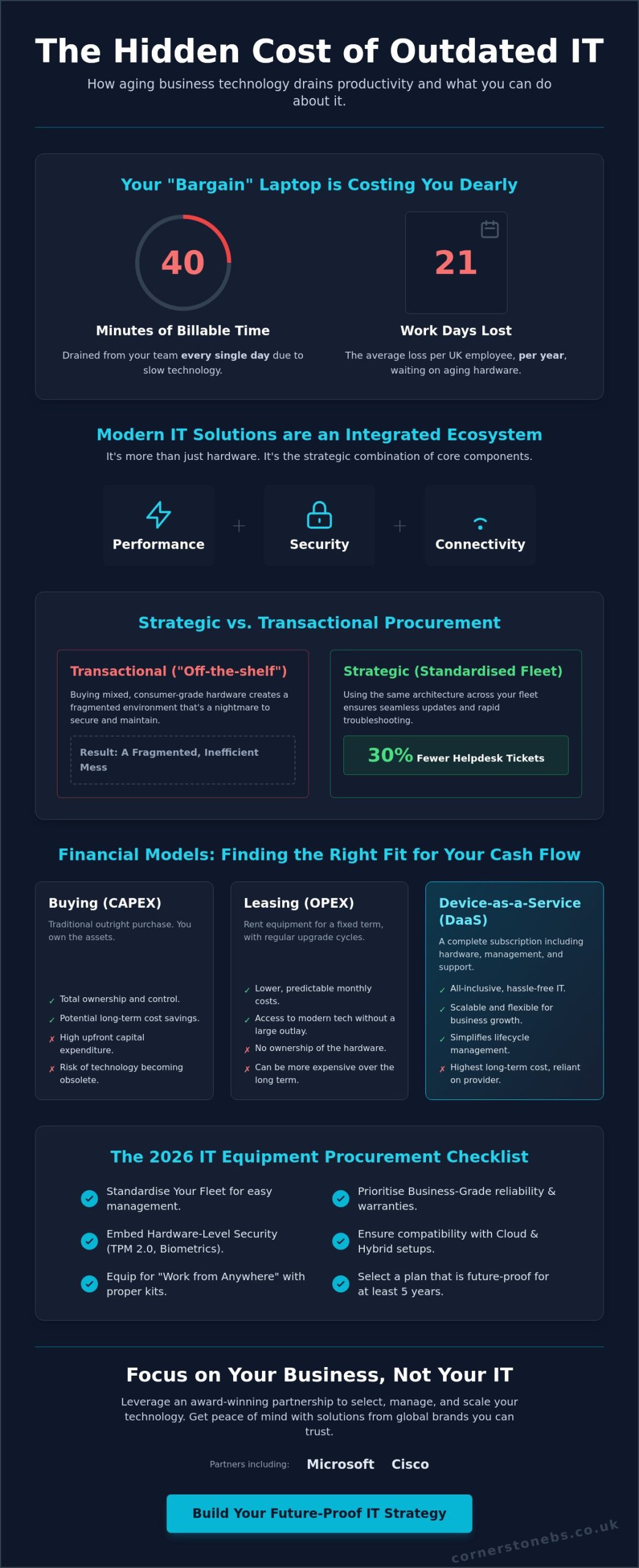
That “bargain” laptop in your office is likely draining 40 minutes of billable time from your team every single day. According to 2024 industry research, UK employees lose nearly 21 days of work per year simply waiting for aging technology to catch up. Finding the right it equipment solutions shouldn’t be a gamble between high upfront costs and technical confusion. It’s a frustrating reality for many North East business owners who want to grow but feel held back by frequent downtime and security worries.
You deserve a setup that just works. We’ve written this guide to help you select, manage, and scale your technology to drive productivity while eliminating the hidden costs of legacy systems. As an award-winning partner, we’re here to simplify the complex stuff so you can focus on your business. You’ll learn how to navigate the 2026 procurement landscape, decide whether leasing or buying fits your cash flow, and build a secure hardware fleet that stays reliable for the long haul.
Key Takeaways
- Modern it equipment solutions are more than just hardware; they are integrated ecosystems that combine connectivity, security, and performance.
- Identify the essential hardware categories every UK business needs to evaluate to remain competitive and secure through 2026.
- Compare the financial benefits of buying, leasing, and Device-as-a-Service to find the best fit for your company cash flow.
- Follow our 2026 procurement checklist to ensure your new hardware remains reliable and future-proof for at least five years.
- Discover how an award-winning partnership provides peace of mind by leveraging global technology brands like Microsoft and Cisco.
What are IT Equipment Solutions in a Modern Business Context?
In the past, buying a computer was a simple transaction. You walked into a shop, picked a box, and plugged it in. Today, it equipment solutions represent a far more sophisticated ecosystem. It involves the integrated hardware, firmware, and initial configuration required to keep your business operational and secure. When we talk about What is IT Infrastructure?, we’re describing the foundation that allows your team to communicate, collaborate, and compete in a digital-first economy. It’s the engine room of your daily operations.
Modern solutions must look beyond the physical device. A laptop is just a piece of plastic and silicon until it’s layered with robust connectivity and proactive security measures. We see many businesses make the mistake of choosing consumer-grade hardware to save pennies. However, business-grade equipment offers enhanced reliability, longer warranties, and remote management features that consumer models lack. This hardware is a vital part of the wider managed IT services ecosystem, ensuring that every device on your network is a known, secure quantity.
The Shift from Transactional to Strategic Procurement
Buying “off-the-shelf” often creates a fragmented environment that’s a nightmare to maintain. Strategic procurement focuses on standardisation. When your entire fleet uses the same architecture, updates are seamless and troubleshooting takes minutes rather than hours. This approach is essential for supporting a hybrid workforce. In 2024, companies using standardised hardware reported 30% fewer helpdesk tickets compared to those with mixed-fleet policies. It’s about creating a stable platform for growth, not just filling desks with monitors.
Core Components of a Business Hardware Stack
A reliable hardware stack is built on three pillars:
- End-user devices: High-performance laptops and tablets tailored to specific roles, from heavy-duty processing for designers to lightweight portability for sales teams.
- Infrastructure: The “heavy lifting” gear including servers, storage units, and networking equipment like routers and firewalls that keep data flowing safely.
- Peripherals and Comms: Modern VoIP handsets, noise-cancelling headsets, and professional conference room technology that make remote collaboration feel natural.
As an award-winning partner based in the North East, we believe your technology should be a quiet partner in your success. It shouldn’t be something you have to worry about every Monday morning. By choosing the right it equipment solutions now, you’re investing in years of hassle-free productivity and peace of mind.
Key Categories of IT Hardware for UK Businesses
Selecting the right hardware isn’t just about processing speed; it’s about building a fortress around your data. By 2026, the equipment you choose must feature hardware-level protections like TPM 2.0 and biometric authentication as standard. We ensure that cyber security services are baked into every device we supply, closing the gap that software alone cannot fill. This proactive approach aligns with the UK Government’s Technology Playbook, which advocates for security-by-design to protect national business interests.
Your server strategy acts as the heart of your it equipment solutions. While many North East firms are transitioning to virtualised environments to slash energy costs and physical footprint, others still rely on physical on-site servers for high-demand local tasks. Whether your infrastructure is on-premise or hybrid, it requires a rock-solid link to your cloud solutions. Without robust networking gear, your team will struggle with latency, regardless of how fast your internet connection claims to be.
End-User Computing (EUC)
Network & Security Infrastructure
Business-grade firewalls are non-negotiable. They do more than block basic threats; they inspect encrypted traffic and manage secure VPN tunnels for your remote staff. We always recommend managed switches over unmanaged ones because they allow us to prioritise voice traffic for your VoIP phones, preventing dropped calls during busy periods. As we move through 2026, upgrading to Wi-Fi 7 Wireless Access Points (WAPs) will become essential to handle the increased density of connected devices in modern offices.
Building a reliable fleet doesn’t have to be overwhelming. If you’re unsure which category to prioritise for your next refresh, our award-winning team is ready to audit your current hardware and provide a clear roadmap for your it equipment solutions.
Financial Models: Buying vs. Leasing vs. Device-as-a-Service (DaaS)
Choosing how to fund your it equipment solutions is a commercial decision that carries as much weight as the technical specifications themselves. It’s about more than just a price tag; it is about balancing immediate cash flow against long term agility. In the current economic climate, UK businesses generally follow three distinct paths to refresh their hardware fleet. Each model has a different impact on your balance sheet and your daily operations. We help you cut through the financial jargon to find the route that provides the most peace of mind for your specific situation.
When weighing up these options, many directors look at the “Total Cost of Ownership” (TCO). This calculation includes the initial purchase, the cost of maintenance, power consumption, and the eventual secure disposal of the data. Industry data from 2024 suggests that unmanaged hardware can cost up to 3 times its original purchase price in hidden maintenance over its lifespan. To make an informed choice, we recommend reviewing the UK government technology procurement standards, which offer a framework for value-driven purchasing.
Traditional Capital Expenditure (Capex)
Buying hardware outright remains a popular choice for businesses with healthy cash reserves. You own the asset from day one. There are no monthly interest charges or ongoing contract obligations. Since the Autumn Statement 2023, the UK’s “Full Expensing” policy allows companies to claim significant tax relief on qualifying IT investments. This is often best for firms with internal IT teams who can handle the maintenance and disposal themselves. However, the downside is the large upfront drain on your capital and the risk of being stuck with “legacy” kit that loses value quickly.
Operational Expenditure (Opex) and DaaS
Many North East SMEs now prefer the flexibility of Opex models. Device-as-a-Service (DaaS) is the modern evolution of the traditional lease. It integrates high-performance hardware with our award-winning it company solutions into one predictable monthly payment. This model allows you to scale up or down as your headcount changes. You get the latest technology without the heavy upfront cost. While you don’t own the asset, you benefit from included support and a guaranteed refresh cycle every three or four years. This keeps your team productive on the latest, most secure devices.
The tax implications of Capex versus Opex can be complex. While we provide the expert technical guidance, we always advise a quick chat with your accountant to see which model best suits your current tax strategy. Our goal is to ensure your it equipment solutions act as a catalyst for growth, not a burden on your bank account.
The 2026 IT Equipment Procurement Checklist
Procurement shouldn’t feel like a guessing game. A strategic approach ensures your it equipment solutions remain viable for the next 3 to 5 years, preventing the “performance cliff” that often hits unmanaged hardware. This checklist moves beyond basic price comparisons to focus on the long term resilience of your fleet. By 2026, every device you purchase must meet strict hardware security standards, including TPM 2.0 and biometric support, to defend against increasingly sophisticated local threats. We also recommend prioritising Energy Star 8.0 ratings to reduce your carbon footprint and lower office energy bills.
Your hardware choices impact your team’s ability to stay productive. If a device fails, the cost isn’t just the replacement part; it’s the hours of lost work. Our award-winning team helps North East businesses build a procurement roadmap that balances cutting-edge performance with environmental responsibility. This includes clear e-waste disposal policies that comply with UK regulations, ensuring your old tech is recycled securely and ethically.
Step 1: Audit Your Current Environment
Before buying anything, you must understand what you already have. Identify aging assets that cause frequent downtime or struggle with modern software. This is particularly important if you are planning a Microsoft 365 migration for business UK, as older hardware may lack the processing power to handle cloud-integrated features efficiently. We suggest defining user personas, such as “Power Users” for your creative team and “Remote Workers” for your sales staff. This allows you to tailor specifications to actual needs rather than overspending on a one-size-fits-all model.
Step 2: Define Minimum Specifications
In 2026, 16GB of RAM is the absolute minimum for business productivity. Anything less will lead to system lag when running multiple browser tabs and communication tools simultaneously. Your it equipment solutions should also standardise on NVMe SSDs, which provide boot times up to 5 times faster than older SATA drives. Don’t overlook physical security features like integrated privacy screens for laptops used in public spaces and hardware-level encryption that protects data even if a device is stolen. These small details provide the peace of mind your business needs to operate anywhere.
A well-planned refresh cycle keeps your business ahead of the curve. To get started with a professional assessment of your current fleet, you can book a hardware audit with our expert team today.
How Cornerstone Delivers Award-Winning IT Equipment Solutions
Cornerstone Business Solutions is more than a service provider; we are your award-winning technology partner. We’ve built a reputation for delivering robust it equipment solutions that empower businesses from our North East headquarters to satellite offices across the UK. We don’t believe in simple “box-shifting” or transactional sales. Instead, we manage the entire hardware lifecycle, ensuring every device remains a high-performing asset rather than a technical burden. This proactive stance is why we’ve secured multiple industry accolades, including being named a multi-award-winning IT partner for our commitment to excellence and regional growth.
Our status as a trusted expert is reinforced by our close ties with global technology leaders. We maintain strategic partnerships with brands like Microsoft, Cisco, and IBM. These alliances ensure our clients receive vetted, industry-leading hardware that integrates perfectly with modern software environments. It is about providing you with the same level of enterprise-grade technology used by global corporations, but with the approachable, regional warmth of a local team that truly cares about your success. We speak your language, simplifying the technical details to provide true peace of mind.
Bespoke Technology Planning
We don’t offer generic, one-size-fits-all hardware bundles. Every hardware stack we design is tailored to meet your specific business objectives for 2026 and beyond. Whether you need to overhaul your network infrastructure or equip a hybrid workforce with secure mobile devices, we bring a “can-do” attitude to even the most complex technical challenges. By providing a single point of contact for all your procurement and support needs, we eliminate the frustration of managing multiple vendors. We simplify your technology stack so you can focus entirely on scaling your business.
Seamless Implementation and Ongoing Support
A hardware rollout shouldn’t cause a single minute of unnecessary downtime. We handle the logistical heavy lifting through a process that includes full pre-configuration in our specialized labs before any equipment arrives at your office. Our expert engineers manage the on-site setup, ensuring everything is “plug-and-play” for your staff from day one. Once your new fleet is live, our proactive monitoring systems provide constant oversight, identifying and resolving performance dips before they impact your productivity. This dedication to reliability is a foundational element of our service.
If you’re ready to stop worrying about aging hardware and start focusing on your future, we’d love to help. We invite you to have a friendly chat about your technology roadmap and discover how the right it equipment solutions can drive your business forward.
Build a Foundation for Success in 2026
Strategic technology procurement is the difference between a team that struggles with downtime and one that thrives. By moving away from reactive purchases, you secure a fleet that is reliable, scalable, and protected against modern threats. We’ve shown how the right financial model and a rigorous 2026 checklist can transform your it equipment solutions into a powerful driver of productivity rather than a hidden cost center. Your hardware should be a silent partner in your growth, not a hurdle to overcome.
At Cornerstone, we pride ourselves on being a multi-award-winning partner with national reach and a proactive “can-do” attitude. Our strategic partnerships with Microsoft, IBM, and Cisco allow us to deliver world-class hardware backed by the approachable, regional warmth of our North East roots. We don’t just supply devices; we provide the peace of mind that comes from knowing your infrastructure is in expert hands. Book a chat with our award-winning team to discuss your IT equipment solutions today. Let’s build a technology roadmap that keeps your business moving forward.
Frequently Asked Questions
How often should a business replace its IT equipment?
Most UK businesses should replace laptops every 3 years and core networking gear every 5 years. Following this cycle prevents the steep drop in reliability that usually occurs after the 36-month mark. 2024 industry studies suggest that employees lose an average of 40 minutes per day when working on hardware that is over 4 years old, making early replacement a smart financial move.
Is it better to buy or lease IT hardware in 2026?
Choosing the right it equipment solutions depends on your specific tax strategy and cash flow. Leasing provides predictable monthly costs and easier scaling for growing teams without a large upfront drain on capital. Buying outright allows you to take advantage of the UK’s 2023 Full Expensing policy for immediate tax relief. Our award-winning team helps you weigh these options to find the best fit for your balance sheet.
What is the difference between consumer and business-grade laptops?
Business-grade laptops are built with more durable materials and include advanced security features like TPM 2.0 chips. Unlike consumer models, they are designed for 8-hour daily use and offer better thermal management to prevent slowing down under load. They also include professional versions of operating systems, which are essential for connecting to your company network safely and managing updates centrally across your entire fleet.
Can I use my existing hardware when migrating to the cloud?
You can often use existing hardware for cloud migration if it supports modern browser standards and secure connection protocols. However, older machines may lack the processing power to handle the latest cloud-integrated features efficiently. In these cases, we often repurpose older kit as “thin clients” to access virtual desktops. This extends the life of your it equipment solutions while maintaining high performance for your staff.
What should I do with old IT equipment when upgrading?
Old hardware must be disposed of via WEEE-compliant recycling services that provide a certificate of data destruction. It is a legal requirement in the UK to ensure all sensitive information is wiped before the physical components are recycled. We handle this entire process for our partners, ensuring 100% of your data is securely erased before the old kit leaves your premises for ethical recycling.
Does business IT hardware come with a better warranty than consumer gear?
Yes, business-grade hardware almost always includes a 3-year Next Business Day (NBD) on-site warranty as standard. This is a significant upgrade from the 1-year return-to-base warranties found on consumer gear. If a device fails, an engineer arrives at your office the following day to fix it. This minimizes downtime and provides the peace of mind that a local expert is always ready to help.
What are the minimum specs I should look for in a business laptop today?
The current benchmark for a reliable business laptop is 16GB of RAM and an NVMe SSD with at least 256GB of storage. You should also ensure the processor is an Intel i5 or AMD Ryzen 5 from the latest two generations. These specs prevent the performance bottlenecks that frequently slow down multitasking and video conferencing in a modern North East office environment.
How can I secure my hardware for remote employees?
Securing remote devices requires a combination of hardware-level encryption and Mobile Device Management (MDM). We implement BitLocker encryption on all endpoints to protect your data if a laptop is lost or stolen. Adding a robust VPN and multi-factor authentication ensures your team can work from anywhere without exposing your network to 2026’s emerging cyber threats. This proactive approach keeps your remote workforce secure and productive.
Tags: Business Technology, Cybersecurity, Hardware as a Service, IT Procurement, IT strategy, Tech Refresh, UK business