
Nearly half of UK landline users still don’t realize that the PSTN switch-off affects much more than just their desk phones, making upgrading to voip from pstn a critical priority for 2026. With the final January 31, 2027 deadline looming, the pressure is on to secure your business communications before the old copper network is retired for good.
It’s natural to feel concerned about the complexity of this transition. You might worry about losing service for critical systems like lift phones and alarms, or feel frustrated by the 40% price hikes hitting legacy lines this October. We know that technical jargon like SoGEA and SIP can feel overwhelming when you’re just trying to keep your business running smoothly. As your local technology partner, we’re here to simplify the process and ensure your operations remain uninterrupted.
This guide gives you a clear, jargon-free roadmap for the 2026 landscape. You’ll discover how to migrate legacy hardware without the stress and gain the confidence to choose a scalable platform that fits your needs. We’ll show you how to turn this technical requirement into a strategic advantage that protects your business and prepares it for the future.
Key Takeaways
- Understand why the January 2027 deadline is a hard cutoff and how it impacts your existing infrastructure.
- Identify the hidden risks to your business, including alarms and lift lines, that rely on the aging copper network.
- Learn the practical steps for upgrading to voip from pstn while maintaining your existing phone numbers and hardware.
- Compare modern alternatives like SIP Trunking and cloud-hosted VoIP to find the best fit for your operational needs.
- Discover how a proactive IT partner can manage your migration to ensure total business stability without technical headaches.
Understanding PSTN and the 2026 Reality for UK Businesses
PSTN, or Public Switched Telephone Network, is the traditional copper-wire system that has powered UK communications for decades. It relies on physical lines and analogue signals to connect calls. Today, we are in the final stages of the national Big Switch Off. Openreach is decommissioning this legacy network to make room for a faster, more reliable digital alternative. Every business across the country must move from analogue signals to IP (Internet Protocol) based communication.
PSTN was the 20th-century foundation of UK voice calls that is no longer fit for a digital-first economy.
Why the Analogue Era is Officially Ending
The aging copper infrastructure is becoming a burden. It is increasingly difficult and expensive for Openreach to maintain these physical lines, especially when they are prone to weather damage and wear. Modern businesses don’t just need voice; they need data-heavy applications that analogue lines simply cannot handle. High-definition video calls, cloud software, and instant file sharing require the bandwidth of a digital network. By moving to an all-IP system, the UK aligns with global standards already adopted by other developed nations. This transition is a foundational step for businesses looking to implement modern it company solutions that drive growth and security.
The 2026 Timeline: Where Does Your Business Stand?
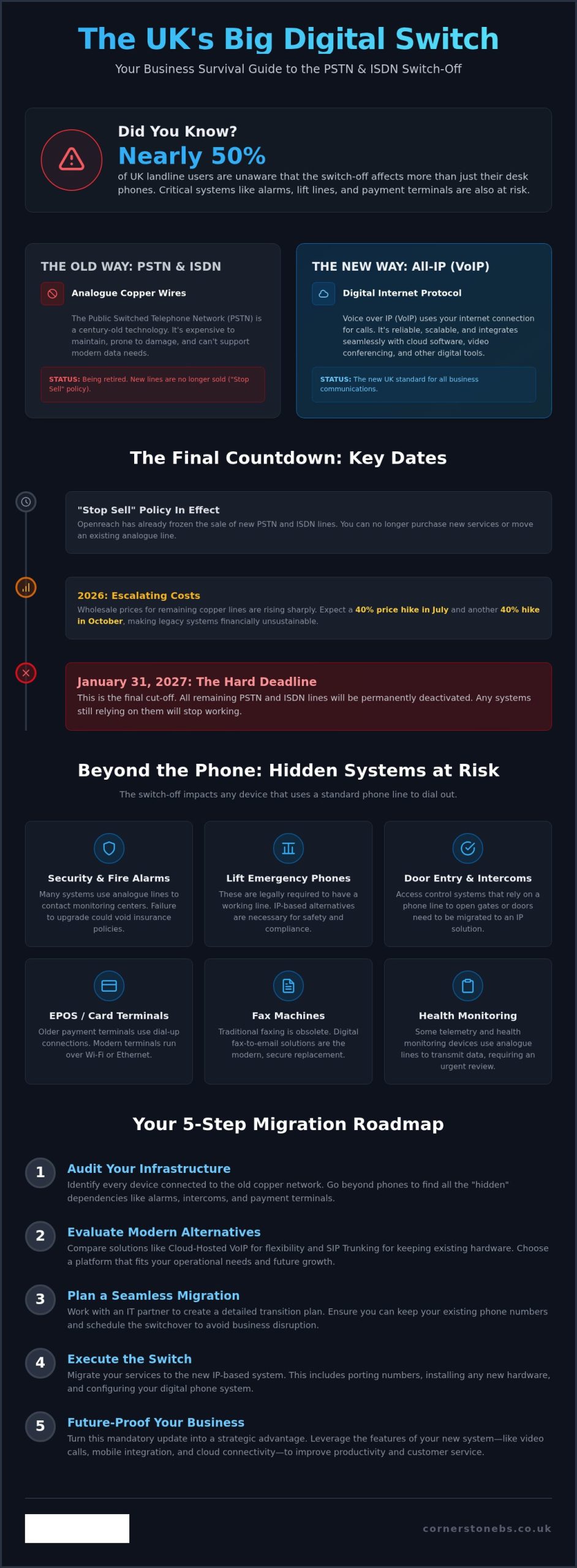
We have reached the final call for legacy lines. While the ultimate deadline is January 31, 2027, 2026 is the year businesses must act to avoid escalating costs and service risks. Wholesale prices for copper lines rose by 40% in July 2026, with another 40% hike expected in October. You might have already encountered the “Stop Sell” policy. This means you can no longer buy new traditional PSTN services or move an existing line. Openreach has frozen these services to ensure everyone prioritises the digital transition.
It is important to understand that both PSTN and ISDN (Integrated Services Digital Network) are being retired simultaneously. While ISDN was once the “high-speed” choice for business, it still relies on the same underlying copper infrastructure. For many, upgrading to voip from pstn is the only logical path forward. The UK PSTN switch-off isn’t just a technical update; it’s a complete change in how your business connects to the world. If you are still on copper, your connectivity is on borrowed time. Making the move now ensures you aren’t caught in the final rush as the 2027 cutoff approaches.
Beyond Voice Calls: The Strategic Impact of the Analogue Retirement
Many business owners assume the PSTN retirement only impacts their desk phones. This is a dangerous misconception. The switch-off is a complete shift in how your building functions. Any device that plugs into a standard wall socket and dials out is at risk. Failing to act creates a significant operational gap. If your business hasn’t planned for this, critical systems could simply stop working without warning once your local exchange is deactivated. Official guidance on analogue to digital landlines makes it clear that the responsibility for this transition lies with the business owner.
Viewing this as a technical chore misses the bigger picture. This transition acts as a strategic gateway. It allows for tighter integration with your managed IT support, creating a unified environment where voice and data work together seamlessly. It is also a necessary prerequisite for adopting high-performance cloud solutions that help your business scale securely. By modernising now, you turn a forced change into a competitive advantage.
Legacy Systems at Risk: The Hidden PSTN Dependencies
Connectivity as the New Business Backbone
Transitioning these complex systems requires a proactive approach to prevent downtime. If you are unsure which devices in your office still rely on copper, our team can help you audit your setup to ensure a smooth path when upgrading to voip from pstn. We focus on building a resilient network that supports your long-term growth.
Evaluating Your Options: Business VoIP, SIP Trunking, and Mobile Integration
Deciding how to move forward when upgrading to voip from pstn requires understanding the two main paths available to UK businesses. While the UK Parliament briefing on the digital switchover highlights the necessity of the change, it doesn’t dictate the specific technology you must use. Most organisations find that Hosted VoIP offers the cleanest break from the past, while others prefer the phased approach of SIP Trunking. The best choice depends on your current hardware investment and future growth plans.
Hosted VoIP: The Modern Standard
Hosted VoIP is now the modern standard for business communication. Because the system lives in the cloud, you don’t need to maintain a physical phone system in your office. This significantly reduces overheads and makes scaling your team as simple as adding a new user in a digital dashboard. You get access to advanced features like auto-attendants and call recording without the need for complex hardware. For many, this transition is a natural part of a wider Microsoft 365 migration for business UK. It allows your phone system to integrate directly with Microsoft Teams, creating a single hub for all your internal and external conversations.
SIP Trunking: For the Legacy-Invested Business
SIP Trunking is the ideal solution if you have recently invested in an expensive on-site PBX system. Instead of replacing your entire hardware setup, SIP allows you to keep your physical handsets and server while ditching the copper PSTN lines. You gain the cost savings and reliability of a digital connection without a massive upfront capital expenditure. Migrating to SIP requires expert oversight to ensure your existing hardware is compatible and secure. It acts as a bridge, allowing you to move to a digital backbone while sweating your current assets for a few more years.
Modern digital systems also solve the problem of the “tethered” worker. With Business Mobile integration, your office number follows you everywhere. By using smartphone apps, your team can make and receive calls on their business line from any location. This ensures a professional image and better work-life balance, as staff don’t have to give out personal mobile numbers. When upgrading to voip from pstn, this mobility becomes a standard feature rather than a paid extra. It turns your communication system into a flexible tool that supports your business wherever it operates.
A 5-Step Roadmap for Upgrading to VoIP from PSTN
- Audit: Identify every device in your building that uses a copper line.
- Connectivity Check: Verify your internet bandwidth can handle high-quality voice traffic alongside daily data.
- Provider Selection: Partner with a firm that understands both IT and Telecoms to avoid compatibility issues.
- Hardware Migration: Replace old handsets or use ATA adapters for legacy analogue devices.
- Staff Training: Ensure your team is comfortable with new digital features and collaboration tools.
Conducting a Full Infrastructure Audit
Success starts with a thorough audit. Many businesses have “invisible” lines they’ve forgotten about. Franking machines, panic buttons, and building monitoring sensors often rely on the same copper network as your phones. If these aren’t identified now, they will stop working the moment the PSTN is switched off. This is also the perfect time to review your existing contracts. You might find you’re still paying for lines and services that are no longer in use. Consulting with an expert IT partner allows you to map these dependencies accurately before the deadline hits.
Testing and Quality of Service (QoS)
Once you’ve identified your hardware, you must look at your network’s performance. Voice traffic is sensitive to delays. To avoid jitter or dropped calls, your network must prioritise voice data over standard web browsing. This is known as Quality of Service (QoS). You’ll need routers and switches that support modern IP telephony standards to manage this traffic effectively. Reliability is the foundation of business stability. We always recommend planning for redundancy by implementing 4G or 5G failover. This ensures that if your primary fibre line goes down, your communication stays up.
Our proactive approach prevents switch-off downtime by handling the technical heavy lifting for you. If you want to ensure your business is fully prepared, speak to our local team of experts about managing your migration today.
Future-Proofing Business Communications with Cornerstone
Choosing the right partner for your digital transition is as important as the technology itself. At Cornerstone Business Solutions, we provide a unified approach to IT and Comms. This eliminates the common frustration of finger-pointing between different service providers. When you are upgrading to voip from pstn, you need a team that understands how your phone system interacts with your wider network infrastructure. Our multi-award-winning team ensures your transition is proactive. We identify potential hurdles and solve them before they cause downtime for your business.
Security is a primary concern when moving voice calls to the internet. We integrate our bespoke cyber security services directly into your communication platform. This protects your IP-based voice traffic from modern threats and ensures your data remains private. We don’t believe in one-size-fits-all packages. Instead, we build technology solutions tailored to the specific operational requirements of your UK business.
The Benefit of Unified IT and Telecoms
Working with us gives you a single point of contact for all your business technology. Whether you have a query about your helpdesk or your phone line, you call one number. We specialise in Microsoft 365 migrations and cloud-hosted voice, creating a streamlined digital office where everything works together. Our proactive monitoring catches connectivity issues before they affect your business continuity. This level of oversight provides the emotional security of knowing your systems are in expert hands.
Beyond the Switch-Off: What is Next?
The 2027 deadline is just the beginning of your digital journey. Once your communication is digital, you can leverage AI and data analytics to gain better customer insights. You’ll see patterns in call volumes and customer interactions that were invisible on analogue lines. To see how these innovations are being put into practice, check out NeverMissACall.ie and their AI virtual receptionist solution. Scalability becomes your new reality. You can add new users or locations in minutes. You no longer have to wait weeks for physical line installations from Openreach.
As you navigate upgrading to voip from pstn, Cornerstone Business Solutions acts as your long-term technology partner. We focus on sustainable growth and ensuring your business remains at the forefront of modern communication. Our team stays connected to our geographical roots while delivering world-class technology. This blend of local trust and technical expertise makes us the ideal choice for UK businesses ready to embrace the digital future. We invite you to start a conversation with our experts to secure your communications today.
Securing Your Business Connectivity for the Digital Decade
The transition from copper to cloud is no longer a distant prospect. It’s a fundamental shift that protects your critical systems, from emergency lift phones to modern payment terminals. By acting now, you avoid the rush of the January 2027 deadline and the sharply rising costs of legacy lines. upgrading to voip from pstn isn’t just about avoiding a service cutoff; it’s about building a scalable foundation for future growth.
As a multi-award-winning UK IT provider with over 15 years of business technology excellence, we understand the nuances of this migration. Our status as Cisco and Microsoft Gold Partners ensures your transition is handled with the highest level of technical expertise and care. We’re ready to help you navigate this change with confidence. Book a free Comms Audit with our national experts today to ensure your business stays connected. The digital future is bright, and with the right partner, your move to modern communications will be seamless and rewarding.
Frequently Asked Questions
Is the PSTN switch-off definitely happening in 2026?
Yes, the retirement of the copper network is in its final stages with a hard deadline of January 31, 2027. While 2026 is the final full year for transition, Openreach has already implemented stop-sell orders across the country. Businesses remaining on legacy lines will face significant wholesale price increases in October 2026. We recommend completing your migration as soon as possible to avoid potential service loss and engineer shortages.
Will my existing business phone numbers change when I move to VoIP?
You can keep your existing business phone numbers when upgrading to voip from pstn through a process called number porting. It is vital that you don’t cancel your old analogue contracts until the porting process is complete, or you risk losing your number forever. Our team manages this transition for you, ensuring your customers can still reach you on the familiar digits they’ve used for years without any interruption.
What happens to my business alarm system after the PSTN switch-off?
Traditional alarm systems that use analogue diallers or red-care signalling will stop working once the copper network is deactivated. These systems rely on the specific voltage of an analogue line to send alerts to monitoring centres. To stay compliant with your insurance policy, you’ll need to upgrade to an IP-based signalling unit. We can help you identify these hidden dependencies during a full audit to keep your premises secure.
Do I need to buy all new handsets for a digital phone system?
Not necessarily, though modern IP handsets offer the best features and audio quality. If you want to keep your existing analogue phones, you can use Analog Telephone Adapters (ATAs) to connect them to your new digital network. However, many of our clients find that switching to softphones on laptops or mobile apps is a more flexible solution. We’ll help you decide if new IT hardware is a better long-term investment for your business.
Can I still use my traditional fax machine on a digital line?
You can use an ATA adapter to connect a physical fax machine, but results can be inconsistent due to how digital lines compress data. We usually recommend moving to a cloud-based e-fax service instead. This integrates perfectly with your Microsoft 365 environment and allows you to send or receive faxes via email. It’s a more reliable, secure, and cost-effective way to handle documents without needing paper, toner, or a dedicated line.
What is the difference between PSTN, ISDN, and VoIP?
PSTN is the old analogue network using copper wires for basic voice calls. ISDN was a digital upgrade that still used those same copper lines to carry more data. VoIP, or Voice over IP, bypasses the copper network entirely by sending your voice as data over your broadband. Since PSTN and ISDN are being retired due to their age, VoIP is the only future-proof choice that offers the scalability your business needs to grow.
How much bandwidth does a standard VoIP call actually use?
A standard high-quality VoIP call uses roughly 100kbps of bandwidth, which is a very small fraction of a modern fibre connection. The key isn’t just the amount of data, but how your network handles it. You need routers that support Quality of Service (QoS) to ensure voice traffic is prioritised over standard web browsing. We audit your network infrastructure to guarantee that your calls remain crystal clear, even during your busiest office hours.
What should I do if my business is still on analogue lines in 2026?
You should start the process of upgrading to voip from pstn immediately to avoid the risk of losing service. Begin by auditing every device in your building that plugs into a phone socket, including lift phones and credit card terminals. With the 2027 deadline approaching, hardware and engineer availability will become limited. Contacting a proactive managed IT partner now will help you secure your communications before the final October price hikes take effect.
Tags: Business Communications, Business Continuity, ISDN Switch Off, PSTN switch-off, SIP Trunking, UK business, Upgrading to VoIP, VoIP