

There is no prescribed UK-wide set of minimum terms for cyber insurance, so cover and conditions depend on the policy. Cyber insurance requirements for UK businesses can also vary according to factors such as business size, sector, security measures and the data held.
Look beyond the policy name: cyber liability cover may help with your own incident costs, third-party claims, or both. Exclusions and security obligations can determine when protection applies. Insurance does not replace sound cyber risk management.
This guide explains what cyber liability insurance may cover, which exclusions and security conditions to review, and what insurers may consider when assessing eligibility. It will help you understand policy wording and identify where stronger cyber security support can help protect business continuity.
Key Takeaways
- Separate cover for your organisation’s direct losses from cover for claims made by others, and see which types of incident response costs the policy may include.
- Review security warranties and renewal details carefully; inaccurate information or unmet controls can affect a claim.
- Look for exclusions involving business interruption, social engineering, customer or supplier outages, and physical damage.
- Assess eligibility against your organisation’s turnover, Cyber Essentials certification, security measures and the insurer’s policy terms.
What is Cyber Liability Insurance?
Cyber liability insurance is cover for financial losses and claims linked to cyber incidents. Policies can address direct damage to your organisation and losses suffered by others.
Data Breach and Security Failure Cover
A data breach or security failure may trigger cover for costs caused by unauthorised access, ransomware or damage to business systems. For example, ransomware could prevent staff from accessing customer records and disrupt trading. First-party cover addresses the organisation’s own losses; third-party cover can respond to claims that customers or other parties have suffered harm. This distinction clarifies whose costs the policy is designed to meet.
For law firms in England and Wales, compulsory professional indemnity insurance does not cover first-party losses from cyber events, such as data breaches, ransomware or system damage. Professional indemnity insurance addresses civil liability, including claims linked to professional services, while cyber cover can address direct incident losses. A policy’s terms determine how these protections interact, so the policy wording matters more than the product label.
Incident Response Cover
Incident response cover helps fund specialist support after a cyber event. Depending on the policy, this may include IT forensics, legal advice, customer notifications, call centres and public relations. These services can help an organisation investigate what happened, communicate with affected people and manage regulatory concerns. A supplier’s cyber incident may also interrupt your operations, but cover depends on whether the policy includes supplier or dependent business interruption protection.
Cyber insurance costs for UK businesses vary by size and sector; there is no single price for every organisation. Insurers assess factors such as existing security, the amount of data held and the cover limit requested. A business holding sensitive customer records may present a different cyber risk from one holding little personal data. These factors influence both the premium and the amount of cover that may suit the business.
Policy exclusions, warranties and security obligations
Policy wording defines which incidents are covered and which losses are excluded. Insurers may also require specific technical controls before providing cover.
Policy Inclusions and Exclusions
Inclusions describe the incidents and costs a policy covers; exclusions identify circumstances in which it will not respond. Compare cover for social engineering, human error and business interruption, including how the policy defines a covered event. A cloud service that slows down may be treated differently from an outage caused by a cyber attack. A broker can explain how exclusions, limits and extensions affect your cover.
Claims and Policy Compliance
Compliance means maintaining the security measures and accurate information required by the policy. Insurers commonly look for firewalls, malware protection, multi-factor authentication, software patching, robust backups and staff awareness training. Policies are commonly reassessed every 12 months, so changed systems or turnover can make an earlier application inaccurate. The National Cyber Security Centre warns that an insurer may not have to pay a claim if a business declared a control that wasn’t actually in place.
Meeting Cyber Insurance Requirements
To meet cyber insurance requirements, match each policy warranty to a real technical control and keep records showing how it operates. Install critical software updates, maintain backups and train staff to recognise threats. Cyber Essentials certification may reassure insurers and could help an applicant retain cover or obtain it at a lower rate. These steps connect policy declarations to everyday cyber security, rather than leaving controls as paperwork.
Compare policies by reviewing covered events, exclusions, security warranties, claims conditions and business-interruption waiting periods. A broker can clarify how cyber cover interacts with existing policies and whether an extension addresses a specific exposure. After cybercrime causes loss or damage, contacting the police and keeping a record of any reference number may be appropriate. A review of your security controls can help identify gaps between stated protections and day-to-day practice.
Cyber insurance exclusions
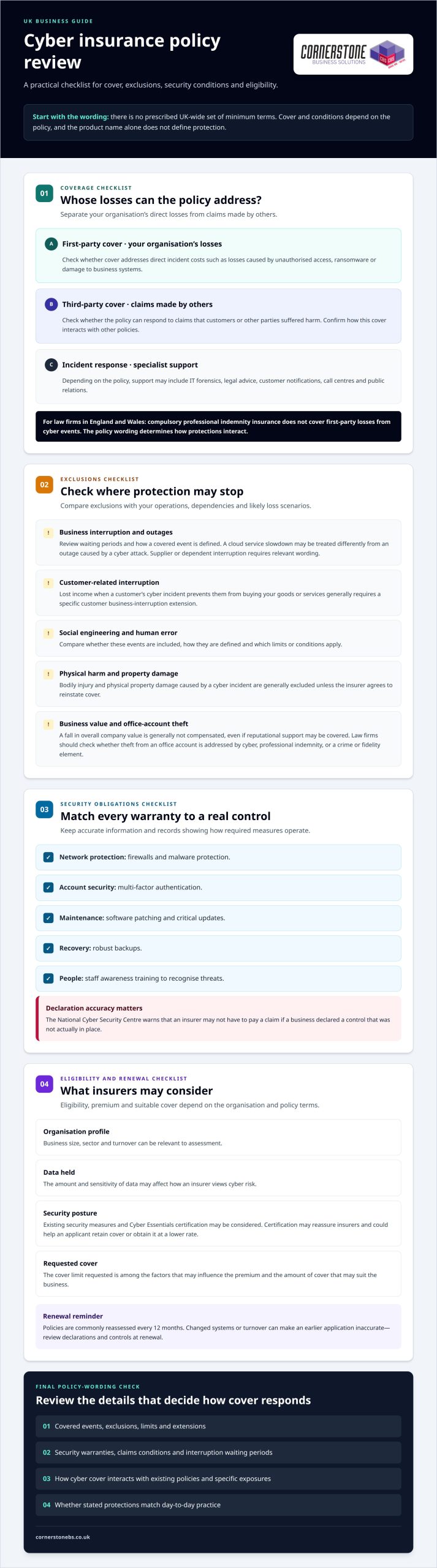
Cyber insurance does not cover every loss connected to a digital incident. For example, losses caused when a customer’s cyber incident prevents them from buying your goods or services generally require a specific customer business-interruption extension. Without that wording, the affected organisation may face lost income despite having cyber insurance. Distinguish this exposure from cover for your own systems, and assess whether customer dependencies could interrupt trading.
Physical consequences also need careful attention. Bodily injury and damage to physical property caused by a cyber incident are generally excluded unless the insurer agrees to reinstate cover. For instance, a cyber attack affecting software that controls equipment could cause physical damage, but a cyber policy may not indemnify that loss. Check how the policy defines covered events and whether an endorsement changes the exclusion.
Cyber insurance generally does not compensate for a fall in a company’s overall value, even if the policy may help manage reputational damage. That distinction matters after a public breach: crisis support may be covered, while a reduced business valuation may not be. Law firms should check whether their cyber and professional indemnity policies cover theft from an office account. A crime or fidelity element may address that exposure.
Before relying on a policy, compare each exclusion with your organisation’s operations, software and payment processes. Identify whether a loss affects your own systems, a customer relationship, physical property or an office account. Then examine the indemnity wording, extensions and limits that apply to each scenario. For example, a supplier outage and a customer outage can trigger different terms, so do not assume one business-interruption clause covers both. Clear distinctions help you understand where protection ends and which financial exposures remain with the organisation.
Business eligibility for cyber insurance
Insurers assess eligibility based on an organisation’s size, sector, security controls and data holdings. UK businesses reviewing cyber insurance requirements should consider how these factors affect available cover and recovery needs.
Requirements for SMEs and Large Businesses
Business size can influence underwriting, but turnover alone does not determine eligibility. Insurers also consider sector, security measures and the data an organisation holds. A small firm with sensitive customer records may have different exposure from a larger company with different systems and operations. Understanding the cyber insurance requirements UK businesses face starts with these risk factors.
One defined route applies to eligible UK-domiciled organisations with turnover under £20m. They can opt in for a £25,000 limit of indemnity after achieving whole-organisation Cyber Essentials certification. This is a specific scheme, not a universal limit for every applicant. Larger organisations should consider potential ransomware disruption, liability and recovery needs when assessing suitable cover. The cyber insurance requirements UK insurers apply can therefore vary with each organisation’s circumstances and policy.
Contract and Sector Requirements
Cyber insurance isn’t a strict regulatory requirement for solicitors in England and Wales. However, Rule 2.5 of the SRA Code of Conduct for Firms requires firms to identify, monitor and manage material business risks. That risk-management obligation doesn’t itself make cyber insurance compulsory.
For government contracts or regulated-sector work, distinguish a legal duty from a condition in a specific contract. Contract wording may set insurance conditions, so requirements depend on the agreement rather than a universal rule for every supplier. Eligibility still depends on underwriting, including the applicant’s security measures and data exposure.
For a clearer view of how your controls support eligibility, discuss your organisation’s cyber security.
Cornerstone Business Solutions: Cyber Security
Cornerstone Business Solutions provides Cyber Security to help businesses strengthen their defences and align day-to-day controls with their risk needs. This support can be useful when preparing for insurance, reviewing security gaps or improving protection for business systems.
Managed IT Support and Microsoft 365 can also form part of a considered approach to managing business technology. The right measures depend on your organisation’s systems, data and operations. Cyber insurance remains a separate policy, so stronger security should complement, not replace, careful review of its terms, warranties and exclusions.
To discuss your organisation’s cyber security, contact Cornerstone Business Solutions.
Build resilience into your next decision
Use your next policy review to connect insurance decisions with how your business manages technology. Assign clear ownership for security information, keep operational changes visible, and make sure decision-makers understand how cyber risk affects continuity. This gives your organisation a stronger foundation for discussing cover and planning for recovery.
Understanding the cyber insurance requirements UK businesses face is part of a wider resilience plan. Cornerstone Business Solutions offers Cyber Security, Managed IT Support and Microsoft 365 to support business technology and security. These services can help businesses strengthen the foundations insurers may assess, while insurance remains a separate financial protection.
If you’re ready to discuss practical ways to support your business systems, start a conversation with Cornerstone Business Solutions. A considered next step can help you move forward with greater clarity and confidence.
Frequently Asked Questions
How does cyber risk management affect premiums?
Stronger cyber risk management can influence an insurer’s assessment and the premium offered. Underwriters consider your organisation’s security measures, sector, size and data holdings. For example, documented access controls and tested recovery arrangements can give a clearer picture of how you manage exposure. Insurers may also adjust terms, limits or exclusions when they identify gaps, so good security does not automatically mean a lower premium.
What cyber insurance requirements do UK insurers commonly impose?
UK insurers commonly expect applicants to describe their security accurately and maintain the controls stated in the policy. Requirements may include multi-factor authentication, patching, backups and staff training. For example, if an application says administrator accounts use multi-factor authentication, that control should actually be active. Policies may also set conditions for reporting incidents and cooperating with investigations, so claims depend on following the specific wording.
What security controls are typically required to qualify for cyber insurance in the UK?
Insurers commonly assess firewalls, malware protection, user access, software updates, backups and staff awareness. Cyber Essentials focuses on five technical control areas: firewalls, secure configuration, user access control, malware protection and security update management. For example, a business can document who receives security updates and how backup restoration is tested. Controls should match the organisation’s actual systems, not just appear in an application.
What does UK cyber insurance typically cover, and what is excluded?
Cover may include technical investigation, legal support, customer notifications and lost income after a covered incident. Supplier-related interruption may be included through dependent business interruption cover. Terms matter: a cloud provider’s cyber attack may be treated differently from services simply slowing down. Policies also commonly exclude losses such as damage to the company’s overall value, as well as physical damage or bodily injury unless cover is specifically reinstated.
What cyber insurance disclosure and claims rules apply in the UK?
Give accurate information when applying and keep it current at renewal, especially details about security controls and material changes to systems. If a claim follows an attack, follow the policy’s notification process and preserve relevant records, such as incident logs and communications. The National Cyber Security Centre warns that an insurer may not have to pay if a business claimed a security control was in place when it was not.
Tags: business insurance, cyber insurance, cyber liability, Cyber Security, Data Protection, insurance exclusions, Risk Management, UK business