

Cloud delivery alone doesn’t tell you who’s responsible for keeping a firewall effective. With firewall as a service UK options, the provider may host the technology, but responsibilities for configuration, monitoring, policy changes and incident response can vary. That distinction matters when a firewall is a core part of your business security.
Before relying on a provider, get clear on what the service includes, where its limits sit and how it will work with your existing systems and team. A cloud-delivered firewall isn’t automatically the right fit, just as an on-premises option isn’t automatically outdated.
This guide explains how Firewall as a Service works and what to compare across managed, cloud-delivered and on-premises approaches. It covers practical questions about security controls, support, accountability and costs, along with what to prepare before speaking with a provider. The aim is to help you assess operational fit, rather than choose based on cloud branding alone.
Key Takeaways
- Understand what firewall as a service UK can mean in practice, and why the provider’s exact service scope matters.
- Check how the proposal handles operational ownership, visibility and integration with your existing environment.
- Compare provider-managed FWaaS, business-managed cloud firewalls and on-premises appliances against your team’s needs.
- Ask providers to clarify who makes policy decisions, manages changes, handles incidents and oversees escalations.
- Prepare for a phased transition by documenting your current environment, agreeing policies and testing before wider deployment.
What is Firewall as a Service UK & How Does It Work?
Keeping network protection consistent can be difficult when staff work remotely, offices connect to shared systems and business applications run in the cloud. Firewall as a service UK options can move firewall capabilities into a provider-hosted service, but the technology and level of management included can differ considerably.
Firewall as a Service (FWaaS) delivers firewall capabilities through a provider-hosted service. Buyers should verify which security functions, management tasks and response responsibilities the contract includes. Cloud delivery describes where or how the firewall is provided. It doesn’t automatically mean the provider configures policies, monitors activity or responds to incidents. Those responsibilities depend on the agreed service.
FWaaS is also distinct from the broader Secure Access Service Edge (SASE) concept, which brings cloud-delivered networking and security capabilities together. A firewall may form part of a wider SASE approach, but don’t assume a firewall service includes every other security or networking function.
How does Firewall as a Service process network traffic?
At a high level, network traffic passes through a firewall inspection point before a connection reaches a protected resource. The firewall checks traffic against configured policies, such as rules governing which connections are permitted or blocked. Architecture and enforcement points vary by supplier, so ask how traffic from your users, sites and cloud services will be handled.
The proposal should explain who configures and approves policies, and what happens when a rule needs changing. Inspection, logging, software or threat updates, and incident response may be included, shared or left to your team. Check each responsibility rather than relying on the phrase “managed firewall”.
Which business environments might use a cloud-delivered firewall?
A cloud-delivered model may be worth assessing if your organisation has distributed staff, several locations, cloud applications or network requirements that change as the business grows. It can provide a way to apply firewall controls across different connections, but suitability depends on your actual environment, not just the appeal of cloud delivery.
Review your traffic patterns, latency needs, existing network infrastructure and appetite for provider involvement. Ask how the proposed design would affect access to key systems, and what alternatives are available if a connection or service is disrupted.
Keep the boundaries clear, too. A firewall controls network traffic under its policies; it isn’t automatically a replacement for endpoint protection on devices, email security or broader managed detection services. Treat these as separate parts of your security plan and confirm which capabilities, if any, are included in the proposal.
What Should a Firewall as a Service Package Include?
A proposal should make clear what you’re buying, who does the work and how the service fits your existing environment. For firewall as a service UK options, don’t judge the package by its label or feature list alone. Features, responsibilities and support arrangements vary between providers, so validate each item in writing before you commit.
The service name alone doesn’t define monitoring or response commitments. A cloud-hosted firewall may be managed by your own team, by a provider, or through shared responsibilities. Ask for a clear description of what’s included, what costs extra and what remains yours to handle.
Which management and monitoring responsibilities should buyers clarify?
Start with operational ownership. Who creates firewall rules, who approves them, and how are changes recorded and reviewed? Clear answers help prevent gaps and unexpected changes to access. Establish whether monitoring, alert triage, incident escalation and remediation are included, separately scoped or assigned to your staff.
Request examples of the reports you’ll receive and ask how often policies are formally reviewed. Check whether reports show activity and changes in a way your team can understand and act on. The UK’s Cyber Essentials scheme provides a useful reference for considering foundational cyber security controls, including how firewall arrangements fit into your wider approach.
How should FWaaS fit with cloud, remote access and existing controls?
Ask the provider to explain how the proposed service will support your users, locations and cloud workloads, and interact with your existing network infrastructure. Don’t assume current systems will connect unchanged. Assess compatibility, traffic routing, dependencies and any required configuration changes before planning a migration.
Consider the wider cloud environment, too. Planning cloud services alongside network security can help you identify dependencies and decide where access controls need to apply. If you’re reviewing cloud arrangements, read Cloud Solutions for UK Businesses as part of that planning. Check how the firewall will work alongside existing controls rather than assuming it replaces them.
Before signing, make sure the proposal documents service scope, ownership, visibility and integration in plain language. You can also discuss your wider IT and cyber security requirements with Cornerstone Business Solutions, while confirming directly whether any proposed firewall service meets your needs.
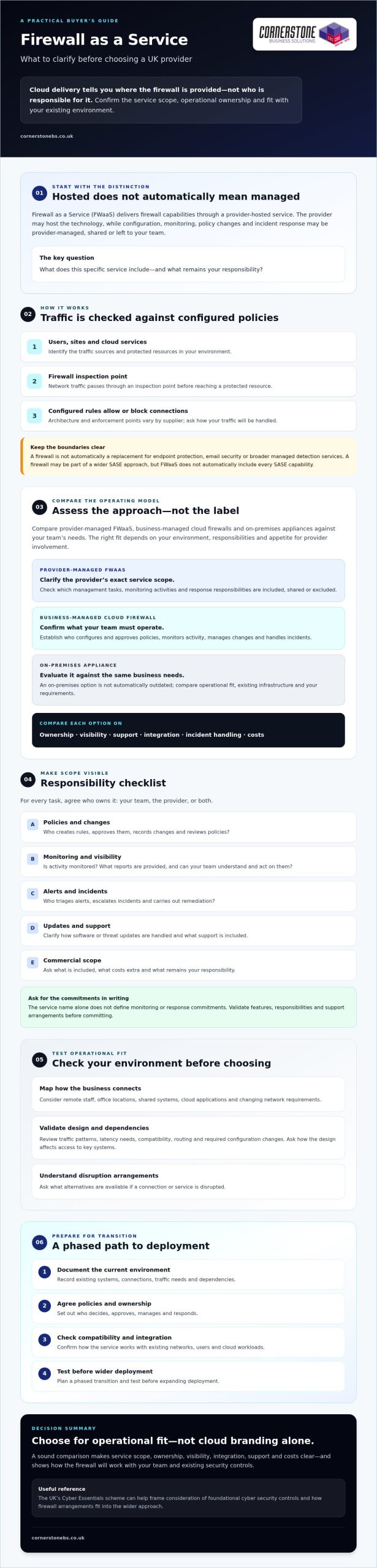
Firewall as a Service vs Traditional Firewalls: Which Model Fits Your Business?
The right choice depends on how your organisation works and who can operate its security controls. A provider-managed service can shift some operational tasks outside your business. A business-managed cloud firewall changes where the control runs, not necessarily who manages it. An on-premises appliance keeps the firewall at your location, with your team or a provider responsible for its operation.
Cloud delivery isn’t automatically more secure or suitable. Compare the management model, visibility and workload each option brings, then check how well it supports your applications and network design. Vendor-neutral NIST firewall policy guidelines can also help inform your approach to firewall policies.
| Model | Management ownership | Deployment considerations | Visibility and operational demands |
|---|---|---|---|
| Provider-managed FWaaS | Provider manages agreed tasks; your organisation retains responsibilities set out in the contract. | Assess how users, sites and cloud workloads connect through the service. | Confirm what logs and reports you can access, and which tasks still need internal oversight. |
| Business-managed cloud firewall | Your team manages configuration and day-to-day operation. | Check compatibility with your cloud environment, network design and applications. | Your team needs the skills and capacity to review policies, alerts and changes. |
| On-premises appliance | Your team or a contracted provider manages the firewall on site. | Consider local infrastructure, site dependencies and plans for hardware changes. | Confirm who maintains policies, checks activity and handles operational issues. |
When could a managed cloud firewall be a practical fit?
A managed cloud firewall may suit an organisation seeking consistent policy management across distributed users or locations, particularly if its internal team has limited capacity to operate and review firewall controls. Provider involvement doesn’t remove the need for oversight. Check that the network design supports your applications and that the provider can meet your documented requirements.
When might an existing firewall or hybrid approach remain appropriate?
If you’re concerned about losing control, examine the contract and operating process. Who approves policy changes? Which accounts can access the system? Can you review audit trails of actions and configuration changes? What happens to your policies, logs and access if you leave the service? For firewall as a service UK options, clear answers to these questions matter as much as the delivery model.
How to Evaluate a Firewall as a Service Provider in the UK
A sound provider assessment looks beyond features and cloud terminology. For firewall as a service UK options, focus on whether the service fits your environment and whether responsibilities are clear before, during and after an incident.
Assess a provider by checking service scope, accountability, visibility and exit planning. Use this five-step process to compare proposals on practical terms:
- Map your requirements. Record your users, locations, cloud workloads, key applications, existing controls and internal capabilities. Note what the firewall needs to protect and any operational constraints.
- Confirm the scope. Ask what the provider will configure, monitor, report on and maintain. Identify what your organisation must do, and whether any tasks are separately scoped.
- Test the operating model. Walk through a policy change and a sample security incident. Confirm who makes decisions, who acts, how incidents are escalated and how actions are communicated.
- Review the terms. Check technical prerequisites, migration responsibilities, data handling, access permissions, subcontracting, contract changes and exit assistance. Ask how continuity arrangements work if the service or a connection is disrupted.
- Compare like for like. Use the same requirements and questions for each provider. Record differences in responsibilities, reporting, dependencies and contract terms, not just quoted features.
What security, reporting and accountability questions should you ask?
Ask how firewall policies are documented, approved, changed and reviewed, including who can authorise exceptions. Request sample reports, alert escalation routes and incident communications so you can judge whether the information will support your team’s oversight. The provider should explain its controls and how they interact with your organisation’s own governance responsibilities.
Make responsibility boundaries explicit. Who decides whether a policy change is appropriate? Who responds to an alert, and who is contacted if an incident needs escalation? Validate any relevant UK regulatory or contractual obligations with suitably qualified advisers. A provider can explain its service, but that isn’t a substitute for advice on your organisation’s specific obligations.
How can you check compatibility, contract terms and resilience?
Before agreeing a migration, confirm technical prerequisites, dependencies and which party handles each change. Review access permissions, data handling, subcontracting arrangements, how contract changes are managed and what assistance is available if you exit. Consider these questions alongside your wider resilience planning, including the principles covered in a Cyber Security Services guide.
If you’d like to assess firewall requirements alongside wider IT and cyber security needs, discuss your requirements with Cornerstone Business Solutions. Confirm directly whether its current services and capabilities fit the scope you’re considering.
Moving to Firewall as a Service: Your Next Steps
A carefully planned move helps protect business continuity as well as network access. Treat firewall as a service UK adoption as a staged change, not a switch to make before you understand what depends on your current setup.
- Document the environment. List locations, users, cloud services, critical applications and current firewall arrangements. Include known dependencies, such as systems that rely on specific network routes or access rules.
- Agree the policies. Decide what the firewall should allow or block, who approves those rules and how exceptions will be handled. Confirm responsibilities with the provider before configuration begins.
- Test the proposed setup. Where practical, trial it with a limited group, location or suitable workload. Check that essential applications work as expected, and record any issues or changes needed.
- Migrate in phases. Expand only after reviewing the test results. A phased rollout can reveal overlooked dependencies before the new arrangement affects more users or services.
- Review after transition. Check access, reporting and policy operation against the agreed requirements. Confirm who owns ongoing reviews and how future changes will be requested and approved.
Before work starts, agree rollback arrangements in case the change disrupts an essential service. Decide how staff and relevant stakeholders will be told about changes, and who owns the firewall after each transition stage. These details help teams respond calmly if the rollout needs adjustment.
What information should you prepare before discussing a firewall service?
Bring a concise picture of your environment and priorities. Note the users, locations, cloud services and critical applications involved, along with your current firewall setup. Add your security priorities, operational pain points, reporting needs and change approval requirements. Identify who in your organisation can make technical decisions, handle procurement and coordinate incident communications.
How can a managed IT partner support the evaluation?
A managed IT or cyber security provider may help you assess firewall requirements alongside your wider technology environment. Ask specifically which firewall services and technologies it currently provides, manages or supports, and which responsibilities it can take on. Confirm the answer against your needs rather than assuming a particular FWaaS offering is available.
For related context, explore the Managed IT Services and Cyber Security Services guides as you consider how firewall decisions fit into broader operational resilience. Cornerstone Business Solutions provides managed IT support and cyber security services across the UK. If you’re considering a move, discuss your business requirements with the team and confirm whether it currently supports the Firewall as a Service scope you need.
Make Your Next Firewall Decision with Confidence
The right firewall approach depends on more than where the technology is hosted. Compare who manages policies and incidents, what visibility your team receives, and how the service fits your network. For firewall as a service UK options, clear responsibilities and a planned transition matter just as much as the features on offer.
Prepare a picture of your users, sites, cloud services and critical applications before you speak with providers. Use it to confirm scope, test compatibility and agree how changes and escalation will work. These practical steps can help you choose an approach that supports security without adding avoidable disruption.
Cornerstone Business Solutions is a multi-award-winning UK IT services provider offering managed IT support and cyber security services, with technology partnerships including Microsoft, IBM and Cisco. Its available service information doesn’t confirm a specific Firewall as a Service package, so ask directly which firewall services, technologies and responsibilities it currently supports.
Discuss your IT and cyber security requirements with Cornerstone Business Solutions and explore how your firewall needs fit into your wider environment. With the right questions and a clear plan, you can take your next step with confidence.
Frequently Asked Questions
What is Firewall as a Service?
Firewall as a Service (FWaaS) delivers firewall capabilities through a provider-hosted service. It inspects network traffic against configured rules, but the provider’s role can range from hosting the technology to managing agreed operational tasks. For firewall as a service UK proposals, check who configures policies, reviews activity, handles updates and responds to incidents. The service name alone doesn’t confirm which functions or responsibilities are included.
Is Firewall as a Service suitable for small businesses?
It can suit a small business if the service matches its network needs and provides a workable level of support and control. Consider how many users and locations need protection, which cloud services and applications they rely on, and whether your team can manage firewall policies internally. Compare the proposed responsibilities and reporting with your capacity. A smaller organisation shouldn’t assume a cloud-delivered model is automatically simpler or more cost-effective.
How does Firewall as a Service differ from a traditional firewall?
The key difference is often how the firewall is delivered and managed, rather than its basic purpose of controlling network traffic. FWaaS uses a provider-hosted service, which may be provider-managed or operated by your own team. A traditional firewall is commonly an appliance at a business location, managed internally or by a contracted provider. Compare ownership, deployment needs, visibility and operational workload to determine which arrangement fits.
Does Firewall as a Service replace antivirus or endpoint protection?
No. A firewall applies rules to network traffic, while antivirus and endpoint protection help protect individual devices. These controls address different parts of your security environment, so a firewall service shouldn’t be treated as a replacement for device protection. Check which security measures your organisation already uses, where gaps may exist and how the proposed firewall works alongside them. Confirm exactly what the provider includes rather than relying on broad package descriptions.
Can Firewall as a Service protect remote workers?
It may help apply firewall controls to remote users, depending on how the service is designed and how their devices connect to business systems. Ask the provider to explain the traffic paths, access rules and any technical requirements for staff working away from an office. Also check how the arrangement fits with endpoint protection and other existing controls. Remote access needs should be tested against real applications and working patterns before wider deployment.
What should I check before choosing a Firewall as a Service provider?
Confirm the service scope, management ownership, reporting, technical prerequisites and migration responsibilities. Ask who approves and changes firewall policies, monitors alerts, handles incidents and manages escalations. Review access permissions, audit records, continuity arrangements, contract terms and exit support. Request examples of reports and incident communications so you can judge their usefulness. Compare providers against the same requirements, and clarify any responsibilities that remain with your organisation.
Does Firewall as a Service guarantee compliance with UK regulations?
No. Using a firewall service doesn’t by itself guarantee compliance. Whether your organisation meets relevant requirements depends on its circumstances, the controls it applies and how it manages its wider responsibilities. Ask the provider to explain its service controls and supply information you can use in your own governance. Validate applicable legal, regulatory and contractual obligations with suitably qualified advisers, rather than treating a product or provider statement as a compliance determination.
Tags: Business Security, Cloud Security, cyber security UK, firewall as a service, FWaaS, IT infrastructure, managed firewall, Network Security