

With one in four small businesses in the UK falling victim to a hack, the question isn’t just about prevention anymore; it’s about your immediate response. If you’ve just discovered a security incident, the pressure to understand how to report a business data breach UK can feel overwhelming while the clock ticks on your 72-hour ICO window. We understand that the fear of heavy GDPR fines or a damaged reputation is enough to keep any business owner awake. You want to protect your customers and your hard-earned local legacy, but the legal requirements can often seem like a complex maze.
We’re here to turn that uncertainty into a clear, actionable plan. This 2026 guide provides a professional roadmap to help you navigate the latest regulations, including the Data (Use and Access) Act, with the confidence of a dedicated partner. You’ll learn exactly how to qualify a breach, the specific steps for reporting to the Information Commissioner’s Office, and how to secure your digital infrastructure to prevent future issues. We will show you how to satisfy your legal obligations while keeping your business continuity and reputation firmly intact.
Key Takeaways
- Identify which security incidents qualify as reportable under UK GDPR, including common 2026 threats like ransomware and unauthorised cloud access.
- Navigate the 72-hour countdown with a step-by-step guide on how to report a business data breach UK using the ICO’s official reporting tools.
- Learn to assess risks to individual rights and freedoms to determine when mandatory notification to the ICO and affected parties is legally required.
- Implement immediate containment and recovery strategies to isolate compromised systems and restore business continuity without delay.
- Build long-term resilience by moving from reactive reporting to a proactive security framework based on Cyber Essentials standards.
Understanding What Constitutes a Reportable Business Data Breach
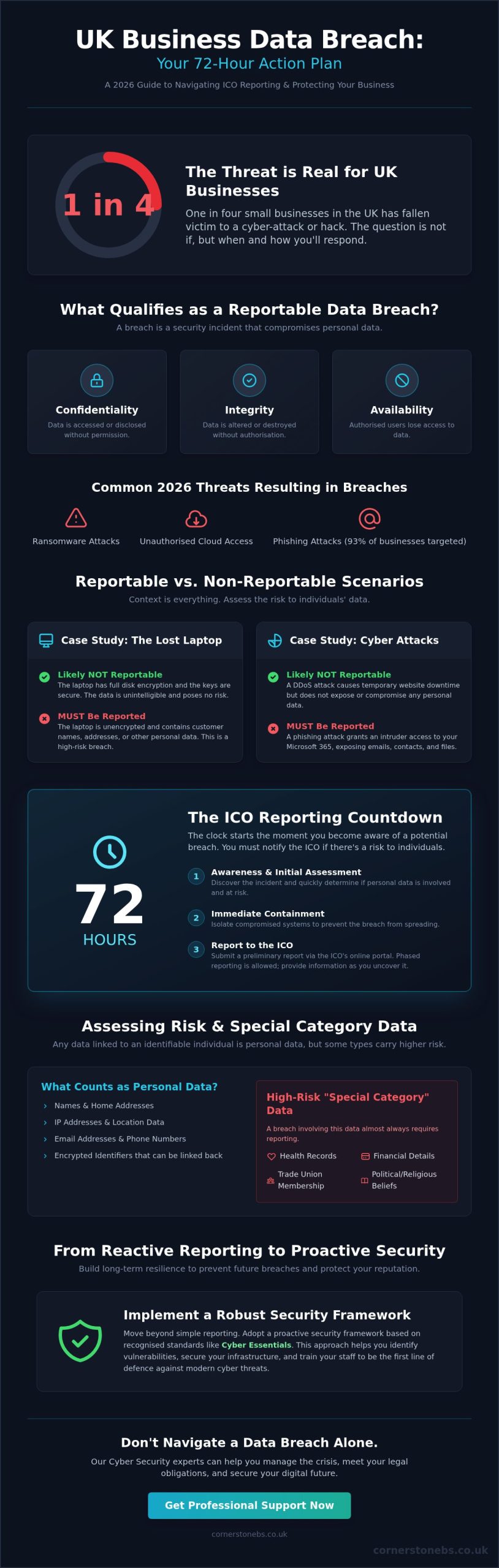
Not every IT glitch is a crisis, but knowing the difference is vital for your compliance. A personal data breach under UK GDPR is more than just a leak. It’s a security incident that compromises the confidentiality, integrity, or availability of personal information. If you are currently investigating an incident, your first priority is determining how to report a business data breach UK properly. This starts with a clear assessment of whether the data has been lost, destroyed, altered, or accessed without permission.
In 2026, the digital landscape presents new challenges for business owners. We see more sophisticated threats like unauthorised cloud access and complex ransomware attacks. These incidents don’t just steal data; they often lock you out of your own systems, which qualifies as a breach of “availability.” Gaining a foundational understanding of what a data breach is helps you separate a minor technical fault from a legal reporting obligation. Even if an employee accidentally sends a spreadsheet to the wrong client, you must conduct a formal assessment. The law doesn’t distinguish between a malicious hacker and a simple human error when it comes to your duty to protect data.
The Broad Definition of Personal Data
Personal data is any information that relates to an identifiable individual. This goes far beyond names and home addresses. In our modern infrastructure, this includes IP addresses, location data, and even encrypted identifiers that could be linked back to a person. According to the latest ICO guidance, personal data is any information relating to an identified or identifiable living individual. You should be particularly cautious with “special category” data. This includes health records, financial details, or trade union memberships, as these carry a much higher risk if exposed.
Examples of Reportable vs. Non-Reportable Incidents
Context is everything when deciding whether to notify the authorities. Consider these scenarios:
- The Lost Laptop: If a staff member loses a laptop with full disk encryption and the keys are secure, it’s likely not reportable because the data is unintelligible. If that same laptop is unencrypted and contains customer names, you have a reportable breach.
- Cyber Attacks: A DDoS attack that causes temporary website downtime but doesn’t expose data is a security incident, not a personal data breach. However, a phishing attack that grants an intruder access to your Microsoft 365 environment is almost certainly reportable.
The Cyber Security Breaches Survey 2025 found that 93% of businesses were targets of phishing. This highlights why a proactive assessment is necessary for every “near miss.” If the incident is likely to result in a risk to the rights and freedoms of your customers, the 72-hour clock begins the moment you become aware of it.
The ICO Reporting Process: The 72-Hour Countdown
The clock starts ticking the moment you realize something is wrong. Whether it’s a suspicious login or a missing folder, you have exactly 72 hours to notify the Information Commissioner’s Office if there’s a risk to individuals. This deadline is strict, but it shouldn’t cause panic. The goal is to provide the ICO with as much information as possible as early as possible. Many business owners wonder exactly how to report a business data breach UK when they don’t yet have all the facts. The ICO understands that forensic investigations take time, which is why they allow for phased reporting. You can submit a preliminary report and follow up as you uncover more details.
To start the process, you’ll need to visit the ICO data breach reporting portal. This online tool walks you through the necessary questions. You’ll be asked to describe the nature of the breach, the categories of data involved, and the approximate number of people affected. Learning how to report a business data breach UK involves understanding that the regulator values honesty and speed over a perfect, final report on day one. If you’re struggling to pull these logs together during a crisis, our team can provide the Cyber Security expertise needed to pinpoint the source of the leak quickly.
What to Include in Your ICO Report
Managing the Deadline During Weekends and Bank Holidays
Cybercriminals don’t work nine to five, and neither does the law. The 72-hour window includes weekends and bank holidays. If you discover a breach on a Friday evening, you cannot wait until Monday morning to start the clock. If you find yourself in a position where you must report late, you must provide a “reasoned justification” for the delay. The ICO may accept these reasons if they are valid, but it’s always better to submit a partial report within the timeframe than a complete one after the deadline has passed. Our local team is here to help you build a resilient infrastructure so you’re never caught off guard by these tight windows.
Assessing Risk to the Rights and Freedoms of Individuals
Determining whether an incident crosses the line from a technical glitch to a legal obligation is the most critical part of your response. It’s not just about the volume of data lost. It’s about the impact on the real people behind those records. Under UK GDPR, you only need to notify the ICO if the breach is likely to result in a risk to the rights and freedoms of individuals. If you’re currently weighing up how to report a business data breach UK, your first step is a thorough risk assessment. You must evaluate the potential for physical, material, or non-material damage to your customers or staff.
What does this “risk” actually look like in a business context? It encompasses a wide range of potential harms. This includes identity theft, financial loss, and even reputational damage to the individual. If sensitive data like health records or financial details are exposed, the risk of discrimination or fraud increases significantly. We recommend using a risk matrix to standardise your approach. By plotting the severity of the potential harm against the likelihood of it occurring, you can make an objective decision about how to report a business data breach UK without letting panic cloud your judgment. This structured method ensures your response is proportionate and legally sound.
When is a Breach “High Risk”?
There’s a vital distinction between a reportable breach and a “high-risk” breach. While a reportable breach requires you to notify the ICO, a high-risk breach triggers the additional requirement to inform the affected individuals directly. This is necessary when the incident is likely to result in a high risk to their rights and freedoms. In these cases, high-risk breaches require notification “without undue delay” to allow individuals to take their own protective measures, such as changing passwords or alerting their banks. This transparency, while difficult, is essential for maintaining long-term trust with your community.
The Role of Internal Documentation
Even if your assessment concludes that a breach isn’t reportable to the ICO, your work isn’t finished. You must document every single personal data breach in an internal register. This log should include the facts of the incident, its effects, and the remedial action you took. The ICO has the authority to audit these records at any time to ensure you’re making the right calls. Maintaining these logs is much easier when you have proactive managed IT services in place to track system changes and access logs. Following the NCSC incident management guidance ensures your internal processes meet the highest national standards, providing you with a solid foundation of evidence if your decisions are ever questioned.
Immediate Technical Response and Containment Strategies
While the 72-hour clock is running for the ICO, your technical team is fighting a different battle. Containment is your absolute priority. You need to stop the data from leaving your network immediately. This often means making tough calls, like isolating affected servers or disabling compromised accounts across the board. If you’re currently investigating how to report a business data breach UK, remember that the ICO expects you to take these containment steps as part of your formal response. They want to see that you’ve acted decisively to limit the damage from the very start.
Finding “patient zero” is essential for a complete and accurate report. You need to know exactly how the intruder got in. Was it a weak password, a phishing link, or a misconfigured firewall? Digital forensics plays a huge role here. However, you must be careful not to destroy evidence while you’re fixing the problem. We work closely with our partners to ensure that logs and system states are preserved correctly. This evidence is vital if the ICO or the police need to conduct a deeper investigation later. Coordinating with an expert IT partner ensures that your recovery is both fast and legally compliant.
Securing Your Perimeter Post-Breach
Once the immediate threat is contained, you must harden your defences. Start by resetting credentials for every user, prioritising those with administrative privileges. It’s also the time to review your firewall logs and cloud solutions for any lingering backdoors. Hackers often leave small entry points to return later. We recommend implementing temporary, heightened monitoring to catch any secondary attempts at entry. This proactive approach ensures that once you’ve closed the door, it stays locked. It’s about restoring stability and peace of mind for your team.
Notifying Affected Individuals
If your risk assessment shows a high risk to individuals, you must tell them. Drafting this notice requires a balance of transparency and calm. Tell them exactly what happened, what data was involved, and what you’re doing to fix it. Most importantly, give them clear instructions on how they can protect themselves, such as monitoring their bank accounts or changing passwords. Whether you choose email, post, or a public notice depends on the scale of the breach. A clear, honest message often does more to protect your reputation than staying silent ever could.
If you’re currently facing a breach and need an expert team to lead the containment, our Cyber Security services are ready to help you secure your infrastructure and meet your reporting duties.
Building a Proactive Cyber Security Framework for 2026
Reporting a breach is a legal necessity, but the real goal is to ensure you never have to do it again. Transitioning from a reactive “emergency mode” to a proactive framework is the best way to protect your local reputation. When you understand how to report a business data breach UK, you quickly realize that the most successful businesses are those that invest in cyber security services before an incident occurs. In 2026, a “set and forget” approach to IT simply doesn’t work. You need a dynamic strategy that evolves alongside new threats.
The foundation of any UK business’s security should be Cyber Essentials or Cyber Essentials Plus. These government-backed certifications provide a clear baseline for your digital safety. Beyond these basics, we advocate for Multi-Factor Authentication (MFA) and Zero Trust architectures. These systems operate on the principle of “never trust, always verify;” they make it significantly harder for an intruder to move through your network even if they steal a password. Small changes in your digital infrastructure create massive barriers for cybercriminals.
Technology is only half the battle. Your team is your first line of defence. Regular staff training is essential to reduce the human error that leads to most data leaks. When your employees know how to spot a sophisticated phishing attempt, your risk drops immediately. We believe in empowering your staff. This turns them from a potential vulnerability into a strong asset for your business’s stability. It’s about creating a culture where security is everyone’s responsibility.
The Value of Managed Security Providers
Disaster Recovery and Business Continuity
A tested backup strategy is your ultimate safety net. If a breach does occur, knowing your data is safe and recoverable allows you to focus on the legalities of how to report a business data breach UK without the fear of total data loss. Regularly auditing your data protection impact assessments (DPIAs) keeps your compliance sharp and your risks low. These audits help you identify gaps in your data handling before they become liabilities. We invite you to a conversation about your current setup. Contact Cornerstone for a proactive security audit today, and let’s build a resilient future for your business together.
Secure Your Resilience and Future Growth
Understanding how to report a business data breach UK is the first step in protecting your customers and your company’s hard-earned reputation. You’ve seen that the 72-hour ICO window is non-negotiable and that a thorough risk assessment is your best defence against unnecessary panic. By prioritising immediate containment and documenting every incident, you satisfy legal requirements while maintaining essential business continuity. Moving from a reactive stance to a proactive security framework ensures that your organisation remains strong in the face of evolving digital threats.
Our team brings the confidence of a multi-award-winning IT provider, backed by strategic partnerships with Microsoft, IBM, and Cisco. We offer proactive 24/7 monitoring and support that acts as a dedicated shield for your digital assets. You deserve the peace of mind that comes from knowing your security is managed by experts who genuinely care about your success. We’re proud to be your local partners, helping you navigate the complexities of 2026 with total confidence.
Secure your business with Cornerstone’s award-winning cyber security services. Let’s work together to build a safe, stable, and prosperous future for your business.
Frequently Asked Questions
Do I have to report a data breach if no data was actually stolen?
You must report a breach even if no data is stolen if the incident affects the availability or integrity of personal information. For instance, if a server failure permanently deletes customer records or ransomware encrypts them, this is a breach of availability. The law requires you to assess the risk to individuals’ rights regardless of whether a third party actually accessed the files. Integrity breaches, where data is altered without permission, also count.
What are the penalties for failing to report a data breach to the ICO in 2026?
Failing to notify the ICO of a reportable breach can result in a fine of up to £8.7 million or 2% of your global turnover, whichever is higher. This is separate from the fine for the actual security failure, which can reach £17.5 million or 4% of turnover. These penalties reflect the regulator’s focus on transparency and accountability. Reporting early acts as a mitigating factor in any enforcement action.
How much does it cost to report a data breach to the Information Commissioner?
There is no financial cost to report a data breach to the Information Commissioner’s Office. The online reporting tool is a free service provided to help businesses comply with their legal obligations. While the reporting itself is free, you may incur costs related to forensic investigations or technical recovery. We always recommend focusing on speed and accuracy rather than worrying about administrative fees. It’s an investment in your company’s long-term compliance.
Can I be fined if the breach was caused by a third-party software provider?
Yes, you can still be fined if the breach occurs through a third-party provider, as you remain the data controller responsible for the personal information. You must ensure your suppliers have robust security measures in place. If a provider suffers a breach, you are still the one who needs to know how to report a business data breach UK to protect your own customers. Your contracts should clearly outline the provider’s duty to notify you immediately.
How do I know if a breach is “likely to result in a risk” to individuals?
A breach results in a risk if it could lead to physical, material, or non-material damage for the individuals involved. Examples include potential identity theft, financial loss, or damage to reputation. You should consider the sensitivity of the data and the volume of records affected. If the data could be used to cause harm or distress, you must treat the incident as a reportable event. Documenting your decision-making process is vital for future audits.
What happens after I submit a report to the ICO?
Once you submit your report, the ICO will acknowledge receipt and assign a case officer to review the details. They may ask for more information or provide specific advice on how to mitigate the impact. In many cases, if you’ve taken proactive steps to contain the breach and notify individuals, the ICO may simply record the incident without taking further enforcement action. Their goal is to ensure you’ve learned from the event and improved your systems.
Do small businesses have different reporting requirements than large corporations?
No, the legal requirements for reporting a breach are the same for all organisations, regardless of their size. Whether you’re a local sole trader or a multinational corporation, the 72-hour window and the risk assessment thresholds apply equally. However, the ICO often provides more tailored support and guidance for small and medium-sized enterprises. They understand that smaller teams may have fewer resources to manage a complex technical response. We’re here to bridge that gap for local firms.
What is the first thing I should do if I suspect a ransomware attack?
Your first step is to isolate the affected systems by disconnecting them from your network and the internet to stop the encryption from spreading. Do not turn off the machines, as this can destroy volatile evidence needed for recovery. Once isolated, you can begin your investigation into how to report a business data breach UK while your IT partner works on restoring your latest clean backups. Quick containment is the key to minimising downtime.
Tags: Cybersecurity, Data (Use and Access) Act, Data Breach, Data Protection, ICO, Incident Response, UK business, UK GDPR